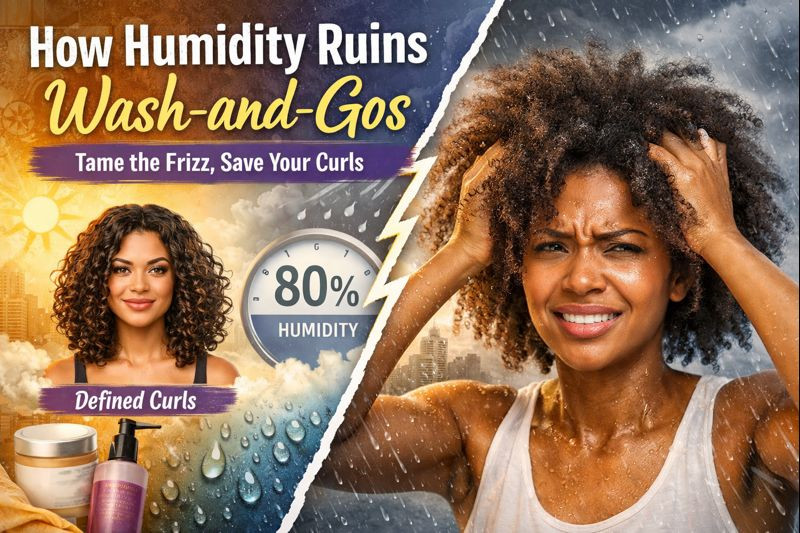
Wash-and-gos are supposed to be effortless. You wash, condition, define, diffuse or air-dry, and step out the door with juicy, popping curls. But the moment humidity enters the chat? Everything falls apart.
One minute your curls are defined and shiny. The next, they’re frizzy, shrunken, sticky, and somehow dry and swollen at the same time.
If your wash-and-go never lasts past day one, looks good indoors but explodes outside, or turns into a puff by noon, humidity is likely the reason — not your technique, not your curl pattern, and not because your hair is “difficult.”
Let’s break down exactly how humidity ruins wash-and-gos, what’s happening at a molecular level, and what you can do to finally win the battle.
What Humidity Actually Is (And Why Hair Reacts So Badly)
Humidity refers to the amount of water vapor in the air. When humidity is high, the air is already saturated with moisture. When it’s low, the air is dry and thirsty.
Your hair responds to humidity because hair is hygroscopic — meaning it absorbs water from the environment.
And curly hair?
Even more so.
Why?
Because:
-
Curly hair has raised cuticles
-
The twists and bends expose more surface area
-
Natural hair tends to be drier and more porous
So when humidity rises, your hair doesn’t just sit there — it drinks the air.
The Science: How Humidity Destroys Curl Definition
1. Water Breaks Your Curl Set
When you do a wash-and-go, you’re essentially setting curls in a controlled water state.
Humidity disrupts this by:
-
Re-introducing moisture after the style has set
-
Causing curls to swell unevenly
-
Breaking hydrogen bonds that hold definition
That’s why curls stretch, lose shape, or look fuzzy instead of clumped.
2. Frizz Is Not “Dryness” — It’s Swelling
One of the biggest myths is that frizz means dry hair.
In humidity, frizz often means:
-
Hair has absorbed too much water
-
The cuticle has lifted
-
Strands are expanding in different directions
Your hair isn’t dry — it’s over-hydrated and unstable.
3. Glycerin Can Make Things Worse
Many wash-and-go products contain humectants like glycerin.
Humectants pull moisture:
-
From the air in high humidity
-
From your hair in low humidity
In high humidity, glycerin can cause:
-
Curl swelling
-
Sticky definition
-
Loss of hold within hours
That’s why your wash-and-go may look amazing indoors but fall apart outside.
Signs Humidity Is Ruining Your Wash-and-Go
If you experience any of these, humidity is likely the culprit:
-
Curls look defined at first, then puff up
-
Hair feels sticky or tacky by midday
-
Frizz forms around curls, not instead of them
-
Shrinkage becomes extreme
-
Hair feels soft but looks messy
-
Definition disappears overnight
Sound familiar? Yep — classic humidity damage.
Why Some Hair Types Suffer More Than Others
High-Porosity Hair
High-porosity hair absorbs moisture fast — including from the air.
That means:
-
Faster swelling
-
Faster frizz
-
Less style longevity
Humidity hits high-porosity hair hard.
Fine Hair
Fine strands have less structure, so humidity causes:
-
Collapse
-
Loss of curl memory
-
Faster puffing
Damaged or Color-Treated Hair
Chemical processing lifts the cuticle, making hair:
-
More reactive to moisture
-
Less able to hold curl definition
The Real Reason Wash-and-Gos Fail in Humidity
It’s not your curl pattern.
It’s not that your hair “doesn’t like wash-and-gos.”
It’s usually because:
-
Too much water is left in the hair
-
Products lack humidity resistance
-
No seal is created
-
Styling happens in the wrong environment
A wash-and-go is not just a style — it’s a controlled moisture system.
And humidity breaks the system.
Common Wash-and-Go Mistakes That Invite Humidity Frizz
1. Styling on Soaking-Wet Hair
Water + humidity = overload.
Hair that’s dripping wet:
-
Takes longer to set
-
Absorbs more environmental moisture
-
Loses definition faster
2. Using Only Creams or Leave-Ins
Creams hydrate but don’t protect.
Without a hold or seal:
-
Moisture moves freely in and out
-
Frizz shows up quickly
3. Skipping a Sealant
Oils and butters help slow moisture exchange.
Without them:
-
Hair stays exposed
-
Humidity gets in easily
4. Touching Hair While It Dries
Every touch lifts the cuticle and invites frizz.
Humidity makes this 10x worse.
How to Humidity-Proof Your Wash-and-Go (For Real)
Step 1: Control Water, Don’t Maximize It
Your hair should be wet, not dripping.
After rinsing:
-
Gently squeeze out excess water
-
Blot with a microfiber towel or t-shirt
-
Hair should clump, not drip
Step 2: Layer Products Strategically
Instead of one product, think layers:
-
Lightweight leave-in (hydration)
-
Curl-defining gel or custard (hold)
-
Light oil or serum (seal)
This creates a moisture barrier instead of a moisture sponge.
Step 3: Choose the Right Ingredients
In high humidity, look for:
-
Anti-humectants
-
Film-forming ingredients
-
Oils that slow water absorption
Avoid:
-
High glycerin products in summer
-
Products labeled “extra moisturizing” without hold
Step 4: Dry Completely Before Going Outside
Partially dried hair is a humidity magnet.
Whether you:
-
Air dry
-
Diffuse
-
Hood dry
Make sure hair is 100% dry before exposure.
Step 5: Hands Off Until Fully Set
Once styled:
-
Do not touch
-
Do not fluff
-
Do not separate curls early
Let the style lock in first.
Why Diffusing Helps in Humidity
Diffusing:
-
Sets curl shape faster
-
Reduces time hair is vulnerable
-
Helps lock definition before humidity interferes
Low heat + low airflow is key.
Can You Ever Fully Beat Humidity?
Let’s be real — humidity always wins a little.
But you can:
-
Reduce frizz by 70–90%
-
Extend your wash-and-go to 3–5 days
-
Maintain curl shape instead of puff
The goal isn’t perfection — it’s control.
Alternatives to Wash-and-Gos in Extreme Humidity
If humidity is brutal where you live, consider:
-
Braid-outs
-
Twist-outs
-
Low buns or pineapple styles
-
Stretching styles with tension
These styles rely less on loose curl definition and hold up better.
Why Your Wash-and-Go Looks Better in Winter
Lower humidity means:
-
Less moisture absorption
-
More stable curl patterns
-
Longer-lasting definition
That’s why many naturals think their hair “grows better” or “acts better” in winter — it’s not magic, it’s physics.
The Truth About “Humidity-Proof” Products
No product can fully block humidity.
What they can do:
-
Slow moisture exchange
-
Create a flexible film
-
Help curls resist swelling longer
Technique matters just as much as product choice.
Final Thoughts: It’s Not Your Hair
If humidity keeps ruining your wash-and-gos:
-
Your hair isn’t broken
-
You’re not doing it wrong
-
Your curls aren’t “low quality”
You’re just dealing with an environment that fights definition.
Once you understand how humidity works — and how to style around it instead of against it — wash-and-gos become predictable, manageable, and actually enjoyable again.
And that’s when your curls finally start behaving ?