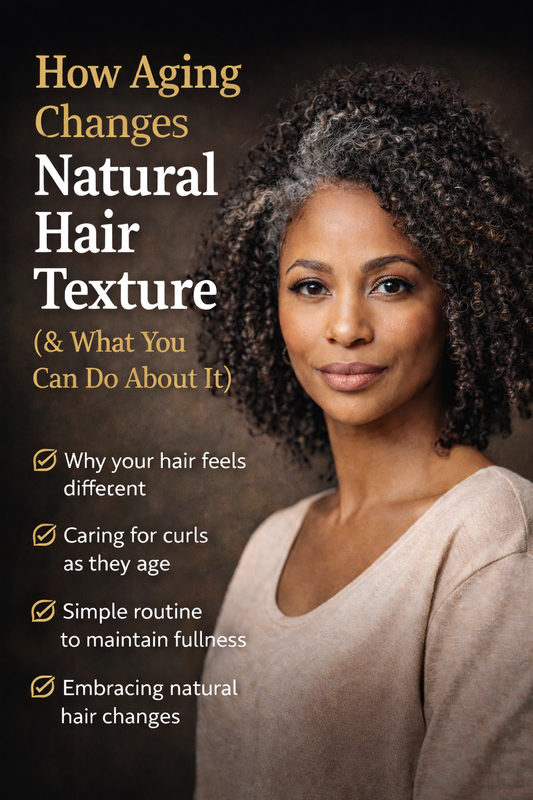
If you’ve been natural for years, you already know your hair has a personality. It shifts with humidity. It responds to products. It reacts to stress. But one of the biggest transformations many women experience is this:
Your natural hair texture changes as you age.
Maybe your curls feel looser than they used to.
Maybe your hair feels drier—even when you deep condition.
Maybe your once-dense twist-outs don’t look as full.
Maybe your strands feel finer, rougher, or more fragile.
Aging affects natural hair in subtle and dramatic ways—and for Black women especially, those changes can feel confusing if no one explains what’s happening.
In this in-depth guide, we’ll break down:
-
Why natural hair texture changes with age
-
How hormones affect curls and coils
-
Why hair feels drier after 30 or 40
-
What happens to density and thickness
-
How to protect aging curls
-
A simple routine to maintain fullness and softness
If you’re building authority content for Hairobics All Natural, this is a powerful evergreen topic. Women in their 30s, 40s, 50s and beyond are actively searching for answers about texture shifts—and most brands are not addressing it deeply.
Let’s change that.
What Does “Hair Texture Changing” Actually Mean?
When people say their texture is changing, they’re usually noticing one or more of these:
-
Curls becoming looser or tighter
-
Hair feeling finer or thinner
-
Increased dryness
-
More frizz
-
Less elasticity
-
Reduced shine
-
More visible scalp
-
Increased breakage
These aren’t random changes. They’re biological.
1. Hormonal Shifts Alter Curl Pattern
Hormones are one of the biggest drivers of texture changes.
Estrogen helps keep hair in its growth phase longer. It also supports:
-
Moisture retention
-
Elasticity
-
Shine
-
Curl definition
As estrogen levels fluctuate (especially after 30 and significantly during perimenopause and menopause), hair may:
-
Grow more slowly
-
Feel thinner
-
Lose some curl tightness
-
Become more fragile
Testosterone and DHT sensitivity may also increase with age, contributing to thinning around the hairline or crown.
Why This Matters for Natural Hair
Coily and curly textures are already structurally more fragile due to bends in the strand. When hormonal support declines, those bends become more prone to breakage.
2. Sebum Production Decreases (Hello, Dryness)
Your scalp produces natural oil (sebum) to protect and lubricate strands.
As you age:
-
Sebum production declines
-
Scalp becomes drier
-
Hair loses natural shine
-
Strands feel rougher
Because natural hair already struggles with oil traveling down the strand, reduced oil production makes dryness more noticeable.
That’s why many women over 35 say:
“My hair feels drier than it ever has.”
It’s not your imagination.
3. Hair Diameter Changes With Age
Hair strands can actually become finer over time.
This doesn’t always mean you’re losing hair. It can mean:
-
Each strand’s diameter shrinks
-
Hair feels lighter
-
Twist-outs look less dense
-
Ponytails feel thinner
This is often called miniaturization—and while it’s commonly associated with hair loss, mild versions happen naturally with aging.
4. The Hair Growth Cycle Slows Down
Hair grows in cycles:
-
Anagen (growth phase)
-
Catagen (transition)
-
Telogen (resting/shedding)
As we age:
-
Growth phase shortens
-
Resting phase lengthens
-
Overall density may decrease
This means hair:
-
Takes longer to reach previous lengths
-
Appears less full
-
May shed more noticeably
5. Protein Structure Shifts
Hair is made of keratin protein. Over time:
-
Structural protein bonds weaken
-
Elasticity decreases
-
Hair stretches less before snapping
This is why aging curls may:
-
Feel stiff
-
Break when detangling
-
Lose bounce
Deep conditioning alone won’t fix this. You must protect both protein balance and moisture levels.
6. Porosity Can Change Over Time
Porosity determines how well your hair absorbs and retains moisture.
With aging:
-
Cuticles may lift more easily
-
Hair may become higher porosity
-
Moisture escapes faster
This results in:
-
Frizz
-
Quick dryness after wash day
-
Reduced curl definition
7. Graying Hair Has a Different Texture
As melanin production decreases, hair turns gray. But gray hair isn’t just a color change.
It often becomes:
-
Coarser
-
Wirier
-
Drier
-
Less flexible
Why? Because melanin helps influence structural strength and moisture retention.
Many women notice:
“My gray hairs feel like a completely different texture.”
That’s biologically accurate.
How Aging Impacts Natural Hair at Different Life Stages
In Your 30s
-
Subtle thinning
-
Slight dryness increase
-
Texture may loosen slightly
-
Growth feels slower
In Your 40s
-
Hormonal fluctuations intensify
-
Density changes more noticeable
-
Edges may thin
-
Scalp sensitivity increases
During Perimenopause & Menopause
-
Significant dryness
-
Density shifts
-
Texture may feel dramatically different
-
Breakage increases if routine isn’t adjusted
Signs Your Texture Change Is Age-Related (Not Damage)
You might be wondering:
Is this aging… or am I damaging my hair?
Here’s how to tell.
Likely Aging:
-
Changes are gradual
-
You’re not using harsh chemicals
-
Hairline slowly thinning
-
No extreme breakage spots
Likely Damage:
-
Sudden breakage
-
Chemical overlap
-
Heat overuse
-
Tight styles
How to Care for Natural Hair as It Ages
Now the important part.
Aging hair requires a strategic shift—not panic.
1. Prioritize Scalp Health
Healthy hair starts at the root.
Use:
-
Lightweight scalp oils
-
Gentle massage
-
Circulation-boosting ingredients
Massaging the scalp 3–4 times weekly supports blood flow and follicle health.
2. Deep Condition With Intention
Instead of random deep conditioning, focus on:
-
Moisture + strengthening balance
-
Steam treatments
-
Low manipulation
Aging curls benefit from consistency over intensity.
3. Avoid Over-Manipulation
Because elasticity declines:
-
Detangle gently
-
Use wide-tooth combs
-
Stretch hair carefully
Protective styles are helpful—but tension must be minimal.
4. Trim Strategically
Split ends travel faster on aging strands. Regular trims prevent thin ends from worsening.
5. Increase Internal Support
Hair health reflects internal health.
Focus on:
-
Hydration
-
Iron levels
-
Vitamin D
-
Omega-3 intake
-
Balanced protein
Best Hairstyles for Aging Natural Hair
These styles reduce stress while enhancing fullness:
-
Layered twist-outs
-
Voluminous wash-and-gos
-
Soft stretched styles
-
Low-tension braids
-
Loose updos
Avoid:
-
Ultra-tight ponytails
-
Heavy extensions
-
Long-term high-tension braids
Emotional Impact of Texture Changes
For many Black women, hair is identity.
When texture shifts:
-
Confidence may dip
-
You may feel like you’ve “lost” your curl pattern
-
You may compare old photos
But texture change is not loss. It’s evolution.
The goal isn’t to fight aging—it’s to support your hair through it.
Can You Reverse Aging Hair Changes?
Let’s be honest.
You can’t fully reverse biological aging.
But you can:
-
Maximize follicle health
-
Improve thickness appearance
-
Reduce breakage
-
Improve shine
-
Maintain curl integrity
Consistency is everything.
Simple 7-Step Routine for Aging Natural Hair
-
Cleanse gently (sulfate-free)
-
Apply deep conditioner with heat
-
Detangle slowly
-
Apply leave-in while hair is damp
-
Seal with lightweight oil
-
Massage scalp 3–4 times weekly
-
Protect hair at night (satin/silk)
When to See a Professional
If you notice:
-
Sudden excessive shedding
-
Bald spots
-
Severe scalp pain
-
Rapid density loss
Consult a dermatologist to rule out underlying conditions.
Final Thoughts: Aging Hair Is Still Beautiful Hair
Natural hair is dynamic.
It responds to hormones.
It responds to stress.
It responds to nourishment.
And yes—it responds to age.
Texture changes aren’t a failure. They’re a biological shift that simply requires a new strategy.
When you understand why your curls feel different, you stop blaming your routine—and start adjusting it.
Aging doesn’t mean thinning into invisibility.
It means evolving into a new version of fullness, softness, and strength.
And with the right care, your natural hair can remain vibrant for decades.