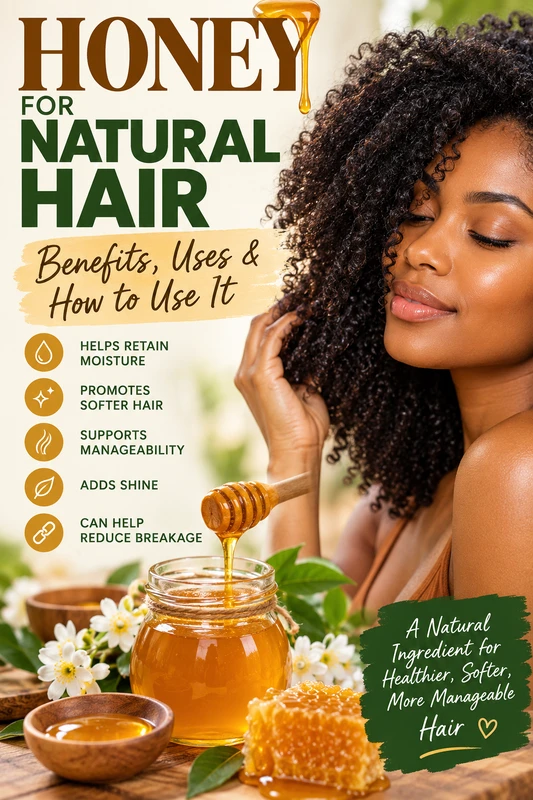
Natural hair needs a healthy balance of moisture, gentle cleansing, conditioning, and protection to look and feel its best. While there are countless hair-care ingredients available, sometimes some of the most useful ingredients are ones that have been used for generations.
One of those ingredients is honey.
Honey is commonly associated with food, tea, and skin care, but it can also be incorporated into a natural hair-care routine. Its humectant properties make it especially interesting for people trying to maintain soft, hydrated-feeling natural hair.
Whether you have loose curls, tight coils, an afro, twists, braids, or locs, understanding how honey works can help you decide whether it deserves a place in your routine.
In this guide, we'll explore the benefits of honey for natural hair, how to use it, how often to use it, what to mix it with, and common mistakes to avoid.
What Does Honey Do for Natural Hair?
Honey is a naturally occurring substance produced by bees from flower nectar. It contains sugars, small amounts of vitamins and minerals, amino acids, antioxidants, and other naturally occurring compounds.
From a hair-care perspective, one of honey's most interesting qualities is that it acts as a humectant.
Humectants attract and hold onto water. This is why honey is often included in moisturizing skin and hair products.
Natural hair can be particularly vulnerable to dryness because the bends and curves in curly and coily strands make it more difficult for natural scalp oils to travel from the roots all the way to the ends.
Using honey as part of a properly formulated moisturizing routine may help hair feel:
- Softer
- More moisturized
- Smoother
- Easier to manage
- More flexible
- Less rough or brittle
However, honey isn't a miracle hair-growth treatment. Its primary value is as a conditioning and moisture-supporting ingredient.
1. Honey Can Help Natural Hair Retain Moisture
One of the biggest reasons people use honey for natural hair is moisture.
Dryness is an extremely common concern among people with curly, kinky, and coily hair.
Hair may feel moisturized immediately after wash day but become dry again a few days later. Environmental conditions, frequent manipulation, heat styling, chemical processing, product buildup, and an ineffective moisturizing routine can all contribute.
Because honey is a humectant, it can help attract water and support hydration when used correctly.
This makes honey particularly useful as an ingredient in conditioners and hair masks.
The key phrase here is used correctly.
Pouring thick, undiluted honey directly onto dry hair isn't necessarily the best approach. Honey is extremely sticky and can be difficult to distribute or rinse out.
Instead, honey generally works better when diluted or combined with a conditioner or other hair-care ingredients.
2. Honey May Help Hair Feel Softer
If your natural hair frequently feels rough, stiff, or crunchy, moisture may be part of the problem.
Honey can be incorporated into conditioning treatments designed to improve softness and manageability.
After shampooing, applying a moisturizing conditioner containing humectants and conditioning agents can help restore a softer feel to the hair.
For a simple DIY approach, some people mix a small amount of honey into their regular rinse-out conditioner.
The conditioner helps distribute the honey while making the mixture considerably easier to apply and rinse away.
Hair that feels softer may also be easier to detangle and style.
3. Honey Can Be Helpful During Detangling
Detangling is one of the most important parts of maintaining natural hair.
It can also be one of the times when breakage occurs.
When hair is dry and tangled, aggressively pulling a comb through it can cause strands to snap.
The solution isn't necessarily stronger hair products. Often, you need more slip.
Slip refers to how easily your fingers, comb, or detangling brush can glide through the hair.
Honey itself is sticky, so it shouldn't be thought of as a traditional detangler. But when properly diluted and combined with a slippery conditioner, it can contribute to a moisturizing treatment that leaves hair feeling softer and more manageable.
For best results, divide your hair into sections and work from the ends toward the roots.
Never force a comb through a stubborn knot.
4. Honey May Help Reduce the Feeling of Dry, Brittle Hair
Hair that constantly feels brittle deserves attention.
Brittleness can have several causes, including:
- Excessive heat
- Chemical processing
- Over-manipulation
- Lack of conditioning
- Environmental exposure
- Improper detangling
- Product buildup
- Split or weathered ends
Adding moisture alone cannot repair every form of hair damage. Once a hair fiber is significantly damaged, cosmetic products can temporarily improve its feel and appearance, but they cannot biologically heal a dead hair strand.
Still, improving your conditioning routine can make brittle-feeling hair more flexible and manageable.
A honey-containing deep-conditioning treatment can be one part of that routine.
5. Honey Can Add Shine to Natural Hair
Healthy-looking natural hair doesn't have to look extremely shiny.
In fact, tightly coiled textures naturally reflect light differently from straight hair. Your hair can be perfectly healthy without having a glossy appearance.
However, rough and dehydrated hair may look dull.
A good conditioning treatment can smooth the surface of the hair enough to improve its appearance and natural luster.
Honey can be incorporated into these treatments to support moisture.
For even better results, focus on the entire routine rather than relying on one ingredient.
Cleanse your hair when necessary, condition thoroughly, minimize unnecessary heat, moisturize consistently, and protect your hair at night.
6. Is Honey Good for the Scalp?
Honey has properties that have made it interesting to researchers in skin and wound-care applications, but those uses should not automatically be interpreted as evidence that ordinary kitchen honey treats scalp diseases.
If your scalp is simply dry, maintaining a gentle hair-care routine may help.
However, persistent itching, redness, sores, severe flaking, unusual hair loss, or scalp pain shouldn't automatically be treated with DIY ingredients.
Those symptoms can have many causes, and a dermatologist can help determine what's happening.
For routine cosmetic use, avoid coating your scalp with large quantities of sticky honey.
If you're using a honey treatment, concentrate primarily on the hair unless the product was specifically formulated for scalp application.
7. Does Honey Make Natural Hair Grow?
This is one of the biggest questions surrounding honey and hair.
Honey should not be considered a proven treatment for making hair grow dramatically faster.
Hair growth occurs within follicles beneath the scalp. Genetics, age, hormones, nutrition, overall health, medications, and certain medical conditions can influence hair growth and hair loss.
A cosmetic ingredient applied to the hair cannot simply override these factors.
However, there is an important distinction between growing hair and retaining length.
Your hair might be growing from your scalp while simultaneously breaking at the ends.
When that happens, it can appear that your hair isn't growing.
A moisturizing, low-manipulation hair routine may help reduce unnecessary breakage. Honey can potentially contribute to that routine by helping hair remain conditioned and manageable.
So rather than thinking:
Honey = faster hair growth
Think:
Honey + good conditioning + gentle handling = potentially better moisture and length retention.
8. Honey for Low-Porosity Natural Hair
Low-porosity hair has a cuticle structure that can make it more challenging for water and some products to penetrate or interact with the fiber.
People with low-porosity hair often complain that products sit on top of their hair.
Honey can still be used, but more isn't necessarily better.
Try using a small amount mixed thoroughly into a lightweight conditioner.
You may also find that applying your conditioning treatment to thoroughly wet hair helps with distribution.
Most importantly, rinse thoroughly.
If your hair feels coated, sticky, heavy, or unusually dull afterward, you may have used too much product.
9. Honey for High-Porosity Natural Hair
High-porosity hair tends to take in and lose water relatively easily.
This may occur naturally or be increased by chemical processing, heat damage, mechanical wear, or other forms of cuticle damage.
People with high-porosity hair often describe their hair as absorbing products quickly but becoming dry again shortly afterward.
Honey-containing conditioners may help support a moisturizing routine, but don't rely on honey alone.
High-porosity hair may benefit from a balanced routine involving:
- Gentle cleansing
- Thorough conditioning
- Leave-in products
- Appropriate styling products
- Reduced heat and manipulation
- Regular trimming when necessary
Consistency matters more than constantly searching for a new miracle ingredient.
10. Honey for Type 4 Hair
Honey can be particularly appealing to people with Type 4 hair because tightly coiled hair commonly struggles with dryness and tangling.
Type 4 hair includes a wide range of textures, densities, strand thicknesses, and porosity levels.
Not everyone with Type 4 hair needs the same routine.
Still, moisture and gentle handling are usually important.
Consider adding honey to a conditioning treatment rather than using it by itself.
For example:
Honey + moisturizing conditioner
This keeps the treatment simple and allows your conditioner to provide most of the slip.
Apply it section by section, focusing especially on dry areas and your ends.
11. How to Use Honey on Natural Hair
You don't need an elaborate recipe.
One of the easiest approaches is adding a small amount to a conditioner you already know works well for your hair.
Simple Honey Conditioning Treatment
You can try:
- 2–4 tablespoons of moisturizing conditioner
- 1 teaspoon of honey
Adjust the amount according to your hair's length and density.
Mix everything thoroughly.
After shampooing, divide your hair into sections and distribute the treatment from roots to ends, paying extra attention to the driest portions.
Allow it to sit according to your conditioner instructions, then rinse thoroughly.
Avoid assuming that leaving a treatment on for hours will automatically produce better results.
Follow the directions of the commercial product you're mixing it with.
12. Honey and Aloe Vera for Natural Hair
Aloe vera is another ingredient commonly found in moisturizing hair products.
Some people enjoy combining aloe-based products with honey because both are associated with hydration.
However, DIY mixtures don't have the same stability or preservation systems as professionally formulated cosmetics.
If you create a fresh mixture, make only enough for immediate use.
Do not prepare a large jar of water-containing DIY hair product and leave it sitting in your bathroom for weeks.
Water-based homemade mixtures can support microbial growth without an appropriate preservative system.
For regular use, a professionally formulated product is usually more convenient and reliable.
13. Honey and Oil for Natural Hair
Honey and oils serve different purposes.
Honey is associated primarily with attracting and retaining water, while oils are generally used for lubrication, softness, shine, and reducing moisture loss.
This is why oil alone doesn't truly replace water.
If your hair is dehydrated, adding more and more oil may simply leave you with greasy hair that still feels dry.
Instead, think in layers.
You might cleanse and condition your hair, apply a water-based leave-in or moisturizing product, and then use an appropriate styling product or small amount of oil if your hair responds well to it.
Honey can be incorporated into the conditioning stage.
14. Honey and Olive Oil Hair Mask
Honey and olive oil are frequently combined in homemade hair treatments.
A basic mixture might include a small amount of each added to conditioner.
However, be careful with the amount of oil.
Fine or low-density natural hair can become weighed down easily.
If your hair feels greasy or limp after treatment, reduce the oil or eliminate it entirely.
Coarse, thick, or very dry-feeling hair may tolerate richer treatments better.
Your individual hair matters more than a generic recipe.
15. Honey and Coconut Oil for Natural Hair
Coconut oil is another popular natural hair ingredient.
Some people's hair responds extremely well to it, while others report that coconut oil makes their hair feel stiff or dry.
If you already know your hair dislikes coconut oil, adding honey isn't necessarily going to change that.
Use ingredients based on how your own hair responds.
If you want to experiment with honey and coconut oil, start with a small amount rather than saturating your entire head.
16. Raw Honey vs Regular Honey for Hair
You may see claims that raw honey is dramatically better for hair than conventional honey.
For basic cosmetic conditioning, you don't necessarily need expensive specialty honey.
What's more important is how you use it.
Honey is extremely concentrated and sticky, so dilution is important.
Never assume that using more honey will create better results.
A small amount can go a long way.
17. Can You Leave Honey in Your Hair Overnight?
It's generally unnecessary.
Leaving sticky DIY treatments in your hair overnight can be messy and may make rinsing more difficult.
More treatment time doesn't automatically equal more moisture.
A better approach is to incorporate honey into your regular wash-day conditioning routine and rinse it out thoroughly.
If you're using a commercially manufactured honey-containing hair product, follow the manufacturer's directions.
18. Can You Use Honey as a Leave-In?
Pure honey isn't ideal as a traditional leave-in product.
Because it is sticky, using too much may leave your hair tacky, attract debris, interfere with styling, or create buildup.
If you want the benefits of honey in a leave-in routine, look for a properly formulated hair product containing honey or honey-derived ingredients.
The manufacturer can balance the ingredient with water, conditioning agents, preservatives, and other components to create a product that's more practical for everyday hair care.
19. How Often Should You Use Honey on Natural Hair?
There isn't one perfect schedule.
For many people, trying a honey conditioning treatment every one to four weeks is a reasonable starting point.
Pay attention to your hair afterward.
Does it feel:
- Soft?
- Flexible?
- Moisturized?
- Easy to detangle?
- Heavy?
- Sticky?
- Coated?
Your hair's response should determine whether you continue.
You don't have to use an ingredient simply because it's popular.
20. Can Honey Cause Buildup?
Yes, especially when too much is used or it isn't rinsed thoroughly.
Natural hair routines can involve numerous products: shampoo, conditioner, leave-in conditioner, creams, gels, butters, oils, edge control, and refreshing sprays.
Layer enough products and eventually the hair may feel coated.
Signs you may need a thorough cleanse include hair that feels unusually waxy, dull, sticky, heavy, or difficult to wet.
Regular shampooing helps remove accumulated products and gives your conditioning products a cleaner surface to work with.
21. Honey in Humid Weather
Because honey is a humectant, climate can affect how humectant-heavy hair routines perform.
Humidity, dew point, your hairstyle, hair porosity, and the rest of the formula all influence results.
Some people find humectant-rich products excellent in certain weather conditions but less predictable in extreme humidity.
If you're trying to maintain a sleek twist-out, braid-out, or stretched style in very humid weather, experiment before an important event.
You may discover that your hair prefers a different product balance depending on the season.
22. Honey for Natural Hair in Winter
Winter creates a different set of challenges.
Cold outdoor conditions combined with heated indoor air can leave natural hair feeling dry.
Instead of responding by piling on heavy oils every day, concentrate on an effective wash-day routine.
Cleanse your scalp, condition thoroughly, apply moisturizing products appropriately, and protect your hair from unnecessary friction.
Honey can be incorporated into your conditioner when your hair needs additional moisture support.
23. Honey for Protective Styles
If you're wearing braids, twists, wigs, or another protective style, avoid pouring thick honey directly into the style.
That can create a sticky mess and make buildup difficult to remove.
Instead, use properly formulated water-based moisturizing products while your hair is styled.
Honey treatments are generally better suited to wash day when your hair is loose and can be thoroughly rinsed.
Remember that a protective style is only protective when your actual hair and scalp are cared for underneath it.
24. Honey for Locs
People with locs should be especially cautious with thick, sticky ingredients.
One of the major goals of loc maintenance is avoiding excessive buildup inside the loc.
Applying pure honey directly to mature locs may make thorough removal difficult.
If you have locs and want to experiment with honey, a well-formulated rinse-out product may be more practical than coating your locs with raw honey.
Always rinse extremely well.
For everyday loc hydration, lightweight water-based moisturizing products are usually easier to manage.
25. Common Mistakes When Using Honey on Natural Hair
Honey can be useful, but the way you use it matters.
Using too much honey: More isn't better. Excess honey can make your hair extremely sticky.
Applying pure honey to dry hair: This can make distribution difficult.
Not rinsing thoroughly: Residue can leave hair feeling coated.
Expecting instant hair growth: Honey is primarily a conditioning ingredient, not a guaranteed hair-growth treatment.
Ignoring your overall routine: One ingredient cannot compensate for excessive heat, rough detangling, tight hairstyles, or neglected ends.
Making large batches of DIY treatments: Homemade water-containing products can become contaminated without proper preservation.
26. Honey vs Glycerin for Natural Hair
Honey and glycerin are both commonly discussed as humectants.
Glycerin is widely used in professionally formulated hair products because it mixes easily into water-based formulations and can help maintain hydration.
Honey is more complex and considerably stickier.
Neither ingredient is automatically superior.
The entire product formula matters.
A professionally formulated product containing glycerin may work much better for your hair than a homemade honey mixture—or vice versa.
Experiment carefully and pay attention to results.
27. Honey vs Aloe Vera for Natural Hair
Honey and aloe vera don't have to compete.
They're different ingredients that may both appear in moisturizing formulas.
Honey is valued primarily for its humectant properties, while aloe-based ingredients are often used in products designed for hydration, soothing, and conditioning.
Your hair may prefer one, both, or neither.
Natural hair care is highly individual.
28. Is Honey Good for Damaged Natural Hair?
Honey can improve the way damaged hair feels, but it cannot permanently repair severe structural damage.
If your ends are severely split, no honey mask can permanently fuse them back together.
Trimming damaged ends may eventually be necessary.
If your hair has been damaged by excessive heat, bleach, relaxers, or repeated mechanical stress, focus on reducing the source of damage first.
Then establish a routine involving gentle cleansing, conditioning, careful detangling, reduced manipulation, and regular trims when necessary.
Honey can complement that routine.
It shouldn't replace it.
29. Building a Healthy Natural Hair Routine
The healthiest approach to natural hair isn't chasing individual miracle ingredients.
It's creating a routine you can consistently maintain.
A simple routine might include:
Step 1: Cleanse
Wash your scalp and hair often enough to remove sweat, dirt, oil, and product buildup.
Step 2: Condition
Use a conditioner with enough slip to make detangling easier.
Step 3: Detangle Carefully
Work in sections and detangle from the ends upward.
Step 4: Moisturize
Apply a suitable water-based leave-in or moisturizing product.
Step 5: Style
Choose styles that don't place excessive tension on your scalp or strands.
Step 6: Protect at Night
A satin or silk bonnet, scarf, or pillowcase can help reduce friction while you sleep.
Step 7: Pay Attention to Your Ends
Your ends are the oldest part of your hair and often need the most protection.
Honey can fit into the conditioning portion of this routine when appropriate.
Frequently Asked Questions About Honey for Natural Hair
Is honey good for natural Black hair?
Honey can be a useful ingredient in natural hair products and conditioning treatments because it has humectant properties. It may help support moisture, softness, and manageability when properly diluted or formulated.
Can I put raw honey directly on my hair?
You can, but it usually isn't the most practical method. Raw honey is extremely sticky. Mixing a small amount with conditioner is generally easier to apply and rinse out.
Does honey grow hair?
There isn't strong evidence that simply applying honey to your hair will make it grow dramatically faster. However, a good moisturizing and conditioning routine may help reduce breakage and improve length retention.
Does honey moisturize dry hair?
Honey is a humectant, meaning it can attract and retain water. It can therefore contribute to moisturizing hair products and treatments.
How long should honey stay in natural hair?
When honey is mixed with a commercial conditioner, follow the conditioner manufacturer's recommended treatment time. Leaving it on overnight generally isn't necessary.
Can honey be used on Type 4 hair?
Yes. People with Type 4 hair can incorporate honey into rinse-out conditioning treatments if their hair responds well to it.
Can I mix honey with conditioner?
Yes. This is one of the easiest ways to experiment with honey. Start with a small amount—such as approximately one teaspoon mixed into enough conditioner for your hair—and adjust based on your results.
Is honey good for low-porosity hair?
It can be, but low-porosity hair can become coated when too much product is applied. Start with a small amount and rinse thoroughly.
Is honey good for high-porosity hair?
Honey-containing conditioning treatments may help high-porosity hair feel moisturized and manageable, but they should be part of a broader routine that minimizes damage and moisture loss.
Can you use honey on locs?
Use caution. Thick raw honey may be difficult to rinse completely from locs and could contribute to buildup. A lightweight, professionally formulated product is generally easier to use.
Final Thoughts: Should You Use Honey on Natural Hair?
Honey can be a useful addition to a natural hair-care routine, particularly when your goal is maintaining soft, moisturized, manageable hair.
Its humectant properties make it an appealing ingredient for conditioners and moisturizing treatments. But the key is moderation.
You don't need to saturate your hair with pure honey.
Instead, try incorporating a small amount into a rinse-out conditioning treatment or choose professionally formulated hair products that contain moisturizing ingredients.
Most importantly, remember that healthy natural hair comes from the entire routine.
Regular cleansing, conditioning, moisturizing, gentle detangling, low-tension styling, nighttime protection, and caring for your ends can make a much bigger difference than relying on any single ingredient.
Honey can be one tool in that routine—but consistency is what helps you maintain healthy-looking natural hair over time.
At Hairobics All Natural, we believe natural hair deserves consistent moisture, gentle care, and products that make maintaining your curls, coils, locs, and protective styles easier. Building a simple routine and learning how your individual hair responds to different ingredients can help you maintain softer, stronger-looking, more manageable hair throughout your natural hair journey.