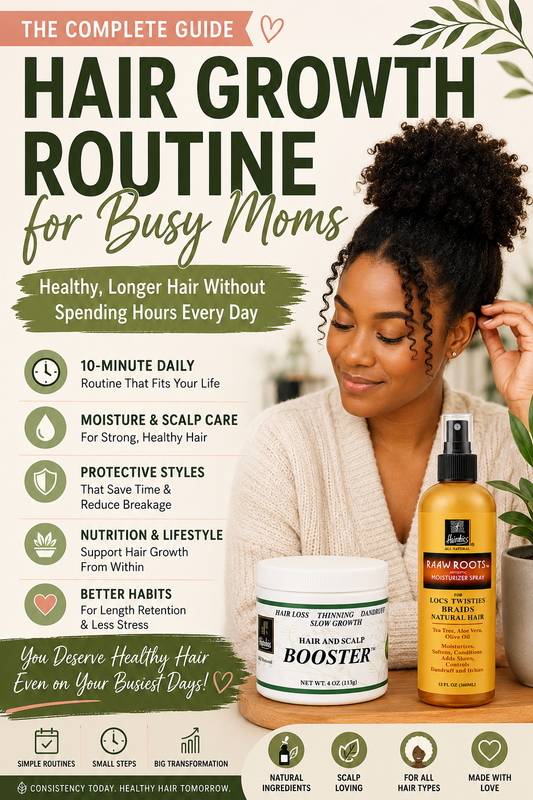
Being a mom is one of the busiest jobs in the world. Between getting children ready for school, preparing meals, working, running errands, attending appointments, helping with homework, and somehow finding time to rest, it's easy for your own self-care to move to the bottom of the list.
For many moms—especially those with natural hair, curls, coils, locs, or protective styles—hair care becomes something that only happens when there's extra time. Unfortunately, "extra time" often never comes.
The good news is that healthy hair growth doesn't require spending hours in front of a mirror every day. In fact, many women unknowingly over-manipulate their hair, causing more breakage than growth.
A simple, consistent routine performed in just a few minutes each day can help improve moisture retention, reduce breakage, maintain a healthy scalp, and support longer, stronger hair over time.
In this guide, you'll learn:
- Why many busy moms struggle with hair growth
- How to create a 10-minute daily routine
- Weekly habits that encourage healthier hair
- Protective styles that save time
- Nutrition and lifestyle tips
- Common mistakes to avoid
- Easy ways to fit hair care into your busy schedule
Whether you're caring for Type 3 curls, Type 4 coils, braids, twists, locs, or relaxed hair, this routine is designed to help you maintain healthier hair without sacrificing valuable family time.
Why Busy Moms Often Struggle With Hair Growth
Many women believe their hair simply "won't grow anymore."
In reality, hair usually continues growing from the scalp. The bigger problem is that the ends break off as quickly as new hair grows.
This is called poor length retention.
Busy schedules often lead to habits that increase breakage without us realizing it.
Common challenges include:
- Skipping wash days
- Forgetting to moisturize
- Sleeping without protecting hair
- Wearing tight ponytails every day
- Stress
- Lack of sleep
- Poor nutrition
- Product buildup
- Dry scalp
- Irregular trimming
- Heat styling for convenience
Over weeks and months, these habits can leave hair feeling dry, brittle, and difficult to manage.
The solution isn't spending more time on your hair.
It's creating smarter routines.
Hair Growth Starts at the Scalp
Healthy hair begins beneath the surface.
Every strand grows from a hair follicle located inside your scalp.
Your scalp needs:
- Good circulation
- Proper moisture balance
- Clean follicles
- Minimal inflammation
- Healthy skin
Ignoring scalp health can lead to:
- Dryness
- Itching
- Flaking
- Product buildup
- Weaker hair strands
A clean scalp provides the best environment for healthy hair growth.
The Biggest Hair Growth Myth
One of the most common myths is that buying expensive products alone will make hair grow faster.
Hair growth depends on several factors working together:
- Genetics
- Overall health
- Nutrition
- Hormones
- Stress levels
- Hair care habits
- Moisture retention
- Scalp health
- Breakage prevention
Products support healthy hair, but consistency is what delivers long-term results.
Why Consistency Beats Perfection
Many moms think they need a full spa day every week to care for their hair.
That's simply not true.
Ten minutes every day is often far more effective than spending three hours once a month.
Think about brushing your teeth.
You don't wait until the end of the month to brush them all at once.
Hair responds the same way.
Small daily habits produce the biggest long-term improvements.
Signs Your Hair Routine Needs Improvement
You may need a better routine if you notice:
- Hair breaking while detangling
- Dry ends
- Split ends
- Excessive shedding
- Itchy scalp
- Dull-looking curls
- Constant tangles
- Thin edges
- Hair that never seems to get longer
These issues usually point to breakage rather than slow growth.
Your Goal Should Be Length Retention
Most healthy adults grow approximately half an inch of hair each month.
That equals roughly six inches per year.
If your hair never appears longer, it's often because the ends are breaking away.
Instead of asking:
"How do I make my hair grow faster?"
Ask:
"How do I stop my hair from breaking?"
That mindset shift changes everything.
Morning Hair Routine for Busy Moms (5 Minutes)
Your mornings are already packed.
Fortunately, healthy hair maintenance doesn't need to take long.
Step 1: Check Your Hair
Spend one minute checking:
- Is your hair dry?
- Does your scalp feel itchy?
- Are your curls flattened?
- Is your protective style still neat?
This quick assessment helps you avoid unnecessary manipulation.
Step 2: Add Moisture if Needed
Dry hair is fragile hair.
If your hair feels dry, lightly mist it with water or a moisturizing spray formulated for natural hair.
Focus on:
- Ends
- Hairline
- Mid-lengths
Avoid soaking the hair unless you're styling it.
Step 3: Seal Moisture
After adding moisture, apply a small amount of lightweight oil or nourishing hair treatment to help reduce moisture loss.
Pay extra attention to:
- Ends
- Hairline
- Dry areas
Using only a small amount helps prevent heavy buildup.
Step 4: Protective Styling
Choose quick, low-manipulation styles like:
- Loose bun
- Pineapple
- Puff
- Flat twists
- Two-strand twists
- Low ponytail
- Loose braid
The goal is protecting your ends while minimizing daily handling.
Step 5: Protect Your Edges
Avoid:
- Tight ponytails
- Tight buns
- Tight braids
- Constant tension around your hairline
Gentle styling helps reduce unnecessary stress on the edges.
Why Moisture Matters
Natural hair naturally loses moisture more quickly than straighter hair textures because the shape of each strand makes it harder for natural oils to travel from the scalp to the ends.
When hair becomes dry, it becomes:
- Brittle
- Rough
- Tangled
- Fragile
- More likely to break
Keeping hair moisturized helps improve flexibility and reduces breakage over time.
Hair Care Doesn't Have to Be Complicated
Social media often makes healthy hair routines look overwhelming.
In reality, the basics remain the same:
- Clean scalp
- Moisturized hair
- Gentle handling
- Healthy nutrition
- Consistency
- Patience
You don't need dozens of products or hours of styling to support healthy hair.
A simple routine repeated consistently often delivers the best results.
The Best Protective Styles for Busy Moms
Protective styles are one of the easiest ways for busy moms to save time while helping reduce daily manipulation. The goal isn't simply to wear a style that looks good—it's to minimize breakage and protect the oldest, most fragile parts of your hair.
A good protective style should:
- Keep your ends tucked away
- Minimize daily combing
- Reduce friction
- Be comfortable
- Avoid excessive tension
- Be easy to maintain
Remember, a protective style is only protective if it's installed and maintained properly. Styles that are too tight can create unnecessary stress on the scalp and edges.
Low-Maintenance Hairstyles That Save Time
1. Two-Strand Twists
Two-strand twists are versatile, easy to maintain, and suitable for many natural hair textures.
Benefits include:
- Less daily manipulation
- Easier detangling
- Moisture retention
- Simple styling options
- Reduced tangling
Twists can also be refreshed section by section instead of restyling your entire head.
2. Loose Buns
A low, loose bun works well for moms on the go.
Keep the bun:
- Low
- Loose
- Comfortable
- Not overly tight
Rotate the bun's position occasionally to avoid repeated tension in one area.
3. Pineapple Style
For curly hair, the pineapple is one of the quickest protective styles.
Simply gather your curls loosely on top of your head using a satin scrunchie.
This helps preserve curl definition overnight and reduces flattening.
4. Braids
Braids can be a convenient option for busy moms because they reduce the need for daily styling.
While wearing braids:
- Keep your scalp clean
- Moisturize regularly
- Avoid excessive product buildup
- Sleep with a satin bonnet
If your braids become excessively frizzy, itchy, or feel too tight, it may be time to remove them.
5. Locs
Locs are naturally low-manipulation, but they still require consistent care.
Maintain locs by:
- Cleansing regularly
- Keeping the scalp moisturized
- Avoiding heavy buildup
- Protecting them at night
- Retwisting only as needed
Healthy locs depend on healthy scalp care.
How to Protect Your Hair During Busy Days
Motherhood often means unexpected schedule changes.
Instead of aiming for perfection, develop quick habits that keep your hair protected.
Examples include:
- Keeping a satin bonnet near your bed
- Carrying a satin scrunchie in your purse
- Keeping a moisturizing spray in your diaper bag or work bag
- Avoiding overly tight ponytails
- Covering your hair during workouts if possible
Small habits can help preserve your style and reduce unnecessary breakage.
Quick Hairstyles That Take Less Than Five Minutes
On hectic mornings, try one of these styles:
- Puff
- Low bun
- Side twist
- Two chunky twists
- Pineapple
- Loose braid
- Half-up style
- Headwrap
These styles require minimal effort while helping protect your hair throughout the day.
How Often Should Busy Moms Wash Their Hair?
There isn't one schedule that works for everyone.
The ideal frequency depends on:
- Hair texture
- Lifestyle
- Exercise routine
- Scalp condition
- Product usage
Many women find success washing every 1–2 weeks, while others may prefer more frequent cleansing depending on their needs.
Pay attention to signs that your scalp needs cleansing, such as:
- Itching
- Heavy buildup
- Excess oil
- Unpleasant odor
- Flaking
A clean scalp creates a better environment for healthy hair.
Moisture Is More Important Than Length
Many people become so focused on growing longer hair that they overlook moisture.
Dry hair is more likely to:
- Snap
- Split
- Tangle
- Lose elasticity
Keeping your hair moisturized helps improve flexibility and supports better length retention.
Protect Your Hair During Exercise
Exercise benefits your overall health, but sweat can affect your scalp and hairstyle.
Before working out:
- Put hair into a loose protective style.
- Wear a sweatband if desired.
- Avoid overly tight styles.
After exercising:
- Allow your scalp to dry.
- Refresh with a light moisturizing spray if needed.
- Cleanse your scalp as appropriate based on sweat and buildup.
Seasonal Hair Care Tips
Winter
Cold weather and indoor heating can contribute to dryness.
Focus on:
- Moisture
- Protective styles
- Deep conditioning
- Satin protection
Summer
Heat, humidity, chlorine, and sun exposure may affect your hair.
Prioritize:
- Cleansing after swimming
- UV protection when possible
- Hydration
- Lightweight moisturizers
Fall
This is a great time to assess your routine.
- Trim damaged ends if needed.
- Deep condition.
- Refresh your regimen.
Spring
Warmer weather is a good opportunity to reset.
- Clarify product buildup.
- Hydrate.
- Try fresh protective styles.
Hair Care While Traveling With Kids
Travel can disrupt even the best routine.
Pack a small hair care kit containing:
- Satin bonnet
- Satin scrunchies
- Moisturizing spray
- Lightweight oil
- Wide-tooth comb
- Edge brush
- Travel-size shampoo and conditioner
Keeping these essentials together makes it easier to maintain your routine away from home.
Monthly Hair Growth Checklist
At the end of each month, ask yourself:
- Is my scalp healthy?
- Are my ends still moisturized?
- Am I seeing less breakage?
- Is detangling becoming easier?
- Have I been consistent with my routine?
- Do I need to trim damaged ends?
- Have I stayed hydrated and eaten balanced meals?
Tracking these habits is often more helpful than measuring your hair every week.
Signs Your Routine Is Working
Healthy progress doesn't always show up as dramatic length right away.
Positive signs include:
- Less hair left in your comb or brush
- Softer texture
- Better moisture retention
- Improved curl definition
- Healthier-looking ends
- Fewer tangles
- Reduced breakage
- A healthier-feeling scalp
These improvements often come before noticeable length gains.
Make Hair Care Part of Self-Care
Taking care of your hair isn't about perfection—it's about making time for yourself, even in small ways.
A few intentional minutes each day can become a calming ritual that helps you feel refreshed while supporting healthier hair over time.
By choosing simple routines you can stick with, you'll be more likely to see lasting results than by following complicated regimens that are hard to maintain.
The Biggest Hair Growth Mistakes Busy Moms Make
Even with the best intentions, certain habits can slow your progress by increasing breakage or making it harder to maintain healthy hair. The good news is that most of these habits are easy to change once you're aware of them.
Mistake #1: Wearing Tight Hairstyles Every Day
Many moms rely on tight ponytails or buns because they're quick and convenient. However, constant tension—especially around the hairline—can lead to breakage and thinning edges over time.
Instead:
- Rotate your hairstyles.
- Use soft satin scrunchies.
- Keep styles secure but not tight.
- Give your edges a break whenever possible.
Mistake #2: Skipping Moisture
Busy schedules often lead to dry hair because moisturizing gets pushed aside.
When hair lacks moisture, it becomes:
- Brittle
- More likely to tangle
- More prone to split ends
- Easier to break
Even spending two or three minutes refreshing your hair can help maintain softness and flexibility.
Mistake #3: Ignoring Your Scalp
Healthy hair starts with a healthy scalp.
Ignoring scalp care may contribute to:
- Product buildup
- Dryness
- Itching
- Flaking
Clean your scalp regularly and choose products that help maintain moisture without leaving excessive residue.
Mistake #4: Using Too Much Heat
Heat tools can make styling faster, but frequent high-heat styling may weaken the hair shaft over time.
If you use heat:
- Apply a heat protectant.
- Use the lowest effective temperature.
- Limit how often you straighten or blow-dry.
- Focus on healthy hair rather than perfectly straight hair every day.
Mistake #5: Detangling Dry Hair
Dry hair is more fragile.
Instead:
- Lightly dampen your hair.
- Apply a conditioner or detangler.
- Work in sections.
- Start from the ends and work upward.
This approach helps reduce unnecessary breakage.
Mistake #6: Comparing Your Hair Journey to Someone Else's
Hair growth varies from person to person.
Factors such as genetics, age, health, hormones, and hair care practices all influence growth and length retention.
Focus on improving the health of your own hair rather than comparing your progress with others.
Hair Growth Myths Every Busy Mom Should Know
Myth: Cutting Your Hair Makes It Grow Faster
Trimming doesn't change how fast hair grows from the scalp.
However, trimming damaged ends may help reduce split ends from traveling farther up the hair shaft, making your hair appear healthier over time.
Myth: More Products Equal Faster Growth
Using ten different products doesn't necessarily produce better results.
A simple, consistent routine is often more effective than constantly switching products.
Myth: Natural Hair Doesn't Grow
Natural hair absolutely grows.
Its curl pattern and shrinkage can make growth less noticeable, and breakage may prevent you from seeing retained length.
Myth: Oiling Your Hair Every Day Is Necessary
Oils help seal in moisture, but they don't replace water-based hydration.
Use oils as part of a balanced routine rather than relying on them alone.
Myth: Protective Styles Don't Need Maintenance
Protective styles still require:
- Scalp cleansing
- Moisture
- Night protection
- Regular monitoring
Neglecting your hair while it's in a protective style can still lead to dryness and buildup.
Frequently Asked Questions
How long does it take to see healthier hair?
Many people notice improvements in softness, moisture retention, and reduced breakage within several weeks of consistent care. Visible length retention typically takes longer and depends on individual factors.
Should I moisturize my hair every day?
Not necessarily.
Moisturize based on your hair's needs. Some textures require more frequent hydration than others.
Can I wash my hair too often?
Hair-washing frequency depends on your hair type, scalp condition, activity level, and product use.
Choose a schedule that keeps your scalp clean without leaving your hair excessively dry.
What if I only have five minutes?
Focus on the essentials:
- Moisturize if needed.
- Protect your ends.
- Wear a satin bonnet at night.
Consistency matters more than perfection.
Are protective styles good for hair growth?
Protective styles don't make hair grow faster, but they can help reduce manipulation and breakage, improving length retention when installed and maintained properly.
Do I need expensive products?
No.
Healthy hair depends more on consistent habits than on the price of your products.
Choose products that work well for your hair and fit your routine.
A Daily Routine You Can Actually Stick To
Morning (5 Minutes)
- Check your hair.
- Refresh moisture if needed.
- Seal lightly.
- Style gently.
- Protect your edges.
Evening (10 Minutes)
- Remove accessories.
- Moisturize dry areas.
- Massage your scalp a few nights each week.
- Protect your ends.
- Wear a satin bonnet or sleep on a satin pillowcase.
Weekly Routine
- Wash your scalp.
- Condition thoroughly.
- Detangle gently.
- Deep condition when needed.
- Restyle in a low-manipulation hairstyle.
Monthly Routine
- Check your ends.
- Clarify if there's buildup.
- Evaluate your progress.
- Trim damaged ends if necessary.
- Adjust your routine based on the season and your hair's needs.
Building a Routine That Lasts
The best hair growth routine is the one you can maintain.
You don't need to spend hours on your hair or buy every trending product.
Instead, focus on:
- Healthy scalp care
- Moisture
- Gentle styling
- Protective habits
- Consistency
- Patience
These simple habits can support healthier hair and better length retention over time.
Final Thoughts
Motherhood is demanding, and it's easy to put your own needs last. But caring for your hair doesn't have to mean spending hours every week or following a complicated routine.
Healthy hair growth comes down to a few consistent habits:
- Keep your scalp clean and healthy.
- Moisturize your hair regularly.
- Protect your ends from breakage.
- Minimize excessive manipulation.
- Eat a balanced diet and stay hydrated.
- Get quality sleep whenever possible.
- Choose hairstyles that reduce tension.
- Be patient and stay consistent.
Remember that your hair is always changing. Pregnancy, postpartum recovery, stress, aging, seasonal weather, and lifestyle changes can all affect how your hair looks and feels. Instead of chasing quick fixes, focus on building habits that fit your daily life.
Even if you only have 10 minutes a day, those small moments of care can make a meaningful difference over time. Healthier hair isn't built in a weekend—it's built through steady, consistent routines that protect your strands and support long-term length retention.
Why Consistency Wins Every Time
One of the biggest reasons women give up on their hair goals is unrealistic expectations.
Many products promise overnight growth, but healthy hair is the result of months of good habits—not days.
Celebrate small victories, such as:
- Less breakage during detangling
- Softer hair
- Better moisture retention
- A healthier scalp
- Stronger ends
- Easier styling
- Fuller-looking curls, coils, or locs
These improvements often come before noticeable length gains.
Where Hairobics Products Can Fit Into Your Routine
A simple routine works best when paired with products that support moisture and scalp care.
For example:
- Morning: Refresh dry hair with Hairobics Raaw Roots Moisturizing Spray before styling.
- Evening: Apply Hairobics Hair & Scalp Booster to areas that feel dry and gently massage your scalp for several minutes.
- Wash Day: Cleanse, condition, moisturize, and seal before placing your hair into a protective style.
Rather than relying on numerous products, choose a few that complement one another and use them consistently.
Hair Growth Routine Checklist
Daily
✅ Drink plenty of water
✅ Protect your hair at night
✅ Moisturize as needed
✅ Avoid tight hairstyles
✅ Minimize unnecessary manipulation
Weekly
✅ Cleanse your scalp
✅ Condition thoroughly
✅ Deep condition if needed
✅ Massage your scalp
✅ Wear a protective style
Monthly
✅ Check your ends
✅ Clarify buildup when necessary
✅ Evaluate your routine
✅ Trim damaged ends if needed
✅ Take progress photos
Key Takeaways
- Hair growth and length retention are different.
- A healthy scalp supports healthy hair.
- Consistency is more important than perfection.
- Protective styling can reduce breakage.
- Moisture is essential for natural hair.
- Gentle handling preserves your ends.
- Busy moms don't need hours to maintain healthy hair.
- Small daily habits lead to lasting results.
Can busy moms grow long natural hair?
Yes. Consistent scalp care, moisture, protective styling, and minimizing breakage can help support healthy length retention.
How often should busy moms wash their hair?
It depends on your hair type, activity level, and scalp needs. Many people find washing every 1–2 weeks works well, while others may prefer more frequent cleansing.
What is the fastest daily hair routine?
A quick routine includes checking moisture levels, refreshing dry hair, gently styling, and protecting your hair at night with a satin bonnet or pillowcase.
Does stress affect hair health?
Stress can influence hair health in some people. Managing stress where possible and maintaining a healthy routine can support overall well-being.
Are protective styles good for hair growth?
Protective styles don't make hair grow faster, but they can help reduce breakage and improve length retention when cared for properly.
Should I oil my scalp every day?
Not necessarily. The best frequency depends on your hair and scalp needs. Oils are most effective when used as part of a balanced routine that includes moisture and regular cleansing.