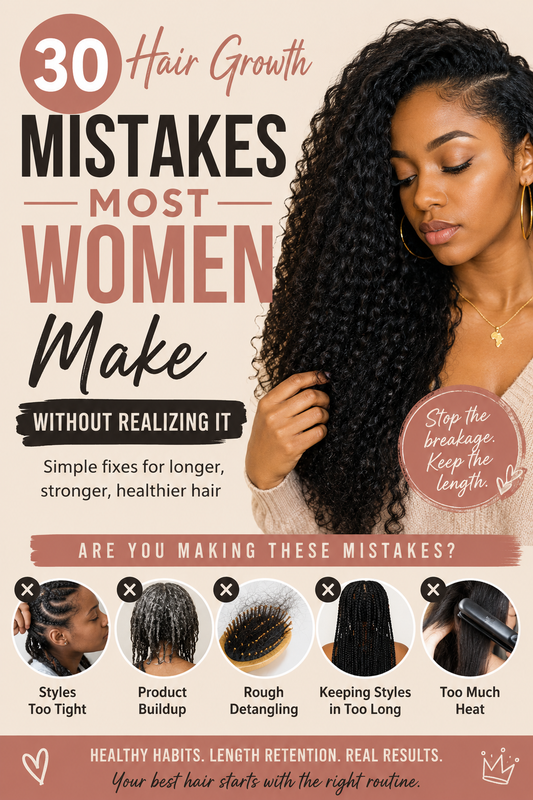
Growing longer, stronger, healthier-looking hair can feel frustrating when you are doing everything you think is right but still aren't seeing the length you want. You may buy quality products, oil your scalp, deep condition regularly, wear protective styles, and avoid excessive heat—yet your hair still seems stuck at the same length.
The problem may not be that your hair isn't growing.
For many women, the bigger issue is length retention.
Hair grows from follicles in the scalp, but the strands you already have can break, split, become damaged, or need trimming. When breakage happens at roughly the same rate as new growth, it can look as though your hair has stopped growing.
This is especially important for women with Black hair, natural hair, curly hair, coily hair, relaxed hair, braids, twists, or locs, because everyday styling and maintenance practices can have a major impact on how much length you retain.
The good news is that many common hair growth mistakes can be corrected.
In this complete guide, we'll cover the most common hair growth mistakes women make, why they can interfere with healthier-looking hair and length retention, and what you can do differently.
What Is the Biggest Hair Growth Mistake Women Make?
One of the biggest mistakes is focusing entirely on making hair grow faster while ignoring the hair that has already grown.
Your scalp and follicles determine new hair growth, while your hair-care routine has a major influence on whether you retain that new length.
Imagine your hair grows approximately half an inch during a month, but your ends continually snap because they are dry and damaged. You may technically be experiencing new growth while seeing very little change in your overall length.
That's why a successful hair growth routine should focus on two goals:
- Supporting a healthy scalp and normal hair growth.
- Protecting existing strands from unnecessary damage and breakage.
Once you understand this difference, building an effective hair routine becomes much easier.
1. Ignoring Your Scalp
Women often spend a lot of time worrying about their ends while paying surprisingly little attention to their scalp.
But hair begins at the scalp.
A healthy hair-care routine should include regular cleansing and attention to scalp health. Sweat, dead skin, excess oil, and styling-product residue can accumulate over time.
Some women mistakenly believe that washing their hair less frequently automatically makes it grow better.
That's not necessarily true.
Your scalp still needs to be cleaned appropriately for your hair type, lifestyle, and styling routine.
Signs your scalp routine may need improvement include:
- Excessive product buildup
- Persistent flaking
- Unusual scalp odor
- Heavy residue
- Frequent itching
- Tenderness
- Excessive oiliness
If you wear braids, wigs, sew-ins, twists, or locs, scalp care remains important.
What to do instead
Create a cleansing schedule based on your actual scalp rather than following someone else's routine.
Some women may prefer weekly cleansing, while others may need more or less frequent washing.
Pay attention to what your scalp is telling you.
2. Thinking Oil Is the Same as Moisture
This is an extremely common natural hair mistake.
You apply oil every day, but your hair still feels dry.
Why?
Because oil and water aren't the same thing.
Hair generally needs water-based moisture, while oils are commonly used as part of a conditioning or sealing routine.
Applying more oil to extremely dry hair doesn't necessarily solve the underlying dryness.
You can end up with hair that feels both oily and dry.
A better approach
When your hair needs moisture, consider beginning with a water-based moisturizing product or leave-in conditioner.
Depending on your hair, you might then apply an appropriate oil or cream.
The exact layering method isn't universal.
Some women love:
Leave-in → cream → oil
Others prefer:
Leave-in → oil → cream
And some hair performs better with a much simpler routine.
The important thing is understanding that adding oil isn't automatically the same as moisturizing your hair.
3. Manipulating Your Hair Every Day
Constant styling can quietly sabotage your length-retention goals.
Every time you:
- Comb
- Brush
- Detangle
- Twist
- Braid
- Slick down
- Redo your edges
- Pull your hair into a ponytail
- Change hairstyles
your strands experience some degree of mechanical manipulation.
Hair can tolerate normal grooming, of course. The problem occurs when manipulation becomes excessive or unnecessarily rough.
Curly and coily hair can be particularly vulnerable because bends and curves along the strand can create points where breakage occurs more easily.
Try low-manipulation styling
Instead of completely restyling your hair every morning, choose hairstyles that can remain presentable for several days.
Examples include:
- Two-strand twists
- Mini twists
- Loose buns
- Flat twists
- Braid-outs
- Twist-outs
- Braids
- Loc styles
Less manipulation doesn't mean never touching your hair.
It means eliminating unnecessary handling.
4. Wearing Hairstyles That Are Too Tight
A hairstyle doesn't need to hurt to look good.
Unfortunately, many women have been taught to associate tightness with neatness or longevity.
Tight braids, ponytails, buns, extensions, and other styles can place unnecessary tension on the hair and scalp.
Pay particular attention to your hairline and edges.
Those areas can be especially vulnerable.
Warning signs that a hairstyle may be too tight
Watch for:
- Pain
- Headaches
- Tenderness
- Redness
- Bumps
- Excessive pulling
- Difficulty moving your eyebrows or facial skin comfortably
- Hair breaking around the hairline
If your protective hairstyle is causing significant pain, don't assume you simply need to "wait for it to loosen."
Hair health should come before getting an extra week or two out of a style.
5. Keeping Protective Styles in Too Long
Protective styling can be useful for reducing daily manipulation.
But protective styles aren't maintenance-free.
Leaving braids, twists, wigs, or extensions in far beyond an appropriate period can create new problems.
As your natural hair grows, shed strands can accumulate. Your roots may begin matting or tangling, and buildup can become harder to manage.
When you eventually remove the hairstyle, detangling may become much more difficult.
Remember:
Protective styling should protect your hair—not simply hide it.
Continue caring for your scalp and hair while wearing the style, and remove it when the condition of your hair indicates it's time.
6. Detangling Too Aggressively
One rushed detangling session can undo weeks of careful hair maintenance.
If you hear strands constantly snapping while combing, brushing, or finger-detangling, slow down.
Your goal isn't to finish as quickly as possible.
Your goal is to remove tangles while preserving as much healthy hair as reasonably possible.
Better detangling habits
Try:
- Working in sections.
- Starting near the ends and gradually moving upward.
- Using enough slip.
- Holding the section above the area you're detangling when appropriate.
- Separating major tangles carefully before forcing a comb through them.
- Avoiding unnecessarily aggressive brushing.
The right detangling method varies by texture, density, length, and hairstyle.
The key principle is simple:
Don't fight your hair.
7. Ignoring Your Ends
Your ends are the oldest part of your hair.
If you have hair that reaches well beyond your shoulders, the ends have potentially been exposed to years of washing, styling, friction, weather, heat, manipulation, and environmental stress.
That makes protecting your ends extremely important for length retention.
Pay attention to:
- Split ends
- Excessive tangling
- Rough ends
- Single-strand knots
- Breakage
- Thin or see-through ends
Your ends may need more conditioning, gentler handling, or trimming when appropriate.
Growing long hair isn't only about creating new growth.
It's also about keeping your oldest hair in good condition.
8. Refusing to Trim Damaged Ends
Some women avoid scissors at all costs because they want long hair.
That can be understandable when you're working hard to gain length.
But refusing to trim severely damaged or split ends isn't necessarily helping your long-term goals.
Trimming doesn't make hair grow faster from the scalp.
However, removing damaged ends when needed can improve the appearance and manageability of your hair and prevent you from holding onto length that is badly compromised.
There isn't one perfect trimming schedule for everyone.
Instead of automatically cutting your hair every specific number of weeks, evaluate the condition of your ends and consult a knowledgeable stylist when necessary.
9. Using Too Much Heat
Heat styling isn't automatically bad.
The problem is excessive heat, very high temperatures, repeated passes, or improper technique.
Flat irons, curling irons, blow dryers, and hot combs can all damage hair when used incorrectly.
Repeated high-heat exposure can leave hair:
- Dry
- Brittle
- Weak
- Prone to splitting
- More susceptible to breakage
Women with natural curls may also notice that excessive heat affects how their curl pattern behaves.
Reduce heat-related damage by:
Using heat less frequently, choosing an appropriate temperature, using a heat protectant, limiting unnecessary passes, and avoiding repeatedly straightening already-straight sections.
10. Sleeping Without Protecting Your Hair
Your nighttime routine matters.
Hair rubbing against bedding for hours can create friction, tangles, and moisture loss.
Many women with curly, coily, natural, or textured hair prefer using satin or silk accessories at night to reduce friction.
Options include:
- Satin bonnet
- Satin scarf
- Satin pillowcase
- Silk scarf
- Silk pillowcase
You don't necessarily need all of them.
Choose the method that keeps your hairstyle protected and is comfortable enough that you'll actually use it consistently.
11. Using Too Many Hair Products
More products don't automatically produce more hair growth.
A complicated routine can sometimes create buildup without giving you better results.
You might have:
Shampoo, clarifying shampoo, conditioner, deep conditioner, leave-in conditioner, curl cream, butter, gel, mousse, edge control, scalp oil, hair oil, serum, growth treatment, and multiple sprays.
You don't necessarily need fifteen products every wash day.
Simplify your routine
Start with the essentials your hair actually needs.
A basic routine might include:
- Cleanser
- Conditioner
- Leave-in or moisturizer
- Styling product
- Oil or scalp product if desired
Additional treatments can be added for specific needs.
Your hair routine should solve problems rather than create clutter.
12. Constantly Switching Products
A viral video says Product A is amazing.
You buy it.
Three days later someone recommends Product B.
You buy that too.
Then an influencer announces that Product C changed her hair completely.
Before long, you own an entire cabinet of half-used products.
Constantly changing products makes it difficult to determine what's actually working.
Unless a product is causing irritation or clearly performing poorly, give your routine enough consistency to evaluate it properly.
Healthy hair habits are usually more important than constantly chasing the newest trend.
13. Copying Someone Else's Hair Routine Exactly
Your favorite influencer may have gorgeous waist-length hair.
That doesn't mean her exact routine is right for you.
Hair differs in:
- Curl pattern
- Strand thickness
- Density
- Porosity
- Length
- Chemical history
- Heat history
- Scalp condition
- Lifestyle
- Styling preferences
A routine that works beautifully for one woman may leave another woman's hair dry, greasy, weighed down, or difficult to manage.
Use other people's routines for ideas—not rigid rules.
Build a regimen based on how your own hair responds.
14. Not Deep Conditioning When Your Hair Needs It
Conditioning can help improve softness, manageability, and detangling.
Some women find that incorporating deeper conditioning treatments periodically is especially helpful when their hair feels dry or has been exposed to demanding styling.
But more isn't always better.
You don't necessarily need to deep condition for hours.
Follow the product directions and pay attention to your hair.
A consistent, sensible routine usually beats an extreme one.
15. Neglecting Your Hair Under Wigs
A wig can make styling incredibly convenient.
But the hair underneath still exists.
One of the biggest mistakes women make is putting on a wig and forgetting about their natural hair for weeks.
Your hair underneath still needs appropriate:
- Cleansing
- Conditioning
- Detangling
- Moisture
- Scalp care
Also pay attention to tension from wig installation methods, adhesives, combs, clips, and tight wig caps—particularly around your hairline.
Wigs can be useful low-manipulation styles when your natural hair underneath is treated with care.
16. Overusing Edge Control
Sleek edges can complete a hairstyle beautifully.
But repeatedly manipulating the same delicate hairs can become a problem.
Think about what happens during a typical week.
You apply edge control.
Brush your edges.
Tie them down.
Redo them tomorrow.
Brush them again.
Add more product.
Repeat.
Over time, the combination of tension, manipulation, buildup, and brushing can become stressful for fragile hairline strands.
Give your edges breaks.
Not every hairstyle needs perfectly sculpted baby hairs.
17. Ignoring Breakage Until It Becomes Severe
Breakage often starts small.
You may notice tiny pieces of hair around your bathroom sink, shoulders, clothing, pillow, or styling area.
Don't automatically ignore them.
Some shedding is a normal part of the hair cycle, but breakage is different.
Shed hair vs. broken hair
Naturally shed strands are often relatively long and may have a small bulb at one end.
Broken hairs may appear as shorter pieces of varying lengths.
If you're noticing increasing breakage, investigate possible causes.
Consider:
- Dryness
- Heat
- Tight styles
- Chemical processing
- Rough detangling
- Excessive manipulation
- Damaged ends
- Friction
Catching a problem early can help prevent further damage.
18. Overlapping Chemical Treatments
Relaxers, permanent color, lighteners, and other chemical services alter the hair.
Improper application or repeatedly processing already-treated hair can increase damage.
For example, when applying a relaxer retouch, repeatedly placing relaxer over previously relaxed lengths can unnecessarily expose those areas to additional processing.
Similarly, aggressive lightening can weaken strands.
Chemical treatments should be performed carefully and according to product instructions, preferably with professional guidance when appropriate.
If your primary goal is length retention, preserving the structural integrity of your strands matters.
19. Thinking Protective Styles Automatically Grow Hair
Braids don't magically cause hair follicles to grow faster.
Neither do wigs, twists, sew-ins, or loc styles.
The advantage of many protective styles is that they can reduce manipulation and help protect length when installed and maintained properly.
That's an important distinction.
If you wear braids for eight weeks and notice significant new growth at your roots, your hair would have been growing during those eight weeks regardless.
The hairstyle may have helped you retain more of that growth because you weren't manipulating your hair daily.
But if the braids were excessively tight and caused breakage, they could work against your goals.
20. Expecting Overnight Results
Healthy hair growth takes time.
This may be the hardest truth to accept in the age of social media.
Videos promising dramatic growth in seven days, two weeks, or one month can create unrealistic expectations.
Hair growth occurs gradually, and individual rates vary.
Instead of obsessing over daily changes, evaluate your progress over longer periods.
Take a picture today.
Take another under similar conditions several months later.
Use the same:
- Hairstyle
- Camera angle
- Lighting
- Shirt or length-check garment
- Hair condition
You'll have a much better idea of your actual progress.
21. Measuring Hair Too Frequently
Checking your length every few days can make it seem like nothing is happening.
Hair growth is gradual.
Instead of repeatedly pulling strands down to see whether they've gained another fraction of an inch, focus on maintaining healthy habits.
Consider doing formal length checks every few months.
You'll spend less time worrying about growth and more time protecting it.
22. Neglecting Hair After Removing Braids
Taking down a protective style isn't the time to rush.
After wearing braids or twists for weeks, you may have accumulated shed hairs, buildup, and tangles.
Immediately shampooing heavily tangled hair without properly separating and detangling it can make matting worse.
A better takedown routine may include:
- Carefully removing the extensions.
- Separating and detangling sections.
- Removing accumulated shed hairs.
- Cleansing the scalp and hair.
- Conditioning thoroughly.
- Detangling gently.
- Moisturizing and styling.
Give yourself enough time.
Protective-style takedown shouldn't be a race.
23. Wearing Tight Ponytails Every Day
Ponytails are convenient.
But repeatedly placing tension on the exact same areas can contribute to breakage.
This is especially important around your temples, edges, and the point where your hair tie sits.
Try alternating styles and ponytail placement.
Choose hair accessories that don't unnecessarily snag your strands.
And don't assume a ponytail needs to be extremely tight to look polished.
24. Ignoring Your Hair's Moisture Needs
Dry hair tends to be less flexible and can become more susceptible to breakage.
This doesn't mean you should constantly soak your hair.
It means you should recognize when your hair needs conditioning and moisture.
Signs may include:
- Rough texture
- Increased tangling
- Brittle-feeling strands
- Lack of flexibility
- Ends that feel unusually dry
Experiment with a consistent moisturizing schedule and adjust based on how your hair responds.
Some women need to moisturize more frequently than others.
25. Using Too Much Protein
Protein treatments can be useful for certain hair needs, particularly when dealing with some types of damage.
But that doesn't mean every wash day needs a strong protein treatment.
Hair products should be selected based on what your hair actually needs.
If you're constantly adding treatments without understanding their purpose, your routine may become unnecessarily complicated.
Balance strengthening products with appropriate conditioning and moisture.
26. Not Protecting Your Hair From Friction
Your pillowcase isn't the only source of friction.
Hair constantly rubs against:
- Sweaters
- Hoodies
- Scarves
- Jackets
- Car headrests
- Hats
- Coat collars
- Furniture
This becomes particularly noticeable once hair reaches shoulder length.
Long natural hair may continually brush against clothing throughout the day.
You don't have to become obsessed with avoiding every surface, but being aware of repeated friction can help you make smarter styling choices.
27. Using Dirty Hair Tools
When was the last time you cleaned your brushes and combs?
Hair tools can collect:
- Shed hair
- Styling product
- Oil
- Dust
- Dead skin
- General residue
Regularly remove trapped hair and clean reusable tools according to their material and manufacturer's instructions.
Also replace tools that have damaged teeth, rough seams, or broken bristles that snag your hair.
A damaged comb can create unnecessary mechanical damage every time you use it.
28. Being Too Rough on Wash Day
Wash day shouldn't feel like a battle.
Aggressively piling long hair on top of your head and scrubbing it into a tangled mass can make detangling harder.
Instead, focus your cleansing efforts appropriately, particularly on your scalp, while handling the lengths gently.
Women with thick, long, curly, or coily hair may find washing in sections easier.
Sections can help reduce tangling and make it easier to ensure the entire scalp is cleansed.
29. Ignoring Your Hairline
Your edges deserve their own strategy.
The hairline is frequently exposed to:
- Braids
- Wigs
- Glue
- Edge control
- Brushing
- Ponytails
- Headbands
- Scarves
- Bonnets
- Extensions
That is a lot of potential manipulation concentrated in one small area.
Treat your hairline gently.
When wearing protective styles, ask your stylist not to place excessive tension on your edges.
If a style is pulling painfully, address it early.
30. Assuming Every Hair Problem Can Be Solved With a Product
Sometimes the solution isn't another bottle.
Your hair may need:
- Less manipulation
- A trim
- Gentler detangling
- Less heat
- A looser hairstyle
- Better cleansing
- More consistent conditioning
- A simpler routine
Products are tools.
They can't compensate for damaging habits indefinitely.
Before buying another product, ask:
What problem am I actually trying to solve?
Then determine whether a product is truly the answer.
What Should a Healthy Hair Growth Routine Look Like?
There isn't one perfect routine for every woman.
However, a practical length-retention routine can be surprisingly simple.
Step 1: Keep Your Scalp Clean
Cleanse according to your scalp, hairstyle, activity level, and product use.
Don't automatically avoid shampoo because you've heard washing prevents hair growth.
Step 2: Condition Your Hair
Use conditioner to improve softness and manageability.
Give particular attention to areas that tend to become dry or tangled.
Step 3: Detangle Gently
Work in manageable sections and use adequate slip.
Don't force tools through knots.
Step 4: Moisturize as Needed
Use a leave-in conditioner or moisturizer that works for your hair.
Adjust the frequency based on how quickly your hair loses moisture.
Step 5: Protect Your Ends
Choose hairstyles that minimize unnecessary friction and manipulation.
Your ends are critical to visible length retention.
Step 6: Limit Excessive Heat
When using heat, use appropriate precautions and avoid unnecessary repeated exposure.
Step 7: Protect Your Hair at Night
Use a satin or silk scarf, bonnet, or pillowcase if it works well for your hair.
Step 8: Monitor Your Progress
Take photos every few months rather than obsessively checking your hair every day.
Consistency gives you better information than daily observation.
A Simple Weekly Hair Growth Routine
If you're overwhelmed by complicated routines, start simple.
Wash Day
Cleanse your scalp and hair appropriately.
Follow with conditioner.
Detangle carefully.
Apply your preferred leave-in or moisturizing products.
Style your hair in a way that minimizes excessive manipulation.
During the Week
Monitor your hair for dryness.
Moisturize when necessary rather than automatically piling on products every day.
Avoid constantly restyling your hair.
At Night
Protect your hairstyle and reduce unnecessary friction.
Every Few Weeks
Evaluate your scalp, ends, and overall hair condition.
Ask yourself:
Is my hair becoming easier or harder to manage?
Am I seeing more or less breakage?
Are my ends becoming rough?
Is my scalp comfortable?
Your answers can help you determine what needs to change.
Hair Growth Mistakes for Black Women
Although many of these mistakes affect all hair types, Black women with natural, relaxed, braided, or loc'd hair may encounter several unique challenges.
Textured hair can require careful handling because curls and coils create multiple bends along each strand.
Length retention therefore becomes extremely important.
Some of the most common mistakes include:
- Excessively tight braids
- Constant wig installations
- Neglecting hair underneath protective styles
- Over-manipulating edges
- Aggressive detangling
- Leaving protective styles in too long
- Using excessive heat
- Failing to protect hair at night
- Allowing ends to become chronically dry
- Constantly switching routines
One of the most effective changes you can make is becoming gentler and more consistent.
Healthy natural hair doesn't necessarily require an extremely complicated regimen.
Hair Growth Mistakes When Wearing Braids
Braids are one of the most popular protective styles, but improper braid care can contribute to breakage.
Avoid these common braid mistakes:
Braiding Too Tight
Your braids shouldn't cause severe pain or excessive scalp tension.
Ignoring Your Scalp
Continue appropriate scalp care while wearing braids.
Constantly Restyling Your Braids
Frequently pulling braids into extremely tight ponytails and buns adds additional tension.
Keeping Braids Too Long
Eventually, new growth, buildup, and shed hair can make maintenance and takedown more difficult.
Rushing Takedown
Take your time removing extensions and detangling your natural hair.
Hair Growth Mistakes When Wearing Wigs
Wigs can be an excellent styling option, but don't let convenience lead to neglect.
Avoid:
- Extremely tight wig caps
- Constant tension around your edges
- Neglecting your scalp
- Leaving your natural hair tangled underneath
- Failing to cleanse your hair appropriately
- Using adhesives carelessly around fragile hair
- Never giving your hairline a break
Your natural hair should still have a complete routine underneath your wig.
Hair Growth Mistakes With Locs
Locs require a different maintenance strategy from loose natural hair, but some principles remain the same.
Common mistakes can include:
- Retwisting too tightly
- Retwisting excessively
- Allowing excessive buildup
- Using too much heavy product
- Neglecting scalp cleansing
- Constantly manipulating locs
- Pulling locs into tight styles
- Ignoring weak or thinning areas
Heavy locs combined with tight styling can place additional tension on the scalp.
Pay attention to changes in loc thickness, especially near the roots.
How Long Does It Take to See Hair Growth Results?
Hair growth is gradual and varies from person to person.
Genetics, age, hormones, overall health, hair practices, and other factors can influence growth and retention.
That's why comparing your results with someone else's can be misleading.
Instead of asking:
"Why isn't my hair as long as hers?"
Ask:
"Is my hair healthier and longer than it was several months ago?"
That's a far more useful comparison.
Take consistent progress pictures every two or three months.
Even if your growth seems slow, improved length retention can produce noticeable differences over time.
Why Does My Hair Grow but Never Get Longer?
If you're seeing new growth at your roots but your overall length remains nearly unchanged, breakage may be one possible explanation.
Imagine your hair grows at the scalp while the ends continually snap.
The result?
Your hair appears to stay the same length.
Look for signs such as:
- Short broken pieces
- Thin ends
- Excessive split ends
- Constant tangling
- Uneven sections
- Hair breaking during detangling
- Hair snapping when manipulated
In this situation, your priority shouldn't necessarily be finding a miracle growth treatment.
Focus on retaining the hair you're already growing.
Can You Actually Make Hair Grow Faster?
There is no single routine or product guaranteed to dramatically accelerate hair growth for everyone.
Hair growth is influenced by biology.
However, you can create better conditions for healthy hair by maintaining your scalp, reducing unnecessary damage, caring for your strands, and addressing underlying health concerns when necessary.
Be skeptical of claims promising several inches of new growth in an extremely short period.
Instead, aim for sustainable progress.
When Hair Loss May Require Professional Help
Not every hair problem is caused by your routine.
If you're experiencing significant or unexplained hair loss, sudden shedding, bald patches, scalp pain, inflammation, sores, or other concerning symptoms, consider seeing a dermatologist or qualified healthcare professional.
Hair changes can sometimes be associated with medical conditions, medications, nutritional issues, hormonal changes, stress, or other factors that can't be diagnosed from a hair-care routine alone.
Don't spend months buying product after product when professional evaluation may be appropriate.
Frequently Asked Questions About Hair Growth Mistakes
What is the number-one mistake that stops hair from getting longer?
For many women, excessive breakage and poor length retention are major reasons hair doesn't appear to get longer. The hair may still be growing from the scalp while breaking along the ends and lengths.
Does oiling your scalp make hair grow faster?
Scalp oils can be part of a hair-care routine, but applying oil isn't a guaranteed method for accelerating hair growth. Choose products based on your scalp's needs and discontinue anything that causes irritation.
Should I moisturize my natural hair every day?
Not necessarily. Moisturizing frequency depends on your hair, hairstyle, products, and environment. Some women need frequent moisture while others can go several days without reapplying products.
Do braids make your hair grow?
Braids don't automatically increase the biological growth rate of your hair. However, properly installed braids may reduce daily manipulation, potentially helping some people retain length.
How often should I trim my hair for growth?
Trimming doesn't make hair follicles grow faster. Trim frequency should depend on the condition of your ends, hairstyle, and hair goals.
Why does my hair keep breaking?
Possible causes include dryness, excessive heat, chemical damage, rough detangling, tight hairstyles, friction, damaged ends, and excessive manipulation. Persistent or unexplained breakage may require professional evaluation.
Is washing your hair bad for hair growth?
No. Appropriate cleansing is part of maintaining your scalp and hair. How often you need to wash depends on your scalp, hair type, lifestyle, hairstyle, and product use.
Can protective styles damage your hair?
Yes, particularly when they're excessively tight, heavy, poorly maintained, or left in too long. Protective styles should minimize manipulation without creating excessive tension.
Is heat stopping my hair from growing?
Heat doesn't necessarily stop follicles from producing hair, but excessive heat can damage existing strands and contribute to breakage, which can make retaining length more difficult.
Why are my edges not growing?
Hairline thinning can have multiple causes, including repeated tension and manipulation. If you're experiencing persistent thinning or hair loss around your edges, consider consulting a dermatologist rather than relying only on cosmetic products.
10 Hair Growth Habits to Start Today
If you recognize several mistakes in your routine, don't feel like you need to completely overhaul everything overnight.
Start with these ten habits:
- Handle your hair gently.
- Keep your scalp appropriately clean.
- Condition consistently.
- Protect your ends.
- Reduce unnecessary manipulation.
- Avoid painfully tight hairstyles.
- Protect your hair while sleeping.
- Use heat responsibly.
- Monitor breakage rather than obsessing only over growth.
- Stay consistent long enough to evaluate your routine.
Small changes performed consistently can have a greater impact than constantly chasing dramatic solutions.
The Secret to Longer Hair Is Often Length Retention
When women think about growing longer hair, the first question is often:
"How can I make my hair grow faster?"
But a better question may be:
"How can I keep more of the hair I'm already growing?"
That change in perspective can completely transform your hair routine.
If your scalp is producing new hair but your strands are constantly breaking, increasing your focus on length retention may make a significant difference.
Treat your ends like they're valuable.
Reduce unnecessary manipulation.
Don't tolerate painful hairstyles.
Keep your scalp clean.
Condition your strands.
Use heat carefully.
Protect your hair at night.
Most importantly, give your routine time.
Final Thoughts: Stop Sabotaging Your Hair Growth Goals
The biggest hair growth mistakes usually aren't dramatic.
They're small habits repeated over and over.
Pulling your ponytail slightly too tight.
Brushing your edges every morning.
Keeping braids in longer than your hair can comfortably handle.
Skipping nighttime protection.
Ripping through tangles because you're in a hurry.
Using excessive heat.
Ignoring damaged ends.
Adding oil when your hair actually needs moisture and conditioning.
Each habit may seem insignificant by itself. But repeated over months or years, unnecessary damage can make retaining length much more difficult.
If your goal is longer, stronger, healthier-looking hair, don't focus exclusively on how quickly your hair grows.
Protect what you grow.
Build a consistent routine centered around a healthy scalp, gentle handling, adequate conditioning, low manipulation, protected ends, and realistic expectations.
Your hair doesn't need a new viral trick every week.
It needs consistent care.
And when you stop making the habits that contribute to unnecessary breakage, you may finally begin seeing more of the length you've been working so hard to achieve.