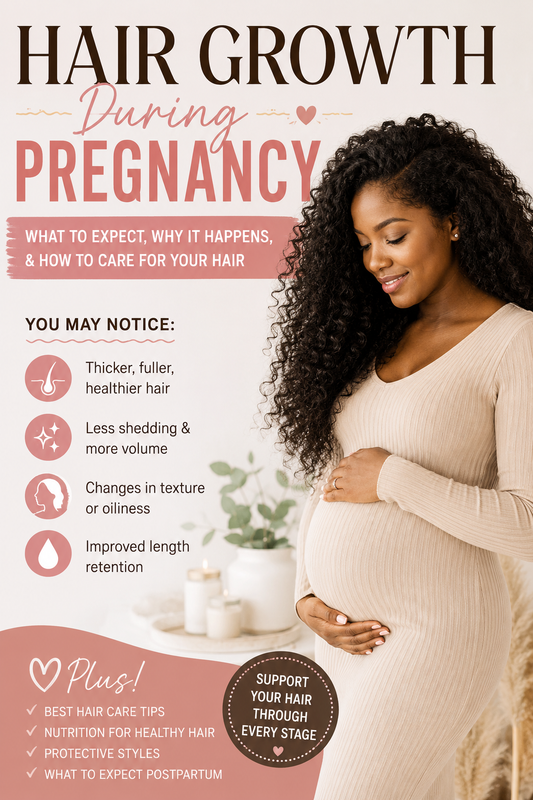
Pregnancy can bring noticeable changes throughout the body, and your hair is no exception. Some women notice that their hair suddenly appears longer, thicker, shinier, or fuller. Others experience dryness, changes in curl pattern, scalp sensitivity, breakage, or little noticeable difference at all.
If you've ever wondered, “Does hair grow faster during pregnancy?”, the answer is a little more complicated than a simple yes or no.
Pregnancy hormones can dramatically affect the normal hair growth cycle. Rather than every woman suddenly producing hair at a much faster rate, pregnancy often causes more hairs to remain in the active growth phase for longer. Because fewer hairs are shedding at the same time, the hair may look significantly thicker and fuller.
For women with Black hair, natural hair, curly hair, coils, locs, braids, or other textured hairstyles, pregnancy may create additional changes in moisture needs, scalp condition, shedding, and daily maintenance.
This complete guide explains hair growth during pregnancy, what happens to the hair growth cycle, why your hair may become thicker, what happens after delivery, and how to maintain healthy hair throughout pregnancy.
Important: Pregnancy-related hair changes vary widely. Sudden, severe, patchy, painful, or otherwise concerning hair loss should be discussed with your healthcare professional. Before starting supplements, medications, essential oils, or hair-loss treatments during pregnancy, ask your healthcare provider whether they are appropriate for you.
What Happens to Your Hair During Pregnancy?
Hair grows according to a natural cycle.
At any given moment, different hairs on your scalp are in different stages of that cycle. Some are actively growing, while others are transitioning, resting, or preparing to shed.
The major phases include:
1. Anagen Phase
The anagen phase is the active growth phase.
During this stage, cells within the hair follicle are actively producing the hair shaft. Scalp hairs can remain in this phase for years.
The longer a strand remains in anagen, the longer it has an opportunity to grow before eventually shedding.
2. Catagen Phase
Catagen is a short transitional period.
The follicle begins moving away from active growth and prepares for the resting stage.
3. Telogen Phase
Telogen is the resting phase.
Eventually, the old strand is released and sheds, making room for another growth cycle.
This process is completely normal.
You naturally lose hairs every day because individual follicles are operating on slightly different schedules.
Pregnancy can temporarily alter that balance.
Does Hair Grow Faster During Pregnancy?
Many pregnant women believe their hair is growing faster because they notice greater length and fullness.
In reality, the most noticeable pregnancy hair change may be reduced shedding rather than dramatically accelerated growth.
Hormonal changes—particularly increased estrogen levels—can influence the hair cycle and cause more hairs to remain in the growth stage longer.
This means fewer hairs may enter the shedding stage.
Imagine that your scalp normally grows 100 hairs while simultaneously shedding a certain number of older hairs. If the shedding suddenly decreases, your overall hair density can increase even if your actual growth rate hasn't changed very much.
The result can be hair that appears:
- Thicker
- Fuller
- Longer
- Denser
- More voluminous
For someone trying to retain length, reduced shedding can make the difference especially noticeable.
Why Does Hair Get Thicker During Pregnancy?
Pregnancy involves major hormonal changes.
Estrogen, progesterone, and several other hormones change throughout pregnancy. These changes can affect skin, nails, oil production, pigmentation, and hair.
One of the most commonly reported hair effects is increased fullness.
Instead of hairs reaching the end of their normal cycle and falling out, more may remain attached to the scalp.
This can create the appearance of unusually thick hair.
Some women even describe pregnancy as the period when their hair looked the healthiest it ever had.
However, not everyone experiences this.
Some women notice:
- Increased dryness
- Increased oiliness
- More tangling
- Different curl patterns
- Scalp sensitivity
- Breakage
- Thinning
- Texture changes
There is no universal pregnancy hair experience.
How Fast Does Hair Grow During Pregnancy?
Average scalp hair growth is often estimated at roughly half an inch per month, although actual growth rates vary considerably from person to person.
Genetics, age, nutrition, health, hormones, hair practices, and the individual follicle all play roles.
Pregnancy doesn't guarantee that your follicles suddenly produce dramatically more length every month.
What may change more noticeably is hair retention.
For example, imagine two people whose hair grows at similar rates.
Person A experiences frequent breakage and shedding.
Person B experiences less shedding and protects the ends from breakage.
After six months, Person B's hair can appear to have grown significantly more even though the follicle growth rates weren't dramatically different.
This distinction between growth and retention is particularly important for natural and textured hair.
Pregnancy Hair Growth and Black Women
Black hair can grow long and healthy during pregnancy just like any other hair type. However, tightly curled and coiled textures can make length retention more challenging because the hair's natural shape can contribute to dryness, tangling, and breakage.
Sebum produced by the scalp does not always travel easily down highly textured strands.
As a result, the ends may become dry even when the scalp feels adequately moisturized.
Pregnancy can potentially change these moisture needs.
Some women notice that their natural hair becomes:
- Softer
- Drier
- More oily
- Easier to detangle
- Harder to detangle
- Thicker
- Less dense
- Looser in certain areas
- Tighter in certain areas
Instead of assuming your old routine will continue working perfectly, pay attention to how your hair responds.
Your pregnancy hair routine may need to evolve.
Natural Hair Growth During Pregnancy
Pregnancy can be an excellent time to simplify a natural hair routine.
You don't necessarily need dozens of products or a complicated seven-day regimen.
The fundamentals remain important:
Clean scalp + conditioned strands + moisture + low manipulation + gentle detangling + protected ends.
If you're retaining more hair because of pregnancy-related hormonal changes, protecting that retained length becomes especially important.
A good natural hair routine during pregnancy might include:
- Regular cleansing
- Conditioning
- Gentle detangling
- Moisturizing as needed
- Protective or low-manipulation styling
- Nighttime protection
- Regular monitoring of the scalp and ends
Consistency usually matters more than complexity.
First Trimester Hair Changes
During the first trimester, pregnancy hormones begin changing rapidly.
But don't expect every hair transformation to happen immediately.
Some women notice very little difference during the first few months.
Others experience increased oil production, dryness, scalp changes, or changes in shedding.
The first trimester can also involve nausea, fatigue, food aversions, and major changes to daily routines.
Hair care may understandably become less of a priority.
If you're exhausted, simplify.
A basic routine of cleansing, conditioning, moisturizing, and wearing a manageable hairstyle can be enough.
Your hair routine should work with your life rather than become another source of stress.
Second Trimester Hair Growth
The second trimester is when some women begin noticing greater fullness.
You may notice:
- Less hair in your comb
- Less hair in the shower
- A fuller ponytail
- Thicker-looking roots
- More overall volume
- Improved length retention
If your hair feels significantly thicker, detangling may take longer.
Divide the hair into manageable sections instead of trying to detangle everything at once.
For highly textured hair, sectioning can dramatically reduce unnecessary pulling.
Third Trimester Hair Changes
By the third trimester, some women have accumulated months of reduced shedding.
Hair may appear exceptionally thick.
This sounds wonderful, but increased density can also mean more work.
Wash day may take longer.
Drying may take longer.
Detangling may require more sections.
The scalp can also become more difficult to reach.
Comfort becomes especially important later in pregnancy. Avoid hairstyles that require you to stand for extremely long periods or keep your arms raised for extended periods if that feels uncomfortable.
Simple, manageable styles can make hair care much easier.
Hair Growth During Pregnancy Month by Month
There isn't a universal month-by-month pregnancy hair growth timeline because everyone responds differently.
Still, a general pattern may look something like this:
Months 1–3
Hormones begin changing, but major hair differences may not yet be obvious.
Months 4–6
Some women begin noticing less shedding and increased fullness.
Months 7–9
Hair may look thicker because more strands have remained in the growing/resting cycle instead of shedding.
Again, this isn't guaranteed.
Another pregnant woman may experience almost no noticeable change.
Both experiences can be normal.
Why Your Hair May Seem to Grow So Much During Pregnancy
Three things can create the impression of extremely rapid growth.
Reduced Shedding
This is one of the biggest factors.
If fewer hairs fall out, overall density increases.
Better Length Retention
Some women become more intentional about self-care during pregnancy and may use fewer damaging hairstyles, less heat, or fewer chemical processes.
Reducing breakage means more of the hair being produced by the follicles remains visible.
Increased Density
More strands remaining on the scalp can make the entire head of hair look healthier and longer.
All three factors can create impressive changes.
Can Pregnancy Change Your Hair Texture?
Yes, some women report changes in hair texture during or after pregnancy.
Hair may seem:
- Straighter
- Curlier
- Coarser
- Softer
- Drier
- More oily
Hormonal changes can influence the hair and scalp in complex ways.
Some changes are temporary.
Others may persist after pregnancy.
If your curl pattern suddenly behaves differently, don't immediately assume your products have stopped working.
Your hair itself may be responding differently.
Experiment gently with your routine rather than aggressively adding products.
Why Pregnancy Hair Can Become Dry
Not everyone gets shiny pregnancy hair.
Some women experience increased dryness.
Dry hair can become more vulnerable to:
- Split ends
- Knots
- Tangling
- Breakage
- Roughness
- Frizz
Textured hair already tends to require intentional moisture management, so pregnancy-related dryness may make this even more noticeable.
The goal isn't to keep your hair soaking wet constantly.
Instead, focus on maintaining flexibility.
Hair that feels extremely brittle may need more conditioning and gentler handling.
Best Hair Growth Routine During Pregnancy
A healthy pregnancy hair routine does not need to be complicated.
Here's a practical approach.
Step 1: Clean Your Scalp Regularly
Healthy hair care starts with the scalp.
Oil, sweat, dead skin cells, and styling products can accumulate over time.
Cleanse according to your scalp and hairstyle.
Some people prefer weekly cleansing.
Others may wash more or less frequently.
The right schedule depends on:
- Scalp oiliness
- Exercise
- Hairstyle
- Product use
- Hair texture
- Dandruff tendencies
Don't assume that avoiding shampoo automatically makes hair grow faster.
A clean, comfortable scalp is generally easier to maintain.
Step 2: Condition Your Hair
Conditioning is especially important for curly, coily, and natural hair.
Conditioner helps improve manageability and reduces friction during detangling.
Apply it throughout the lengths of your hair, paying special attention to dry areas and ends.
Use the opportunity to gently separate tangles.
Step 3: Detangle in Sections
Trying to detangle thick pregnancy hair all at once can create unnecessary breakage.
Instead, separate the hair into four, six, or more sections.
Work slowly.
Start near the ends and gradually move upward.
Avoid aggressively pulling through knots.
When you encounter a stubborn tangle, use your fingers to separate it before forcing a comb through it.
Step 4: Moisturize According to Your Hair's Needs
Moisture needs vary.
Some hair may need refreshing every few days.
Other hair can remain soft for much longer.
Pay attention to how your strands feel.
When hair begins feeling rough, stiff, or difficult to manipulate, it may be time to refresh your moisture routine.
Step 5: Protect Your Ends
Your ends are the oldest portion of your hair.
If your hair is 18 inches long, those ends have experienced years of:
- Washing
- Styling
- Detangling
- Clothing friction
- Weather
- Heat
- Manipulation
Protecting the ends helps preserve length.
Consider low-manipulation styles where the ends aren't constantly rubbing against clothing.
Step 6: Reduce Excessive Heat
Heat isn't automatically destructive.
However, frequent high-temperature styling can weaken the hair over time, especially when combined with poor technique.
If your goal is maximum length retention during pregnancy, consider reducing unnecessary heat.
When using heat, use appropriate temperature control and avoid repeatedly passing hot tools over the same section.
Step 7: Protect Your Hair at Night
Cotton pillowcases can create friction and absorb moisture from the hair.
Many women with natural or curly hair prefer sleeping with:
- Satin bonnets
- Satin scarves
- Satin pillowcases
Nighttime protection can help reduce tangling and friction.
It can also help hairstyles last longer.
Protective Hairstyles During Pregnancy
Protective styles can make pregnancy hair care significantly easier.
Popular options include:
- Two-strand twists
- Mini twists
- Braids
- Cornrows
- Flat twists
- Buns
- Wigs worn with proper hair care underneath
- Loc styles
However, the word protective doesn't automatically mean a hairstyle is healthy.
A protective style that's extremely tight can place unnecessary tension on the scalp.
Your hairstyle should not cause significant pain.
If your edges are being pulled tightly or you notice bumps and irritation, the style may be applying too much tension.
Braids During Pregnancy
Braids can be convenient because they reduce daily manipulation.
However, your natural hair still needs care underneath.
Avoid excessively tight installation, especially around the hairline.
Keep your scalp clean according to your needs and don't leave braids installed indefinitely simply because they're convenient.
When removing braids, take your time.
Hair that would normally have shed each day may remain trapped inside the braided style.
When you finally remove your braids, seeing accumulated shed hairs can be alarming.
That doesn't automatically mean your hair is suddenly falling out.
Some of that hair may simply represent normal shedding that couldn't fall away while your hair was braided.
Loc Growth During Pregnancy
Women with locs may also notice increased fullness or reduced shedding during pregnancy.
Continue focusing on scalp health.
Avoid excessively tight retwists and hairstyles.
Constant tension can place stress on individual locs, especially around the hairline.
Keep locs clean and dry them thoroughly after washing.
If pregnancy fatigue makes your usual loc routine difficult, simplify your styling schedule.
Can You Oil Your Scalp During Pregnancy?
Many people enjoy using hair oils as part of their routine.
However, pregnancy is a period when ingredient awareness becomes particularly important.
A product being marketed as natural does not automatically mean every ingredient is appropriate for every pregnant person.
Essential oils and concentrated botanical ingredients deserve particular attention.
Before using new concentrated essential oils, supplements, medications, or treatments during pregnancy, discuss them with your healthcare provider.
For ordinary cosmetic products, review the complete ingredient list and follow product directions.
Foods and Nutrition for Healthy Hair During Pregnancy
Hair is made primarily from keratin, a protein.
Your body needs adequate nutrition to support countless processes during pregnancy, including tissue development.
Rather than trying to eat a single magical “hair growth food,” focus on overall nutritional adequacy based on your healthcare professional's recommendations.
Important nutrients associated with normal body and hair function include:
- Protein
- Iron
- Zinc
- Vitamin D
- Vitamin B12
- Folate
- Essential fatty acids
Pregnancy nutritional needs are different from those of a nonpregnant adult.
That's why supplementation should be guided by a healthcare professional rather than random hair-growth advice online.
Protein and Hair Growth During Pregnancy
Hair is composed primarily of protein, so adequate dietary protein contributes to normal tissue maintenance.
Protein sources can include foods such as:
- Eggs
- Fish that is appropriate for pregnancy
- Poultry
- Beans
- Lentils
- Greek yogurt
- Nuts
- Seeds
- Tofu
Your individual nutritional needs during pregnancy should be discussed with your healthcare provider.
Iron and Pregnancy Hair
Iron is particularly important during pregnancy because maternal blood volume increases substantially.
Iron deficiency can contribute to hair shedding in some people.
However, you shouldn't diagnose yourself based on hair changes alone.
Fatigue and hair shedding can have many causes.
If you're concerned about iron, ask your healthcare provider whether testing is appropriate.
Avoid taking excessive iron specifically for hair growth unless instructed to do so.
Should You Take Hair Growth Vitamins While Pregnant?
Do not automatically add hair-growth supplements on top of your prenatal vitamin.
Many beauty supplements contain large doses of vitamins, minerals, herbs, or other compounds.
More is not always better.
Certain nutrients can be harmful in excessive amounts, particularly during pregnancy.
Your prenatal vitamin is designed around pregnancy-related nutritional needs.
Before taking any additional supplement—including products marketed for hair, skin, and nails—talk with your obstetrician, midwife, pharmacist, or other qualified healthcare professional.
What About Biotin During Pregnancy?
Biotin is frequently marketed as a hair-growth vitamin.
However, taking very high doses isn't automatically beneficial.
Biotin supplements can also interfere with certain laboratory tests.
Pregnant women should not assume that taking extra biotin will dramatically accelerate hair growth.
Use supplements according to professional medical guidance rather than marketing claims.
Hydration and Healthy Hair
Drinking enough fluids is important for overall health during pregnancy.
However, drinking excessive amounts of water won't directly transform hair growth.
Hair care still requires external management.
Think of hydration and nutrition as part of supporting your overall health—not as instant hair-growth treatments.
Scalp Massage During Pregnancy
Gentle scalp massage can be a relaxing addition to your hair routine.
Use the pads of your fingers rather than scratching with your nails.
Massage gently.
You don't need to aggressively rub the scalp for long periods.
Scalp massage can also give you an opportunity to inspect your scalp for:
- Irritation
- Flaking
- Tenderness
- Bumps
- Unusual thinning
If you notice persistent problems, consult an appropriate healthcare professional.
What Hair Products Should You Avoid During Pregnancy?
Pregnancy product safety is more complicated than simply creating a universal list of “good” and “bad” ingredients.
Formulation, concentration, route of exposure, frequency of use, and individual medical circumstances matter.
If you're unsure about a specific product, show the ingredient list to your healthcare provider or pharmacist.
This is particularly important for:
- Prescription scalp treatments
- Hair-loss medications
- Strong medicated products
- Concentrated essential oils
- Supplements
- Products making drug-like growth claims
Avoid assuming that something is safe solely because it is herbal or natural.
Can You Use Hair Growth Treatments During Pregnancy?
This depends on the treatment.
Some common hair-loss medications and treatments may not be appropriate during pregnancy.
If you've previously used a treatment for thinning or hair loss, don't automatically continue it after becoming pregnant.
Ask your healthcare professional whether you should continue, pause, or replace the treatment.
This is particularly important with medicated hair-growth products.
Hair Growth Oil During Pregnancy
Hair oils can help reduce friction, add shine, and support moisture retention depending on the formula and how they're used.
But oils do not magically force follicles to produce several inches of new hair overnight.
A hair oil can be part of a healthy routine by helping maintain the strands you're already growing.
For natural hair, this distinction matters.
Hair growth happens at the scalp. Length retention happens along the strand.
Both contribute to the appearance of longer hair.
How to Retain Length During Pregnancy
Pregnancy may provide a temporary opportunity to retain more hair because shedding can decrease.
Take advantage of that period by reducing unnecessary breakage.
Focus on:
- Gentle detangling
- Regular conditioning
- Low-manipulation styling
- Moisture management
- Protecting your ends
- Nighttime satin protection
- Avoiding excessively tight hairstyles
- Reducing unnecessary heat
The goal isn't to manipulate your hair constantly because you want it to grow.
Sometimes doing less is more effective.
Common Pregnancy Hair Growth Mistakes
Mistake #1: Assuming More Oil Means Faster Growth
Covering the scalp with large quantities of oil won't automatically make follicles grow faster.
Too much product can also create buildup.
Use products intentionally rather than excessively.
Mistake #2: Taking Multiple Hair Supplements
Combining prenatal vitamins with beauty vitamins and hair supplements without medical guidance can expose you to unnecessary amounts of certain nutrients.
Always discuss supplements with your healthcare provider.
Mistake #3: Ignoring Breakage
You may be growing hair normally while losing length from the ends.
Look at the condition of your strands, not just your roots.
Mistake #4: Wearing Extremely Tight Protective Styles
Pain is not proof that a hairstyle will last longer.
Excessive tension can be damaging.
Mistake #5: Avoiding Washing for Months
Dirty hair doesn't inherently grow faster.
Clean your scalp according to your individual needs.
Mistake #6: Panicking About Every Shed Hair
Some shedding is normal.
Pay attention to dramatic changes rather than expecting zero hair to fall out.
The Biggest Surprise: Postpartum Hair Shedding
One of the most important things to understand about pregnancy hair is what can happen after the baby is born.
During pregnancy, hormonal changes may keep more hairs from shedding.
After delivery, hormone levels shift again.
Many of the hairs that remained in the growth/resting cycle longer than usual can eventually enter the shedding phase.
This can lead to noticeable postpartum hair shedding, often referred to as postpartum hair loss.
The amount of hair coming out can be startling.
But in many cases, this represents a temporary shift in the hair cycle rather than permanent baldness.
When Does Postpartum Hair Loss Start?
Postpartum shedding often becomes noticeable a few months after delivery rather than immediately after birth.
You may notice:
- More hair in the shower
- Hair on your clothing
- Hair in your comb
- A thinner ponytail
- Thinning near the temples
- Shorter hairs around the hairline later as regrowth occurs
The timing and severity vary considerably.
Some women experience mild shedding.
Others experience dramatic shedding.
Why Does Hair Fall Out After Pregnancy?
Think of pregnancy as temporarily delaying the departure of some hairs.
Eventually, those hairs still have to complete their cycle.
When hormone levels change after delivery, a larger-than-usual group of hairs can enter the shedding stage around the same time.
This synchronized shedding creates the impression that you're suddenly losing an enormous amount of hair.
In many cases, the follicles themselves remain capable of producing new hair.
Does Postpartum Hair Grow Back?
In many cases, postpartum shedding improves as the normal hair cycle reestablishes itself.
Regrowth may initially appear as short hairs around the hairline or throughout the scalp.
It takes time because hair grows gradually.
Don't expect postpartum hair density to return overnight.
If hair loss is severe, persists longer than expected, creates distinct bald patches, or is accompanied by scalp symptoms or other health concerns, consult a healthcare professional.
Other conditions can sometimes occur around the same time as postpartum shedding and should not automatically be blamed on pregnancy.
How to Care for Postpartum Hair
Your postpartum routine should focus heavily on gentle handling.
Hair that is shedding doesn't need aggressive manipulation.
Consider:
- Detangling carefully
- Using conditioner
- Avoiding tight ponytails
- Reducing tension around the edges
- Wearing manageable hairstyles
- Protecting hair at night
- Continuing appropriate nutrition
- Keeping the scalp clean
New parenthood can also make elaborate hair routines unrealistic.
Choose routines you can actually maintain.
Pregnancy Hair vs. Postpartum Hair
Pregnancy hair can feel like the ultimate hair-growth phase.
Your ponytail may become thicker.
Your curls may look fuller.
Your locs may seem denser.
Then postpartum shedding begins and it may feel as though you've lost all your progress.
Remember that these are connected stages.
The extra fullness during pregnancy was partly created because hair that normally would have shed remained attached longer.
When that delayed shedding occurs later, density can move back toward your baseline.
Understanding this before delivery can make postpartum shedding less surprising.
Can Breastfeeding Cause Hair Loss?
Postpartum hair changes happen during a period when many other changes are occurring simultaneously.
That can make it easy to attribute shedding to breastfeeding.
Hormonal shifts associated with pregnancy and delivery play a major role in postpartum hair-cycle changes.
Nutrition, stress, sleep, medical conditions, and other factors can also affect hair.
If you're breastfeeding and experiencing concerning hair loss, talk with your healthcare provider rather than assuming breastfeeding itself is the sole cause.
How to Measure Hair Growth During Pregnancy
If you're curious about your progress, don't rely entirely on memory.
Take a photograph at the beginning of your pregnancy.
Then take another every four to eight weeks.
Try to use:
- Similar lighting
- Similar hairstyle
- Similar angle
- Similar clothing
- Similar hair stretching method
You can also measure specific sections.
For natural hair, shrinkage can make visual growth difficult to detect.
A stretched strand may show several inches of progress that isn't obvious when the hair is fully shrunken.
Shrinkage Can Hide Pregnancy Hair Growth
Curly and coily hair can shrink significantly.
That means you could be retaining length without seeing much difference in your everyday hairstyle.
Instead of constantly stretching the hair to check growth, use periodic photographs or measurements.
Shrinkage isn't evidence that your hair isn't growing.
It is a characteristic of textured hair.
How Often Should You Trim During Pregnancy?
There is no special pregnancy trimming schedule that applies to everyone.
Trim based on the condition of your ends.
Signs that a trim may be helpful include:
- Persistent split ends
- Excessive tangling at the ends
- See-through ends
- Rough ends
- Frequent single-strand knots
- Breakage concentrated at the ends
Trimming doesn't make the follicle grow faster.
However, removing damaged ends can improve manageability and reduce continued splitting.
Can Stress Affect Hair During Pregnancy?
Stress can affect the body in many ways, and significant physical or emotional stress can influence hair cycles.
Pregnancy itself involves major physiological changes.
Rather than becoming stressed about achieving a certain amount of hair growth, focus on maintaining your overall health and a manageable routine.
Hair growth is gradual.
You don't need to monitor your roots every day.
A Simple Weekly Pregnancy Hair Routine for Natural Hair
Here's an example of a low-maintenance routine.
Wash Day
Cleanse the scalp thoroughly but gently.
Follow with conditioner.
Detangle in sections.
Rinse thoroughly.
Apply your preferred moisturizing products.
Style your hair in twists, braids, or another comfortable low-manipulation style.
Midweek
Check moisture levels.
Refresh only if needed.
Avoid adding product simply because it's a certain day of the week.
Nightly
Cover your hair with satin or sleep on a satin pillowcase.
Throughout the Week
Avoid constantly restyling the hair.
Give your strands a chance to remain undisturbed.
Hair Growth During Pregnancy With Braids
If you're wearing braids during pregnancy, create a maintenance routine rather than forgetting about your natural hair.
Keep your scalp clean.
Avoid excessive product buildup.
Don't scratch aggressively.
Moisturize according to your hair's needs.
Most importantly, avoid overly tight braids.
Your edges are delicate.
Repeated tension around the hairline can contribute to breakage.
Hair Growth During Pregnancy With Locs
Locs can be a convenient pregnancy hairstyle because they don't require daily detangling.
Still, they need proper maintenance.
Wash your scalp regularly.
Dry your locs thoroughly.
Avoid excessive buildup.
Don't retwist excessively tightly.
Keep heavy hairstyles to a minimum if they create tension.
Healthy loc growth requires healthy maintenance habits.
Hair Growth During Pregnancy With Relaxed Hair
Pregnant women with relaxed hair should also prioritize length retention.
The point where new growth meets previously relaxed hair can require careful handling.
Use gentle detangling techniques and avoid unnecessary pulling.
If you're considering chemical services during pregnancy and have questions about exposure or product safety, discuss them with your healthcare provider.
Hair Growth During Pregnancy FAQ
Does pregnancy make your hair grow faster?
Pregnancy can make hair appear to grow faster because hormonal changes may reduce normal shedding and increase fullness. Actual follicle growth speed may not increase dramatically.
Why is my hair so thick while pregnant?
More hairs may remain in the growth cycle instead of shedding at their usual time, increasing overall density.
Does everyone's hair get thicker during pregnancy?
No. Pregnancy hair changes vary widely. Some women experience thicker hair, while others experience dryness, texture changes, increased oiliness, or shedding.
How much does hair grow during nine months of pregnancy?
Hair growth rates vary. Scalp hair is often estimated to grow around half an inch per month on average, but genetics and individual biology can produce significant variation.
Why am I losing hair while pregnant?
There can be many reasons for hair shedding during pregnancy. If the shedding is substantial, sudden, patchy, or concerning, talk with your healthcare provider.
Can I take hair vitamins while pregnant?
Don't add hair-growth supplements without discussing them with your healthcare provider. Some supplements contain nutrients or botanical ingredients that may not be appropriate during pregnancy or may duplicate your prenatal vitamin.
Can I use hair growth oil while pregnant?
Many cosmetic hair oils are commonly used, but formulations differ. Check ingredients and consult your healthcare provider about ingredients you're uncertain about, especially concentrated essential oils or medicated products.
Will my pregnancy hair stay thick after delivery?
Not necessarily. Many women experience postpartum shedding as the hair cycle adjusts after pregnancy.
When does postpartum shedding stop?
The timeline varies. Hair cycles take time to normalize. Persistent, severe, patchy, or otherwise concerning hair loss should be evaluated by a healthcare professional.
Can natural hair grow long during pregnancy?
Absolutely. Natural hair can retain significant length during pregnancy when it is protected from excessive breakage. Focus on moisture, conditioning, gentle detangling, and low-manipulation styling.
Best Tips for Maximizing Healthy Hair Retention During Pregnancy
If your hair becomes fuller during pregnancy, use the opportunity to improve your hair habits.
Remember these fundamentals:
- Keep your scalp clean.
- Condition regularly.
- Detangle gently.
- Protect your ends.
- Avoid excessively tight hairstyles.
- Reduce unnecessary manipulation.
- Protect hair while sleeping.
- Eat according to your pregnancy nutrition plan.
- Don't take random hair supplements.
- Prepare mentally for possible postpartum shedding.
You don't need a miracle product.
Healthy hair care is usually built around consistency.
Hair Growth During Pregnancy: What Really Matters
Pregnancy can be an exciting period for your hair.
You may notice thicker roots, a fuller ponytail, longer-looking curls, or impressive length retention.
But it's important to understand what's actually happening.
Pregnancy hormones can alter the normal hair cycle and cause more strands to remain on your scalp longer. That means the dramatic “pregnancy hair growth” many women experience may partly reflect reduced shedding and increased retention, not simply faster follicle growth.
For Black women and anyone with natural, curly, coily, braided, relaxed, or loc'd hair, protecting that retained length is especially important.
Focus on keeping your hair:
- Clean
- Conditioned
- Moisturized appropriately
- Gently detangled
- Protected from excessive tension
- Protected from unnecessary breakage
And remember that postpartum shedding can be a normal part of the transition after pregnancy.
Your hair journey doesn't end when pregnancy ends.
Final Thoughts
Hair growth during pregnancy can look different for every woman.
Some experience incredibly thick, full hair. Some see only subtle changes. Others struggle with dryness, breakage, or unexpected shedding.
Rather than comparing your pregnancy hair to someone else's, pay attention to what your own scalp and strands are telling you.
Pregnancy may temporarily change the hair cycle, but the basic principles of healthy hair remain the same: care for your scalp, protect your strands, minimize unnecessary damage, support your overall health, and give your hair time.
If you experience significant or unusual hair loss during pregnancy or after delivery, speak with your healthcare provider so potential nutritional, hormonal, thyroid, dermatologic, or other medical causes can be properly evaluated.
With a simple and consistent routine, you can focus less on chasing unrealistic growth promises and more on maintaining strong, healthy-looking hair throughout pregnancy and beyond.