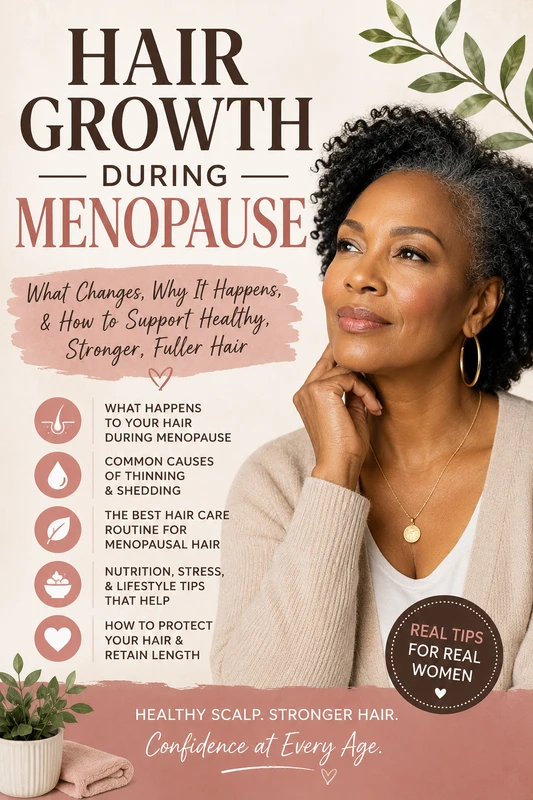
Menopause brings many changes to a woman’s body, and hair is no exception. While hot flashes, sleep changes, and shifts in mood are often discussed, changes in hair growth during menopause can be just as noticeable. Hair that once felt thick and full may begin to look thinner. The hairline may appear less dense, the part may become wider, and strands can become drier, more fragile, or more difficult to retain.
For Black women and women with natural, curly, coily, or textured hair, these changes can be especially frustrating. Textured hair already tends to require careful moisture management and gentle handling. When menopause-related hormonal changes are added to the equation, maintaining length, thickness, softness, and scalp comfort may require a different approach than it did earlier in life.
The encouraging news is that menopause does not automatically mean your hair will stop growing. Hair follicles can continue producing new strands. What may change is the speed of growth, the length of the growth phase, the diameter of individual strands, and how well you retain the hair that grows.
Understanding what is happening—and adjusting your routine accordingly—can make a major difference.
This complete guide explains hair growth during menopause, why thinning can occur, what happens to natural and Black hair during this stage of life, how to reduce unnecessary breakage, and how to build a realistic menopause hair-growth routine.
What Happens to Your Hair During Menopause?
Menopause officially occurs after a woman has gone 12 consecutive months without a menstrual period. However, hormonal changes usually begin earlier during perimenopause, which can last for several years.
One of the most important changes is a decline in estrogen and progesterone.
These hormones influence many tissues throughout the body, including the skin and hair follicles. As their levels change, some women begin noticing differences in their hair.
Common changes can include:
- Increased shedding
- Thinner-looking hair
- A wider part
- Reduced density around the hairline or crown
- Slower apparent growth
- Shorter or finer strands
- Increased dryness
- More breakage
- Changes in curl pattern or texture
- A drier or more sensitive scalp
Not every woman experiences all of these changes. Genetics, nutrition, stress, medications, medical conditions, styling habits, and overall health can influence what happens to your hair.
For some women, the changes are subtle. For others, hair thinning becomes one of the most noticeable parts of menopause.
Does Hair Still Grow During Menopause?
Yes.
Hair can absolutely continue growing during and after menopause.
Your follicles do not simply shut down because estrogen levels decline.
However, several factors can make it seem as though your hair has stopped growing.
Your hair may:
- Grow more slowly than it once did.
- Produce finer strands.
- Spend less time in the active growth phase.
- Shed more frequently.
- Break before you can retain noticeable length.
That last point is particularly important for natural and textured hair.
If your hair grows half an inch but breaks half an inch from the ends, you will see little or no increase in length.
This creates the impression that your hair has stopped growing when the real problem may be length retention.
For women going through menopause, successful hair growth therefore isn't only about stimulating the scalp.
It is also about protecting the hair you already have.
Why Can Hair Become Thinner During Menopause?
Hair thinning during menopause is usually not caused by one single factor.
Several changes may happen at the same time.
1. Declining Estrogen Levels
Estrogen plays a role in the hair-growth cycle.
During the reproductive years, higher estrogen levels may help support longer periods of active hair growth. As estrogen declines during menopause, some follicles may spend less time in the growth phase.
This can result in:
- Shorter growth cycles
- Increased shedding
- Reduced overall density
- Finer-looking hair
It doesn't necessarily mean your follicles are permanently damaged.
The environment surrounding the follicles has simply changed.
2. Hormonal Balance Changes
Although androgen levels may also change with age, declining estrogen can make androgen effects relatively more noticeable in some women.
Women who are genetically susceptible to pattern hair loss may begin noticing thinning around the:
- Crown
- Top of the scalp
- Center part
- Temples
- Frontal hairline
A widening part is one of the signs women commonly notice first.
If you experience significant or rapidly progressing thinning, consider speaking with a dermatologist or healthcare professional rather than assuming menopause is the only cause.
Hair Growth During Perimenopause
Hair changes can begin before menopause officially starts.
During perimenopause, hormone levels can fluctuate considerably.
You may notice periods when your hair seems completely normal followed by periods of:
- Increased shedding
- Dryness
- Reduced density
- Scalp changes
- Texture changes
This can make hair changes confusing.
You might wonder:
Why is my hair suddenly shedding when nothing in my routine changed?
Your routine may not have changed—but your body has.
Hormonal fluctuations can influence the hair cycle months before you notice visible differences.
That is why hair care during perimenopause may require experimentation.
A routine that worked perfectly at 35 may not work exactly the same at 45 or 50.
Your hair isn't necessarily becoming "bad."
Its needs may simply be changing.
Menopause and Black Hair
Menopause can present unique challenges for Black women because curly, coily, and kinky hair has structural characteristics that can make moisture retention and breakage prevention especially important.
Natural oils from the scalp do not always travel easily down tightly curled strands.
As a result, textured hair can naturally be more susceptible to dryness.
If menopause increases dryness or changes sebum production, the difference can become even more noticeable.
A woman may suddenly find that:
- Her old moisturizer isn't enough.
- Her ends feel rough faster.
- Her hair tangles more easily.
- Wash day creates more breakage.
- Her hairline looks thinner.
- Protective styles don't last as well.
- Her curls appear different.
- Her scalp feels tighter or drier.
This is where adjusting the routine becomes important.
Trying to force your hair to behave exactly as it did ten years earlier can lead to frustration.
Instead, focus on what your hair needs now.
Does Menopause Change Hair Texture?
It can.
Some women notice their hair becomes:
- Finer
- Coarser
- Straighter
- Curlier
- Less defined
- More frizzy
- Drier
Hormones can influence the follicle and hair-growth process, while aging itself also affects the characteristics of hair.
If you've had the same natural hair routine for decades and suddenly your products don't seem to work as well, your changing hair characteristics could be one reason.
You may need lighter products if strands have become finer.
Alternatively, increased dryness may mean your hair needs better conditioning and moisture retention.
Pay attention to how your hair responds instead of automatically adding more products.
Menopause Hair Growth vs. Hair Retention
One of the most important concepts for women with textured hair is understanding the difference between hair growth and hair retention.
Hair growth occurs at the scalp.
Hair retention is your ability to keep that new growth without losing length to breakage.
Imagine your hair grows approximately five inches during a year.
If four inches break away because of:
- Dryness
- Split ends
- Excessive heat
- Tight hairstyles
- Rough detangling
- Chemical damage
you will only see about one inch of retained length.
You may believe your hair barely grew.
In reality, it grew—but you didn't keep it.
During menopause, protecting your ends becomes especially important if your strands are becoming finer or drier.
Signs Your Hair Is Still Growing During Menopause
It isn't always easy to notice growth, especially with shrinkage.
Look for these signs:
New growth around the roots
If you color your hair, visible roots can provide an obvious indication of growth.
Increased length when stretched
Curly and coily hair may grow considerably without looking much longer because of shrinkage.
New short hairs
Small hairs around the hairline can sometimes represent new growth, although short strands can also be breakage.
Protective styles becoming looser
Braids or twists may become looser around the roots as new hair grows.
Locs showing new growth
Women with locs can often see growth clearly between retwists.
Taking monthly photographs is one of the easiest ways to track progress.
Hair changes slowly, making daily observation unreliable.
How Fast Does Hair Grow During Menopause?
There is no universal menopause hair-growth rate.
The often-cited average scalp hair growth rate is around half an inch per month, but individual growth varies considerably.
Your personal rate can be influenced by:
- Genetics
- Age
- Hormones
- Nutrition
- Overall health
- Medications
- Stress
- Hair-growth cycle
- Scalp conditions
The goal should not necessarily be forcing your hair to grow faster than your genetics allow.
Instead, concentrate on creating conditions that support normal growth while minimizing unnecessary hair loss and breakage.
The Best Hair Growth Routine During Menopause
A menopause hair routine doesn't need to contain 15 products or require hours every day.
Consistency usually matters more than complexity.
Here is a practical routine.
Step 1: Keep Your Scalp Clean
Healthy hair care begins with scalp care.
Oil, sweat, dead skin, styling products, and environmental debris can accumulate over time.
Regular shampooing helps remove buildup and maintain a clean scalp environment.
Your ideal washing frequency depends on:
- Hair type
- Activity level
- Hairstyle
- Scalp oiliness
- Product usage
- Whether you wear braids or locs
Some women do well washing weekly.
Others prefer every 7–14 days.
If your scalp is excessively itchy, flaky, sore, inflamed, or develops persistent buildup, don't simply cover the symptoms with oil. Persistent scalp problems may need professional evaluation.
Step 2: Be Gentle With Your Hairline
The hairline deserves special attention during menopause.
If your hair is already becoming finer, repeated tension can make the appearance of thinning worse.
Be careful with:
- Tight ponytails
- Tight braids
- Heavy extensions
- Tight wigs
- Excessive edge control
- Frequent slicked-back hairstyles
- Repeated pulling around the temples
Protective styles should actually protect your hair.
Pain is not a requirement for a good hairstyle.
If braids are so tight that your scalp hurts or develops bumps, the style is placing unnecessary stress on your follicles.
Step 3: Moisturize Consistently
Moisture becomes increasingly important when dealing with dry menopausal hair.
For textured hair, a simple moisture routine may include:
- Water or a water-based product
- A moisturizing leave-in
- A small amount of oil or another sealing product when appropriate
The exact combination depends on your hair.
The goal is soft, flexible strands—not hair coated with layers of heavy products.
When hair is properly moisturized, it is generally easier to manipulate and less likely to snap during styling.
Step 4: Condition After Shampooing
Conditioning is especially valuable if menopause has left your hair feeling rougher or drier.
A conditioner can help improve:
- Softness
- Slip
- Manageability
- Detangling
- Flexibility
Apply conditioner throughout the hair, paying particular attention to older sections and the ends.
These are the oldest parts of your strands and have experienced the greatest amount of manipulation.
Step 5: Deep Condition When Needed
Some women benefit from periodic deep conditioning, particularly if their hair is:
- Very dry
- Color-treated
- Heat-styled
- Chemically processed
- Frequently exposed to protective styling
Deep conditioning isn't necessarily required every day or even every wash.
Use your hair's condition as your guide.
If it feels soft and manageable, your current routine may already be sufficient.
Step 6: Reduce Excessive Heat
Heat isn't automatically harmful.
The problem is excessive temperature, repeated passes, and frequent styling without adequate protection.
Flat irons, curling irons, and high-temperature blow dryers can weaken strands over time.
For menopause-related thinning, minimizing unnecessary damage becomes even more important.
If you use heat:
- Use a heat protectant.
- Avoid extremely high temperatures.
- Limit repeated passes.
- Don't flat iron excessively.
- Give your hair breaks between heat sessions.
Keeping the strand intact is essential for maintaining length.
Step 7: Detangle Carefully
Detangling can be one of the biggest sources of breakage for curly and coily hair.
Avoid ripping through knots.
Instead:
- Divide hair into sections.
- Apply a product that provides slip.
- Start near the ends.
- Gradually work upward.
- Hold the section to reduce pulling at the roots.
- Separate stubborn knots gently.
Finger detangling can work well for some women, while others prefer a wide-tooth comb or detangling brush.
There is no universal perfect tool.
Choose the method that produces the least breakage for your hair.
Step 8: Protect Your Hair at Night
Nighttime friction can contribute to dryness and breakage.
Cotton pillowcases can create friction as your hair moves during sleep.
Consider using:
- A satin bonnet
- Satin scarf
- Satin pillowcase
You don't necessarily need all three.
The purpose is simply to reduce friction and protect your hairstyle and ends.
Women with longer natural hair or locs may also benefit from loosely securing their hair before sleeping.
Avoid extremely tight nighttime hairstyles.
Step 9: Protect Your Ends
Your ends are the oldest part of your hair.
If you have shoulder-length hair, your ends may have been exposed to years of:
- Washing
- Detangling
- Sun
- Heat
- Clothing friction
- Styling
- Product buildup
- Environmental exposure
Protect them.
Simple low-manipulation hairstyles can help reduce unnecessary handling.
Examples include:
- Loose twists
- Buns without excessive tension
- Two-strand twists
- Flat twists
- Braids without excessive tension
You don't have to hide your hair constantly.
The goal is reducing unnecessary wear and tear.
Protective Styles During Menopause
Protective styling can still be useful during menopause, but the word protective matters.
A hairstyle that places excessive tension on thinning follicles isn't protective.
Be especially cautious with heavy extensions.
As natural hair becomes finer, it may not tolerate the same amount of extension hair it tolerated years earlier.
Consider:
- Larger braids
- Lighter extensions
- Shorter styles
- Less tension
- Longer breaks between installations
Listen to your scalp.
Pain, tenderness, bumps, or persistent soreness are warning signs.
Braids and Menopause Hair Growth
Braids can reduce daily manipulation and make maintaining textured hair easier.
However, tight braids can place significant tension on the hairline.
If you're noticing thinning around your temples, avoid repeatedly braiding those areas tightly.
Ask your stylist to:
- Leave fragile edges alone.
- Reduce extension weight.
- Avoid excessive tension.
- Use larger sections around vulnerable areas.
Your edges don't have to be pulled into every braid.
Protecting the follicle is more important than making every strand look perfectly sleek.
Loc Care During Menopause
Women with locs may also notice menopause-related changes.
Locs can become:
- Drier
- Thinner at the roots
- More fragile
- More prone to weak spots
Avoid overly frequent or tight retwisting.
Repeated tension on the same areas can weaken the roots.
Keep your scalp clean, moisturize appropriately, and watch for locs that appear significantly thinner near the base.
If a loc becomes very heavy while the root becomes increasingly thin, speak with an experienced loctician about ways to reduce stress on the area.
Can Oils Help Hair Growth During Menopause?
Hair oils can be useful components of a routine, but they should be understood correctly.
Oil does not replace:
- Adequate nutrition
- Medical treatment when necessary
- Proper scalp care
- Gentle styling
- Moisture
- Healthy hair-care habits
For natural hair, oils may be useful for lubrication, sealing, scalp massage, or improving the feel of dry strands depending on the product and individual hair type.
Popular oils used in textured hair routines include:
- Castor oil
- Coconut oil
- Olive oil
- Jojoba oil
- Avocado oil
You don't need to use every oil at once.
More oil does not automatically equal more growth.
Choose products based on how your hair and scalp respond.
Does Scalp Massage Help?
Scalp massage can be a relaxing addition to your hair routine.
Using your fingertips, gently massage different areas of your scalp without scratching with your nails.
Try approximately 3–5 minutes.
The most important word is gently.
Aggressive rubbing isn't necessary.
You can massage your scalp while shampooing or as a separate part of your routine.
If your scalp is painful, inflamed, or affected by an unexplained condition, seek medical guidance before repeatedly manipulating the area.
Nutrition and Hair Growth During Menopause
Hair is part of your body.
A great hair routine cannot compensate for inadequate nutrition.
A balanced diet that provides sufficient calories, protein, vitamins, minerals, and healthy fats helps support normal body functions, including hair production.
Foods commonly included in a balanced diet include:
- Eggs
- Fish
- Chicken
- Beans
- Lentils
- Nuts
- Seeds
- Leafy vegetables
- Fruits
- Whole grains
- Avocado
- Sweet potatoes
Protein is especially important because hair is primarily composed of keratin, a protein.
Extremely restrictive diets or rapid weight loss can sometimes contribute to increased shedding.
Iron and Menopause Hair Loss
Iron status can be relevant when evaluating hair shedding.
However, you should not automatically take high-dose iron simply because your hair is thinning.
Too much iron can be harmful.
If you are experiencing unexplained shedding, a healthcare professional can determine whether testing for iron status or other nutritional factors is appropriate.
This is particularly important because hair thinning can have multiple causes.
Vitamin D and Hair Health
Vitamin D is involved in numerous processes throughout the body.
Low vitamin D levels have been investigated in relation to several forms of hair loss, but that doesn't mean everyone experiencing menopause-related thinning should automatically take large doses.
If you suspect a deficiency, discuss testing and supplementation with your healthcare provider.
Supplements are most useful when they address an actual nutritional need.
Biotin: Do You Need It?
Biotin is one of the most heavily marketed hair supplements.
True biotin deficiency is relatively uncommon.
Taking excessive amounts doesn't guarantee faster hair growth and can interfere with certain laboratory tests.
Instead of automatically reaching for high-dose hair vitamins, focus first on:
- Balanced nutrition
- Adequate protein
- Proper hair care
- Stress management
- Sleep
- Medical evaluation when thinning is significant
Hydration and Menopause Hair
Drinking enough water supports overall health, but water alone isn't a cure for hair loss.
Still, maintaining normal hydration is part of taking care of your body.
Remember that drinking water and moisturizing hair are different things.
You can drink plenty of water while still having dry natural hair.
External hair moisture usually requires appropriate conditioning and hair-care practices.
Stress and Menopause Hair Shedding
Menopause can coincide with a stressful stage of life.
Women may be managing:
- Careers
- Family responsibilities
- Aging parents
- Financial pressures
- Sleep disruption
- Relationship changes
- Physical changes
Significant physical or emotional stress can affect the hair-growth cycle and may contribute to temporary shedding in some situations.
Stress management doesn't have to mean eliminating every source of stress.
Focus on manageable habits such as:
- Regular physical activity
- Consistent sleep routines
- Relaxation
- Time outdoors
- Hobbies
- Social support
If stress or mood changes are interfering significantly with daily life, professional support may be helpful.
Sleep and Hair Growth During Menopause
Sleep problems are common during menopause.
Although sleeping eight hours won't magically produce longer hair overnight, sleep is an important part of overall health.
Develop a consistent bedtime routine when possible.
Keep your bedroom comfortable and reduce habits that interfere with quality sleep.
If hot flashes or other menopause symptoms repeatedly disrupt sleep, speak with your healthcare provider about appropriate options.
Improving menopause symptoms can benefit your overall quality of life—not just your hair routine.
Exercise and Healthy Hair
Regular physical activity supports cardiovascular health, strength, mood, sleep, and general well-being.
If you sweat heavily during exercise, pay attention to your scalp.
You may need to shampoo more frequently than someone with a less active lifestyle.
Don't allow fear of "washing away your natural oils" to keep you from cleansing a scalp that is covered in sweat and buildup.
Your wash schedule should fit your lifestyle.
Gray Hair During Menopause
Many women also notice increasing gray hair around the same period.
Gray strands can sometimes feel different from pigmented hair.
Some women describe them as:
- Coarser
- Drier
- More wiry
- More resistant to styling
Gray natural hair can be beautiful, but it may require adjustments to your moisture and styling routine.
Condition consistently and minimize unnecessary damage.
If you color your gray hair, remember that chemical processing can increase the need for careful conditioning and breakage prevention.
Menopause and Hair Breakage
Not every short strand in your sink represents hair loss from the follicle.
Sometimes you're seeing breakage.
Learning the difference is useful.
A naturally shed strand usually comes from the root and is approximately the full length of your hair.
Breakage often produces:
- Short pieces
- Uneven fragments
- Snapped ends
If you're seeing numerous tiny pieces during styling, focus on reducing mechanical damage.
Possible causes include:
- Dryness
- Rough detangling
- Excessive heat
- Tight hairstyles
- Chemical overprocessing
- Constant manipulation
Hair-growth efforts will have limited visible results if new length continually breaks away.
How Often Should You Trim During Menopause?
There is no universal trimming schedule.
You don't have to trim your hair every six weeks simply because someone told you to.
Watch your ends.
Consider trimming when you notice:
- Persistent split ends
- Excessive single-strand knots
- Rough ends
- Severe tangling
- Uneven breakage
Trimming does not make hair grow faster from the scalp.
What trimming can do is remove damaged ends and make the remaining hair easier to maintain.
That can support length retention over time.
Can Menopause Cause a Receding Hairline?
Hormonal changes may contribute to changes in hair density, but a noticeably receding hairline shouldn't automatically be blamed on menopause.
Other possibilities can include:
- Traction alopecia
- Pattern hair loss
- Certain inflammatory scalp conditions
- Medical conditions
- Medication effects
This distinction matters because some forms of hair loss can become harder to reverse when treatment is delayed.
If your hairline is rapidly receding, becoming shiny, developing smooth bald areas, or showing other significant changes, consider seeing a dermatologist.
When Should You See a Doctor About Menopause Hair Loss?
Some gradual thinning can occur with age and hormonal changes.
However, seek professional evaluation when you experience:
- Sudden heavy shedding
- Bald patches
- Rapidly widening part
- Significant recession
- Scalp pain
- Burning
- Severe itching
- Redness
- Scaling
- Scarring
- Hair loss accompanied by other unexplained symptoms
A healthcare professional may consider whether factors such as thyroid function, nutritional deficiencies, medications, hormonal changes, autoimmune conditions, or specific types of alopecia could be involved.
Don't assume every case of hair loss after age 40 is simply "menopause."
Common Menopause Hair Growth Mistakes
Sometimes improving your routine means stopping habits that work against your goals.
Mistake #1: Using More Oil Instead of More Moisture
Oil and water are not the same.
If your hair is extremely dry, covering it in additional oil may simply leave you with oily, dry hair.
Use conditioning and water-based moisture appropriately.
Mistake #2: Wearing Tight Protective Styles Continuously
Your scalp needs relief from constant tension.
Rotate hairstyles and give fragile areas a break.
Mistake #3: Ignoring the Scalp
Healthy-looking strands don't compensate for a scalp that is chronically inflamed, painful, or covered in buildup.
Pay attention to your scalp.
Mistake #4: Assuming Every Hair Vitamin Works
Supplements are not automatically harmless or necessary.
Identify the underlying problem first.
Mistake #5: Comparing Your Hair to Your 25-Year-Old Hair
Hair changes throughout life.
Instead of trying to recreate exactly what you had decades ago, create the healthiest version of the hair you have today.
Mistake #6: Changing Products Every Week
Hair growth requires patience.
Constantly changing your entire routine makes it difficult to determine what actually works.
Give a reasonable routine time to work unless a product is causing irritation or obvious problems.
Mistake #7: Expecting Overnight Results
Hair grows slowly.
A product used for seven days cannot reasonably produce six months of visible length.
Track your progress over months rather than days.
A Simple Weekly Menopause Hair Routine
You don't need a complicated schedule.
Wash Day
Step 1: Shampoo your scalp thoroughly.
Step 2: Condition your hair.
Step 3: Detangle gently in sections.
Step 4: Apply a leave-in or moisturizer appropriate for your hair.
Step 5: Style with minimal tension.
During the Week
Monitor moisture levels.
Refresh dry sections as needed rather than automatically piling product onto your entire head every day.
At Night
Protect your hair with satin or another low-friction material.
Monthly
Take pictures of:
- Front
- Left side
- Right side
- Crown
- Back
Use similar lighting and angles each month.
This provides a much better measurement of progress than checking the mirror every morning.
90-Day Menopause Hair Growth Plan
If you're trying to improve your routine, commit to consistency for approximately three months.
Month 1: Reset
Focus on:
- Consistent scalp cleansing
- Gentle detangling
- Moisture
- Reduced tension
- Less heat
- Nighttime protection
Take baseline photographs.
Month 2: Protect
Pay attention to breakage.
Ask:
- Are my ends snapping?
- Is my hairline under tension?
- Is my scalp comfortable?
- Does my hair stay moisturized?
- Am I manipulating my hair too frequently?
Make small adjustments rather than replacing your entire routine.
Month 3: Evaluate
Compare your photographs.
Look for:
- New growth
- Improved retention
- Reduced breakage
- Better moisture
- Improved scalp condition
- Changes in density
If shedding or thinning continues to worsen despite good hair-care practices, consider professional evaluation.
Hair Growth After Menopause
Hair growth doesn't end when menopause ends.
Women can maintain healthy natural hair well into their 50s, 60s, 70s, and beyond.
Your goals may simply evolve.
Instead of chasing unrealistic growth promises, focus on:
- Healthy scalp habits
- Moisture
- Strength
- Gentle handling
- Length retention
- Appropriate nutrition
- Early attention to unusual hair loss
Healthy hair doesn't have an age limit.
Can You Grow Long Natural Hair After Menopause?
Yes.
Age alone does not prevent a woman from growing long hair.
However, maximum length depends on multiple factors, including:
- Genetics
- Growth cycle
- Breakage
- Styling practices
- Hair health
- Overall health
For natural hair, length retention often becomes the key.
If you can protect your ends and minimize breakage, you give your hair a better opportunity to retain the length it produces.
Best Hairstyles for Menopause Hair
The best hairstyle is one that works with your current density and minimizes unnecessary stress.
Consider:
- Two-strand twists
- Loose buns
- Flat twists
- Low-tension braids
- Natural curls
- Wash-and-go styles when appropriate
- Short natural cuts
- Locs
- Low-manipulation styles
If your hair has become finer, lighter styles may be preferable to extremely heavy extensions.
The goal isn't to avoid styling.
It's to avoid sacrificing your follicles for a hairstyle.
What If Your Edges Are Thinning?
Thinning edges are common concerns among women with textured hair.
Start by removing avoidable tension.
Reduce:
- Tight braids
- Tight ponytails
- Wig adhesive stress
- Heavy extensions
- Excessive brushing
- Constant edge-control manipulation
Then monitor the area.
If thinning continues, seek professional evaluation.
Early intervention is particularly important with certain types of hair loss.
Menopause Hair Growth FAQ
Does menopause stop hair growth?
No. Hair can continue growing during and after menopause, although hormonal and age-related changes may affect density, strand diameter, growth cycles, shedding, and retention.
Why is my hair getting thinner at 50?
Hormonal changes, genetics, aging, nutrition, medical conditions, medications, stress, and styling practices can all contribute. A healthcare professional can help evaluate significant thinning.
Can hair become thick again after menopause?
The answer depends on why the hair became thinner. Some causes may improve when the underlying issue is addressed, while others may require ongoing treatment. Early diagnosis can be important.
Should I oil my scalp every day?
Not necessarily. Daily oiling isn't required for hair growth and can contribute to buildup for some people. Base your routine on your scalp and hair's actual needs.
How can Black women protect menopausal hair?
Prioritize moisture, gentle detangling, low-tension styling, scalp cleansing, nighttime protection, minimal unnecessary heat, and reduced manipulation.
Can I still wear braids after menopause?
Yes, but avoid excessive tension and heavy extensions, particularly if your hairline or crown is already thinning.
Should I take vitamins for menopausal hair loss?
Don't automatically take high-dose supplements. If you suspect a deficiency, speak with a healthcare professional about appropriate testing and supplementation.
Can stress make menopause shedding worse?
Significant physical or emotional stress can affect the hair-growth cycle in some people. Managing stress and addressing persistent health concerns can be useful components of an overall hair-health strategy.
How long should I wait before expecting hair-growth results?
Think in months rather than days. Because hair grows gradually, photographs taken every four weeks are more useful than daily comparisons.
10 Rules for Growing and Retaining Hair During Menopause
- Keep your scalp clean. Don't allow excessive buildup to become your normal.
- Reduce tension. Protect your edges and vulnerable areas.
- Moisturize consistently. Dry hair breaks more easily.
- Condition your hair. Make detangling easier and reduce unnecessary friction.
- Handle your hair gently. Every styling session matters.
- Protect your hair at night. Reduce friction while sleeping.
- Limit unnecessary heat. Protect the integrity of your strands.
- Eat a balanced diet. Hair health begins inside the body as well as outside.
- Track your progress. Monthly photographs reveal changes that daily mirror checks miss.
- Don't ignore significant hair loss. Early professional evaluation can matter.
Building Confidence With Menopause Hair
Hair changes can be emotional.
For many women, hair is connected to identity, beauty, culture, confidence, and personal expression.
Seeing your hair become thinner or behave differently can therefore feel like more than a cosmetic change.
But menopause can also be an opportunity to rethink your relationship with your hair.
Perhaps your new routine is simpler.
Perhaps you stop wearing styles that constantly pull your edges.
Perhaps you embrace your gray strands.
Perhaps you cut your hair and start over.
Or perhaps your goal is growing your natural hair longer than ever.
There isn't one correct menopause hairstyle.
The goal should be healthy hair practices that work for your current hair and scalp.
Final Thoughts: Hair Growth During Menopause Is Possible
Menopause may change your hair, but it doesn't mean your healthy-hair journey is over.
Hormonal changes can influence hair density, shedding, dryness, texture, and the hair-growth cycle. At the same time, everyday habits such as tight styling, excessive heat, rough detangling, inadequate conditioning, and poor length retention can make menopausal hair appear even thinner.
The best approach combines healthy scalp care, consistent moisture, gentle handling, low-tension styling, balanced nutrition, and realistic expectations.
For Black women and women with natural, curly, coily, braided, or loc'd hair, protecting the strands you already have is especially important. Every inch you prevent from breaking is an inch you have a better chance of retaining.
Pay attention to what your hair is telling you.
Cleanse your scalp consistently. Moisturize your strands. Protect your ends. Avoid hairstyles that hurt. Reduce unnecessary manipulation. Track your progress over several months rather than several days.
And remember: significant or sudden hair loss should not automatically be dismissed as a normal part of menopause. A dermatologist or healthcare professional can help determine whether another condition may be contributing.
Your hair may not behave exactly the way it did in your 20s or 30s—and that's okay.
With the right routine, patience, and attention to your changing needs, it is still possible to work toward stronger, healthier, fuller-looking natural hair during menopause and beyond.