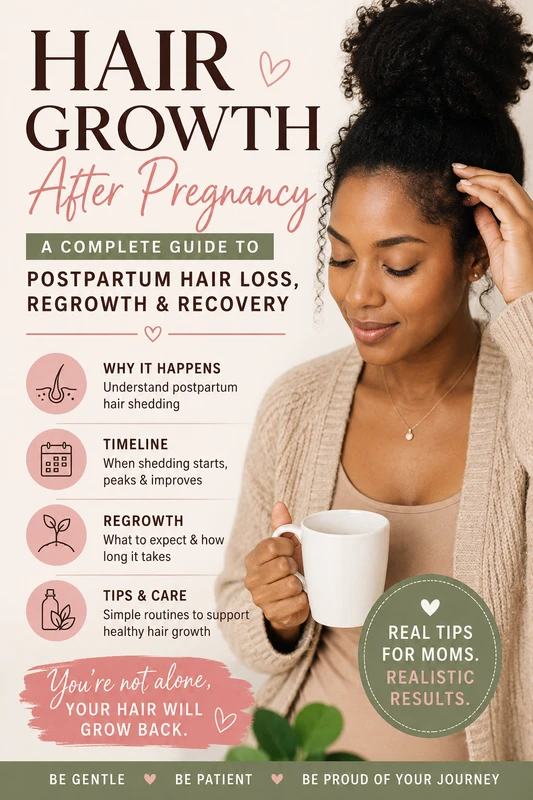
Pregnancy can bring dramatic changes to your hair. For some women, pregnancy means thicker, fuller-looking strands and less shedding than usual. Then, a few months after giving birth, everything seems to change. Suddenly there may be hair in the shower, on your pillow, around the bathroom sink, and wrapped around your fingers after styling.
If you're experiencing hair loss or excessive shedding after pregnancy, you're far from alone. Postpartum hair shedding is extremely common and is usually related to the hormonal changes that occur during and after pregnancy.
The good news is that postpartum shedding is typically temporary. Your hair follicles generally aren't permanently damaged. Instead, many hairs that remained in the growing phase during pregnancy enter the shedding phase around the same time after delivery.
Understanding what's happening can make postpartum hair changes much less alarming.
In this complete guide, we'll discuss hair growth after pregnancy, why postpartum shedding happens, how long it can last, what a realistic postpartum hair growth timeline looks like, and practical ways to protect your hair while your normal growth cycle returns.
What Happens to Your Hair During Pregnancy?
Your hair is constantly moving through a natural growth cycle.
The major phases include:
Anagen — The Growing Phase
Anagen is the active growth phase. Hair follicles produce new hair, and strands gradually become longer.
A large percentage of scalp hairs are normally in this phase at any given time.
Catagen — The Transition Phase
Catagen is a short transitional period during which active growth slows and the follicle prepares for its resting stage.
Telogen — The Resting Phase
During telogen, the strand remains in the follicle but is no longer actively growing.
Eventually, the hair is released and sheds as the follicle prepares to begin another cycle.
During pregnancy, hormonal changes can alter this normal rhythm. Higher estrogen levels are associated with more hairs remaining in the growing phase for longer.
This is why many pregnant women notice that their hair appears:
- Fuller
- Thicker
- Longer
- Less prone to shedding
- More voluminous
The individual strands haven't necessarily become dramatically thicker. Instead, fewer hairs may be shedding each day, which creates the appearance of increased density.
After childbirth, hormone levels begin shifting toward their pre-pregnancy state.
Many of the hairs that remained in the growing phase then move toward the resting and shedding phases.
The result can be a noticeable increase in hair shedding.
What Is Postpartum Hair Loss?
The commonly used term postpartum hair loss is slightly misleading.
In many cases, what you're experiencing is excessive temporary shedding rather than permanent hair loss.
The medical term commonly associated with this type of shedding is telogen effluvium.
A larger-than-usual number of follicles enter the resting phase around the same time. Several weeks or months later, those hairs shed.
Because hundreds or even thousands of follicles may be affected, the amount of hair coming out can look dramatic.
You might notice shedding:
- While shampooing
- While detangling
- On your pillow
- Around your clothing
- In your brush
- On your bathroom floor
- Around your hairline
- Near your temples
For women with long, curly, coily, or tightly textured hair, shedding may appear especially dramatic because loose hairs can remain trapped within the hairstyle instead of falling away immediately.
When wash day finally arrives, several days' worth of shed hair may come out at once.
That doesn't automatically mean your follicles are permanently losing hair.
When Does Postpartum Hair Loss Start?
Postpartum shedding doesn't always begin immediately after delivery.
Many women continue enjoying relatively full pregnancy hair for several weeks.
Noticeable shedding often begins approximately two to four months after giving birth, although everyone's timeline is different.
This delay occurs because hair doesn't immediately fall out when it enters the resting phase.
The follicle progresses through its cycle before the strand is eventually released.
That's why you may suddenly notice heavy shedding months after your baby arrives.
When Is Postpartum Hair Loss the Worst?
Postpartum shedding often becomes most noticeable several months after childbirth.
For some women, the peak occurs around the third or fourth month. Others may notice their heaviest shedding somewhat later.
You may feel like your hair suddenly changed overnight.
Common signs include:
- A thinner-looking ponytail
- Less density around the temples
- Increased scalp visibility
- Hair coming out during detangling
- Large amounts of hair during wash day
- Shorter-looking or thinner edges
Hairline changes can be particularly noticeable because the temples naturally contain finer hairs.
When these areas shed, the contrast can look significant.
Does Hair Grow Back After Pregnancy?
In most cases of ordinary postpartum shedding, yes, the hair grows back.
The follicles remain capable of producing new strands.
Once the hormonal transition settles and the follicles begin returning to their regular growth patterns, new hairs can emerge.
However, regrowth isn't instant.
Hair grows slowly.
Average scalp hair growth is often estimated at roughly half an inch per month, although individual growth rates vary.
This means a new hair that has grown for six months may only be a few inches long.
You may therefore have new growth long before your overall hairstyle looks completely restored.
Postpartum Hair Growth Timeline
Every woman's experience is different, but understanding a general timeline can help set realistic expectations.
0–2 Months Postpartum
Your hair may still look similar to how it looked during pregnancy.
You might experience relatively little shedding.
Hormone levels, however, are already changing.
The hair cycle is beginning to adjust.
2–4 Months Postpartum
This is when many women first notice increased shedding.
You may see significantly more hair during shampooing and detangling.
Your temples may begin looking thinner.
Try not to judge your future hair density based solely on this period.
Your follicles are still adjusting.
4–6 Months Postpartum
Shedding may become especially noticeable during this stage.
At the same time, some follicles may already be producing new strands.
Look closely around the hairline and you may begin seeing small, short hairs.
These can be early signs of regrowth.
6–9 Months Postpartum
For many women, shedding gradually becomes less intense.
New hairs become easier to see.
You might notice short strands sticking up around your:
- Hairline
- Temples
- Crown
- Part
These hairs can sometimes be mistaken for breakage.
The difference isn't always obvious, but regrowth frequently has a tapered end, while broken hairs can appear blunt or damaged.
9–12 Months Postpartum
Hair density may continue improving.
New strands become longer, which can make the hair appear progressively fuller.
Many women see substantial improvement by their baby's first birthday.
However, complete cosmetic recovery can take longer because the new hairs still need time to gain length.
Why Postpartum Hair Growth Can Feel So Slow
Imagine losing a 15-inch strand and replacing it with a brand-new hair emerging from your scalp.
The follicle may be functioning perfectly.
But the replacement strand still has to grow from almost zero inches.
If your hair grows approximately half an inch per month, gaining six inches of new length can take around a year.
This explains why postpartum recovery can feel frustratingly slow even when healthy regrowth is happening.
The process involves two separate goals:
Regrowing the hair from the follicle and retaining the new length once it appears.
Both matter.
Postpartum Hair Growth for Black Women
Postpartum shedding affects women across hair textures, but it can create some unique concerns for Black women and women with tightly textured natural hair.
Curly and coily strands have bends throughout the hair shaft.
Those bends contribute to beautiful texture, but they can also make the strand more vulnerable to mechanical breakage, especially when hair is dry or manipulated aggressively.
This creates two different issues that may happen simultaneously:
Shedding from the root and breakage along the hair shaft.
If you're experiencing postpartum shedding while also dealing with breakage, your hair can appear to lose density and length more quickly.
This makes gentle postpartum natural hair care especially important.
Postpartum Shedding vs. Hair Breakage
Understanding the difference between shedding and breakage can help you improve your hair routine.
Shedding
A shed hair generally comes from the follicle.
You may notice a tiny bulb-like structure at one end of the strand.
The hair may also be close to your normal overall length.
Breakage
Broken hair snaps somewhere along the shaft.
You may notice:
- Short pieces
- Uneven lengths
- Split ends
- Rough ends
- Excessive tangling
- Hair snapping during manipulation
You can experience both at the same time.
Postpartum hormonal changes may contribute to shedding, while dryness, tight hairstyles, heat, friction, or rough detangling can contribute to breakage.
The goal of a good postpartum routine is therefore not only to support normal growth but also to protect the hair you already have.
How to Support Healthy Hair Growth After Pregnancy
There isn't a magic product that can instantly reverse normal postpartum shedding.
However, there are several things you can do to create better conditions for healthy hair and reduce unnecessary breakage.
1. Keep Your Scalp Clean
Healthy hair begins with good scalp care.
During the postpartum period, maintaining a consistent cleansing routine can be difficult. Caring for a newborn often means your own routines get pushed aside.
But repeatedly going extremely long periods without cleansing can allow sweat, oil, dead skin, and product residue to accumulate.
Wash your scalp according to your individual needs.
Your routine might be weekly, every 7–10 days, or another schedule that works for your scalp and hairstyle.
Focus shampoo primarily on your scalp.
Use your fingertips rather than aggressively scratching with your nails.
2. Be Extremely Gentle With Your Edges
The hairline can become one of the most visibly affected areas during postpartum shedding.
Avoid adding unnecessary tension.
Be cautious with:
- Tight ponytails
- Tight buns
- Heavy braids
- Small tight braids around the edges
- Tight wigs
- Strong wig adhesives
- Repeated edge brushing
- Tight headbands
Your edges don't need aggressive styling every day.
Sometimes the best thing you can do is leave them alone.
3. Reduce Manipulation
New motherhood often means less time for complicated hair routines anyway.
Fortunately, simple routines can be beneficial.
Repeated combing, brushing, restyling, and pulling can increase mechanical stress.
Try hairstyles that allow your hair to remain relatively undisturbed for several days while still keeping the scalp accessible.
Options can include:
- Loose twists
- Two-strand twists
- Loose buns
- Low-tension braids
- Simple natural styles
Protective doesn't automatically mean tight.
A hairstyle should never require pain to be effective.
4. Moisturize Your Hair Consistently
Dry hair is more likely to break.
This is especially important for curly, coily, and kinky textures.
Your routine might include:
- Water or a water-based moisturizing product
- A leave-in treatment
- An appropriate cream or oil depending on your hair's needs
You don't necessarily need a dozen products.
Consistency matters more than creating an overly complicated routine.
Pay special attention to your ends because they're the oldest part of your hair.
5. Detangle Carefully
Aggressive detangling can turn temporary shedding into unnecessary breakage.
Work in sections.
Apply enough moisture or conditioner to provide slip.
Start near the ends and gradually work toward the roots.
Use your fingers or an appropriate detangling tool.
Don't rip through knots.
If you encounter a difficult tangle, stop and gently separate the strands rather than repeatedly pulling.
How Often Should You Wash Postpartum Hair?
There isn't one universal postpartum wash schedule.
Your ideal schedule depends on:
- Scalp oil production
- Hair texture
- Product usage
- Exercise
- Protective hairstyles
- Dandruff or scalp concerns
- Personal preference
For many women with natural hair, washing approximately every 7–10 days may be manageable.
Others need more frequent cleansing.
The key is not allowing fear of shedding to prevent you from washing your hair.
You may notice a lot of shed hair during shampooing, but washing isn't necessarily causing the underlying postpartum shedding.
The loose hairs were often already ready to leave the follicle.
Should You Avoid Washing Because Hair Is Falling Out?
No.
It's understandable to become nervous when you see large amounts of hair during wash day.
But avoiding shampoo for weeks doesn't stop hairs that have already entered the shedding process.
Instead, loose hairs may remain trapped among your curls.
When you finally detangle, you'll see a larger collection of accumulated shed strands.
Continue maintaining a clean scalp while handling your hair gently.
Scalp Massage After Pregnancy
Gentle scalp massage can be a relaxing addition to your postpartum routine.
Using the pads of your fingertips, massage the scalp gently for several minutes.
Avoid scratching.
You don't need to massage aggressively.
A simple massage routine can also give you an opportunity to examine your scalp for irritation, unusual patches, or changes that might warrant professional attention.
If you're using oils, remember that more isn't necessarily better.
Heavy oil buildup can make cleansing more difficult.
Best Oils for Postpartum Hair Care
Hair oils can help lubricate the hair shaft and reduce friction, but oils should not be viewed as a guaranteed treatment for postpartum shedding.
Different oils have different cosmetic properties.
Popular choices for textured hair include:
Coconut Oil
Coconut oil is commonly used in natural hair routines and can help reduce protein loss from the hair shaft in certain circumstances.
Jojoba Oil
Jojoba oil is lightweight and often used as a scalp or hair oil.
Olive Oil
Olive oil is a heavier oil that some women prefer for dry strands.
Castor Oil
Castor oil is popular within natural hair communities, particularly around edges and protective styles.
However, claims that castor oil dramatically accelerates the biological rate of hair growth shouldn't be confused with established evidence.
Oils are most useful as part of an overall hair-care routine that focuses on reducing dryness, friction, and breakage.
Nutrition and Hair Growth After Pregnancy
Your body has significant nutritional demands during pregnancy and postpartum recovery.
Hair follicles also require nutrients to function normally.
Rather than searching for one "miracle hair food," focus on an overall balanced diet.
Important nutrients involved in normal hair biology include:
- Protein
- Iron
- Zinc
- Vitamin D
- B vitamins
- Essential fatty acids
Food sources can include eggs, fish, beans, lentils, leafy vegetables, nuts, seeds, poultry, whole grains, fruits, and vegetables.
Individual nutritional needs vary, particularly during breastfeeding.
Before starting supplements specifically for hair growth, discuss them with your healthcare provider.
More isn't automatically better, and excessive amounts of certain vitamins or minerals can cause problems.
Protein and Postpartum Hair Growth
Hair is largely composed of a protein called keratin.
Your body therefore needs adequate dietary protein to support normal tissue and hair production.
Protein-rich foods include:
- Eggs
- Chicken
- Turkey
- Fish
- Greek yogurt
- Beans
- Lentils
- Tofu
- Nuts and seeds
You don't need an extreme high-protein diet.
The goal is simply to meet your nutritional needs consistently.
Iron and Postpartum Hair Changes
Iron deserves special attention because pregnancy and childbirth can affect iron levels.
Iron deficiency can also be associated with hair shedding.
If postpartum shedding seems unusually severe, continues longer than expected, or occurs alongside symptoms such as significant fatigue, weakness, dizziness, or shortness of breath, speak with a healthcare professional.
Don't automatically assume every case of postpartum hair loss is hormonal.
A clinician may decide whether blood testing or additional evaluation is appropriate.
Can Breastfeeding Cause Hair Loss?
Breastfeeding and postpartum hair changes happen during the same general period, which can make it easy to assume breastfeeding is directly causing your hair to fall out.
The relationship is more complicated.
Postpartum hormonal changes are a major contributor to the typical shedding pattern.
Breastfeeding can also influence hormonal patterns and nutritional requirements, but stopping breastfeeding solely because you're experiencing normal postpartum shedding isn't generally the answer.
If you're concerned about your hair, nutrition, medications, or supplements while breastfeeding, talk with your healthcare provider.
Postpartum Hair Growth Around the Edges
One of the most common complaints after pregnancy is thinning around the temples and edges.
Because the hairline frames your face, even moderate shedding can feel dramatic.
As regrowth begins, you may notice tiny hairs around the perimeter.
Protect them.
Avoid repeatedly:
- Brushing them aggressively
- Applying heavy tension
- Pulling them into ponytails
- Using excessive gel
- Reapplying strong adhesives
- Installing tight braids
New hairs are short and can be delicate.
Give them time to mature.
Are Those Baby Hairs or New Growth?
Those short strands appearing several months postpartum may actually be regrowth.
Look at where they're coming from.
If numerous short hairs are emerging directly from your scalp—particularly in areas that recently became thinner—they may be new growth.
If you see random short pieces throughout your hair accompanied by split ends, dryness, or snapping, breakage may be contributing.
Sometimes both are happening simultaneously.
Protective Hairstyles After Pregnancy
Protective styles can make postpartum hair care easier, but they must actually protect your hair.
A style isn't protective simply because the ends are tucked away.
Avoid styles that create excessive tension.
Good options may include:
- Medium-sized twists
- Loose braids
- Low-tension cornrows
- Loose buns
- Wigs installed without excessive tension
- Simple tucked styles
Pay attention to how the style feels.
Pain, bumps, headaches, or excessive pulling are warning signs that a style may be too tight.
Should You Get Braids During Postpartum Shedding?
You can wear braids, but be careful.
Postpartum hairlines may already appear thinner.
Adding excessive tension can worsen the appearance of thinning and potentially contribute to traction-related hair loss.
Ask your stylist to avoid gripping the hairline tightly.
Consider larger sections and lighter extensions.
Your hairstyle shouldn't hurt.
Should You Wear Wigs After Pregnancy?
Wigs can be convenient during postpartum shedding, especially if you're uncomfortable with temporary changes in density.
But your natural hair underneath still requires care.
Keep your scalp clean.
Moisturize your hair as needed.
Avoid extremely tight wig caps and repeated tension around your hairline.
If you're using adhesives, pay particular attention to your edges.
A wig can be a protective styling option when worn carefully, but poor installation practices can create additional hairline stress.
Postpartum Natural Hair Routine
A postpartum routine doesn't need to take hours.
New parents have enough responsibilities already.
Try keeping it simple.
Wash Day
Cleanse your scalp thoroughly but gently.
Follow with conditioner.
Detangle in sections.
Apply a moisturizing leave-in product.
Style your hair in a low-manipulation hairstyle.
During the Week
Monitor moisture.
Refresh dry areas as necessary.
Avoid unnecessary daily combing.
At Night
Cover your hair with satin or silk or sleep on a smooth pillowcase.
Keep styles loose enough that your hairline isn't under constant tension.
This simple approach can dramatically reduce the amount of unnecessary manipulation your strands experience.
Why Nighttime Hair Protection Matters
Cotton pillowcases can create friction against textured hair.
That friction may contribute to tangling, dryness, and breakage.
A satin bonnet, scarf, or pillowcase creates a smoother surface.
This won't stop hormonally driven postpartum shedding.
However, it can help protect the strands that remain and support better length retention.
That's an important distinction.
You can't control every hair that naturally sheds, but you can reduce avoidable breakage.
Should You Cut Your Hair After Pregnancy?
You don't have to cut your hair because of postpartum shedding.
However, some women choose to trim or cut their hair because shorter styles can make differences in density less noticeable and easier to manage.
A trim may also help remove damaged or split ends.
Whether you cut your hair is ultimately a personal choice.
Cutting the ends doesn't make hair grow faster from the scalp.
Hair growth occurs within the follicle.
But healthier ends can reduce tangling and breakage, helping you retain more of the length you grow.
How to Retain Length During Postpartum Regrowth
Length retention is one of the most overlooked parts of growing longer hair.
Imagine your scalp produces six inches of new hair during a year.
If your ends break off at nearly the same rate, you may see little change in overall length.
For better retention:
- Moisturize consistently
- Avoid excessive heat
- Limit harsh chemical processing
- Detangle carefully
- Protect your ends
- Avoid tight hairstyles
- Trim damaged ends when needed
- Reduce unnecessary manipulation
The goal isn't to prevent every single broken strand.
Some wear and tear is inevitable.
The goal is to reduce excessive breakage.
Heat Styling and Postpartum Hair
If your hair is already fragile, frequent high-temperature styling may increase the risk of breakage.
You don't necessarily have to eliminate heat permanently.
Instead, consider reducing frequency and temperature.
Always use an appropriate heat protectant.
Avoid repeatedly passing a flat iron over the same section.
And remember that straightening can make temporary postpartum thinning more visually noticeable because the hair loses some of the volume created by curls.
Chemical Treatments After Pregnancy
Relaxers, permanent color, bleach, and other chemical processes alter the hair shaft.
If you're experiencing heavy shedding and increased breakage, you may want to simplify your routine temporarily.
Your scalp may also feel different postpartum.
If you have irritation, unusual sensitivity, sores, or other scalp problems, consult a healthcare professional before applying potentially irritating chemical treatments.
Stress, Sleep, and Postpartum Hair
Telling a new parent to "just get more sleep" isn't particularly useful.
Newborn schedules can make uninterrupted sleep difficult.
Still, physical and emotional stress can affect the body in numerous ways.
Focus on what is realistically within your control:
Eat regularly.
Drink enough fluids.
Accept help when it's available.
Rest when circumstances allow.
Keep your hair routine simple.
And don't create additional anxiety by counting every strand you lose.
Postpartum recovery involves your entire body, not just your hair.
What Not to Do During Postpartum Hair Loss
When hair starts shedding heavily, it's natural to panic and start experimenting with every hair-growth technique you can find.
That can sometimes make things worse.
Avoid:
Constantly Changing Products
Using a new product every few days makes it difficult to understand what your hair actually likes.
Aggressive Scalp Scrubbing
More stimulation isn't necessarily better.
Extremely Tight Protective Styles
Tension can create additional hair loss.
Excessive Edge Styling
Give your hairline time to recover.
Avoiding Shampoo Completely
A clean scalp remains important.
Overloading Your Hair With Oil
Oil can help lubricate strands, but excessive buildup isn't a shortcut to faster growth.
Taking Random Supplements
Speak with a healthcare professional before adding supplements, especially during breastfeeding.
Can Postpartum Hair Grow Back Thicker?
Once the postpartum shedding cycle resolves, your hair can gradually move back toward its usual pre-pregnancy density.
However, remember that pregnancy itself may have temporarily made your hair appear unusually thick because fewer strands were shedding.
Your goal shouldn't necessarily be to permanently maintain pregnancy-level density.
Instead, look for a return toward your normal baseline.
Hair texture and density can also change somewhat over time because of hormones, aging, styling practices, genetics, and other factors.
How Long Does It Take Hair to Grow Back After Pregnancy?
Many women begin noticing visible regrowth within several months.
But restoring the appearance of your previous length can take much longer.
Consider this example.
Suppose your hairline begins regrowing three months after shedding peaks.
Six months later, those new hairs might only be several inches long.
They may stick up or refuse to blend with the rest of your hairstyle.
That's actually a positive sign.
Those annoying little hairs may represent progress.
By 12–18 months, they can become significantly easier to incorporate into hairstyles.
When Should You Be Concerned About Postpartum Hair Loss?
Typical postpartum shedding should gradually improve.
However, not every type of hair loss after pregnancy is automatically normal postpartum shedding.
Consider speaking with your doctor or a dermatologist if you notice:
- Clearly defined bald patches
- Scalp pain
- Significant itching or inflammation
- Scarring
- Persistent heavy shedding well beyond the expected postpartum period
- Hair loss that continues worsening
- Significant widening of your part
- No obvious signs of recovery over time
- Other concerning physical symptoms
Conditions involving thyroid function, nutritional deficiencies, autoimmune disease, scalp disorders, genetic hair loss, or other medical factors can sometimes occur during the postpartum period.
A healthcare professional can help determine what's happening.
When Should You See a Dermatologist?
If your hair isn't beginning to recover or the pattern doesn't resemble typical diffuse postpartum shedding, a dermatologist can examine your scalp and hair follicles.
They may ask about:
- Pregnancy and delivery timeline
- Medications
- Diet
- Family history
- Menstrual changes
- Hair-care practices
- Recent illnesses
- Stress
- Chemical treatments
- Hairstyle tension
Depending on your symptoms, further testing may be recommended.
Early evaluation is particularly important if you notice smooth bald patches, scalp scarring, persistent inflammation, or progressive hairline loss.
A Simple 30-Day Postpartum Hair Care Plan
You don't need an elaborate routine.
Try this straightforward approach.
Week 1
Evaluate your current routine.
Remove any hairstyle that feels tight.
Wash and condition your hair.
Detangle carefully.
Choose a low-manipulation style.
Week 2
Focus on moisture.
Pay attention to your ends and hairline.
Reduce daily manipulation.
Protect your hair at night.
Week 3
Cleanse again according to your normal schedule.
Check your scalp.
Look for excessive buildup, irritation, or unusual areas of thinning.
Continue gentle styling.
Week 4
Evaluate your progress based on hair condition rather than daily shedding counts.
Ask:
Is my scalp comfortable?
Is my hair staying moisturized?
Am I experiencing less breakage?
Are my hairstyles low tension?
Am I seeing tiny new hairs around previously thin areas?
Continue the habits that are working.
Postpartum Hair Growth Routine for Busy Moms
Your routine can be incredibly simple:
Cleanse → Condition → Moisturize → Protect → Repeat.
That's enough for many women.
You don't need a 15-step routine.
You don't need to style your hair every morning.
You don't need to apply oil every two hours.
And you don't need to buy every product marketed for hair growth.
Focus on scalp health, gentle handling, moisture, low tension, nutrition, and patience.
Frequently Asked Questions About Hair Growth After Pregnancy
Does postpartum hair loss happen after every pregnancy?
Not necessarily.
A woman may experience significant shedding after one pregnancy and relatively little after another.
Hormonal changes and individual hair cycles vary.
Can postpartum hair loss start six months after birth?
It can. Timelines aren't identical for everyone.
However, if significant shedding begins much later or continues for an extended period, consider discussing it with a healthcare professional to rule out other causes.
Can postpartum hair loss cause bald spots?
Typical postpartum shedding usually causes diffuse thinning rather than isolated completely bald patches.
Distinct bald patches deserve medical evaluation.
Does cutting your hair stop postpartum shedding?
No.
Cutting the hair changes the length of the strands but doesn't stop the follicle's shedding cycle.
Does shaving your head make postpartum hair grow back thicker?
No.
Shaving doesn't change the number of follicles or biologically increase the thickness of new hair.
Can you prevent postpartum hair loss?
There isn't a guaranteed way to completely prevent hormonally driven postpartum shedding.
The better goal is protecting your remaining hair from unnecessary breakage while the normal growth cycle recovers.
Will my edges grow back after pregnancy?
When thinning is caused by normal postpartum shedding and the follicles remain healthy, regrowth commonly occurs.
Avoid adding tension while the area recovers.
How fast does postpartum hair grow?
Once follicles re-enter the growing phase, scalp hair generally grows at its normal biological rate. Approximately half an inch per month is often used as a general average, but individual growth rates vary.
Should I take biotin after pregnancy?
Don't automatically start high-dose biotin or other supplements specifically for hair loss.
Talk with your healthcare provider first, particularly if you're breastfeeding or taking medications.
Is postpartum hair loss permanent?
Typical postpartum shedding is generally temporary.
Persistent or unusual hair loss should be evaluated because other conditions can sometimes resemble postpartum shedding.
10 Postpartum Hair Growth Tips to Remember
- Don't panic when shedding begins. Temporary postpartum shedding is common.
- Keep your scalp clean. Don't stop washing because you're afraid of seeing shed hair.
- Protect your edges. Avoid excessive pulling and repeated styling.
- Moisturize textured hair consistently. Dryness can contribute to breakage.
- Detangle gently. Work from the ends upward.
- Use low-tension hairstyles. Protective styles shouldn't hurt.
- Eat a balanced diet. Hair growth depends on overall nutrition.
- Protect your hair while sleeping. Satin or silk can reduce friction.
- Be patient with new growth. Short postpartum hairs need time to gain length.
- Seek professional advice when something seems abnormal. Not every case of hair loss after pregnancy is caused by postpartum hormones.
The Biggest Postpartum Hair Growth Mistake
One of the biggest mistakes is assuming that because you're shedding, your hair has stopped growing.
Shedding and growth can happen simultaneously.
While older strands are falling out, other follicles may already be entering a new growing phase.
You simply can't see all of that activity immediately.
Hair growth is slow and occurs beneath the surface before the results become visually obvious.
That's why consistency matters.
Focus on Hair Retention, Not Just Faster Growth
People searching for postpartum hair-growth solutions often focus exclusively on making hair grow faster.
But growth is only half the equation.
Growth + retention = visible length.
Your follicles can produce healthy new hair while your ends are simultaneously breaking.
That's especially important for Black women with natural, curly, or coily hair.
Your postpartum routine should therefore protect both ends of the strand:
Support a healthy scalp at the root while reducing breakage at the ends.
Building a Long-Term Healthy Hair Routine After Pregnancy
Postpartum hair recovery can actually be an opportunity to simplify your hair-care routine.
Instead of chasing overnight results, develop habits you can maintain for years.
A sustainable routine includes:
- Regular cleansing
- Consistent conditioning
- Gentle detangling
- Adequate moisture
- Minimal tension
- Limited unnecessary heat
- Nighttime protection
- Balanced nutrition
- Regular evaluation of your scalp
Those habits remain valuable long after postpartum shedding ends.
Final Thoughts: Your Postpartum Hair Needs Time
Seeing your hair shed after pregnancy can be frustrating, particularly if pregnancy gave you some of the thickest hair you've ever experienced.
But postpartum hair changes are often part of the body's transition back toward its usual hormonal state.
The key is understanding what you can and can't control.
You may not be able to completely stop normal hormonally driven shedding.
You can control how gently you handle your hair.
You can reduce unnecessary tension.
You can protect your edges.
You can keep your scalp clean.
You can moisturize your strands.
You can improve length retention.
And you can give new growth time to become visible.
For many women, the tiny hairs that eventually appear around the temples and hairline are the beginning of the recovery process. Month by month, those strands become longer and easier to style.
Treat postpartum hair recovery as a long-term process rather than a 30-day transformation.
Your hair follicles need time to cycle.
Your new strands need time to grow.
And your overall density needs time to recover.
With patience, gentle hair care, and appropriate medical attention when something doesn't seem normal, you can support your hair through the postpartum period and build a routine that promotes healthier, stronger-looking hair for the months and years ahead.