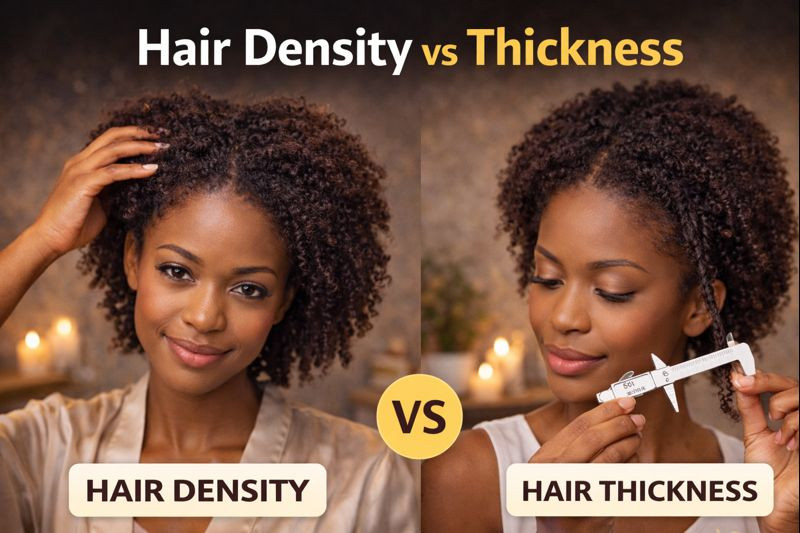
If you’ve ever wondered why your hair looks full but feels fine—or thick but still sparse—you’re not alone. One of the most misunderstood topics in hair care is the difference between hair density vs thickness.
Many people use the terms interchangeably, but they describe two very different things, and knowing which one matters more for your hair goals can completely change how you care for your hair.
In this guide, we’ll explain:
-
The real difference between hair density and hair thickness
-
How each affects hair growth, breakage, and fullness
-
Which one matters more—and when
-
How to improve both naturally
What Is Hair Density?
Hair density refers to how many individual hair strands grow on your scalp.
It answers the question:
How much hair do I actually have?
Hair density is determined by:
-
Number of hair follicles per square inch
-
Genetics
-
Hormonal health
-
Scalp condition
-
Long-term hair care habits
Density categories:
-
Low density – scalp easily visible
-
Medium density – scalp slightly visible
-
High density – scalp barely visible
? Density is about quantity, not strand size.
What Is Hair Thickness?
Hair thickness (also called strand width or hair diameter) refers to how thick each individual hair strand is.
It answers the question:
How thick is each strand of hair?
Thickness categories:
-
Fine hair – very thin strands
-
Medium hair – average strand width
-
Coarse hair – thick, strong strands
? Thickness is about strand size, not amount.
Why People Confuse Density and Thickness
Many people assume:
-
Thick-looking hair = high density
-
Thin-looking hair = low density
But that’s not always true.
You can have:
-
High density + fine strands
-
Low density + coarse strands
-
Medium density + medium strands
This is why two people with the same hairstyle can look completely different.
Hair Density vs Thickness: Key Differences
| Feature | Hair Density | Hair Thickness |
|---|---|---|
| What it measures | Number of strands | Strand width |
| Affects fullness | Yes | Yes |
| Affects strength | Indirectly | Directly |
| Mostly genetic | Yes | Yes |
| Can be improved | Somewhat | Somewhat |
Both matter—but they matter in different ways.
Which Matters More for Hair Growth?
Density matters more for overall fullness
If your goal is:
-
A fuller-looking head of hair
-
Less visible scalp
-
Thicker-looking styles
Then hair density plays a bigger role.
Low density means:
-
Fewer follicles producing hair
-
Styles appear flatter
-
Breakage is more noticeable
Thickness matters more for strength and retention
If your goal is:
-
Less breakage
-
Longer hair
-
Stronger strands
Then hair thickness is more important.
Thin strands:
-
Break more easily
-
Are sensitive to manipulation
-
Require gentler handling
Hair Density vs Thickness for Natural Hair
Natural hair—especially coily and kinky textures—can be deceptive.
Because coils stack on top of each other:
-
Fine strands can look thick
-
Low density can look full when shrunken
But once stretched or styled, the truth shows.
This is why understanding both is critical for natural hair routines.
How Hair Density Affects Styling
High density hair:
-
Holds volume easily
-
Takes longer to dry
-
Requires sectioning
-
Benefits from layered cuts
Low density hair:
-
Gets weighed down easily
-
Needs lightweight products
-
Benefits from strategic parts
-
Requires careful tension control
Using heavy products on low-density hair can actually make it look thinner.
How Hair Thickness Affects Breakage
Fine hair strands:
-
Break under tension
-
Are sensitive to dryness
-
Require frequent moisture
-
Need low-manipulation styles
Coarse strands:
-
Handle tension better
-
Retain length more easily
-
Can feel dry if not moisturized
-
Still break if neglected
? Thickness determines how much stress each strand can handle.
Can You Increase Hair Density?
Hair density is largely genetic—but it can be supported and preserved.
You may improve density by:
-
Keeping follicles unclogged
-
Reducing tension and traction
-
Massaging the scalp regularly
-
Supporting hormonal balance
-
Preventing breakage at the root
While you can’t create new follicles, you can keep existing ones active and productive.
Can You Increase Hair Thickness?
Yes—to a degree.
Thickness can improve when:
-
Hair is properly moisturized
-
Protein-moisture balance is healthy
-
Breakage is reduced
-
Cuticle damage is minimized
Thicker-looking strands often come from healthier growth, not just genetics.
Why Breakage Makes Hair Look Less Dense
Many people think they’re losing density when they’re actually losing length at the same rate hair grows.
Chronic breakage:
-
Shortens strands
-
Exposes more scalp
-
Creates uneven growth
This creates the illusion of thinning—even when follicles are fine.
Density vs Thickness and the Crown Area
The crown often:
-
Has lower density
-
Experiences more friction
-
Suffers more breakage
If crown hair breaks faster than it grows, both density appearance and thickness retention suffer.
This is why crown care is critical for fullness.
Which Matters More for Your Hair Goals?
If you want fuller-looking hair:
? Focus on density preservation
If you want longer, stronger hair:
? Focus on thickness protection
If you want both:
? You need a routine that supports scalp health + strand strength
How to Care for Low-Density Hair
-
Use lightweight, water-based products
-
Avoid heavy oils and butters
-
Limit tight styles
-
Keep scalp clean and stimulated
-
Avoid over-manipulation
The goal is to maximize what you have, not weigh it down.
How to Care for Fine Hair Strands
-
Moisturize frequently
-
Use low-tension styles
-
Detangle gently and slowly
-
Avoid excessive heat
-
Focus on length retention
Fine strands can grow long—but they need protection.
Common Myths About Density and Thickness
❌ “If hair is thick, it’s dense”
❌ “Low density means you can’t grow hair”
❌ “Oils increase hair density”
❌ “More products = thicker hair”
Truth: Technique matters more than products.
How Long Does It Take to See Improvements?
With consistency:
-
Reduced breakage: 3–4 weeks
-
Improved fullness appearance: 6–8 weeks
-
Better length retention: 8–12 weeks
Healthy hair habits compound over time.
Final Thoughts: Density vs Thickness Isn’t a Competition
Hair density and thickness aren’t enemies—they’re teammates.
-
Density determines how full your hair looks
-
Thickness determines how strong each strand is
When you understand the difference, you stop fighting your hair and start working with it.
✨ Healthy hair isn’t about having “perfect” density or thickness—it’s about protecting what you have and helping it thrive.