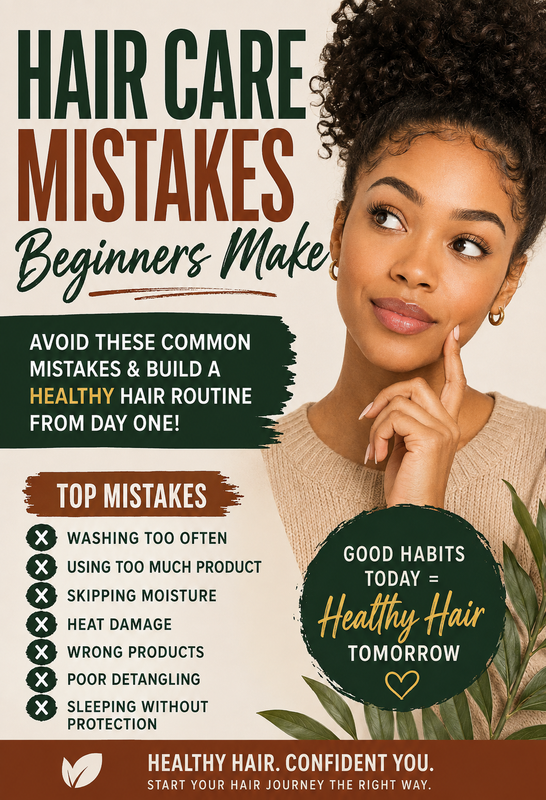
Starting a healthy hair journey is exciting. Whether you have natural curls, coils, relaxed hair, locs, braids, or straight hair, learning proper hair care can completely transform the health and appearance of your hair.
Unfortunately, beginners often make mistakes without realizing it. Social media trends, conflicting advice, and marketing claims can make hair care feel confusing. Many people unknowingly damage their hair by using too much heat, washing incorrectly, skipping moisture, or choosing products that aren't suitable for their hair type.
The good news is that healthy hair doesn't require perfection. It requires consistency, patience, and good habits.
This complete guide covers the most common hair care mistakes beginners make and explains exactly how to avoid them so your hair can become stronger, healthier, shinier, and easier to manage.
Why Hair Care Knowledge Matters
Hair is made mostly of keratin, a protein that forms the structure of every strand.
Healthy hair depends on:
- Moisture
- Protein balance
- Healthy scalp
- Gentle handling
- Proper nutrition
- Consistent care
Small mistakes repeated every day often create more damage than occasional mistakes.
Mistake #1: Washing Hair Too Often
Many beginners think clean hair means washing daily.
In reality, frequent shampooing strips away natural oils that protect hair.
This often leads to:
- Dryness
- Frizz
- Split ends
- Breakage
- Scalp irritation
Better Routine
Wash based on your hair type.
Typical schedule:
- Straight hair: every 2–3 days
- Wavy hair: every 3–4 days
- Curly hair: every 5–7 days
- Coily hair: every 7–14 days
- Locs: every 2–4 weeks depending on stage and activity
Mistake #2: Ignoring the Scalp
Healthy hair begins with a healthy scalp.
Many beginners only focus on the hair strands.
The scalp needs:
- Cleaning
- Moisture
- Massage
- Protection
A neglected scalp may develop:
- Dandruff
- Excess oil
- Product buildup
- Itching
- Slow healthy hair growth
Mistake #3: Using Too Much Product
More product does not equal healthier hair.
Overusing products causes:
- Heavy buildup
- Greasy appearance
- Flat curls
- Clogged follicles
- Difficult styling
Instead:
Start with a small amount.
Add more only if needed.
Mistake #4: Following Every TikTok Trend
Hair trends go viral every week.
Not every trend is backed by science.
Examples include:
- Excessive oil layering
- DIY chemical mixtures
- Overusing rice water
- Lemon juice treatments
- Toothpaste on scalp
- Harsh baking soda washes
Research every trend before trying it.
Mistake #5: Skipping Conditioner
Conditioner restores moisture after shampooing.
Without conditioner hair becomes:
- Rough
- Dry
- Difficult to detangle
- More likely to break
Condition after every shampoo.
Mistake #6: Brushing Hair Incorrectly
Many beginners brush aggressively.
This stretches wet hair beyond its limits.
Instead:
Start detangling from the ends.
Work upward slowly.
Use:
- Wide-tooth comb
- Detangling brush
- Fingers
Mistake #7: Detangling Dry Hair
Dry detangling often causes unnecessary breakage.
Instead use:
- Conditioner
- Leave-in conditioner
- Water spray
- Detangling spray
Hair becomes more flexible and easier to separate.
Mistake #8: Not Moisturizing Enough
Dry hair breaks.
Moisturized hair bends.
Hydrated hair is stronger and shinier.
Moisture should become part of your routine.
Mistake #9: Confusing Oil with Moisture
This is one of the biggest beginner mistakes.
Oil does NOT moisturize hair.
Water moisturizes.
Oil seals moisture inside.
Always moisturize first.
Seal second.
Mistake #10: Using Too Much Heat
Daily flat ironing eventually damages hair.
Heat damage can cause:
- Loss of curl pattern
- Split ends
- Weak strands
- Breakage
Limit heat styling.
Always use heat protectant.
Mistake #11: Sleeping Without Protection
Cotton pillowcases absorb moisture.
Instead use:
- Satin bonnet
- Silk scarf
- Satin pillowcase
These reduce:
- Frizz
- Breakage
- Tangles
Mistake #12: Trimming Too Late
Many beginners avoid trims.
Unfortunately split ends continue splitting upward.
Regular trims help preserve healthy length.
Mistake #13: Expecting Overnight Hair Growth
Hair growth takes time.
Average growth:
About half an inch each month.
Consistency beats quick fixes.
Mistake #14: Comparing Your Hair to Others
Everyone has different:
- Density
- Curl pattern
- Thickness
- Genetics
- Growth rate
Focus on improving YOUR hair.
Mistake #15: Using Dirty Brushes
Brushes collect:
- Oils
- Dead skin
- Dust
- Old product
Wash styling tools monthly.
Mistake #16: Wearing Tight Hairstyles Constantly
Constant tension can lead to:
- Edge thinning
- Hair loss
- Scalp pain
- Traction alopecia
Rotate protective styles.
Mistake #17: Skipping Deep Conditioning
Deep conditioners restore moisture lost from:
- Weather
- Heat
- Coloring
- Shampooing
Deep condition every 1–2 weeks.
Mistake #18: Protein Overload
Protein strengthens hair.
Too much makes hair stiff.
Balance moisture and protein.
Mistake #19: Never Clarifying Hair
Products leave residue over time.
Clarify monthly to remove:
- Oils
- Styling products
- Silicone buildup
- Hard water minerals
Mistake #20: Touching Hair Constantly
Constant manipulation increases:
- Frizz
- Breakage
- Dirt transfer
Hands off equals healthier hair.
Mistake #21: Not Drinking Enough Water
Hydration supports overall hair health.
Drink water consistently while maintaining a balanced diet rich in vitamins, minerals, and protein.
Mistake #22: Poor Diet
Hair depends on nutrients.
Important nutrients include:
- Protein
- Iron
- Zinc
- Vitamin D
- Vitamin C
- Biotin
- Omega-3 fats
Mistake #23: Using Every Product at Once
Beginners often buy dozens of products.
Simple routines usually work better.
Basic routine:
- Shampoo
- Conditioner
- Leave-in
- Moisturizer
- Oil
- Styler
Mistake #24: Ignoring Hair Porosity
Hair absorbs moisture differently.
Low porosity:
Moisture enters slowly.
High porosity:
Moisture escapes quickly.
Knowing your porosity helps choose better products.
Mistake #25: Washing with Extremely Hot Water
Hot water strips oils.
Use lukewarm water.
Finish with cool water if desired.
Mistake #26: Skipping Protective Styles
Protective styles reduce manipulation.
Examples:
- Twists
- Braids
- Buns
- Flat twists
- Wigs (properly installed)
Avoid wearing styles too long.
Mistake #27: Believing Expensive Products Always Work Better
Price doesn't determine effectiveness.
Focus on:
- Ingredients
- Consistency
- Proper routine
Mistake #28: Ignoring Breakage
Breakage isn't normal.
Signs include:
- Tiny broken hairs
- Uneven ends
- Excess shedding
- Split ends
Find the cause early.
Mistake #29: Using the Wrong Shampoo
Different shampoos serve different purposes.
Examples:
- Moisturizing
- Clarifying
- Protein
- Color-safe
- Sulfate-free
Choose one based on your needs.
Mistake #30: Giving Up Too Soon
Healthy hair develops over months.
Stay consistent.
Take photos monthly instead of daily.
Beginner Hair Care Routine
Step 1
Cleanse gently.
Step 2
Condition thoroughly.
Step 3
Detangle carefully.
Step 4
Apply leave-in conditioner.
Step 5
Seal with oil if needed.
Step 6
Style gently.
Step 7
Protect hair overnight.
Weekly Beginner Routine
Sunday
Wash Day
Monday
Light moisture
Tuesday
Protective style
Wednesday
Scalp massage
Thursday
Refresh curls
Friday
Light moisture
Saturday
Rest hair
Signs Your Routine Is Working
You'll likely notice:
- Less shedding
- More shine
- Softer hair
- Better curl definition
- Easier detangling
- Fewer split ends
- Reduced frizz
- Improved length retention
- Healthier scalp
Hair Care Myths Beginners Should Ignore
Myth: Cutting hair makes it grow faster.
Fact: Trims improve length retention but do not change growth rate.
Myth: Oil alone moisturizes hair.
Fact: Water provides moisture; oils help seal it in.
Myth: More products mean better results.
Fact: A simple, consistent routine is often more effective.
Myth: Hair must be washed every day.
Fact: Most hair types do not require daily shampooing.
Myth: Protective styles guarantee hair growth.
Fact: They help reduce breakage when installed and maintained correctly.
Frequently Asked Questions
How long does it take to see healthier hair?
Many people notice improvements in softness and manageability within a few weeks. Significant improvements in strength and length retention often take several months of consistent care.
Should beginners oil their scalp every day?
Not necessarily. Oiling frequency depends on your scalp and hair type. Applying too much oil can lead to buildup, so use it only as needed.
Is expensive hair care worth it?
Not always. Products with effective ingredients and a routine that fits your hair type matter more than price.
Can I repair split ends?
No. Once hair splits, trimming is the only way to remove the damage and prevent it from traveling farther up the strand.
What's the most important habit for beginners?
Consistency. A simple routine followed regularly will usually outperform a complicated routine that isn't maintained.
Final Thoughts
Everyone starts somewhere, and making mistakes is part of learning how to care for your hair. The key is recognizing habits that may be holding you back and replacing them with practices that protect your strands, support a healthy scalp, and encourage long-term hair health.
Rather than chasing every new trend or filling your shelf with products, focus on building a routine you can maintain. Gentle cleansing, regular conditioning, proper moisturizing, careful detangling, and protecting your hair while you sleep will have a greater impact than any miracle treatment.
Healthy hair is built one wash day, one protective style, and one good habit at a time. Stay patient, be consistent, and celebrate the small improvements along the way. Over time, those healthy choices add up to stronger, longer, and more resilient hair.