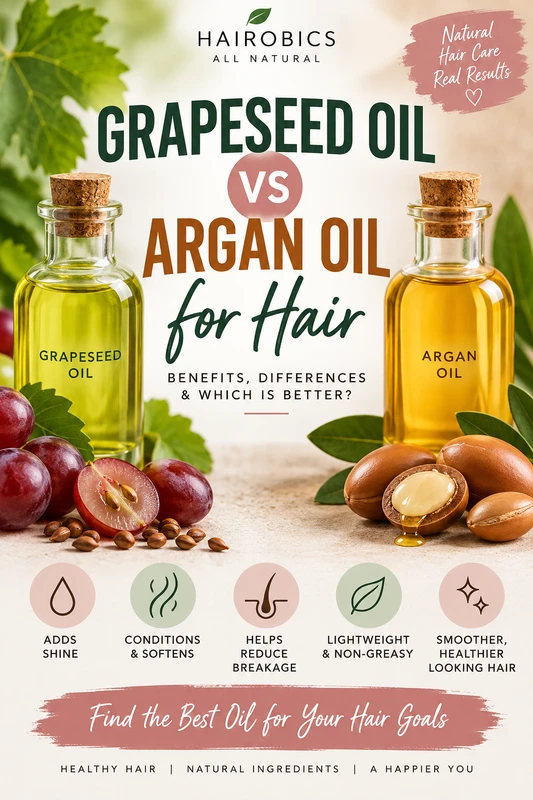
When it comes to natural hair care, choosing the right oil can make a noticeable difference in how your hair looks, feels, and retains moisture. Two popular choices are grapeseed oil and argan oil. Both are lightweight plant oils that can help condition the hair, reduce friction, add shine, and support a healthy hair-care routine, but they are not exactly the same.
If you have natural hair, curls, coils, locs, braids, relaxed hair, or a dry scalp, you may be wondering: Is grapeseed oil or argan oil better for hair?
The answer depends largely on your hair type and what you want the oil to accomplish.
Grapeseed oil is especially attractive to people who want a very lightweight oil that spreads easily without making the hair feel excessively greasy. Argan oil is also relatively lightweight, but it tends to be especially popular for smoothing, conditioning, shine, and helping hair feel softer and more manageable.
Neither oil actually moisturizes hair in the same way that water does. Oils are better thought of as conditioning and sealing ingredients. They can help reduce moisture loss and improve the feel of the hair when used appropriately.
In this guide, we'll compare grapeseed oil vs argan oil for hair, including their benefits, differences, how to use them, and which one may work better for natural hair, dry hair, low-porosity hair, high-porosity hair, damaged hair, and more.
Grapeseed Oil vs Argan Oil: Quick Comparison
Before getting into the details, here is the basic difference.
Grapeseed oil is extracted from grape seeds, usually as a byproduct of winemaking. It has a thin, lightweight texture and contains a high proportion of linoleic acid, an omega-6 fatty acid.
Argan oil comes from the kernels of the argan tree, which is native to Morocco. It contains fatty acids, including oleic and linoleic acids, as well as vitamin E compounds and other naturally occurring antioxidants.
For hair care, you can think about the two oils this way:
Grapeseed oil may be a good choice when you want:
- A very lightweight oil
- Less greasy buildup
- An oil for sealing after a water-based moisturizer
- A light scalp oil
- An oil that works well on fine or easily weighed-down hair
- Added shine without a heavy coating
Argan oil may be a good choice when you want:
- Softer-feeling hair
- More shine
- Smoother-looking strands
- Help reducing friction and roughness
- A finishing oil
- Additional conditioning for dry or damaged-feeling hair
Both oils can be useful. The better choice depends on your individual hair.
What Is Grapeseed Oil?
Grapeseed oil is made from the seeds of grapes. Although grape seeds are small, they contain oils that can be extracted and used in foods, skin-care products, and hair-care formulas.
One reason grapeseed oil has become popular in natural hair care is its texture.
Compared with heavier oils such as castor oil, grapeseed oil feels relatively thin and light.
That can make it appealing to people whose hair becomes greasy or limp when they use heavier oils.
Grapeseed oil is particularly rich in linoleic acid. It also contains smaller amounts of other fatty acids and vitamin E compounds.
When applied to hair, oils mainly work on the surface of the strand. They can lubricate the hair, reduce friction between strands, improve shine, and help the hair feel smoother.
This is important for curly and coily hair because bends and twists in the hair fiber can increase friction during manipulation.
Less friction can mean easier styling and potentially less mechanical damage during everyday handling.
What Is Argan Oil?
Argan oil comes from the kernels of the Argania spinosa tree, which grows primarily in Morocco.
It has been used traditionally in Morocco for both culinary and cosmetic purposes.
Argan oil became particularly popular in modern hair care because it provides conditioning without necessarily feeling as heavy as some traditional oils and butters.
It contains a combination of fatty acids, especially oleic acid and linoleic acid, along with tocopherols, which are forms of vitamin E.
Argan oil is frequently included in:
- Hair serums
- Conditioners
- Leave-in conditioners
- Heat-styling products
- Hair masks
- Anti-frizz products
- Hair oils
- Shine sprays
When applied to hair, argan oil can coat and lubricate the hair fiber. This can make strands feel smoother and reduce some of the friction that occurs when hair rubs against other strands, clothing, pillows, combs, or brushes.
For natural hair, this can be particularly useful around the ends, which are generally the oldest and most weathered portion of the hair.
Grapeseed Oil vs Argan Oil for Natural Hair
Natural Black hair often benefits from products that help maintain softness, reduce friction, and limit excessive moisture loss.
However, natural hair is extremely diverse.
Someone with fine 3C curls may need something completely different from someone with dense 4C coils.
That is why there isn't one universally "best" natural hair oil.
Grapeseed Oil for Natural Hair
Grapeseed oil can be an excellent option when natural hair becomes weighed down easily.
Because of its lightweight consistency, you can use a small amount after applying your leave-in conditioner or moisturizer.
For example:
- Lightly dampen your hair.
- Apply a water-based leave-in treatment.
- Distribute it through your hair.
- Apply a small amount of grapeseed oil.
- Concentrate primarily on your ends.
The oil can help provide lubrication while reducing the heavy feeling that sometimes occurs with thicker oils.
Argan Oil for Natural Hair
Argan oil may be particularly useful when natural hair feels rough or lacks shine.
A few drops can be smoothed over the hair after moisturizing.
It can also work well as a finishing oil after styling.
For example, after completing twists or a twist-out, rub several drops between your palms and gently smooth your hands over your hair.
This can help provide additional shine and make the hair feel smoother.
Which Oil Is Better for Dry Hair?
If your hair constantly feels dry, the first thing to understand is that oil and moisture are not the same thing.
Water provides hydration.
Oil does not replace water.
This means continuously applying oil to extremely dry hair without adding water or a water-based moisturizer may leave you disappointed.
Your hair may become oily while still feeling dry.
Instead, try applying your oil after hydration.
For very dry hair, argan oil may have a slight advantage as a finishing and conditioning oil because it can help the hair feel soft and smooth.
However, grapeseed oil can also work extremely well if heavier products make your hair greasy.
Your routine might look like:
Water or water-based moisturizer → leave-in conditioner → small amount of oil.
This gives the oil something to help seal in rather than simply applying oil to dehydrated hair.
Grapeseed Oil vs Argan Oil for Low-Porosity Hair
Low-porosity hair has cuticle layers that tend to resist rapid water penetration.
People with low-porosity hair frequently complain that products seem to sit on top of their hair.
Heavy butters and oils may make this problem worse.
For this reason, grapeseed oil can be an especially useful option for some people with low-porosity hair.
Its relatively lightweight texture makes it easier to use sparingly.
Argan oil can also work very well on low-porosity hair, particularly when only a few drops are used.
The biggest mistake is usually not choosing the "wrong" oil.
It's using too much oil.
If you have low-porosity hair, start with a tiny amount.
You can always add more.
Removing excessive oil generally requires washing the hair again.
Grapeseed Oil vs Argan Oil for High-Porosity Hair
High-porosity hair tends to absorb and lose water relatively easily.
Hair can naturally be more porous, but chemical treatments, heat, UV exposure, weathering, and mechanical damage can also increase porosity.
For high-porosity hair, either grapeseed or argan oil can be useful as part of a layered routine.
Argan oil may be particularly appealing when high-porosity hair feels rough because of its conditioning properties.
However, some people with very porous, coarse hair may find that neither oil is heavy enough by itself.
In that situation, you might combine a lightweight oil with a richer cream or butter.
For example:
Leave-in conditioner → moisturizing cream → oil.
Experiment to determine how much product your hair actually needs.
Which Oil Is Better for Fine Hair?
Fine hair can become weighed down quickly.
This is where grapeseed oil really shines.
Because it has a relatively light texture, grapeseed oil may be easier to use on fine hair without creating excessive heaviness.
Start with only one or two drops.
Rub the oil between your palms before applying it.
This spreads the oil across a larger surface area and reduces the likelihood that one section receives too much.
Argan oil can still work beautifully on fine hair.
In fact, many commercial smoothing products use argan oil.
But again, quantity matters.
A few drops may produce shine.
A palmful may produce greasy hair.
Which Oil Is Better for Thick Hair?
Thick or dense hair can sometimes tolerate larger amounts of product.
Both oils can work.
If your thick hair feels dry and rough, you may prefer argan oil for its smoothing and conditioning feel.
If your hair is dense but doesn't tolerate heavy oils well, grapeseed oil may be preferable.
You can also use both.
For example, grapeseed oil could be used during your moisturizing routine, while a few drops of argan oil could be applied to your ends as a finishing treatment.
Grapeseed Oil vs Argan Oil for 4C Hair
4C hair has tight coils that can make natural scalp oils less able to travel down the length of the strand.
As a result, the ends can feel particularly dry.
But 4C hair does not automatically require extremely heavy oils.
Some people with 4C hair love castor oil and thick butters.
Others find them much too heavy.
Grapeseed oil provides a lighter alternative.
Apply it after a leave-in conditioner to help lubricate the strands and reduce friction.
Argan oil can be especially useful for smoothing the ends of 4C hair and adding shine.
Try each individually for several wash days.
Pay attention to:
- Softness
- Shine
- Buildup
- Detangling
- How long your style lasts
- How your ends feel
- Whether your hair becomes greasy
Your hair's response is more useful than simply following a hair-type chart.
Which Oil Is Better for Frizzy Hair?
Frizz can have many causes.
Humidity, damaged cuticles, styling technique, dryness, hair texture, and friction can all contribute.
Oils won't permanently eliminate frizz.
However, applying a small amount to the hair surface can make strands appear smoother.
Argan oil is particularly popular as a finishing oil for frizz.
Apply a few drops after styling rather than saturating your hair.
Grapeseed oil can provide a similar benefit with an even lighter feel.
If you have fine curls that become limp when you apply oil, grapeseed may be the better starting point.
Grapeseed Oil vs Argan Oil for Hair Growth
This is where hair-care marketing can become confusing.
You'll often see claims that particular oils "make hair grow."
Hair growth is more complicated than that.
Hair grows from follicles in the scalp, and growth is influenced by genetics, age, hormones, nutrition, health conditions, medications, and other biological factors.
There isn't strong evidence that simply applying grapeseed oil or argan oil to the scalp will dramatically increase the biological rate of hair growth.
However, hair retention is extremely important.
Imagine your hair grows approximately half an inch during a certain period, but your ends continuously break.
Your hair is technically growing, yet you may not see much increase in length.
Reducing unnecessary breakage can help you retain more of the hair you've already grown.
Oils may indirectly support length retention by:
- Lubricating strands
- Reducing friction
- Improving manageability
- Helping hair feel softer
- Protecting vulnerable ends during styling
So instead of asking only:
"Which oil grows hair faster?"
A better question is:
"Which oil helps me maintain my hair with less breakage and manipulation?"
That answer will vary from person to person.
Can Grapeseed Oil Grow Your Edges?
There isn't strong evidence showing that grapeseed oil alone can regrow thinning edges.
If your edges are thinning, first consider what may be causing the problem.
Common contributors can include:
- Tight braids
- Tight ponytails
- Tight wigs
- Excessive edge control
- Repeated brushing
- Friction
- Chemical damage
- Heat damage
Persistent or unexplained hair loss should be evaluated by a dermatologist or other qualified healthcare professional.
Oil can help condition the existing hair, but it shouldn't be viewed as a treatment for every type of hair loss.
Can Argan Oil Grow Your Hair?
Argan oil is frequently advertised as a hair-growth oil.
Its better-established cosmetic role is conditioning the hair.
Keeping your hair conditioned and reducing unnecessary friction can support length retention, but that isn't the same as directly stimulating follicles to produce hair faster.
Use argan oil because of what it can realistically contribute to your routine: lubrication, shine, softness, and conditioning.
Which Oil Is Better for Hair Breakage?
Hair breakage can occur because of:
- Excessive manipulation
- Heat damage
- Chemical treatments
- Tight hairstyles
- Rough detangling
- Weathering
- Lack of conditioning
- Friction
Neither grapeseed nor argan oil can magically repair severely damaged hair.
Once the hair fiber is significantly damaged, cosmetic products mainly improve its appearance and manageability.
However, oils can help reduce friction.
That matters because excessive friction during detangling and styling can contribute to breakage.
Argan oil may be particularly useful for damaged-feeling hair because of the smooth, conditioned feel it can provide.
Grapeseed oil is excellent when you need lubrication without heaviness.
Grapeseed Oil vs Argan Oil for Split Ends
Unfortunately, split ends cannot truly be permanently repaired with oil.
Once the end of a hair strand physically splits, trimming is the only way to completely remove the split portion.
Some products can temporarily smooth split ends and make them less noticeable.
Argan oil can work well for this purpose.
Put one or two drops between your fingertips and gently apply them to the last few inches of your hair.
Grapeseed oil can also help lubricate your ends and reduce friction.
Preventing unnecessary damage is more effective than trying to reverse severe split ends.
Which Oil Is Better for Shine?
Both oils can increase shine.
However, argan oil is particularly popular as a shine-enhancing finishing oil.
Use very little.
Too much oil can make hair look greasy instead of shiny.
Grapeseed oil can create a softer, lighter shine that may work especially well for fine hair.
Grapeseed Oil vs Argan Oil for the Scalp
Both oils can be applied to the scalp, but your scalp doesn't necessarily need to be oiled.
Some people enjoy scalp oil.
Others develop buildup, itching, or irritation when they apply oils frequently.
If you like oiling your scalp, grapeseed oil's lighter consistency may make it more comfortable for frequent use.
Apply only a small amount.
Your scalp should not be dripping with oil.
Argan oil can also be applied sparingly.
If you have persistent dandruff, severe itching, redness, sores, or scaling, simply applying more oil may not solve the underlying problem.
In some cases, oil can make certain scalp conditions more difficult to manage.
Consider seeing a dermatologist when scalp symptoms persist.
Which Oil Is Better for Locs?
Locs require a balance.
You want enough conditioning to prevent the hair from feeling excessively dry, but too much heavy product can contribute to buildup inside the locs.
For this reason, grapeseed oil can be an excellent option for locs.
Its lightweight consistency makes it easier to apply sparingly.
Try misting your locs with a water-based moisturizing spray first and then smoothing a small amount of oil over them.
Argan oil can also be useful, especially as a finishing oil when locs appear dull.
Remember:
Oil does not replace water.
If your locs are extremely dry, continually adding oil may leave you with oily but dehydrated locs.
Hydrate first.
Then seal lightly.
Grapeseed Oil vs Argan Oil for Braids
Either oil can be used while wearing braids.
Grapeseed oil is particularly useful if you want something lightweight on your scalp.
Apply it sparingly between the parts.
Argan oil can be smoothed over exposed natural hair or the ends if they're left out.
Avoid pouring large amounts of oil onto your braids.
This can contribute to buildup and make cleansing more difficult.
Which Oil Is Better for Relaxed Hair?
Relaxed hair has undergone a chemical process that permanently changes the hair structure.
Because chemically processed hair can be more vulnerable to damage, gentle handling and regular conditioning are especially important.
Argan oil can be a useful finishing product for relaxed hair.
A small amount may improve:
- Shine
- Smoothness
- Manageability
- Softness
Grapeseed oil is also useful when relaxed hair is fine and easily weighed down.
Neither oil replaces a good conditioner.
Think of oil as an additional step rather than your entire hair-care routine.
Can You Use Grapeseed Oil Before Shampooing?
Yes.
Grapeseed oil can be used as a pre-shampoo treatment, often called a pre-poo.
Apply a modest amount to your hair before washing.
Focus particularly on areas that experience significant friction during shampooing.
Leave it on briefly before cleansing.
You don't need to soak your hair in oil.
The goal is simply to lubricate the strands.
Can You Use Argan Oil Before Shampooing?
Yes.
Argan oil can also be used before shampooing.
However, because argan oil is often more expensive than grapeseed oil, some people prefer saving it for finishing their hair.
You might use an inexpensive oil before shampooing and save argan oil for your ends and final styling.
Grapeseed Oil vs Argan Oil for Heat Styling
If you blow-dry or flat-iron your hair, don't assume that applying a natural oil automatically provides adequate heat protection.
A properly formulated heat protectant is usually the better option.
Some commercial heat protectants contain argan oil, but the formula includes other ingredients specifically designed to improve styling performance.
If you use argan or grapeseed oil around heat styling, use them as part of your broader routine rather than relying on pure oil as your only heat protection.
Can You Mix Grapeseed Oil and Argan Oil?
Absolutely.
You don't necessarily have to choose between them.
You can combine grapeseed and argan oil.
A simple mixture might contain mostly grapeseed oil with a smaller amount of argan oil.
This gives you the lightweight consistency of grapeseed oil with some of the conditioning characteristics associated with argan oil.
You could also use them separately.
For example:
Grapeseed oil: moisturizing/sealing routine.
Argan oil: finishing and ends.
Sometimes using products strategically works better than trying to find one ingredient that does everything.
How to Use Grapeseed Oil on Natural Hair
One of the simplest methods is to apply it after moisturizing.
Step 1: Add Water
Start with damp hair or use a water-based moisturizer.
Step 2: Apply Leave-In Conditioner
Work your leave-in through your hair.
Pay particular attention to your ends.
Step 3: Add Grapeseed Oil
Place several drops into your hands.
Rub your palms together.
Step 4: Smooth It Over Your Hair
Gently distribute the oil over your strands.
Avoid oversaturating the hair.
Step 5: Style
Proceed with your preferred protective or low-manipulation style.
This could include:
- Two-strand twists
- Braids
- Bantu knots
- Flat twists
- Bun
- Afro
- Wash-and-go
How to Use Argan Oil on Natural Hair
Argan oil works particularly well as a finishing oil.
After styling:
- Put a few drops in your palm.
- Rub your hands together.
- Gently smooth them over your hair.
- Concentrate on the ends.
- Add more only if necessary.
The key word is small.
You shouldn't need to saturate your hair.
How Often Should You Use Hair Oil?
There isn't one schedule that works for everyone.
Some people use oil several times per week.
Others only use it on wash day.
Instead of automatically oiling your hair every day, pay attention to how it feels.
If your hair is soft, moisturized, and manageable, you may not need more oil.
If your hair feels dry, first determine whether it actually needs water or conditioner rather than additional oil.
Excessive oiling can create buildup.
That buildup may eventually require stronger cleansing to remove.
Does Grapeseed Oil Cause Buildup?
Any oil can contribute to buildup when used excessively.
Grapeseed oil's light texture doesn't mean you can apply unlimited amounts.
If your hair starts feeling:
- Coated
- Greasy
- Limp
- Sticky
- Dull
- Difficult to moisturize
you may be using too much product.
A thorough shampoo can help reset your hair.
Does Argan Oil Cause Buildup?
Argan oil can also accumulate if used excessively.
This is particularly likely when you're layering oil over:
- Leave-in conditioner
- Styling cream
- Gel
- Butter
- Edge control
- Serum
Product layering adds up.
Use only what your hair actually needs.
Grapeseed Oil vs Argan Oil: Which Is Better for Everyday Use?
For frequent use, grapeseed oil may have an advantage because of its very lightweight texture.
You can apply a small amount without necessarily creating the heavy coating associated with thicker oils.
However, if your main goal is shine and smoothing, argan oil may be preferable.
Think of it this way:
Grapeseed oil = lightweight everyday sealing and lubrication.
Argan oil = smoothing, conditioning, and finishing.
There is considerable overlap between them, so these aren't strict rules.
Grapeseed Oil vs Argan Oil vs Castor Oil
Castor oil is significantly thicker than both grapeseed and argan oil.
If your hair loves heavy oils, castor oil may work well.
If castor oil leaves your hair feeling sticky or coated, grapeseed or argan oil may be easier to use.
A simple texture comparison is:
Grapeseed oil → very lightweight
Argan oil → lightweight to medium-light
Castor oil → heavy
You can even mix oils to adjust their consistency.
For example, adding grapeseed oil to castor oil can create a thinner mixture that's easier to spread.
Grapeseed Oil vs Argan Oil vs Coconut Oil
Coconut oil behaves differently from many other oils because it can penetrate the hair fiber to some degree and has evidence supporting its ability to reduce protein loss from hair under certain conditions.
However, not everyone enjoys how coconut oil makes their hair feel.
Some people report that their hair feels stiff or rough after using it.
Grapeseed and argan oils are often preferred primarily for their surface-conditioning and cosmetic benefits.
If coconut oil doesn't work well for you, there's no requirement to use it simply because it's popular.
Which Oil Is Better for Men With Natural Hair?
Both oils can work extremely well for men's natural hair.
Grapeseed oil may be particularly convenient for:
- Short natural hair
- Waves
- Afros
- Locs
- Twists
Because it's lightweight, it can provide shine without making short hair excessively greasy.
Argan oil can work well for longer hair, dry ends, and locs.
Men with waves should use either oil very sparingly because too much product can create buildup.
Which Oil Is Better for Children's Hair?
Either oil can potentially be used on children's hair, but simple routines are usually best.
Use small amounts and avoid unnecessary essential oils or heavily fragranced mixtures, particularly on sensitive scalps.
For fine children's hair, grapeseed oil's lightweight texture may be useful.
Argan oil can help smooth longer curls and coils.
Always stop using a product if irritation develops.
Common Mistakes When Using Grapeseed or Argan Oil
1. Using Oil Instead of Moisture
This is probably the biggest mistake.
Dry hair doesn't necessarily need more oil.
It may need water.
2. Applying Too Much
More oil does not automatically mean healthier hair.
3. Never Shampooing Properly
Hair and scalp need cleansing.
Don't allow months of oils, creams, gels, and butters to accumulate.
4. Expecting Oil to Repair Split Ends
Oil can temporarily smooth damaged ends.
It cannot permanently fuse severely split hair back together.
5. Expecting Overnight Hair Growth
Hair growth takes time.
Be cautious of exaggerated claims that an oil will produce several inches of new growth in a few weeks.
6. Ignoring Your Ends
If length retention is your goal, pay close attention to your ends.
They are the oldest part of your hair and often experience the most wear.
How to Choose Between Grapeseed Oil and Argan Oil
Ask yourself what your hair actually needs.
If your hair becomes oily easily, start with grapeseed oil.
If your hair feels rough and you want additional smoothness and shine, try argan oil.
If you have fine hair, start with grapeseed.
If you have damaged-feeling ends, try argan.
If you have locs and are worried about heavy buildup, grapeseed may be particularly useful.
If you want a finishing serum-like oil after styling, argan may be preferable.
But remember:
Your individual results matter more than general recommendations.
Can You Use Both Oils in the Same Hair Routine?
Yes, and this may actually be the best approach for some people.
For example:
Wash day: Shampoo and condition.
Moisturizing: Apply a water-based leave-in treatment.
Sealing: Apply a small amount of grapeseed oil.
Styling: Complete your twists, braids, or other style.
Finishing: Apply one or two drops of argan oil to your ends.
This allows each oil to serve a slightly different purpose.
Grapeseed Oil vs Argan Oil for Hair: Final Comparison
So, which oil wins the grapeseed oil vs argan oil for hair comparison?
There isn't one winner for every hair type.
Choose grapeseed oil if you want a very lightweight oil that can help lubricate the hair, seal after moisturizing, and add shine without excessive heaviness. It can be particularly useful for fine hair, low-porosity hair, locs, short natural hairstyles, and people who dislike thick oils.
Choose argan oil if your priority is softness, smoothing, shine, and conditioning. It can be particularly useful on dry-feeling ends, frizzy hair, chemically processed hair, and hair that feels rough from everyday wear.
And you don't have to choose only one.
Grapeseed oil can work beautifully as your lightweight sealing oil, while argan oil can be reserved for smoothing your ends and finishing your hairstyle.
Most importantly, remember that oil isn't a replacement for moisture.
For healthy-looking natural hair, focus on a complete routine that includes regular cleansing, water-based hydration, conditioning, gentle detangling, minimal unnecessary tension, protection of your ends, and consistent maintenance.
The best hair oil is ultimately the one that complements that routine and leaves your hair soft, manageable, and easy to care for.
Frequently Asked Questions
Is grapeseed oil or argan oil better for hair growth?
Neither oil has strong evidence showing that simply applying it to your hair or scalp dramatically accelerates hair growth. Both can help condition and lubricate the hair, potentially supporting length retention by reducing friction and unnecessary breakage.
Is grapeseed oil lighter than argan oil?
Grapeseed oil generally has a very light consistency and is often preferred by people who don't like heavy oils. Argan oil is also relatively lightweight.
Can I leave grapeseed oil in my hair overnight?
Yes, if your hair tolerates it. You don't necessarily need to use a large amount or leave it on overnight to receive conditioning benefits.
Can I leave argan oil in my hair?
Yes. Argan oil is commonly used as a leave-in finishing oil. Start with just a few drops.
Can I mix argan and grapeseed oil?
Yes. The two oils can be combined or used during different stages of your hair-care routine.
Which oil is better for 4C hair?
Either can work. Grapeseed oil is useful when you want something lightweight, while argan oil can be useful for smoothing and adding shine. Your hair's density, strand thickness, porosity, and product preferences matter more than curl pattern alone.
Which oil is better for low-porosity hair?
Grapeseed oil is often a good starting choice because it is lightweight. However, argan oil can also work when used sparingly.
Does argan oil moisturize hair?
Not exactly. Water provides hydration. Argan oil can condition, lubricate, and help reduce moisture loss, but it shouldn't replace water or a water-based moisturizer.
Can grapeseed oil be used on locs?
Yes. Its lightweight consistency makes grapeseed oil a useful option for people with locs who want to avoid overly heavy products.
Which oil is better for dry ends?
Argan oil can be an excellent choice for smoothing and conditioning dry-feeling ends. Apply it after hydrating and conditioning your hair rather than relying on oil alone.