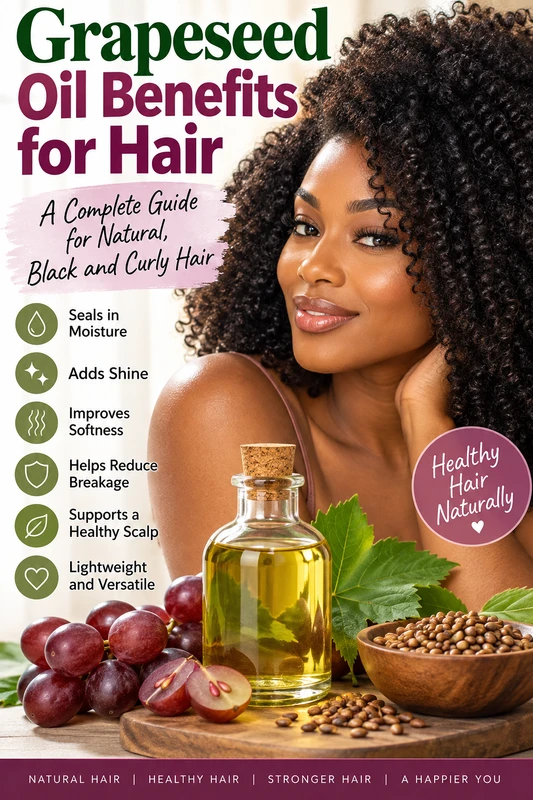
Grapeseed oil may not receive as much attention as coconut oil, castor oil, or olive oil, but it has become a popular option for people looking for a lightweight oil to add to their hair-care routine. Extracted from the seeds of grapes, this versatile oil contains fatty acids and vitamin E and can be used on both the hair and scalp.
For people with Black hair, natural hair, curly hair, locs, braids, and protective styles, one of the biggest advantages of grapeseed oil is its lightweight texture. Heavy oils and butters can sometimes leave hair greasy, weighed down, or coated with buildup. Grapeseed oil offers another option for sealing in moisture and adding softness without necessarily leaving the hair feeling excessively oily.
But what exactly does grapeseed oil do for hair?
In this complete guide, we'll explore the benefits of grapeseed oil for hair, how to use it, whether it can support healthy hair growth, how it compares with other popular oils, and how to incorporate it into a natural hair routine.
What Is Grapeseed Oil?
Grapeseed oil is an oil extracted from grape seeds, which are typically a byproduct of winemaking.
Although the seeds are small, their oil contains several compounds that have made grapeseed oil popular in cosmetics, skin-care products, massage oils, and hair-care formulas.
Grapeseed oil contains fatty acids, including a high proportion of linoleic acid, an omega-6 fatty acid. It also contains vitamin E and other antioxidant compounds, although the exact composition can vary depending on how the oil is produced and refined.
For hair care, grapeseed oil is especially appealing because it tends to feel lighter than oils such as castor oil.
This can make it useful for people who want the benefits of an oil without applying something extremely thick.
Grapeseed Oil Benefits for Hair
There isn't one single reason people use grapeseed oil. Its combination of texture and fatty-acid content makes it useful in several different types of hair routines.
Potential grapeseed oil benefits for hair include:
- Helping seal moisture into the hair
- Improving softness
- Adding shine
- Reducing the dry feeling of hair
- Lubricating strands during styling
- Helping reduce friction
- Supporting a comfortable, conditioned scalp
- Providing a lightweight alternative to heavier oils
- Helping protect dry ends
- Making curls and coils look more polished
These benefits can be particularly valuable for textured hair, which may struggle to retain moisture from roots to ends.
1. Grapeseed Oil Helps Seal in Moisture
One of the most important things to understand about hair oils is that oil and moisture are not the same thing.
Water provides moisture.
Oil can help reduce how quickly that moisture escapes.
This distinction is especially important for natural hair.
If your hair is extremely dry and you simply apply grapeseed oil to it, the oil may make the surface feel smoother temporarily, but it isn't necessarily solving the underlying lack of water.
A better approach is usually to apply a water-based moisturizer or leave-in conditioner first and then use a small amount of grapeseed oil afterward.
Think of it like this:
Water or leave-in conditioner = moisture
Grapeseed oil = seal
This is why grapeseed oil can fit well into LOC and LCO hair-care methods.
2. Grapeseed Oil Is Lightweight
This is arguably one of grapeseed oil's greatest advantages.
Castor oil is popular in Black hair care, but its thick consistency isn't ideal for every person or every hairstyle.
Grapeseed oil is generally much lighter.
That makes it useful for people with:
- Fine natural hair
- Low-density hair
- Loose curls
- Wavy hair
- Hair that becomes greasy easily
- Locs that accumulate buildup easily
- Braids and twists
- Hair that doesn't respond well to heavy oils
You can often distribute a small amount across the hair without creating the same heavy feeling associated with thicker oils.
The key is still moderation.
Even a lightweight oil can cause buildup when too much is applied repeatedly.
3. Grapeseed Oil Can Make Hair Feel Softer
Dry natural hair often feels rough because the surface of the strands lacks sufficient lubrication and conditioning.
Applying a small amount of grapeseed oil may make the strands feel smoother and softer.
This can be particularly helpful after moisturizing.
For example, you might:
- Lightly mist your hair with water.
- Apply your favorite leave-in treatment.
- Distribute a few drops of grapeseed oil over the hair.
- Concentrate on dry areas and ends.
The result may be hair that feels softer and more manageable.
4. Grapeseed Oil Adds Natural-Looking Shine
Natural hair doesn't always reflect light in the same way straight hair does.
The bends and curves of curls and coils can scatter light rather than reflecting it uniformly.
This means perfectly healthy textured hair may still appear less shiny.
A small amount of grapeseed oil can coat the surface of the hair and increase visible sheen.
Because it is lightweight, the shine can look more natural rather than excessively greasy.
Try warming several drops between your palms and gently smoothing them over the finished hairstyle.
You don't need to saturate your hair.
5. Grapeseed Oil May Help Reduce Breakage From Friction
Hair breakage has many possible causes, including dryness, excessive manipulation, heat, chemical treatments, tight hairstyles, damaged ends, and friction.
No oil can completely prevent breakage.
However, oils can provide lubrication between hair strands.
That lubrication may help reduce some of the friction that occurs when strands rub against each other during detangling and styling.
This is especially relevant for curly and coily hair because strands can easily intertwine.
When hair is properly moisturized and lubricated, it may be easier to manipulate gently.
The less unnecessary friction and force you use, the better your chances of retaining length.
6. Grapeseed Oil Can Be Excellent for Natural Hair
Grapeseed oil and natural hair can work particularly well together.
Natural Black hair tends to have curls, coils, and bends that can make it more difficult for natural scalp oils to travel down the entire hair shaft.
As a result, the ends can become dry even when the scalp doesn't feel dry.
Applying a lightweight oil to the lengths and ends can help supplement your conditioning routine.
Grapeseed oil can be used for:
- Twist-outs
- Braid-outs
- Wash-and-gos
- Two-strand twists
- Bantu knots
- Afro styles
- Protective styles
- Blowouts
- Nighttime hair routines
The amount needed depends on your hair's length, density, porosity, and how easily it becomes weighed down.
7. Grapeseed Oil Can Help Protect Dry Ends
Your ends are the oldest portion of your hair.
If your hair is several years old, the ends have been through countless wash days, styling sessions, detangling sessions, weather changes, and nights of sleeping.
That's why ends frequently become dry before the rest of the hair.
Try concentrating grapeseed oil primarily on your ends rather than coating every inch of hair.
After applying moisturizer, smooth one or two drops over each section's ends.
This simple step can help your ends feel softer and better lubricated.
Remember that oil cannot permanently repair split ends.
Once an end has significantly split, trimming is generally the most reliable solution.
8. Grapeseed Oil Can Be Used for Scalp Massage
Grapeseed oil can also be used as a carrier oil for scalp massage.
Place a small amount on your fingertips and gently massage your scalp using the pads of your fingers.
Avoid aggressively scratching with your nails.
A scalp massage can feel relaxing and helps you spend time paying attention to the condition of your scalp.
However, more oil is not necessarily better.
Your scalp does not need to be drenched.
If you experience persistent itching, flaking, sores, significant scaling, or sudden hair loss, don't simply keep adding oils. Those symptoms can have causes that require evaluation by a dermatologist or other qualified healthcare professional.
9. Grapeseed Oil Works Well With Protective Styles
Protective styles can reduce daily manipulation, but the hair underneath still needs appropriate care.
Grapeseed oil can be useful with:
- Box braids
- Knotless braids
- Cornrows
- Feed-in braids
- Crochet styles
- Twists
- Wigs
- Sew-ins
Instead of pouring oil all over your braids, use a small amount strategically.
If your hair underneath feels dry, begin with a lightweight water-based moisturizing product. Then apply a small amount of oil where appropriate.
This can help maintain softness without creating excessive buildup.
10. Grapeseed Oil Can Be Used on Locs
People with locs often need to be particularly careful about heavy products.
Thick waxes, creams, butters, and oils may accumulate inside locs when used excessively.
Because grapeseed oil is relatively lightweight, some people find it easier to incorporate into a loc routine.
After lightly hydrating your locs, smooth a very small amount of grapeseed oil over them.
Pay particular attention to dry areas.
The goal should be conditioned locs—not oily locs.
Regular cleansing remains essential.
Does Grapeseed Oil Grow Hair?
This is one of the most common questions about nearly every hair oil.
It's important to distinguish between supporting healthy hair practices and directly causing faster biological hair growth.
Grapeseed oil contains compounds that can make it useful as a conditioning oil, but applying it should not be treated as a guaranteed cure for hair loss or a guaranteed way to dramatically accelerate hair growth.
Hair growth is influenced by many factors, including:
- Genetics
- Age
- Nutrition
- Hormones
- Scalp health
- Health conditions
- Medications
- Hair-care practices
- Breakage
Where grapeseed oil may help your hair journey is length retention.
Suppose your hair grows normally at the scalp but continually breaks at the ends.
You may feel like your hair "isn't growing."
Improving moisture, lubrication, detangling practices, nighttime protection, and overall hair care may reduce breakage.
If you retain more of the hair you grow, your hair can become visibly longer over time.
That's different from claiming that grapeseed oil makes follicles grow hair faster.
Grapeseed Oil for Black Hair
Black hair varies tremendously from person to person.
There is no universal oil that works for every Black person's hair.
However, grapeseed oil has several characteristics that may make it attractive for textured hair.
It's lightweight, easy to spread, and can be layered with other hair-care products.
For Black hair, try using it:
After wash day: Apply leave-in conditioner and seal with a small amount of grapeseed oil.
Before twisting: Smooth a little oil over moisturized sections.
On dry ends: Apply after misting or moisturizing.
Before bed: Smooth a few drops over dry areas before covering your hair with satin.
During protective styles: Use sparingly as part of your scalp and hair maintenance routine.
The goal is balance.
Grapeseed Oil for 4C Hair
4C hair can experience significant shrinkage and dryness, but that doesn't automatically mean it needs the heaviest products available.
Some people with 4C hair love heavy butters and oils.
Others find that heavy products simply sit on their hair.
Grapeseed oil can be worth experimenting with if you prefer lightweight products.
Try this simple 4C routine:
Step 1: Hydrate
Apply water or a water-based leave-in product.
Step 2: Condition
Use a moisturizing leave-in or cream appropriate for your hair.
Step 3: Seal
Apply a small amount of grapeseed oil, concentrating on the ends.
Step 4: Style
Put the hair into twists, braids, or another low-manipulation style.
Step 5: Protect Overnight
Use a satin bonnet, scarf, or satin pillowcase.
Consistency across your entire routine matters much more than relying on a single oil.
Grapeseed Oil for Low-Porosity Hair
Low-porosity hair has a cuticle structure that can make product absorption and moisture routines challenging.
Heavy oils and butters may leave some low-porosity hair feeling coated.
Because grapeseed oil is lightweight, it may be a more comfortable option.
Start with very little.
Apply your water-based products first, followed by a few drops of oil.
If your hair becomes limp, greasy, or coated, reduce the amount or frequency.
Grapeseed Oil for High-Porosity Hair
High-porosity hair tends to absorb moisture easily but may also lose it quickly.
Grapeseed oil can be used after moisturizing to help coat the hair.
However, some people with high-porosity or extremely dry hair may prefer a richer oil or butter.
You can also combine oils.
For example, grapeseed oil could be blended with a small amount of castor oil to create something richer without using pure castor oil alone.
Grapeseed Oil for Curly Hair
Curly hair often needs moisture and lubrication without excessive weight.
This makes grapeseed oil particularly interesting for curl routines.
Try using one to three drops after your styling product has been distributed.
You can also use a tiny amount to scrunch out the crunchy cast created by certain gels once your hair is completely dry.
This may leave curls feeling softer while maintaining definition.
Grapeseed Oil for Men's Hair
Men can use grapeseed oil too.
It can work with:
- Waves
- Afros
- Locs
- Twists
- Braids
- Short curls
- Longer natural styles
Men with short hair may only need one or two drops.
Apply it after moisturizing and distribute evenly.
For waves, avoid using so much that the hair becomes excessively greasy underneath a durag.
Grapeseed Oil for Kids' Hair
Children's hair often needs gentle care more than complicated routines.
A small amount of grapeseed oil may be used after applying an appropriate moisturizer.
However, parents should always consider allergies, skin sensitivity, age, and product instructions before introducing new products.
Keep products away from children's eyes and discontinue use if irritation occurs.
How to Use Grapeseed Oil for Hair
There are several ways to incorporate grapeseed oil into your routine.
Method 1: Seal in Moisture
This is one of the simplest methods.
Apply:
Water → Leave-in conditioner → Grapeseed oil
Use only enough oil to lightly coat the strands.
Method 2: Use on Your Ends
Apply moisturizer first.
Then rub a few drops between your fingertips and gently coat your ends.
Method 3: Scalp Massage
Apply a few drops to your fingertips and massage gently.
You don't need to soak your scalp.
Method 4: Pre-Shampoo Treatment
Apply grapeseed oil to the hair before shampooing.
Leave it on briefly, then shampoo normally.
People use pre-shampoo treatments to reduce the stripped feeling that sometimes follows cleansing.
Method 5: Add to Deep Conditioner
Some people like adding a small amount of oil to their conditioning routine.
Rather than pouring a large quantity into your entire conditioner container, mix a little in your hand for an individual application.
Method 6: Finish a Hairstyle
Rub one or two drops between your palms and smooth lightly over your finished hairstyle.
This can increase shine while reducing a dry appearance.
Grapeseed Oil vs Castor Oil
Both oils can have a place in a natural hair routine, but they feel very different.
Grapeseed oil:
- Lightweight
- Spreads easily
- Good for people who dislike greasy hair
- Useful for fine strands
- Convenient for lightweight sealing
Castor oil:
- Very thick
- Rich
- Creates a heavier coating
- Often preferred by people with very dry or thick hair
- Can be too heavy for some hair types
You don't necessarily have to choose one.
You can blend a small amount of castor oil with grapeseed oil.
Grapeseed Oil vs Coconut Oil
Coconut oil is one of the most researched and widely used hair oils.
Some people love it.
Others report that coconut oil makes their hair feel stiff or dry.
Grapeseed oil has a lighter feel and different fatty-acid composition.
If your hair doesn't respond well to coconut oil, grapeseed oil may be worth trying as an alternative.
Your hair's response matters more than following trends.
Grapeseed Oil vs Olive Oil
Olive oil is typically richer and heavier than grapeseed oil.
For thick, extremely dry hair, olive oil's heavier feel may be desirable.
For fine hair, curls, braids, or locs, grapeseed oil may feel more comfortable.
Again, neither is automatically "better."
They simply offer different characteristics.
Grapeseed Oil vs Jojoba Oil
Jojoba oil is technically a liquid wax and is widely used in skin and hair-care products.
Both jojoba and grapeseed oil are relatively lightweight options compared with castor oil.
The best choice comes down to your hair, scalp, routine, budget, and personal preference.
Some people even blend them.
Can You Use Grapeseed Oil Every Day?
You can use grapeseed oil regularly, but daily use isn't necessary for everyone.
If your hair still feels moisturized and soft, you don't need to keep adding more oil simply because another day has passed.
Repeatedly layering oil without washing your hair can eventually lead to buildup.
Instead, pay attention to your hair.
Ask:
Does it feel dry?
Do my ends need attention?
Does my hair feel greasy?
Is my scalp becoming itchy?
When was my last wash?
Adjust accordingly.
Can Grapeseed Oil Cause Buildup?
Yes.
Any oil can contribute to buildup when overused.
"Lightweight" does not mean buildup-proof.
If you apply oil every day without cleansing adequately, layers of product, sweat, dead skin, environmental debris, and natural oils can accumulate.
This is particularly important for people wearing braids or locs.
Don't confuse continually adding oil with maintaining scalp cleanliness.
Your scalp still needs regular cleansing.
How Much Grapeseed Oil Should You Use?
Start small.
For short or fine hair, several drops may be enough.
For long, thick, or dense natural hair, you may need more.
Instead of immediately pouring oil directly onto your head, put a small amount in your palm.
Add more only if necessary.
Hair should generally feel soft and lightly lubricated—not drenched.
When Should You Apply Grapeseed Oil?
One of the best times is after adding moisture.
For example:
After washing your hair, apply your leave-in treatment while the hair is still damp.
Then seal with grapeseed oil.
You can also apply it between wash days after refreshing your hair with water or a moisturizing spray.
Should Grapeseed Oil Go on Wet or Dry Hair?
It can be applied to either, depending on your goal.
If your goal is sealing moisture, damp or freshly moisturized hair generally makes more sense.
If your goal is simply adding shine, you can smooth a tiny amount over dry hair.
Applying large amounts of oil to extremely dry hair without first addressing moisture may leave you with hair that feels oily but still dry underneath.
Can You Mix Grapeseed Oil With Other Oils?
Yes.
Grapeseed oil can be used as a carrier oil and combined with other compatible oils.
Popular combinations may include:
- Grapeseed oil + castor oil
- Grapeseed oil + jojoba oil
- Grapeseed oil + avocado oil
- Grapeseed oil + olive oil
Be careful when adding essential oils.
Essential oils are highly concentrated and should not automatically be applied directly to the scalp. Appropriate dilution, product directions, individual sensitivity, and safety considerations matter.
Does Grapeseed Oil Help With Frizz?
Grapeseed oil may help hair appear smoother by lightly coating and lubricating the strands.
That can make it useful as part of a frizz-management routine.
However, frizz can be influenced by many factors, including humidity, hair damage, styling techniques, product selection, and the natural structure of curly hair.
A few drops after styling may help create a smoother finish.
Does Grapeseed Oil Help With Dandruff?
Dandruff is not simply a dry scalp.
It can involve a complex interaction between scalp oil, skin turnover, and microorganisms naturally present on the scalp.
Applying more oil is therefore not automatically the right treatment and can sometimes be counterproductive depending on the scalp condition.
If you have persistent dandruff, significant flakes, redness, itching, sores, or scalp irritation, consider appropriate anti-dandruff care and professional medical advice rather than relying exclusively on hair oils.
Possible Disadvantages of Grapeseed Oil
Despite its benefits, grapeseed oil isn't perfect for everyone.
Potential drawbacks include:
- Buildup from overuse
- Greasy hair when too much is applied
- Possible skin sensitivity or allergic reaction
- Insufficient richness for extremely dry hair
- Reduced volume when applied excessively
- Possible irritation from fragranced or blended products
Patch testing a new product can be sensible, particularly if you have sensitive skin.
Stop using it if you develop irritation.
How to Choose Grapeseed Oil for Hair
Read the ingredient label.
If you specifically want grapeseed oil, look for a product where grapeseed oil is clearly identified.
You may see the botanical name Vitis vinifera seed oil.
You can also find grapeseed oil as an ingredient in formulated hair products.
A properly formulated leave-in treatment, serum, oil blend, or conditioner may be more convenient than using pure oil.
Simple Grapeseed Oil Natural Hair Routine
Here's an easy routine you can experiment with.
Wash Day
Cleanse your scalp and hair thoroughly.
Follow with conditioner or deep conditioner when appropriate.
Moisturize
Apply your preferred water-based leave-in treatment.
Seal
Apply a small amount of grapeseed oil, concentrating on your ends.
Style
Choose a low-manipulation hairstyle such as twists, braids, or a defined curl style.
Protect
Cover your hair with satin at night.
Refresh
Between washes, add moisture only when needed and use another small amount of grapeseed oil if your hair requires resealing.
This keeps the routine simple.
Frequently Asked Questions About Grapeseed Oil for Hair
Is grapeseed oil good for Black hair?
It can be. Grapeseed oil is lightweight and may help seal moisture, improve softness, add shine, and lubricate textured hair without the heaviness of some thicker oils.
Is grapeseed oil good for natural hair?
Yes, it can be incorporated into natural hair routines, particularly as a lightweight sealing or finishing oil.
Is grapeseed oil good for 4C hair?
It can be. Some people with 4C hair prefer heavier products, while others respond better to lightweight oils. Experiment with a small amount after moisturizing.
Can grapeseed oil make hair grow faster?
Grapeseed oil should not be viewed as a guaranteed treatment for faster hair growth. Its more practical role is supporting conditioning, lubrication, and moisture-retention practices that may help reduce breakage and improve length retention.
Can I leave grapeseed oil in my hair overnight?
Many people use small amounts of hair oil overnight. Avoid saturating the hair and scalp unnecessarily, and discontinue use if irritation occurs.
Can I put grapeseed oil directly on my scalp?
You can apply small amounts if your scalp tolerates it. However, oil isn't required for every scalp, and persistent scalp symptoms should not simply be covered with more oil.
Is grapeseed oil good for locs?
Its lightweight texture can make it useful for locs, particularly compared with extremely heavy oils and butters. Use sparingly and maintain a regular cleansing routine.
Can I use grapeseed oil on braids?
Yes. Use it as part of a balanced braid-care routine, but remember that your hair may still need water-based moisture.
Does grapeseed oil moisturize hair?
Technically, oils primarily provide lubrication and help seal or reduce moisture loss rather than supplying water-based hydration. For dry hair, use water or a water-based moisturizing product before sealing with oil.
How often should I use grapeseed oil?
There is no universal schedule. Use enough to support your hair's needs without allowing excessive buildup.
Final Thoughts: Is Grapeseed Oil Good for Hair?
Grapeseed oil deserves more attention in natural hair care.
Its biggest advantage is simplicity.
It provides a lightweight oil option for sealing in moisture, improving softness, adding shine, lubricating strands, and caring for dry ends without necessarily creating the heavy feeling associated with thicker oils.
This can make grapeseed oil especially appealing for Black hair, natural hair, 4C hair, curly hair, braids, twists, locs, men's hair, and protective styles.
However, the best results come from understanding what oil can and cannot do.
Grapeseed oil doesn't replace water.
It doesn't replace conditioner.
It doesn't replace shampoo.
And it shouldn't be promoted as a guaranteed cure for hair loss.
Instead, use grapeseed oil strategically as one part of a complete hair-care routine.
Cleanse regularly. Keep your hair properly hydrated. Condition your strands. Minimize unnecessary manipulation. Protect your hair at night. Pay special attention to your ends. Then use a small amount of grapeseed oil when your hair needs additional lubrication, sealing, or shine.
Over time, those consistent habits can be much more valuable than chasing one miracle ingredient.
For anyone looking for a lightweight alternative to castor oil, olive oil, or other heavy oils, grapeseed oil may be an excellent addition to a natural hair routine.