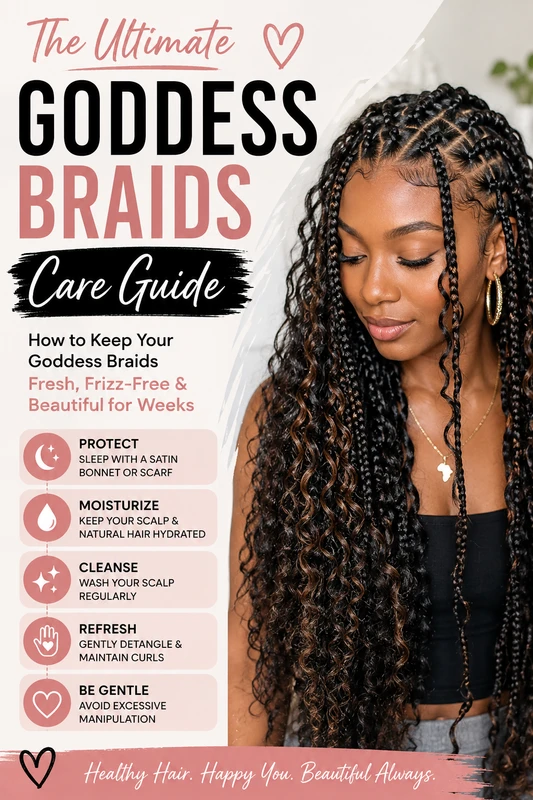
Goddess braids are one of the most beautiful protective hairstyles for Black women. They combine the neat, structured appearance of traditional braids with soft, flowing curls that create a romantic and effortless look. Whether you choose goddess knotless braids, goddess box braids, bohemian-inspired braids, or long goddess braids with curly pieces throughout, the finished style can be stunning.
However, goddess braids require a little more maintenance than traditional box braids.
The loose curly pieces that give goddess braids their signature appearance are also the parts most likely to tangle, frizz, dry out, and lose definition. Your natural hair and scalp underneath the braids also need attention if you want the style to function as a true protective hairstyle.
The good news is that maintaining goddess braids doesn't have to become a complicated daily routine.
With proper nighttime protection, gentle moisturizing, scalp care, curl maintenance, and smart washing techniques, you can keep your goddess braids looking fresh while protecting the natural hair underneath.
This complete Goddess Braids Care Guide explains how to maintain goddess braids, reduce frizz, care for the curly ends, keep your scalp comfortable, wash your braids safely, protect them while sleeping, and know when it's finally time to take them down.
What Are Goddess Braids?
The term "goddess braids" can describe several braided styles, but today it commonly refers to braids featuring loose curly or wavy pieces of hair.
The braids themselves may resemble knotless braids, box braids, or individual braids. Curly strands are intentionally left outside the braids at different points, especially toward the ends.
This creates a softer appearance than traditional braids.
Depending on the installation method, the curly pieces may be made from synthetic hair, human hair, or a combination of extensions and natural hair.
You'll often see goddess braids in:
- Waist-length styles
- Shoulder-length braids
- Knotless goddess braids
- Goddess box braids
- Medium goddess braids
- Small goddess braids
- Jumbo goddess braids
- Curly goddess braids
- Bob-length goddess braids
- Braids with loose curly ends
Because loose hair is incorporated into the style, goddess braids need slightly different maintenance than fully braided hairstyles.
Why Do Goddess Braids Require Extra Maintenance?
Traditional box braids contain most of the hair inside the braid.
Goddess braids deliberately leave sections loose.
Those loose sections can rub against clothing, pillows, other curls, and the braided portions of the hairstyle. This friction can gradually create tangles and frizz.
Curly synthetic extensions can be especially prone to tangling because individual fibers may catch against one another.
Human hair curls may feel softer and behave more naturally, but they still need maintenance to preserve their appearance.
Meanwhile, your scalp continues producing natural oils and collecting sweat, dead skin cells, and product residue.
That's why a good goddess braid maintenance routine should focus on three areas:
Your scalp.
Your natural hair underneath the braids.
The loose curls surrounding the braids.
Taking care of all three can help your protective style remain comfortable and attractive.
How to Prepare Your Natural Hair Before Getting Goddess Braids
Good goddess braid maintenance actually starts before your stylist installs the first braid.
Your natural hair may remain braided for several weeks, so starting with clean, conditioned hair can make maintaining the style easier.
1. Cleanse Your Hair Thoroughly
Wash your natural hair before your appointment.
Pay particular attention to your scalp.
You want to remove excess oil, styling products, sweat, and buildup before covering much of your hair with extensions.
If you've been using heavy oils, gels, butters, or edge-control products, you may benefit from a thorough cleansing shampoo.
You don't necessarily need to make your hair feel stripped or squeaky clean. The goal is simply to start with a clean scalp and clean strands.
2. Condition Your Hair
Follow shampooing with conditioner.
Braided hairstyles can expose natural hair to tension and friction, so you want your strands to feel conditioned and manageable before installation.
A moisturizing deep-conditioning treatment may also be helpful, particularly if your natural hair tends to become dry easily.
3. Detangle Carefully
Your hair should be thoroughly detangled before braiding.
Start at the ends and gradually work toward the roots.
Ripping through tangles immediately before a long-term protective style can create unnecessary breakage.
4. Stretch the Hair if Necessary
Some braiders prefer working with stretched natural hair because it allows them to create smoother sections and braids.
Stretching can be accomplished through methods such as:
- Banding
- African threading
- Large twists
- Large braids
- Low-heat blow-drying
If using heat, apply an appropriate heat protectant and avoid excessive temperatures.
5. Don't Overload Your Hair With Heavy Products
It's tempting to coat your natural hair in thick oils and butters before braiding because you know it will be tucked away.
More isn't always better.
Too much product can contribute to buildup underneath the braids.
Start with properly conditioned hair and use a reasonable amount of moisturizer or leave-in product instead of saturating the strands.
How to Care for Goddess Braids Daily
You don't need to spend an hour maintaining your goddess braids every morning.
A few minutes of gentle attention is often enough.
Your basic daily goddess braid routine can include checking the curls for tangles, lightly refreshing dry areas, and protecting the hairstyle from unnecessary friction.
Separate the Curls Gently
Loose curls can begin sticking together as you wear the style.
Use your fingers to gently separate curls that have started tangling.
Avoid aggressively pulling them apart.
If you find a knot, hold the hair above the knot to reduce pulling and carefully loosen it from the ends upward.
A small amount of lightweight product may help provide slip.
Avoid Constantly Touching Your Braids
It's easy to play with fresh braids throughout the day.
Unfortunately, constant touching creates friction.
Your hands can also transfer oil and other residue to your hairstyle.
Enjoy your braids, but avoid unnecessarily twisting, pulling, separating, or running your fingers through the curls all day.
Be Careful With Clothing
Long goddess braids frequently rub against:
- Sweaters
- Hoodies
- Jackets
- Scarves
- Coat collars
This friction can make the curly sections frizzy faster.
When possible, move long braids away from rough fabrics.
Smooth fabrics tend to create less friction.
How to Moisturize Goddess Braids
Your natural hair can still become dry underneath goddess braids.
A lightweight moisturizing routine can help without coating your scalp and extensions in excessive product.
Use a Lightweight Moisturizing Spray
A water-based moisturizing spray is convenient for braided hairstyles.
Lightly mist the braided portions where your natural hair is contained.
You don't need to soak the braids.
Focus on keeping your natural hair comfortable rather than making the extensions extremely wet every day.
Pay Attention to Your Natural Hair
Remember that moisturizing your extensions isn't the same thing as moisturizing your natural hair.
Your primary concern should be the strands hidden inside the braids.
Apply products lightly enough that they can reach your natural hair without causing excessive buildup.
Don't Drench Your Braids Every Day
More moisture isn't automatically better.
Repeatedly soaking goddess braids can make the hairstyle take longer to dry and may contribute to frizz or buildup.
Use enough product to address dryness without saturating your entire hairstyle.
How to Keep Goddess Braids From Frizzing
Some frizz is inevitable.
Goddess braids are designed to have loose curls, and those curls naturally become less polished with wear.
However, you can slow the process significantly.
Sleep With Satin or Silk Protection
Nighttime friction is one of the biggest contributors to frizz.
Sleeping directly on cotton bedding allows your braids and curls to rub against the pillow for several hours every night.
Instead, use:
- A satin bonnet
- A satin scarf
- A silk scarf
- A satin pillowcase
- A silk pillowcase
A large bonnet is especially useful for long goddess braids because it gives the curls enough room without crushing them excessively.
Minimize Manipulation
The more you restyle your braids, the more friction they experience.
Constantly switching between high buns, ponytails, half-up styles, and other arrangements may cause the roots and curls to look worn faster.
There's nothing wrong with styling your goddess braids.
Just avoid excessive daily manipulation.
Don't Use Too Much Product
Heavy products can make the curls sticky.
Once the hair becomes sticky, lint and other strands can attach to it more easily.
Lightweight products generally work better for goddess braids.
Trim Only Obvious Frizz Carefully
Some people lightly trim stray synthetic fibers from braided sections.
Be extremely careful.
Your natural hair is inside the braid.
You don't want to accidentally cut your own strands.
If you're unsure whether a strand is your natural hair, leave it alone.
How to Maintain the Curly Pieces in Goddess Braids
The curls are usually the highest-maintenance portion of goddess braids.
How you maintain them depends partly on whether your stylist used synthetic or human hair.
Finger-Detangle the Curls
Avoid aggressively brushing through the curls.
Instead, divide the hairstyle into manageable sections.
Start with one curl or small group of curls.
Use your fingers to gently separate tangles from the bottom upward.
If necessary, apply a small amount of lightweight detangling product.
Patience is important.
Pulling tangles apart quickly can turn defined curls into frizz.
Human Hair Goddess Braids
Human hair curls generally offer more styling flexibility.
Depending on the specific extensions, you may be able to:
- Wet them
- Condition them
- Detangle them
- Apply curl products
- Redefine them
- Use appropriate heat styling
Always follow the manufacturer's care instructions for the extension hair you're wearing.
Human hair isn't automatically maintenance-free. It can still become tangled or dry if neglected.
Synthetic Goddess Braids
Synthetic curls may require a different approach.
Some synthetic fibers respond poorly to certain products or heat.
Don't assume you can use hot tools on synthetic goddess braid curls.
Check whether the extension hair is heat-safe before applying heat.
When in doubt, focus on gentle finger detangling and minimal manipulation.
How to Sleep With Goddess Braids
Your nighttime routine can make a major difference in how long goddess braids look fresh.
Don't simply throw your braids behind your head and sleep directly on them.
Step 1: Separate the Hair
Before bed, gently separate any curls that have begun tangling.
You don't need to fully detangle your entire head every night.
Focus on obvious problem areas.
Step 2: Gather the Braids Loosely
Depending on the length, you can loosely gather the braids so they aren't moving freely underneath you throughout the night.
Avoid creating an extremely tight ponytail.
Your scalp deserves a break from tension.
Step 3: Cover the Style
Use a large satin or silk bonnet.
For very long braids, an extra-long bonnet can be helpful.
You can also use a satin scarf around the hairline to keep the roots neat.
Step 4: Use a Satin Pillowcase as Backup
Bonnets occasionally come off while you're sleeping.
A satin pillowcase provides another layer of protection.
The combination of a bonnet and satin pillowcase is especially useful if you're an active sleeper.
How to Keep the Roots of Goddess Braids Looking Fresh
As your natural hair grows, your braids will naturally become looser at the roots.
That's normal.
You can't permanently prevent new growth.
However, you can avoid making the roots look prematurely messy.
Protect Your Hairline at Night
Tie a satin or silk scarf gently around your edges and roots.
This can reduce nighttime friction.
Use Edge Control Sparingly
Edge control can make your hairline look polished.
But applying thick layers every day can create buildup.
Use a small amount when needed.
Avoid Constant Tight Ponytails
Pulling your goddess braids tightly backward can place additional stress around the hairline.
Your braids don't need to look freshly installed every day.
A slightly relaxed root is preferable to repeatedly creating excessive tension.
How to Care for Your Scalp With Goddess Braids
A healthy goddess braid routine shouldn't focus exclusively on appearance.
Your scalp matters too.
Because the hair is sectioned, braids make the scalp relatively easy to access.
Take advantage of that accessibility.
Keep the Scalp Clean
Sweat, oil, dead skin cells, and styling products can accumulate between the braids.
If your scalp needs cleansing, clean it.
Don't assume that washing will automatically ruin your protective style.
Avoid Scratching With Sharp Objects
When your scalp itches, don't dig underneath the braids with fingernails, combs, hairpins, or other sharp objects.
Aggressive scratching can irritate the scalp.
Instead, address the reason for the itching and use gentle fingertip pressure when necessary.
Use Scalp Products Lightly
Oils can be useful when they fit your hair-care routine, but your scalp doesn't necessarily need to be drenched in oil every day.
Too much product may contribute to buildup.
Apply small amounts and monitor how your scalp responds.
Can You Wash Goddess Braids?
Yes.
Goddess braids can be washed carefully when needed.
Some people avoid washing braided hairstyles because they're worried about frizz.
But keeping a hairstyle perfectly smooth shouldn't come at the expense of scalp cleanliness.
The frequency depends on your lifestyle and scalp.
Someone who exercises frequently or sweats heavily may need cleansing sooner than someone with a less active routine.
How to Wash Goddess Braids
Step 1: Dilute Your Shampoo if Helpful
Mixing shampoo with water can make it easier to distribute along the scalp without depositing concentrated shampoo in one location.
Step 2: Focus on the Scalp
Apply cleanser between the braid sections.
Massage gently with the pads of your fingers.
Don't aggressively scratch.
Step 3: Let the Suds Travel Down
You don't need to scrub every inch of every braid.
Allow the cleanser and water to move down the length while rinsing.
Step 4: Handle the Curls Carefully
Avoid piling the loose curls on top of your head and rubbing them together.
That can create tangles.
Keep the hair moving mostly in a downward direction.
Step 5: Rinse Thoroughly
Leftover shampoo can contribute to residue and discomfort.
Take your time rinsing.
Step 6: Remove Excess Water
Gently squeeze excess water from the braids.
Don't aggressively wring or rub them.
Step 7: Dry Completely
This step is extremely important.
Braids can hold water.
Give your hairstyle enough time to dry thoroughly.
Don't repeatedly go to sleep with wet braids.
How Often Should You Wash Goddess Braids?
There isn't one universal washing schedule.
Some people may cleanse their scalp approximately every one to two weeks while wearing braids, while others need a different schedule based on sweating, buildup, scalp comfort, exercise, and product use.
Instead of following the calendar blindly, pay attention to your scalp.
Possible signs that cleansing may be needed include:
- Noticeable buildup
- Excess oil
- Sweat accumulation
- Flaking
- Unpleasant odor
- A scalp that simply feels dirty
If you regularly exercise while wearing goddess braids, you may need to cleanse or refresh your scalp more frequently.
How to Exercise With Goddess Braids
You don't have to stop exercising because you're wearing braids.
Before exercising, keep long braids away from your face and body using a loose arrangement.
After exercising, don't immediately cover a sweaty scalp with a heavy hat or tight bonnet for the rest of the day.
Give your scalp an opportunity to dry.
If you sweat heavily, adjust your cleansing routine accordingly.
How to Shower With Goddess Braids
If you're taking a normal shower and aren't washing your hair, use a large shower cap.
Make sure all of the loose curls are tucked inside.
Steam isn't necessarily disastrous, but repeatedly exposing the hairstyle to unnecessary moisture can encourage frizz.
If your braids accidentally get wet, allow them to dry thoroughly.
Can You Swim With Goddess Braids?
You can swim while wearing goddess braids, but swimming adds additional maintenance.
Chlorinated and salt water can affect both your natural hair and extension hair.
After swimming, rinse or cleanse appropriately rather than allowing pool or ocean residue to remain on the hair and scalp for days.
Be especially careful with the loose curls.
Water can cause them to tangle together.
Separate and detangle them gently after swimming.
How to Refresh Goddess Braids
After a few weeks, goddess braids may still be wearable even though they no longer look freshly installed.
A refresh can help.
Clean the Scalp
Removing visible buildup can immediately improve the overall appearance.
Refresh the Hairline
Your stylist may be able to redo a small number of braids around the perimeter.
This can dramatically improve the appearance without reinstalling the entire hairstyle.
Refresh the Curls
Gently detangle and redefine loose curls using a method appropriate for your extension hair.
Apply Mousse if Appropriate
A lightweight styling mousse is sometimes used to smooth braided hairstyles.
Avoid applying excessive amounts.
Tie Down the Roots
After refreshing, gently tying the hairline with a satin scarf can help create a neater appearance.
How Long Do Goddess Braids Last?
Goddess braids commonly last several weeks, but there's no exact number that applies to everyone.
How long they remain attractive and comfortable depends on factors including:
- Installation quality
- Braid size
- Extension hair quality
- Your natural hair texture
- Hair growth
- Exercise habits
- Nighttime protection
- Curl maintenance
- Product use
- Scalp condition
- Lifestyle
The loose curls often begin looking worn before the braided portions do.
That's normal.
The goal shouldn't be keeping goddess braids indefinitely.
Protective hairstyles should protect your natural hair—not simply remain installed for as long as physically possible.
Signs It's Time to Remove Goddess Braids
Eventually, refreshing the style stops being worthwhile.
Consider taking your braids down when you notice excessive new growth, heavy buildup, severe tangling, significant matting around the roots, persistent discomfort, or difficulty maintaining the style.
You should also remove braids if they're creating excessive tension or damaging your natural hair.
Don't sacrifice your natural hair simply to get another week out of the hairstyle.
Common Goddess Braid Mistakes
Mistake 1: Sleeping Without Protection
This can cause the curls and braided sections to become frizzy faster.
Better approach: Wear a satin or silk bonnet or scarf.
Mistake 2: Applying Too Much Oil
Drenching your scalp in oil doesn't guarantee healthier hair.
Better approach: Use products strategically and avoid unnecessary buildup.
Mistake 3: Ignoring the Curls Until They're Completely Tangled
Small tangles can become larger mats.
Better approach: Gently separate problem areas regularly.
Mistake 4: Pulling Braids Into Tight Hairstyles
Heavy extensions combined with tight styling can create unnecessary tension.
Better approach: Choose loose, comfortable styles.
Mistake 5: Avoiding Shampoo for the Entire Style
A dirty scalp doesn't become healthier simply because you're wearing a protective hairstyle.
Better approach: Clean your scalp when needed.
Mistake 6: Sleeping With Wet Braids
Thick braids can take a long time to dry.
Better approach: Give washed braids enough time to dry thoroughly before bed.
Mistake 7: Cutting Frizz Carelessly
Your natural hair may be mixed into the braid.
Better approach: Never cut a strand unless you're certain it isn't your natural hair.
Mistake 8: Leaving Goddess Braids in Too Long
Longer isn't always better.
Better approach: Remove the hairstyle when your natural hair needs attention.
Simple Goddess Braids Maintenance Routine
You don't need dozens of products to maintain goddess braids.
A straightforward routine is usually more practical.
Daily
Check the loose curls for obvious tangles.
Separate them gently when necessary.
Avoid excessive touching and tight hairstyles.
At Night
Loosely gather your braids.
Cover them with a satin or silk bonnet or scarf.
Use a satin pillowcase as additional protection.
As Needed
Lightly moisturize your natural hair.
Apply a small amount of scalp product if it works for your routine.
Refresh curls carefully.
Clean visible buildup.
After Heavy Sweating
Allow the scalp to dry.
Cleanse when necessary.
Every Week
Take a closer look at your scalp, roots, curls, and hairline.
Ask yourself:
Is there buildup?
Are the curls tangling?
Does my scalp feel comfortable?
Are any braids pulling?
Does my natural hair feel excessively dry?
This quick check can help you address problems before they become worse.
Best Products for Maintaining Goddess Braids
You don't need an overflowing bathroom cabinet.
A basic goddess braid care kit might include:
- Satin or silk bonnet
- Satin or silk scarf
- Satin pillowcase
- Lightweight moisturizing spray
- Gentle shampoo
- Lightweight scalp product
- Styling mousse
- Edge control
- Detangling product
- Large shower cap
The exact products you choose should depend on your natural hair, scalp, and the type of extensions used.
The key is avoiding unnecessary product layering.
How to Take Goddess Braids Down Safely
Removing your braids deserves just as much patience as maintaining them.
Don't rush.
Cut Extensions Carefully
If cutting the extension hair to make removal faster, make absolutely sure you're cutting well below the length of your natural hair.
When uncertain, don't cut.
Unravel Each Braid
Work from the bottom upward.
Avoid ripping through tangled sections.
Detangle Shed Hair
Natural hair sheds every day.
When your hair is braided for several weeks, many shed strands remain trapped inside the braids.
Seeing a significant amount of shed hair during takedown can therefore be normal.
Before shampooing, carefully remove loose shed strands and tangles.
Detangle in Sections
Divide your hair into manageable sections.
Apply a detangling product with good slip if needed.
Work from the ends upward.
Shampoo Thoroughly
After wearing a long-term protective hairstyle, your hair and scalp may have accumulated oils and product residue.
Cleanse thoroughly.
Condition
Follow cleansing with conditioner.
A deep-conditioning treatment may be helpful if your hair feels dry after takedown.
Give Your Hair Attention
Don't automatically rush into another tight protective hairstyle.
Take time to evaluate your scalp, edges, and strands.
Goddess Braids FAQs
How do I keep goddess braids looking fresh?
Protect them at night with satin or silk, minimize manipulation, maintain the loose curls, keep the scalp clean, and avoid excessive product buildup.
How do I stop goddess braid curls from tangling?
Separate the curls gently before major tangles develop. Reduce friction at night and avoid constantly manipulating the loose hair.
Should I oil my scalp with goddess braids?
You can use a scalp oil if it works well for your hair-care routine, but you don't need to saturate your scalp. Use small amounts and avoid excessive buildup.
Can I wash goddess braids?
Yes. Focus shampoo on your scalp, rinse thoroughly, handle the loose curls carefully, and allow the braids to dry completely.
Can goddess braids get wet?
They can get wet, but repeated unnecessary soaking may increase frizz and tangling. Dry them thoroughly whenever they become wet.
How do I sleep with goddess braids?
Loosely gather the braids and place them inside a large satin or silk bonnet. A satin pillowcase provides additional protection.
How often should I moisturize goddess braids?
There's no universal schedule. Lightly moisturize your natural hair when it feels necessary rather than automatically saturating the braids every day.
Why are my goddess braids getting frizzy?
Friction, sleeping without protection, manipulation, humidity, washing, new growth, and normal wear can all contribute to frizz.
Can I put mousse on goddess braids?
A lightweight mousse may help smooth the braided portions of the hairstyle. Use it sparingly to avoid unnecessary buildup.
Are goddess braids a protective hairstyle?
They can be. The hairstyle protects much of your natural hair from daily manipulation, but it stops being protective if the braids are installed too tightly, kept in excessively long, or poorly maintained.
Final Thoughts: Keep Your Goddess Braids Beautiful Without Neglecting Your Natural Hair
Goddess braids are beautiful because they combine the convenience of braids with the softness and movement of loose curls.
Those curls require extra attention, but maintaining the style doesn't need to become complicated.
The most important steps are simple:
Protect your goddess braids at night.
Keep the scalp clean.
Moisturize your natural hair when necessary.
Handle the loose curls gently.
Avoid excessive tension.
Minimize unnecessary manipulation.
Dry the hairstyle thoroughly after washing.
And take the braids down when it's time.
Most importantly, remember why you chose a protective hairstyle in the first place.
Your natural hair underneath the goddess braids should remain the priority.
A hairstyle can look beautiful on the outside while the natural hair underneath becomes dry, tangled, or stressed. A proper goddess braid care routine addresses both.
When you protect your hair at night, maintain a clean scalp, gently care for the curly pieces, and pay attention to how your natural hair feels, you can enjoy gorgeous goddess braids while supporting healthier hair-care habits.
Whether you're wearing long goddess knotless braids, goddess box braids, medium goddess braids, or a shorter curly style, consistency makes the biggest difference.
A few minutes of care today can prevent hours of detangling later.
Treat your goddess braids gently, protect your natural hair underneath, and enjoy your style for as long as it remains comfortable, healthy, and beautiful.