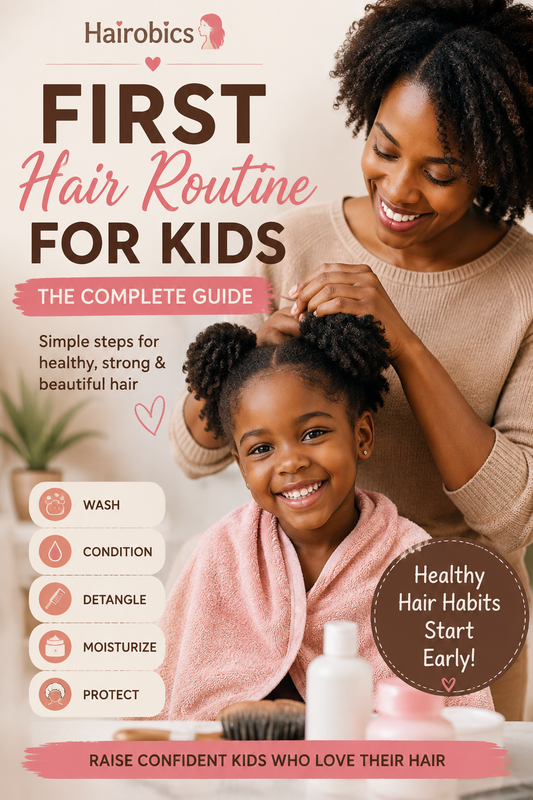
Creating your child’s first hair routine can feel like a big milestone. Whether your child has soft curls, tight coils, an afro, waves, locs, or a combination of textures, establishing healthy hair habits early can make caring for their hair easier as they grow.
A good first hair routine for kids does not need to involve dozens of products or complicated hairstyles. In fact, children’s hair care is often best when it is kept simple.
The basic goals are straightforward:
- Keep the scalp clean.
- Keep the hair moisturized.
- Detangle gently.
- Minimize unnecessary breakage.
- Protect the hair during sleep and play.
- Avoid excessive tension.
- Teach children positive hair-care habits.
For Black children and kids with naturally curly, coily, or textured hair, moisture and gentle handling are especially important. Curly and coily strands can be more susceptible to dryness and mechanical breakage, particularly when hair is repeatedly combed, brushed, pulled, or styled.
The right routine can help make wash day easier while teaching your child that caring for their natural hair is a normal and positive part of self-care.
This complete guide explains how to build a first hair routine for kids, including washing, conditioning, detangling, moisturizing, styling, nighttime protection, scalp care, and common mistakes parents should avoid.
What Is a Good First Hair Routine for Kids?
A simple kids’ hair routine usually consists of five basic steps:
- Cleansing
- Conditioning
- Detangling
- Moisturizing
- Protecting or styling
You don't necessarily have to perform every step every day.
Washing and conditioning may happen weekly or according to your child's individual needs, while moisturizing and nighttime protection can be done more frequently.
The ideal schedule depends on factors such as:
- Hair texture
- Hair density
- Hair length
- Activity level
- Scalp condition
- Weather
- Hairstyle
- How quickly the hair becomes dry
- How much the child sweats
Instead of following a rigid schedule, parents should learn to observe their child's hair.
If the scalp looks dirty or has significant buildup, it may be time to wash it.
If the hair feels rough and dry, it may need moisture.
If the ends are constantly tangling, they may require additional conditioning, gentler detangling, or a trim.
A routine should respond to what the child's hair actually needs.
Why Kids Need a Consistent Hair Routine
Consistency is one of the most important parts of children's hair care.
Healthy-looking hair usually isn't the result of one miracle product. It is the result of repeatedly taking care of the hair and avoiding practices that cause unnecessary damage.
A consistent routine can help parents maintain cleanliness, moisture and manageability.
It can also make hair care more predictable for children.
Instead of suddenly spending several hours detangling badly tangled hair, regular maintenance can prevent some of those problems from developing.
This becomes especially important as children's hair grows longer.
Longer curly and coily hair can become tangled relatively quickly when left loose for extended periods.
Regular moisturizing, detangling and protective styling can make maintenance much easier.
Understanding Your Child's Hair
Before creating a routine, spend some time learning how your child's hair behaves.
You don't have to become obsessed with determining an exact curl type.
Understanding practical characteristics is usually more useful.
Pay attention to:
Texture
Does your child have:
- Straight hair?
- Wavy hair?
- Loose curls?
- Tight curls?
- Coils?
- Kinks?
- Multiple textures?
Many children have more than one curl pattern on their head.
For example, curls near the front may be looser than the hair near the crown.
That is completely normal.
Density
Density refers to how much hair grows on the scalp.
Some children have very dense hair, while others naturally have less dense hair.
Dense hair often benefits from being divided into sections during washing and detangling.
Strand Thickness
Individual strands may be:
- Fine
- Medium
- Coarse
Fine strands may require especially gentle handling because they can break relatively easily.
Dryness
Observe how quickly the hair feels dry after moisturizing.
Some children's hair stays soft for several days.
Other children's hair may need refreshing sooner.
Tangle Patterns
Pay attention to where tangles develop most often.
Common areas include:
- The nape
- Crown
- Ends
- Behind the ears
Knowing these trouble areas allows you to give them extra attention during detangling.
When Should Kids Start a Hair Routine?
There isn't one exact age when every child needs to begin a formal hair routine.
Hair care begins in infancy, but the routine changes as children grow.
Babies generally need very simple scalp and hair care.
As hair becomes longer, thicker and more textured, parents can gradually introduce additional steps such as conditioning, detangling and protective styling.
A young child's routine should remain gentle.
There is usually no reason to overload children's hair with numerous styling products.
The priority should be maintaining a healthy scalp and manageable hair.
Step 1: Create a Regular Wash-Day Schedule
Washing is the foundation of a healthy hair routine.
The scalp naturally accumulates:
- Sweat
- Oil
- Dead skin
- Dirt
- Environmental debris
- Styling-product residue
Children may accumulate sweat relatively quickly because they are active.
Running, playing outside, participating in sports and sleeping can all contribute to scalp buildup.
Regular cleansing helps remove that buildup.
How Often Should You Wash a Child's Hair?
There is no universal schedule.
Some children may do well with washing approximately once a week, while others may need washing more or less frequently.
A child's scalp and lifestyle should determine the schedule.
For example, a child who participates in sports several times per week may need more frequent cleansing than a child with a less active routine.
Watch for signs that washing may be needed:
- Visible buildup
- Excessive oil
- Dirt
- Sweat
- Unpleasant scalp odor
- Flaking associated with product buildup
- Hair that feels coated
Avoid delaying washing solely because you want a hairstyle to last longer.
Scalp cleanliness should take priority.
How to Wash Kids' Natural Hair
Wash day can become overwhelming when a child has thick or long natural hair.
Sectioning can make the process much easier.
Divide the hair into approximately four to eight sections depending on thickness and length.
Loosely twist or clip each section.
Then work through the sections systematically.
Step 1: Wet the Hair
Use comfortably warm water rather than extremely hot water.
Make sure the hair becomes thoroughly wet.
Step 2: Apply Shampoo Primarily to the Scalp
Focus cleansing on the scalp where oil, sweat and buildup accumulate.
Massage gently with your fingertips.
Avoid aggressively scratching the scalp with fingernails.
Step 3: Rinse Thoroughly
Allow the shampoo and water to travel through the length of the hair.
Step 4: Repeat If Necessary
If the scalp has substantial buildup, a second gentle cleanse may be helpful.
Otherwise, one thorough wash may be sufficient.
Step 2: Condition the Hair
Conditioning is especially important for curly and coily children's hair.
Shampoo removes dirt and buildup, but hair may feel less slippery after cleansing.
Conditioner helps improve softness and manageability.
This can make detangling considerably easier.
Apply conditioner throughout the hair, paying particular attention to the lengths and ends.
The oldest part of the hair is at the ends, so those areas frequently require additional care.
Should Kids Use Deep Conditioner?
Deep conditioning does not necessarily need to be part of every child's routine.
However, it can occasionally be useful for hair that feels especially dry or difficult to manage.
Always choose products appropriate for the child's age and follow the manufacturer's directions.
More conditioning is not automatically better.
The objective is soft, manageable hair—not coating the hair with excessive amounts of product.
Step 3: Detangle Gently
Detangling is one of the most important parts of a natural hair routine for kids.
It is also one of the steps most likely to cause unnecessary breakage when performed aggressively.
Never treat detangling like a race.
The goal is to separate tangled strands while preserving as much hair as possible.
Never Aggressively Comb Dry, Tangled Hair
Trying to force a comb through dry, tangled curls can lead to:
- Breakage
- Snapping
- Unnecessary discomfort
- Frayed ends
- Hair-care anxiety
Instead, detangle when the hair has adequate moisture and slip.
Conditioner can provide excellent slip during wash day.
How to Detangle a Child's Natural Hair
Start by dividing the hair into manageable sections.
Take one section and hold the hair gently.
Begin working through tangles near the ends.
Gradually move upward toward the roots.
This is generally easier on the hair than immediately pulling a comb from the roots all the way through tangled ends.
You can begin with your fingers before using a tool.
Finger detangling allows you to feel knots before pulling through them.
After removing larger tangles, use an appropriate detangling brush or wide-tooth comb if needed.
Make Detangling Comfortable
Children may develop negative feelings about hair care if every wash day involves excessive pulling and discomfort.
Try to create a calm environment.
Depending on the child's age, they might:
- Watch a favorite show.
- Listen to music.
- Read a book.
- Play with a toy.
- Take short breaks.
Patience is more important than speed.
If you become frustrated, taking a brief break can be better than rushing through difficult tangles.
Step 4: Moisturize Your Child's Hair
Moisture is particularly important for naturally curly and coily hair.
Natural scalp oils can have difficulty traveling along highly curved strands.
As a result, the lengths and ends may feel dry even when the scalp is producing oil normally.
This doesn't mean the hair is unhealthy.
It means the routine may need to help maintain moisture throughout the strand.
Water Is an Important Source of Moisture
Parents sometimes think oils alone moisturize hair.
Oil and water serve different purposes.
Water provides hydration, while oils and conditioning products can help reduce moisture loss and improve lubrication.
If your child's hair feels extremely dry, simply adding more oil may not solve the underlying problem.
A water-based moisturizing product may be more useful.
A Simple Moisturizing Routine for Kids
After washing:
- Start with damp hair.
- Apply an age-appropriate leave-in conditioner or moisturizer if needed.
- Distribute it throughout the hair.
- Pay attention to the ends.
- Use a small amount of suitable oil or styling product if desired.
- Style gently.
You do not need five or six layers of products.
Start simple.
Add products only when they have a clear purpose.
How Often Should You Moisturize Kids' Hair?
There is no universal answer.
Some children may need refreshing every few days.
Others may maintain soft hair for considerably longer.
Touch the hair.
If it still feels:
- Soft
- Flexible
- Smooth
- Manageable
you may not need to add anything.
If it feels:
- Rough
- Brittle
- Very dry
- Difficult to manipulate
it may need moisture.
The goal isn't to follow social-media routines exactly.
It is to understand your child's hair.
Step 5: Choose Simple Hairstyles
Children's hairstyles should be practical, comfortable and age appropriate.
There are many possibilities for natural hair.
Popular styles include:
- Two-strand twists
- Braids
- Puffs
- Ponytails
- Buns
- Cornrows
- Afro styles
- Flat twists
The most important consideration isn't simply how beautiful a style looks.
It is how the hairstyle affects the hair and scalp.
Avoid Excessively Tight Hairstyles
A hairstyle should not cause significant pain.
Watch for:
- Bumps around the hairline
- Extreme scalp tenderness
- Redness
- Headaches
- Excessive pulling around the edges
- Difficulty sleeping because of the hairstyle
These can indicate excessive tension.
Repeated pulling can damage fragile hair around the hairline.
Children's edges should be handled especially carefully.
A style does not need to be extremely tight to look neat.
Protect Your Child's Edges
The hairline is often one of the most fragile areas.
Avoid repeatedly pulling the same areas into tight ponytails or braids.
Rotate hairstyles when possible.
For example:
Week 1: twists
Week 2: loose puffs
Week 3: braids
Week 4: another low-manipulation style
Changing where tension occurs can help reduce repetitive stress on the same strands.
What Is Protective Styling for Kids?
Protective styling generally refers to hairstyles designed to reduce daily manipulation and help keep the ends of the hair protected.
Examples can include:
- Two-strand twists
- Braids
- Cornrows
- Flat twists
- Simple tucked styles
Protective styles can be convenient for school because parents do not need to completely restyle the hair every morning.
However, a hairstyle is not truly protective if it creates excessive tension or is left in too long without appropriate scalp and hair care.
Don't Leave Kids' Hairstyles in Too Long
It can be tempting to leave braids or twists in for as long as possible.
But children's scalps still need care.
Hair also continues to shed naturally while the style is installed.
Over time, shed hairs, lint, product residue and tangles can accumulate.
How long a hairstyle should remain installed depends on the style and the child's hair.
Instead of following an arbitrary number of weeks, monitor the condition of the hair and scalp.
If the style is extremely frizzy, tangled, dirty, uncomfortable or causing buildup, it may be time to take it down.
Step 6: Create a Nighttime Hair Routine
A child's nighttime routine can make mornings significantly easier.
Hair repeatedly rubbing against bedding can become tangled and frizzy.
For curly and coily hair, nighttime protection may help preserve hairstyles and reduce friction.
Options include:
- Satin bonnet
- Satin scarf
- Satin pillowcase
The best choice depends on the child's age, comfort and safety.
Always use sleep accessories that are appropriate for your child's age and follow relevant child-safety guidance.
Simple Night Routine for Kids
For older children, a nighttime routine might look like this:
- Check the hair for excessive dryness.
- Lightly moisturize only if needed.
- Loosely secure long hair if necessary.
- Put on a comfortable satin bonnet.
- Sleep on a satin pillowcase as additional protection.
You don't necessarily need to restyle the entire head every night.
The purpose is to reduce unnecessary manipulation.
Step 7: Develop a Simple Morning Routine
School mornings can become chaotic.
A good hairstyle and nighttime routine can reduce the amount of work required.
The morning routine might involve:
- Removing the bonnet
- Gently fluffing the hair
- Refreshing a few dry sections
- Smoothing flyaways
- Repositioning twists or braids
- Re-creating puffs or ponytails
Avoid soaking the hair with multiple products every morning unless necessary.
If the hair still feels moisturized, leave it alone.
Sample Weekly Hair Routine for Kids
Here is a simple schedule that parents can modify.
Sunday — Wash Day
Cleanse the scalp.
Condition the hair.
Detangle in sections.
Apply moisturizer.
Style the hair.
Monday — Minimal Manipulation
Remove nighttime protection.
Refresh only where necessary.
Tuesday — Moisture Check
Feel the hair.
Add a small amount of moisture only if needed.
Wednesday — Scalp and Style Check
Inspect the scalp.
Check the hairstyle for excessive tension or tangles.
Thursday — Light Refresh
Refresh dry sections if needed.
Friday — Low-Manipulation Day
Avoid unnecessary combing.
Saturday — Prepare for Wash Day
Take down old styles if necessary.
Finger-detangle carefully.
Prepare for the next wash.
This is only an example.
Your child's routine should be customized to their needs.
Hair Routine for Black Kids
A Black kids hair routine should focus heavily on moisture, gentle handling and avoiding excessive tension.
Black hair can include a huge range of textures.
One child may have loose curls while another has tightly coiled strands.
Even siblings can have dramatically different hair.
Do not assume one routine will work perfectly for every child.
The fundamentals, however, remain similar:
Cleanse + Condition + Detangle + Moisturize + Protect
Everything else can be customized.
Hair Routine for Kids With 4C Hair
Children with tightly coiled hair may experience substantial shrinkage and tangling.
Shrinkage is a normal characteristic of curly and coily hair.
It doesn't automatically mean the hair isn't growing.
For highly coiled hair, working in sections can be particularly useful.
Try keeping the hair sectioned during:
- Washing
- Conditioning
- Detangling
- Moisturizing
- Styling
This helps prevent freshly detangled sections from becoming tangled again.
Low-manipulation hairstyles such as twists can also make weekly maintenance easier.
Hair Routine for Kids With Curly Hair
Children with looser curls may not need the same styling routine as children with tightly coiled hair.
After washing and conditioning, parents may apply a lightweight leave-in or curl product and allow curls to form naturally.
Avoid constantly brushing curls once they are dry.
Excessive dry brushing can separate curl clumps and create frizz.
Instead, detangle primarily when the hair has sufficient moisture and slip.
Hair Routine for Boys
Boys' hair deserves the same attention to scalp health and gentle care.
A boy with an afro, curls, twists, braids or locs may benefit from a structured routine.
A simple routine could include:
- Regular cleansing
- Conditioning
- Moisturizing
- Gentle detangling
- Nighttime protection
For boys with short hair, maintenance may be relatively quick.
As hair grows longer, sectioning and detangling become increasingly useful.
Kids With Locs
Children with locs require a routine tailored to their hairstyle.
The scalp should still be cleaned regularly.
Locs should be thoroughly dried after washing.
Avoid excessive buildup from heavy products.
Parents should also avoid overly tight retwisting.
The goal should be maintaining clean, comfortable locs rather than trying to make every strand look perfectly neat at all times.
Scalp Care for Kids
Healthy hair care begins with scalp care.
The scalp is skin and should be treated gently.
Keep it clean and avoid unnecessary scratching.
Be cautious about applying large amounts of heavy products directly to the scalp.
More oil does not necessarily mean a healthier scalp.
If your child experiences persistent itching, sores, significant flaking, hair loss, scalp pain, or other concerning symptoms, consult a qualified healthcare professional rather than trying to solve the problem solely with cosmetic hair products.
How Much Product Should You Use?
One of the most common mistakes is using too much product.
Children's hair doesn't need to be saturated with oils, creams and gels every day.
Product buildup can make the hair feel coated and may require more cleansing.
Start with small amounts.
Add more only when needed.
Remember:
More product does not automatically equal more moisture.
Ingredients and Product Safety
Children can have sensitivities to cosmetic products just like adults.
Choose age-appropriate products and follow product directions.
Stop using a product if it appears to cause irritation.
Be particularly cautious around the eyes and face.
When introducing a new product, it can be useful to introduce one product at a time rather than changing the entire routine simultaneously.
This makes it easier to identify which product may be causing a problem.
Don't Build an Overly Complicated Routine
Social media can make natural hair care look incredibly complicated.
You might see routines involving:
- Pre-poo
- Shampoo
- Clarifying shampoo
- Conditioner
- Deep conditioner
- Leave-in
- Cream
- Oil
- Butter
- Gel
- Edge control
- Hair mist
A child usually does not need all of these products at once.
Start with the essentials.
A basic routine might require only:
- Gentle cleanser
- Conditioner
- Moisturizer or leave-in
- Detangling tool
- Styling product when necessary
- Nighttime protection
Simple routines are easier to maintain consistently.
Teach Your Child About Their Hair
Hair care is also an opportunity to teach children self-care.
As your child becomes older, involve them in the process.
You might teach them how to:
- Put on their bonnet.
- Separate their hair into sections.
- Moisturize their ends.
- Hold their hair while detangling.
- Recognize when their hair feels dry.
- Keep their scalp clean.
- Care for their hairstyle.
Eventually, they can take increasing responsibility for their routine.
Make Hair Care Positive
Children absorb messages about their appearance very early.
Avoid describing their hair as:
- Bad
- Unmanageable
- Ugly
- Too nappy
- Impossible
Instead, use neutral or positive language.
Hair can be:
- Thick
- Coily
- Curly
- Dense
- Soft
- Full
- Shrinkage-prone
- Delicate
When children hear adults complain about their hair constantly, they may begin associating their natural texture with something negative.
Hair care should teach confidence as well as maintenance.
Common Kids' Hair Care Mistakes
Even well-intentioned parents can develop habits that make hair maintenance more difficult.
Here are some of the most common mistakes.
Mistake #1: Detangling Too Aggressively
Forcing a brush through knots can cause unnecessary breakage.
Use moisture, slip, sections and patience.
Mistake #2: Making Every Hairstyle Extremely Tight
Tighter does not automatically mean better.
Comfort should be a priority.
Mistake #3: Using Too Much Product
Product buildup can make the hair harder to manage.
Use only what the hair needs.
Mistake #4: Ignoring the Scalp
Hair length should not distract from scalp cleanliness.
Mistake #5: Constantly Manipulating the Hair
Daily brushing, combing and restyling can increase mechanical stress.
Mistake #6: Neglecting Nighttime Protection
Nighttime friction can contribute to tangles and frizz.
Mistake #7: Ignoring the Ends
The ends are the oldest portion of the hair and can be particularly vulnerable to breakage.
Mistake #8: Comparing Siblings
Children can have completely different hair textures.
Build a routine around each child's actual hair rather than forcing everyone to follow exactly the same routine.
How to Reduce Breakage in Kids' Hair
Hair growth and length retention are not exactly the same thing.
Hair can grow from the scalp while simultaneously breaking at the ends.
If breakage occurs at a similar rate to growth, it may appear that the hair is not getting longer.
To help minimize avoidable breakage:
- Detangle gently.
- Avoid excessive heat.
- Limit tight hairstyles.
- Keep hair appropriately conditioned.
- Protect hair during sleep.
- Handle the ends carefully.
- Reduce unnecessary manipulation.
- Trim damaged ends when appropriate.
The goal is not to eliminate every shed hair.
Normal hair shedding occurs naturally.
The goal is to reduce preventable breakage.
Should Kids Use Heat?
Heat styling should generally be approached cautiously.
Children do not need regular flat ironing or blow-drying to maintain healthy hair.
When heat is used, parents should avoid excessive temperatures and repeated passes.
Keeping heat styling occasional can reduce unnecessary exposure to thermal stress.
Natural hair can be stretched without high heat through techniques such as:
- Twists
- Braids
- Banding
- Other gentle stretching methods
How Often Should Kids Get Their Hair Trimmed?
There is no universal trimming schedule.
Instead of automatically cutting the hair every few weeks or months, pay attention to its condition.
Possible signs that a trim may be helpful include:
- Split ends
- Excessive tangling at the ends
- Rough ends
- Uneven breakage
- Damaged ends
A professional stylist experienced with children's textured hair can help determine when trimming is appropriate.
Swimming and Kids' Hair
Swimming can affect children's hair because of exposure to pool chemicals or saltwater.
Before swimming, consider wetting the hair with clean water and using appropriate protection.
Protective styles may also make long natural hair easier to manage.
After swimming, rinse or cleanse the hair as appropriate rather than allowing pool water and residue to remain indefinitely.
Condition afterward when needed.
Kids' Hair Care During Sports
Active children may sweat heavily around the scalp.
If your child participates in:
- Soccer
- Basketball
- Football
- Dance
- Gymnastics
- Swimming
- Martial arts
- Track
you may need to adjust the wash schedule.
Don't rely exclusively on a fixed calendar.
If the scalp needs cleansing, cleanse it.
Winter Hair Routine for Kids
Cold weather and dry indoor environments can make some children's hair feel drier.
During winter, you may need to pay closer attention to moisture retention.
You might:
- Check moisture more frequently.
- Protect hair from rough hat materials.
- Use satin-lined hats when practical.
- Keep ends protected.
- Use low-manipulation styles.
Avoid automatically piling on heavy products.
Adjust based on how the hair actually feels.
Summer Hair Routine for Kids
Summer often means:
- Swimming
- Outdoor play
- Heat
- Humidity
- Sweat
The routine may require more frequent cleansing.
Simple braids and twists can be convenient during active summer months.
Just remember that protective styles still require scalp care.
School Hair Routine for Kids
School hairstyles should ideally be comfortable and practical.
Styles that can last several days may make mornings easier.
Examples include:
- Two-strand twists
- Braided ponytails
- Cornrows
- Flat twists
- Puffs
- Simple braids
Prepare as much as possible at night.
A five-minute morning refresh is much easier than completely detangling and restyling the hair before school every day.
Sample First Hair Routine for Kids
Parents looking for the simplest possible starting point can use this framework.
Wash Day
Step 1: Divide hair into sections.
Step 2: Wet thoroughly.
Step 3: Gently cleanse the scalp.
Step 4: Rinse completely.
Step 5: Apply conditioner.
Step 6: Detangle carefully from ends upward.
Step 7: Rinse as directed.
Step 8: Apply an age-appropriate moisturizer or leave-in if needed.
Step 9: Style gently.
Step 10: Protect the hairstyle at bedtime.
That's it.
Your child's routine does not need to be complicated to be effective.
What Products Do You Need for a Child's First Hair Routine?
You can begin with a relatively small collection.
Consider having:
1. Gentle Shampoo
For cleansing the scalp and removing buildup.
2. Conditioner
For softness, slip and easier detangling.
3. Leave-In or Moisturizer
Useful when the hair requires additional moisture after washing.
4. Wide-Tooth Comb
Helpful for section-by-section detangling.
5. Detangling Brush
Optional depending on your child's texture and preference.
6. Hair Clips
Helpful for keeping sections separated.
7. Satin Night Protection
For older children when age appropriate.
You can add styling products as necessary.
There is no need to purchase an enormous collection immediately.
How to Know Whether Your Child's Routine Is Working
You don't need to measure hair every week.
Instead, look for practical improvements.
A good routine may result in hair that is:
- Easier to detangle
- Softer
- More manageable
- Less prone to excessive tangling
- Experiencing less avoidable breakage
Wash day may also become easier.
If the routine consistently leaves the hair extremely dry, coated, tangled or difficult to manage, make adjustments.
Hair care is an ongoing process.
Frequently Asked Questions About Kids' Hair Routines
What is the best hair routine for kids?
A good basic routine includes regular cleansing, conditioning, gentle detangling, appropriate moisturizing and low-tension styling.
The exact products and frequency depend on the child's hair and scalp.
How often should I moisturize my child's natural hair?
Moisturize based on the condition of the hair rather than automatically adding product every day.
Check the hair regularly and refresh it when it begins feeling dry.
How often should Black kids wash their hair?
There isn't one schedule appropriate for every Black child.
Activity level, scalp condition, hairstyle and product use all affect how often cleansing is needed.
Should I oil my child's scalp every day?
Daily scalp oiling is not automatically necessary.
Adding excessive oil can contribute to buildup.
Focus on keeping the scalp clean and comfortable.
Should kids sleep with a bonnet?
Older children with curly, coily or textured hair may benefit from age-appropriate satin nighttime protection.
Parents should always consider the child's age, comfort and safety.
Why is my child's hair always dry?
Dryness can have many causes, including environmental conditions, cleansing practices, styling, product selection and the natural characteristics of curly or coily hair.
If dryness persists despite a reasonable routine or is accompanied by scalp symptoms, consult an appropriate professional.
Why does my child's hair keep breaking?
Possible contributors include aggressive detangling, excessive tension, frequent manipulation, heat damage and damaged ends.
Evaluate the entire routine rather than assuming one product will solve the problem.
Is protective styling good for kids?
It can be.
Braids, twists and similar styles can reduce daily manipulation when installed gently.
Avoid excessive tension and continue caring for the scalp.
Can kids use adult hair products?
Not every adult cosmetic product is appropriate for children.
Choose products suitable for your child's age and follow the manufacturer's directions.
What is the easiest hairstyle for kids' natural hair?
Two-strand twists are popular because they can be relatively easy to maintain and can reduce daily manipulation.
Puffs, simple braids and other low-tension styles can also work well.
Building Healthy Hair Habits for Life
Your child's first hair routine is about more than shampoo and conditioner.
It is an opportunity to build habits that may continue into adulthood.
Teach children that healthy hair care involves:
- Cleanliness
- Moisture
- Patience
- Gentle handling
- Consistency
- Scalp care
- Protection
Most importantly, teach them to appreciate their natural hair.
A child shouldn't grow up believing that their curls, coils, kinks, shrinkage or thickness are problems that need to be fixed.
They are simply characteristics of their hair.
Once you understand those characteristics, caring for the hair becomes much easier.
Final Thoughts: Creating the Best First Hair Routine for Kids
The best first hair routine for kids is usually the one that is simple enough to follow consistently.
You don't need ten products.
You don't need complicated styling techniques.
And you don't need to copy every routine you see online.
Start with the fundamentals:
Cleanse the scalp.
Condition the hair.
Detangle gently.
Maintain moisture.
Avoid unnecessary tension.
Protect the hair from excessive friction and manipulation.
Then observe your child's hair and make adjustments.
Some children need more frequent cleansing.
Some need additional moisture.
Some do better with twists.
Others do better with braids, puffs or loose curls.
There is no single routine that works for every child.
A successful kids' hair routine should make the hair easier to manage while keeping the scalp comfortable and teaching healthy hair-care habits.
Keep the process gentle, simple and positive.
Those habits can become the foundation for a lifetime of healthy hair care.