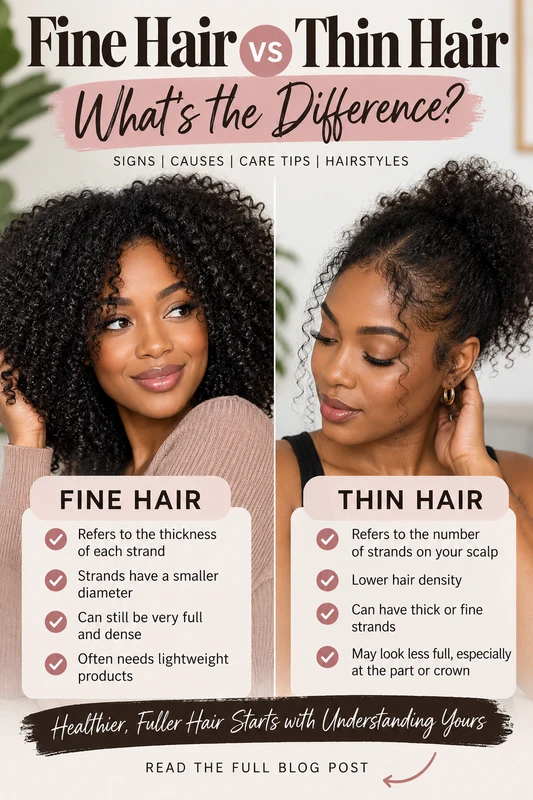
If you have ever looked at your hair and wondered whether it is fine, thin, or both, you are definitely not alone. The terms fine hair and thin hair are often used interchangeably, but they actually describe two different characteristics of your hair.
Fine hair refers to the diameter or thickness of each individual strand, while thin hair generally refers to how much hair you have on your scalp, also known as hair density.
That means someone can have fine strands but a lot of them, resulting in fine hair with high density. Another person may have thick, coarse individual strands but fewer of them, giving the appearance of thin or low-density hair.
Understanding this difference can completely change how you approach your hair-care routine. It can help you choose better products, avoid unnecessary breakage, create more volume, and understand why certain hairstyles work better for your hair than others.
For people with natural, curly, coily, or textured hair, recognizing the difference can be especially important because shrinkage, curl patterns, breakage, and styling techniques can make density difficult to judge.
In this complete guide, we'll explain fine hair vs thin hair, how to tell which one you have, what causes thinning, how to care for fine natural hair, and what you can do to help your hair look fuller and healthier.
What Is Fine Hair?
Fine hair describes the diameter of an individual strand of hair.
Every strand of hair has a certain width. Hair strands are generally described as:
- Fine
- Medium
- Coarse
If your individual strands have a relatively small diameter, your hair is considered fine.
This doesn't necessarily mean you don't have much hair.
You could have thousands of fine strands packed closely together, giving you very dense, full-looking hair.
This is one of the biggest misconceptions surrounding fine hair.
Fine hair does not automatically mean thinning hair.
A person with fine hair may actually have very high hair density.
What Is Thin Hair?
Thin hair usually refers to having fewer hairs growing within a particular area of the scalp.
This is related to hair density rather than individual strand thickness.
Imagine looking at two heads of hair.
One person has 100 individual strands growing within a small section of scalp.
Another person has only 50 strands growing within the same-sized area.
Even if their individual strands are exactly the same thickness, the second person's hair will generally look thinner because there are fewer strands.
This is why someone can have coarse hair strands and still have thin-looking hair.
Fine Hair vs Thin Hair: The Main Difference
The easiest way to remember the difference is:
Fine hair = strand diameter
Thin hair = number of strands
Fine hair describes how thick each individual strand is.
Thin hair describes how densely those strands grow across your scalp.
These characteristics can occur independently.
For example, you could have:
Fine hair + high density: Small individual strands but lots of them.
Fine hair + low density: Small strands and fewer hairs overall.
Coarse hair + high density: Thick strands and lots of them.
Coarse hair + low density: Thick strands but fewer hairs overall.
This explains why two people with the same curl pattern can have completely different-looking hair.
Is Fine Hair the Same as Low-Density Hair?
No.
Fine hair and low-density hair are not the same thing.
Hair density refers to approximately how closely hair strands are distributed across the scalp.
You can have fine hair and high density.
In fact, someone with extremely fine strands may still have very full-looking hair if they have enough strands.
Likewise, someone with coarse strands may have low-density hair.
Their individual strands may feel thick and strong, but you may be able to see their scalp more easily because fewer hairs are growing in each area.
This distinction becomes especially important when choosing products.
How to Tell If You Have Fine Hair
One of the easiest ways to determine whether you have fine hair is to examine a single strand.
Take a clean shed hair and gently roll it between your fingertips.
If the strand is difficult to feel, your hair may be fine.
If you can feel the strand but it isn't especially thick, you may have medium strands.
If the strand feels substantial or almost thread-like between your fingers, it may be coarse.
You can also visually inspect the strand against a contrasting background.
Fine strands may appear extremely delicate.
However, strand diameter can vary throughout your head.
It is completely normal to have some finer strands and some thicker strands.
Instead of judging your entire head based on one strand, examine hairs from several areas.
How to Tell If Your Hair Is Thin
Determining whether your hair is thin involves examining density rather than individual strands.
Stand in front of a mirror under normal lighting and look at your scalp while your hair is dry and relatively clean.
Part your hair in several locations.
Pay attention to how easily you can see your scalp.
With higher-density hair, the scalp may be difficult to see except along a deliberate part.
With lower-density hair, more scalp may be visible between strands.
Another useful method is comparing your hair over time.
If your hair has always had lower density, that may simply be your natural hair characteristic.
If your hair used to appear significantly fuller and now looks noticeably thinner, something may have changed.
That distinction matters.
Can You Have Both Fine and Thin Hair?
Absolutely.
Some people naturally have both fine strands and lower hair density.
Because each strand is small and there are fewer strands overall, this combination can make hair appear particularly delicate.
Fine, low-density natural hair often requires careful handling because excessive manipulation can cause breakage that makes the hair look even less dense.
Heavy products may also weigh the hair down, making the scalp more visible.
The goal isn't necessarily to make naturally fine hair become coarse.
Instead, the goal should be to protect the strands you have, maintain a healthy scalp, reduce unnecessary breakage, and style the hair in ways that work with its natural characteristics.
Can You Have Fine Hair That Looks Thick?
Yes.
This happens frequently.
Someone may have extremely fine individual strands but very high density.
When thousands of fine strands are packed closely together, the overall head of hair can appear extremely full.
Curly and coily textures can create even more visual volume.
Because curls expand outward rather than simply hanging straight down, fine natural hair can sometimes look surprisingly thick.
Once the hair becomes wet, however, the scalp may suddenly become more visible.
This doesn't necessarily mean the hair is thinning.
Water causes strands to group together, which can expose more scalp.
Why Does Natural Hair Look Thin When Wet?
Many people become concerned when they wash their natural hair and suddenly notice their scalp.
This can be completely normal.
Dry curls naturally occupy more space.
Once hair becomes wet, individual strands often clump together into curls or coils.
Instead of hundreds of strands spreading across the scalp, they form larger curl groups.
The result can make the scalp much easier to see.
Wet hair also stretches from the weight of water.
Shrinkage disappears temporarily, and the hair loses some of its dry volume.
Therefore, avoid diagnosing hair thinning based solely on what your hair looks like while wet.
Compare your hair's density over time instead.
Fine Natural Hair vs Thin Natural Hair
With natural hair, curl pattern can make this distinction harder to recognize.
A person with fine 4C hair may have an enormous-looking Afro because of shrinkage and high density.
Another person with coarse 4C strands may have a much smaller Afro because their density is lower.
This is why curl type alone doesn't determine how thick someone's hair appears.
You need to consider several characteristics:
Curl pattern: The shape of your curls or coils.
Strand thickness: Fine, medium, or coarse.
Density: How many strands are growing across the scalp.
Porosity: How readily the hair takes in and loses water.
Length: Longer hair may behave differently from shorter hair.
Understanding all of these characteristics provides a much clearer picture of what your hair actually needs.
Is Fine Hair More Fragile?
Fine hair can be more vulnerable to mechanical damage because each strand has a smaller diameter.
That doesn't mean fine hair is automatically unhealthy or weak.
Healthy fine hair can grow long and beautiful.
However, rough handling may have a greater effect on fine strands.
Practices that can contribute to breakage include:
- Aggressive detangling
- Tight ponytails
- Excessive brushing
- Repeated high-heat styling
- Tight braids
- Tight wigs or extensions
- Rough towel drying
- Constant manipulation
When many fine strands break, overall density can begin to look reduced even when the hair follicles themselves are healthy.
Protecting length is therefore especially important for fine-haired naturals.
Why Does Fine Hair Get Weighed Down So Easily?
Heavy products can quickly overwhelm fine strands.
Thick butters, pomades, creams, gels, and oils may coat the hair.
Instead of creating definition and volume, too much product can cause fine hair to look:
- Flat
- Greasy
- Limp
- Stringy
- Heavy
- Less voluminous
The curls may also lose some of their bounce.
This doesn't mean people with fine hair can never use oils or creams.
The amount matters.
Fine hair often responds better when products are applied gradually rather than heavily coating every section.
Start with a small amount and add more only when necessary.
Why Does Fine Hair Get Oily Faster?
Natural oils produced by the scalp can become more noticeable on fine strands.
Because each strand is small, it doesn't take as much oil or product buildup to make the hair look coated.
Straight fine hair may become oily particularly quickly because sebum can travel down straighter strands more easily.
With tightly coiled natural hair, scalp oils may have more difficulty reaching the ends.
This creates an interesting situation where the scalp may feel oily while the ends remain dry.
Your wash and moisturizing routine should therefore respond to what your actual hair and scalp need rather than following a rigid rule.
What Causes Hair to Become Thin?
There is an important distinction between naturally having low-density hair and experiencing new or progressive hair thinning.
A person's natural density is influenced in part by genetics.
However, noticeable changes in density can have many possible causes.
These can include:
- Hair breakage
- Repeated tension
- Certain hairstyles
- Aging
- Hormonal changes
- Nutritional deficiencies
- Certain medications
- Illness
- Stress
- Scalp conditions
- Genetic forms of hair loss
If you notice significant or unexplained thinning, especially if it develops rapidly or occurs in patches, consider speaking with a dermatologist or healthcare professional.
Hair products alone cannot address every cause of hair loss.
Breakage vs Hair Thinning
Breakage can sometimes create the appearance of thinning.
When strands repeatedly snap close to the scalp or at different points along their length, certain areas may appear less full.
Common signs of breakage can include:
- Short hairs of different lengths
- Excessive snapping during detangling
- Uneven ends
- Broken pieces around the sink or floor
- Thinning around high-manipulation areas
Shedding is different.
A naturally shed hair generally comes out from the follicle at the end of its growth cycle.
Breakage happens somewhere along the hair shaft.
Learning to distinguish between the two can help you understand what is happening to your hair.
Fine Hair and Hair Breakage
Fine hair requires a balance between styling and protection.
Many people accidentally damage fine natural hair because they treat it as if it were extremely coarse.
For example, aggressively raking through tangles may work for someone with stronger, thicker strands but cause unnecessary breakage in fine hair.
Fine strands often benefit from slower detangling.
Work in sections and start near the ends.
Gradually work upward toward the roots instead of forcing a comb through the entire section.
Use enough slip to help knots separate.
Your fingers can also help identify stubborn tangles before a comb or brush pulls through them.
How to Wash Fine Hair
Fine hair usually benefits from keeping the scalp and strands free from excessive buildup.
When layers of oils, gels, butters, leave-ins, and styling creams accumulate, fine strands can quickly lose volume.
Your exact wash frequency will depend on your scalp, lifestyle, hairstyle, and product use.
Instead of asking, "How often is everyone else washing their hair?" pay attention to your own signs of buildup.
Your hair may need cleansing when:
- The scalp feels dirty or itchy
- Hair feels heavily coated
- Products stop performing normally
- Curls appear unusually limp
- Hair has lost its normal movement
- Styling products are visibly accumulating
A clean scalp also provides a healthier environment for normal hair growth.
Should Fine Hair Use Clarifying Shampoo?
Occasional clarifying can be useful for people who experience significant product buildup.
Clarifying shampoos are designed to remove stubborn residue more thoroughly than some regular cleansers.
However, clarifying too frequently may leave some hair feeling dry.
The goal is balance.
Use clarifying shampoo when your hair actually needs a deeper cleanse rather than automatically using it every wash day.
Follow with appropriate conditioning and moisture.
How to Moisturize Fine Natural Hair
Fine hair needs moisture just like other hair types.
The challenge is providing moisture without coating the hair with excessive product.
Water is central to hydration.
Conditioners and leave-in products can then help the hair maintain softness and manageability.
Instead of applying a large amount of heavy product, try layering smaller quantities.
For example:
- Start with clean or refreshed hair.
- Apply a lightweight leave-in product.
- Distribute it thoroughly.
- Add a small amount of oil or styling product if needed.
- Allow the hair to dry before deciding whether it needs more.
You may discover that your fine hair needs much less product than you previously thought.
Best Products for Fine Hair
There is no single product that works for every person with fine hair.
However, fine strands often respond well to formulas that provide conditioning without excessive weight.
You might look for:
- Lightweight leave-in conditioners
- Moisturizing sprays
- Light oils
- Lightweight creams
- Foams or mousses
- Lightweight gels
- Water-based moisturizers
The right choice also depends on porosity.
Fine low-porosity hair may behave very differently from fine high-porosity hair.
That's why hair type should never be reduced to one characteristic.
Oils for Fine Natural Hair
People with fine hair don't necessarily need to avoid oil.
Instead, consider the type and amount.
Heavy applications can make fine hair look flat.
A few drops may be enough for an entire section.
Some people prefer lighter-feeling oils such as:
- Jojoba oil
- Grapeseed oil
- Argan oil
- Sweet almond oil
Heavier oils can still work for some people when used sparingly.
Your hair's reaction matters more than following a universal list.
Fine Hair and Protein
Because fine hair can be delicate, some people find that appropriately formulated protein-containing hair products help their hair feel stronger.
However, more protein isn't always better.
Hair-care products containing hydrolyzed proteins can temporarily help improve the feel or appearance of damaged hair, but they don't permanently repair a damaged strand.
If your hair becomes unusually stiff, rough, or difficult to manage after using protein-heavy products, you may need to adjust your routine.
Balance conditioning, moisture, cleansing, and strengthening treatments based on your hair's response.
How to Detangle Fine Natural Hair
Detangling is one of the most important parts of a fine-hair routine.
Start by dividing your hair into manageable sections.
Apply water, conditioner, or another product that provides enough slip.
Begin separating large tangles with your fingers.
Then work from the ends upward.
Avoid starting at the roots and dragging a comb through knots.
If you encounter resistance, stop and identify the knot rather than forcing your tool through it.
Patience can preserve hundreds of strands over time.
And when you have fine hair, preserving those individual strands can make a noticeable difference in overall fullness.
Fine Hair and Protective Styles
Protective styling can be helpful, but "protective" doesn't automatically mean harmless.
Braids, twists, wigs, and extensions can create significant tension if installed too tightly or made too heavy.
Fine strands may be particularly vulnerable to repeated pulling.
Protective styles should not cause:
- Persistent pain
- Severe tightness
- Bumps around the hairline
- Significant scalp soreness
- Obvious pulling around the edges
Your hairstyle should protect your hair rather than place excessive stress on it.
Best Hairstyles for Fine Natural Hair
Styles that create texture and movement can make fine natural hair appear fuller.
Options may include:
Twist-outs: Separating twists carefully can create significant volume.
Braid-outs: These can create definition while increasing the appearance of fullness.
Wash-and-gos: Defined curls can give fine high-density hair beautiful movement.
Afros: Picking the roots gently can create volume without excessively separating the ends.
Bantu-knot-outs: These can create larger curls and body.
Roller sets: Rollers can produce smoothness and volume.
The best hairstyle depends on your density, curl pattern, length, lifestyle, and personal preference.
Hairstyles for Thin or Low-Density Hair
With lower-density hair, styling techniques can help reduce visible gaps between sections.
Very precise parts may make the scalp more noticeable.
Instead, some people prefer less-defined parting.
Fluffing the roots can also create visual fullness.
You may want to avoid applying excessive oils directly to the strands before styling because overly coated strands can clump together, making density look lower.
Volume-focused styles can often create a fuller appearance.
Can Fine Hair Grow Long?
Yes.
Fine hair can absolutely grow long.
Your strand diameter doesn't determine a maximum length.
However, retaining length can be challenging if fine strands repeatedly break.
Hair grows from the scalp, but visible length depends heavily on retention.
Imagine your hair grows several inches over the course of a year but repeatedly breaks at the ends.
It may appear that your hair isn't growing.
In reality, the new growth is being offset by breakage.
Reducing unnecessary damage allows more of that growth to remain.
Does Thin Hair Grow More Slowly?
Not necessarily.
Density and growth rate are different characteristics.
Someone with low-density hair may have a completely normal hair growth cycle and growth rate.
Their hair simply contains fewer strands.
Likewise, someone with very dense hair doesn't automatically grow hair faster.
When you're evaluating growth, look at changes in individual strands and length rather than judging growth based solely on overall fullness.
Fine Hair vs Thinning Hair
This is another important distinction.
Fine hair may simply be the hair you were born with.
Thinning describes a reduction in density over time.
Ask yourself:
Has my hair always looked like this?
If yes, you may simply have naturally fine or lower-density hair.
If the answer is no and your hair has become noticeably less dense, investigate further.
Take photographs every few months using similar:
- Lighting
- Hairstyles
- Angles
- Hair condition
Comparing consistent photographs is much more useful than relying entirely on memory.
Why Are My Edges Thinner Than the Rest of My Hair?
The hairline contains delicate hairs that may be vulnerable to repeated tension.
Common sources of tension include:
- Tight ponytails
- Slick-back styles
- Braids
- Extensions
- Wig adhesives
- Tight headbands
- Repeated edge styling
If you're experiencing thinning around your hairline, reducing tension is an important first step.
Persistent hairline loss should be evaluated by a dermatologist, particularly if the area continues to worsen.
Some types of hair loss can become more difficult to reverse if the follicles are damaged over a long period.
Does Aging Make Hair Thinner?
Hair can change with age.
Some people experience changes in density, strand diameter, texture, growth cycles, or pigmentation as they get older.
Hormonal changes can also influence hair.
For women, changes surrounding menopause may affect the hair and scalp.
However, don't automatically assume noticeable hair loss is simply "getting older."
Sudden, significant, or unusual thinning deserves medical attention.
Fine Hair vs Thin Hair in Black Women
Black women can have every combination of strand diameter and density.
There is a misconception that tightly coiled hair is automatically coarse.
It isn't.
A person can have very tightly coiled 4C hair and extremely fine strands.
This is important because treating fine 4C hair as though it is automatically thick and strong can contribute to unnecessary damage.
Fine coily hair may require especially gentle detangling because the curls can wrap around one another while the individual strands remain delicate.
Shrinkage can also hide true length and density.
Learning your individual hair characteristics is therefore more valuable than relying only on a curl-type label.
How to Make Fine Hair Look Fuller
If your goal is more visual volume, small styling changes can make a significant difference.
Avoid overloading your strands with heavy products.
Concentrate on lightweight moisture and styling products.
Once the hair is dry, gently separate curls where appropriate.
Lift the roots carefully with your fingers or a hair pick.
Change your part occasionally.
Consider styles that create width and texture rather than pulling all of the hair tightly against the scalp.
Most importantly, don't sacrifice hair health for temporary volume.
Aggressive teasing and excessive manipulation can damage fine strands.
How to Protect Fine Hair at Night
Nighttime protection can reduce friction and tangling.
A satin or silk bonnet, scarf, or pillowcase can help reduce friction between your hair and bedding.
You may also place your hair into loose twists or another low-tension nighttime style.
Avoid securing your hair extremely tightly every night.
Repeated tension in the same location can contribute to breakage.
In the morning, gently reshape your hair rather than aggressively brushing or combing it.
Should You Trim Fine Hair?
Fine hair can benefit from trimming damaged or severely split ends when needed.
Split ends can travel farther up the strand if they're ignored.
You don't necessarily need to follow a rigid trimming schedule.
Instead, monitor the condition of your ends.
Signs you may need a trim include:
- Persistent tangling at the ends
- Visible split ends
- Extremely uneven ends
- Rough ends that remain rough after conditioning
- Excessive single-strand knots
Removing damaged ends can make fine hair look healthier and sometimes visually fuller.
Can Hair Products Make Thin Hair Thick?
This is where realistic expectations are important.
Cosmetic hair products can improve moisture, manageability, shine, styling, and the appearance of the hair.
Some products can also temporarily make strands feel fuller by coating them.
But a cosmetic product cannot guarantee that naturally fine strands will permanently become coarse or that lost follicles will regrow.
Hair loss has many possible causes.
If actual hair loss is occurring, identifying the underlying cause is more important than simply applying more products.
When Should You See a Dermatologist About Thinning Hair?
Consider seeking professional evaluation if you experience:
- Sudden hair loss
- Rapidly increasing scalp visibility
- Circular or patchy bald areas
- Significant hairline recession
- Persistent scalp inflammation
- Scarring
- Burning or pain
- Unexplained excessive shedding
- Thinning that continues to worsen
A dermatologist can examine the scalp and determine whether additional evaluation or treatment is appropriate.
Earlier evaluation can be particularly important for conditions capable of causing permanent follicle damage.
Fine Hair Care Routine
A simple fine natural hair routine might look like this:
Step 1: Cleanse
Wash your scalp and hair when they need cleansing.
Avoid allowing excessive product buildup to accumulate simply because you're afraid shampoo will dry your hair.
Step 2: Condition
Use a conditioner that provides enough slip for gentle detangling.
Step 3: Detangle Carefully
Work in sections and start at the ends.
Step 4: Add Lightweight Moisture
Use an appropriate leave-in conditioner or moisturizing spray.
Step 5: Seal If Needed
Apply a small amount of oil or another product if your hair benefits from it.
Step 6: Style With Minimal Tension
Choose a hairstyle that doesn't place unnecessary stress on the scalp or strands.
Step 7: Protect at Night
Use satin or silk and minimize friction.
The routine doesn't need to contain ten different products.
Consistency and gentle handling are often more valuable than complexity.
Low-Density Hair Care Routine
For naturally lower-density hair, the focus is similar:
Keep the scalp clean.
Condition appropriately.
Minimize unnecessary breakage.
Avoid chronic tension.
Use products that don't excessively weigh down your strands.
Choose hairstyles that work with your natural density.
If your density has recently decreased, however, don't assume your styling routine is the only possible cause.
Consider whether professional evaluation is appropriate.
Fine Hair vs Thin Hair: Frequently Asked Questions
Is fine hair unhealthy?
No. Fine hair is a normal strand characteristic.
Fine doesn't mean damaged.
A fine strand can be completely healthy.
Can thick hair be thin?
Yes.
Someone can have coarse individual strands but low overall density.
Their strands are thick, but there are fewer of them.
Can fine hair be thick?
If by "thick" you mean dense or full-looking, yes.
Someone can have fine strands but extremely high hair density.
Why can I see my scalp through my hair?
Visible scalp can result from naturally lower density, hair parting, wet hair, certain hairstyles, lighting, breakage, or hair loss.
If scalp visibility is noticeably increasing over time, consider professional evaluation.
Does fine hair break easily?
Fine strands can be more vulnerable to mechanical damage, particularly when subjected to rough detangling, excessive heat, or repeated tension.
Gentle handling can help reduce unnecessary breakage.
Should fine hair avoid oils?
Not necessarily.
Fine hair may simply need smaller amounts or lighter-feeling products.
Is 4C hair always coarse?
No.
Curl pattern and strand diameter are different characteristics.
4C hair can be fine, medium, or coarse.
Can someone have fine, high-density 4C hair?
Absolutely.
The strands can be extremely fine while growing very densely across the scalp.
Does seeing your scalp mean you're balding?
Not necessarily.
Hair density, parting, lighting, wetness, and styling all influence scalp visibility.
The more important question is whether scalp visibility has changed significantly over time.
How do I know if my hair is naturally thin or actually thinning?
Look at older photographs and compare your density, part width, hairline, and overall fullness.
Naturally low-density hair generally remains relatively consistent.
Progressively thinning hair changes over time.
Fine Hair vs Thin Hair: Final Thoughts
Understanding the difference between fine hair and thin hair can make building a hair-care routine much easier.
Remember the simplest distinction:
Fine hair describes the diameter of your individual strands.
Thin hair describes having fewer strands or lower overall density.
You can have fine hair without having thin hair.
You can have thin hair without having fine hair.
And you can have both.
For people with natural hair, this distinction becomes especially useful because curl pattern alone doesn't tell you how strong, dense, or thick your strands are.
Fine natural hair often benefits from gentle detangling, lightweight products, controlled manipulation, regular cleansing, low-tension styling, and nighttime protection.
Lower-density hair can benefit from many of the same practices, especially when the goal is protecting the strands you already have and maintaining visual fullness.
Most importantly, learn what is normal for your own hair.
Don't compare your density to someone else's curls on social media. Your genetics, strand diameter, density, curl pattern, porosity, length, and styling habits all contribute to how your hair looks.
If your hair has always been fine, that's simply one of its natural characteristics.
If your hair has recently become thinner, your part is widening, your edges are receding, or you're experiencing unusual shedding, consider speaking with a dermatologist to determine what may be causing the change.
Healthy hair isn't defined by having the thickest strands or the highest density.
It's about understanding the hair you have and giving it the care it needs to thrive.