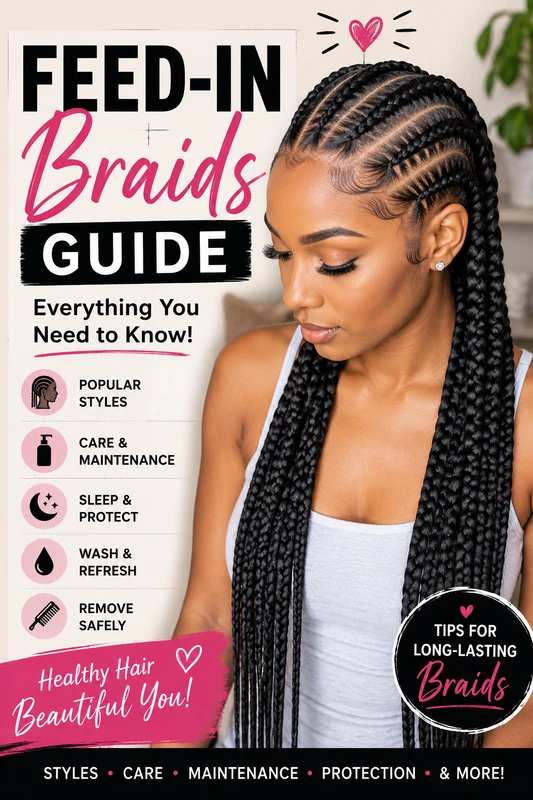
Feed-in braids have become one of the most popular protective hairstyles for Black women because they combine a sleek, natural appearance with incredible styling versatility. Whether you prefer simple straight-back cornrows, intricate designs, ponytails, buns, or long flowing braids, the feed-in technique can create a polished braided style without the bulky appearance that sometimes comes with traditional extensions.
One of the biggest differences between feed-in braids and traditional cornrows with extensions is how the braiding hair is added. Instead of starting the braid with a large amount of extension hair, small pieces are gradually incorporated as the braid progresses. This creates a braid that begins small near the scalp and gradually becomes thicker.
The result is a smoother and more natural transition between your real hair and the added braiding hair.
But getting beautiful feed-in braids is only part of the process. Proper preparation, scalp care, nighttime protection, moisturizing, and maintenance can make a major difference in how your braids look and how your natural hair feels when you eventually remove them.
This complete feed-in braids guide covers what feed-in braids are, how they are installed, popular styles, how long they last, how to maintain them, how to sleep with them, how to wash them, and how to protect your natural hair underneath.
What Are Feed-In Braids?
Feed-in braids are braided hairstyles created by gradually adding extension hair to a cornrow as it is braided along the scalp.
The stylist usually begins with the person's natural hair. Small amounts of braiding hair are then "fed" into the braid.
As additional pieces are incorporated, the braid gradually increases in thickness and length.
This technique creates the signature feed-in appearance: a small, relatively flat beginning that transitions smoothly into a longer and often thicker braid.
Traditional extension cornrows may begin with a larger amount of extension hair at the root. This can sometimes create a noticeable knot or bulky section near the beginning of the braid.
Feed-in braids are designed to create a more seamless transition.
The technique can be used for many hairstyles, including:
- Straight-back feed-in braids
- Feed-in cornrows
- Two feed-in braids
- Four feed-in braids
- Six feed-in braids
- Feed-in ponytails
- Feed-in buns
- Side feed-in braids
- Lemonade-inspired braids
- Stitch feed-in braids
- Tribal-inspired braided styles
- Small feed-in cornrows
- Jumbo feed-in braids
- Feed-in braids with curly ends
Because the technique is so versatile, feed-in braids can range from simple everyday hairstyles to elaborate braided designs.
Feed-In Braids vs. Regular Cornrows
Feed-in braids and cornrows are closely related, but the terms aren't always interchangeable.
Cornrows describe a braiding technique in which hair is braided close to the scalp. Cornrows can be created entirely with natural hair or with extensions.
Feed-in braiding describes a specific method of incorporating extension hair into the cornrow.
With regular extension cornrows, a larger portion of braiding hair may be incorporated near the beginning of the braid.
With feed-in braids, extension hair is gradually added.
This usually produces a smoother progression from the person's natural hair into the extension.
Feed-in braids are therefore essentially cornrows created using a gradual extension-feeding technique.
Why Are Feed-In Braids So Popular?
Feed-in braids have remained popular because they offer several advantages.
They Look Natural
The gradual transition from natural hair into extension hair can make feed-in braids appear less bulky at the roots.
Instead of an obvious extension attachment point, the braid grows progressively larger.
They Are Versatile
Feed-in braiding techniques can create an enormous variety of hairstyles.
You can choose simple straight-back braids one month and an elaborate braided ponytail the next.
They Can Be Low Maintenance
Once installed, feed-in braids don't require daily styling.
You may only need a few minutes each morning to moisturize your scalp when necessary and smooth or refresh the style.
They Protect the Length of Your Hair
When appropriately installed and maintained, braids can reduce the amount of daily manipulation your loose hair receives.
However, protective styling doesn't automatically guarantee healthier hair.
Excessive tension, inadequate moisture, rough handling, or leaving braids installed for too long can work against the purpose of wearing a protective hairstyle.
How Long Do Feed-In Braids Last?
Feed-in braids commonly remain presentable for approximately two to six weeks, although there is no universal expiration date.
How long your particular hairstyle lasts depends on factors including:
- Braid size
- Installation technique
- Hair texture
- Exercise frequency
- Scalp oil production
- How much you sweat
- How quickly your hair grows
- Whether you cover your braids at night
- Exposure to water and humidity
- Products used on the braids
- How frequently you manipulate the hairstyle
Larger feed-in braids may become loose or fuzzy sooner than smaller, more intricate styles.
Someone who exercises heavily several times per week may also need to cleanse or refresh their scalp more frequently.
The goal shouldn't simply be keeping the hairstyle for as long as physically possible.
Pay attention to your scalp and natural hair.
If you experience significant buildup, persistent itching, matting, excessive loosening, odor, or discomfort, it may be time to remove the style.
Are Feed-In Braids a Protective Style?
Feed-in braids can function as a protective style because much of your natural hair remains braided and doesn't require daily combing, brushing, heat styling, or restyling.
However, the effectiveness of a protective hairstyle depends heavily on how it is installed and maintained.
A hairstyle that constantly pulls on your scalp isn't particularly protective.
Healthy protective styling should focus on both appearance and hair preservation.
Your braids should feel secure without causing unnecessary discomfort.
Do Feed-In Braids Hurt?
Feed-in braids shouldn't require severe pain to look neat.
Some people may notice mild scalp sensitivity immediately after getting their hair braided, particularly if they aren't accustomed to braided styles.
But significant pain shouldn't be treated as a normal requirement.
Be cautious if your braids cause:
- Intense scalp pain
- Headaches
- Throbbing
- Burning sensations
- Small bumps around the hairline
- Extreme tightness
- Difficulty sleeping because of scalp pain
- Visible pulling around the edges
Tell your braider immediately if the hairstyle feels excessively tight.
Don't assume you simply need to "wait for the braids to loosen."
Your edges and hairline are particularly important areas to protect because those hairs can be more vulnerable to repeated pulling and tension.
How to Prepare Your Hair for Feed-In Braids
A good feed-in braid installation starts before you sit in the braiding chair.
Preparing your natural hair properly can make the braiding process easier while helping you begin your protective style with clean, conditioned hair.
Step 1: Remove Your Previous Hairstyle
Carefully take down your previous hairstyle and remove shed hair.
Natural hair normally sheds over time. When your hair has been braided or otherwise contained, some shed strands remain trapped instead of falling away.
Detangle carefully rather than aggressively combing through knots.
Step 2: Detangle Your Hair
Detangle before shampooing if your hair is particularly prone to matting.
Divide your hair into manageable sections and work through each section gently.
Start near the ends and gradually work toward the roots.
Step 3: Shampoo Your Scalp and Hair
Feed-in braids may remain installed for several weeks, so starting with a clean scalp is important.
Concentrate shampoo primarily on the scalp, where oil, sweat, dead skin, and styling-product residue tend to accumulate.
Rinse thoroughly.
Step 4: Condition
Conditioning helps improve manageability before braiding.
Apply conditioner throughout your hair, paying particular attention to the lengths and ends.
Detangle gently while the conditioner provides slip if this method works well for your hair.
Step 5: Deep Condition if Needed
If your hair feels especially dry, a deeper conditioning treatment before braiding may be helpful.
Follow the directions provided with your chosen treatment rather than assuming that leaving it on for hours automatically provides better results.
Step 6: Dry Your Hair
Your stylist may have a preferred preparation method.
Some braiders prefer stretched hair because it makes sectioning and braiding easier.
If you use a blow dryer to stretch your hair, consider using moderate temperatures and appropriate heat protection rather than unnecessarily high heat.
Should You Oil Your Scalp Before Feed-In Braids?
You don't necessarily need to coat your scalp with a heavy layer of oil immediately before braiding.
Using too much product can create buildup before the hairstyle even begins.
If your scalp tends to become dry, a small amount of an appropriate scalp product may be enough.
Remember that oils primarily help lubricate and reduce moisture loss. Oil itself isn't the same thing as water.
A balanced hair-care routine may involve hydration plus a lightweight product that helps reduce dryness.
Popular Feed-In Braid Styles
One of the biggest advantages of feed-in braids is the number of available styling options.
1. Two Feed-In Braids
Two large feed-in braids are simple, sporty, and relatively quick to install.
The hair is usually divided down the center and braided backward into two long braids.
2. Four Feed-In Braids
Four braids provide additional detail without requiring an extremely long installation.
They can be braided straight backward or incorporated into more creative patterns.
3. Six Feed-In Braids
Six feed-in braids create a fuller cornrow look while still allowing each braid to remain relatively large.
4. Straight-Back Feed-In Braids
Straight-back braids are a classic choice.
The clean parallel sections create a simple hairstyle that works with different braid sizes and lengths.
5. Feed-In Stitch Braids
Stitch braids incorporate precise horizontal sections that create the recognizable "stitched" appearance along each cornrow.
Combining stitch parting with feed-in extension techniques produces a very polished style.
6. Feed-In Braided Ponytail
For this style, braids are directed toward a central ponytail position.
The result can be dramatic while keeping the hair away from the face.
7. Feed-In Braided Bun
Braids can also be arranged so the ends form a bun.
This is a useful option for anyone who likes braided styles but doesn't want extremely long extensions hanging down the back.
8. Side Feed-In Braids
Instead of traveling directly backward, the braids curve toward one side.
This creates movement and allows the braider to experiment with different patterns.
9. Jumbo Feed-In Braids
Jumbo braids make a bold statement and generally require fewer individual braids.
10. Small Feed-In Braids
Smaller feed-in braids provide more detail and styling versatility, although installation generally takes longer.
11. Feed-In Braids With Curly Ends
Leaving or adding curly ends can soften the appearance of traditional cornrows and create additional texture.
12. Feed-In Braids With Designs
Experienced braiders can create hearts, curves, zigzags, intersecting patterns, and other artistic designs using careful parting.
How Long Does It Take to Get Feed-In Braids?
Installation time depends heavily on the complexity of your hairstyle.
Two large feed-in braids can be considerably faster than a head full of small, intricately patterned feed-in braids.
Your appointment length can also depend on:
- Hair length
- Hair thickness
- Braid size
- Number of braids
- Parting complexity
- Extension length
- Stylist experience
- Whether washing is included
- Whether your natural hair needs to be stretched
Ask your braider for an estimated appointment time when scheduling.
How to Maintain Feed-In Braids
Maintenance determines how fresh your braids look and, more importantly, how your scalp and natural hair are treated underneath.
Keep Your Scalp Clean
A protective hairstyle doesn't eliminate the need for scalp hygiene.
Sweat, oil, skin cells, and product residue can still accumulate between your braids.
How frequently you cleanse depends on your individual scalp and lifestyle.
Moisturize When Necessary
Your natural hair may still become dry while braided.
Use a lightweight moisturizing product when necessary, concentrating on your natural hair rather than repeatedly saturating synthetic extensions.
Avoid layering excessive amounts of products every day.
Limit Heavy Products
Heavy gels, creams, butters, and oils can accumulate around braid roots.
More product doesn't necessarily mean more moisture.
A simple routine is often easier to maintain.
Protect Your Braids at Night
Nighttime protection can significantly affect how quickly your braids become fuzzy.
Use a satin or silk scarf, bonnet, or pillowcase.
Reducing friction between your braids and cotton bedding can help preserve the appearance of the hairstyle.
How to Sleep With Feed-In Braids
Long feed-in braids can feel awkward during the first few nights.
Instead of lying directly on all of your braids, gently gather them into a comfortable position.
You might:
- Place long braids loosely above your head
- Gather them into a very loose low ponytail
- Wrap the scalp portion with a satin scarf
- Cover the remaining length with a long bonnet
Avoid securing the braids tightly every night.
The objective is to minimize friction without adding unnecessary tension.
How to Wash Feed-In Braids
Yes, feed-in braids can be cleaned.
The key is being gentle.
Step 1: Dilute Shampoo if Necessary
A diluted shampoo can sometimes make application between cornrows easier.
Step 2: Apply Shampoo to the Scalp
Focus primarily on your scalp and the spaces between the braids.
Step 3: Massage Gently
Use your fingertips rather than aggressively scratching with your nails.
Step 4: Rinse Thoroughly
Product left behind can contribute to buildup, so rinse carefully.
Step 5: Remove Excess Water
Gently squeeze or blot the braids.
Avoid rough towel rubbing.
Step 6: Let the Braids Dry Completely
This is especially important for thick braided styles.
Avoid repeatedly going to bed with damp braids.
Can You Work Out With Feed-In Braids?
Yes.
Feed-in braids can actually be convenient for people with active lifestyles because the hair is already secured.
However, frequent exercise means more sweat.
After a workout, allow your scalp to dry instead of immediately covering wet, sweaty braids with a hat, scarf, or bonnet.
People who exercise heavily may also need to cleanse their scalp more frequently than someone with a less active routine.
Can You Swim With Feed-In Braids?
You can swim while wearing feed-in braids, but swimming may cause the hairstyle to become fuzzy sooner.
Pool water and repeated wetting can also affect the feel of your natural hair and extensions.
After swimming, rinse the hair thoroughly and make sure the braids dry properly.
If you swim frequently, you may need to accept that your hairstyle won't remain salon-fresh for as long.
How to Reduce Frizz in Feed-In Braids
Some frizz is inevitable.
Your natural hair continues to grow, and normal movement gradually loosens the hairstyle.
You can slow down visible frizz by:
- Wearing a satin scarf at night
- Avoiding constant manipulation
- Keeping your scalp clean
- Limiting unnecessary product buildup
- Avoiding repeatedly soaking the braids
- Protecting your hair during sleep
Don't sacrifice scalp comfort just to keep every strand perfectly smooth.
How to Refresh Feed-In Braids
After a couple of weeks, your braids may need a refresh.
Start by addressing the scalp.
Clean away excessive buildup and moisturize your natural hair as needed.
If the hairline has become fuzzy, a small amount of styling product may help smooth loose hairs.
Tie a satin scarf around the front portion briefly to help maintain the finished appearance.
Don't repeatedly pull loose edges into tighter styles just to make older braids appear new.
How to Protect Your Edges With Feed-In Braids
Your hairline deserves special attention.
The small hairs around the edges can experience considerable stress if extension hairstyles are repeatedly installed too tightly.
Tell your braider that protecting your hairline is important.
You can also request that vulnerable hairs around the perimeter be left out rather than forced into a tight braid.
During the weeks you're wearing the style, avoid constantly pulling your feed-in braids into tight ponytails and buns.
Changing the direction of the braids every day can repeatedly place stress on the same areas.
Common Feed-In Braid Mistakes
Beautiful braids can still create problems when maintenance habits aren't ideal.
Mistake #1: Accepting Excessive Tightness
Pain isn't proof that your braids were installed properly.
Mistake #2: Ignoring Your Scalp
Protective styling doesn't mean ignoring scalp hygiene for weeks.
Mistake #3: Using Too Much Product
Repeatedly applying thick oils, creams, edge controls, and gels can contribute to visible buildup.
Mistake #4: Sleeping Without Protection
Nightly friction can quickly make braids look fuzzy.
Mistake #5: Keeping the Style Too Long
Trying to get "one more week" out of an old style isn't always worth it.
Mistake #6: Removing Braids Too Quickly
Take your time during removal.
Cutting or ripping through extensions can accidentally damage your natural hair.
How to Take Down Feed-In Braids Safely
Removal deserves just as much attention as installation.
Start by determining where your natural hair ends before cutting extension hair.
If you're uncertain, don't cut.
Unravel each braid carefully.
Once the braids are removed, expect to see shed hair. Hair that would normally have fallen away throughout the weeks you wore the style can remain trapped inside the braids.
Detangle Before Shampooing
Use your fingers to remove major knots and shed strands.
Work in sections.
Applying an appropriate detangling product can make the process easier.
Shampoo Thoroughly
After several weeks of wearing braids, your scalp may have accumulated oil, sweat, and product residue.
A thorough shampoo can help create a clean foundation for your next routine.
Condition
Follow cleansing with conditioner and gently detangle your hair.
Should You Get Feed-In Braids Back-to-Back?
Some people regularly alternate between braided styles.
However, continually applying tension to exactly the same areas can become problematic.
Consider your hair and scalp condition after removing each style.
If your scalp feels tender or your hairline appears stressed, give your hair time without tight extension styles.
Protective styling should support your long-term hair goals rather than simply provide a convenient way to avoid dealing with your natural hair.
Feed-In Braids for Natural Hair
Feed-in braids work particularly well with natural hair because cornrowing provides a foundation for gradually incorporating extensions.
Your natural hair doesn't need to be perfectly straight.
Some stylists prefer stretched hair because it can make parting and braiding easier, but excessive heat isn't necessary simply to make natural hair "acceptable" for braiding.
Discuss preparation requirements with your braider before your appointment.
Feed-In Braids for Short Hair
Whether short hair can be feed-in braided depends on how much hair is available for the braider to grip securely.
Hair that is extremely short may be more difficult to incorporate without excessive tension.
An experienced braider can evaluate whether your current length is suitable.
Avoid choosing a stylist who compensates for insufficient length by pulling extremely tightly.
Feed-In Braids for Thin or Fine Hair
People with fine hair can wear feed-in braids, but weight and tension deserve extra consideration.
Extremely long or heavy extensions may place unnecessary stress on delicate strands.
Consider:
- Lighter extension amounts
- Moderate braid lengths
- Larger sections
- Reduced tension
- Avoiding extremely heavy accessories
A skilled stylist should adapt the hairstyle to your actual hair density rather than installing the exact same braid pattern on every client.
Feed-In Braids for Thick Hair
Thick natural hair provides many feed-in styling possibilities.
The main challenge can be creating clean, even sections and ensuring the hair is thoroughly detangled before installation.
Longer appointment times may also be necessary.
How Much Braiding Hair Do You Need?
The amount of extension hair depends on:
- Number of braids
- Desired thickness
- Desired length
- Brand of braiding hair
- Hairstyle design
Ask your stylist before purchasing hair.
Many braiders have preferred extension types because certain textures or lengths work better with their technique.
What Length Should Feed-In Braids Be?
There is no ideal length.
Shorter feed-in braids are generally lighter and easier to manage.
Waist-length and extra-long braids create a dramatic appearance but require more extension hair and may feel heavier.
Think about your lifestyle.
If you exercise daily, sleep on your back, work around machinery, or simply dislike managing very long hair, shorter braids may be more practical.
Feed-In Braids FAQ
How long do feed-in braids last?
Feed-in braids often last around two to six weeks depending on braid size, hair growth, maintenance, scalp condition, exercise habits, and installation technique.
Are feed-in braids good for natural hair?
They can be a useful protective hairstyle when installed without excessive tension and maintained properly.
Can feed-in braids damage your edges?
Any hairstyle that repeatedly creates excessive tension around the hairline can contribute to breakage. Avoid overly tight installations and heavy extensions.
Can you wash feed-in braids?
Yes. Clean the scalp gently, rinse thoroughly, and allow the braids to dry completely.
Can you shower with feed-in braids?
Yes. You can cover the braids when you aren't intentionally washing them to reduce unnecessary wetting.
Can you sleep with feed-in braids?
Yes. A satin scarf, bonnet, or pillowcase can help reduce friction while sleeping.
How do you keep feed-in braids from getting frizzy?
Protect them at night, reduce unnecessary manipulation, keep the scalp clean, and avoid constantly wetting or restyling them.
Are feed-in braids the same as stitch braids?
Not exactly. Feed-in describes how extension hair is gradually incorporated. Stitch braiding refers to the distinctive separated or "stitched" sections visible within the cornrow. The two techniques are often combined.
Do feed-in braids grow your hair?
Braids don't directly make hair grow faster. They can reduce daily manipulation, which may help some people retain more length by reducing unnecessary breakage.
How often should you moisturize feed-in braids?
There isn't a universal schedule. Moisturize according to how your hair and scalp feel rather than automatically applying heavy products every day.
Should you grease your scalp with feed-in braids?
You don't necessarily need heavy grease. If your scalp feels dry, use an appropriate lightweight product while avoiding excessive buildup.
Final Thoughts: Are Feed-In Braids Worth It?
Feed-in braids offer an impressive combination of versatility, convenience, and style.
From two simple braids to elaborate stitch designs and braided ponytails, the gradual feed-in technique allows extension hair to blend smoothly into natural cornrows.
But the best feed-in braid experience isn't just about how your hair looks when you leave the salon.
Healthy braid care starts with clean, detangled, conditioned hair. It continues with an installation that doesn't create excessive tension and a maintenance routine that keeps your scalp clean while protecting the hairstyle at night.
Most importantly, listen to your hair and scalp.
Don't tolerate severe tightness for the sake of a sleek hairstyle, don't overload your scalp with products, and don't keep an old braided style installed simply because you want to extend it another week.
With thoughtful installation, proper nighttime protection, gentle cleansing, and careful removal, feed-in braids can be a stylish addition to your natural hair routine.