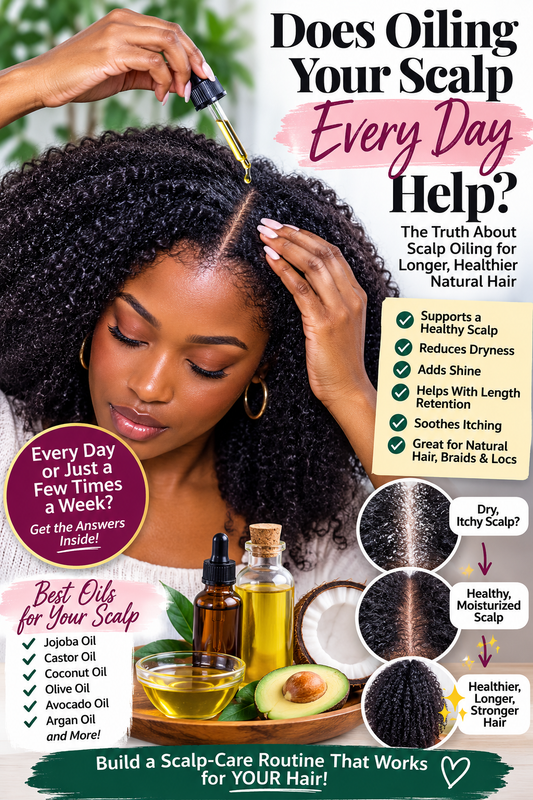
If you grew up around Black hair care, there is a good chance that scalp oiling was part of your routine. From castor oil and coconut oil to jojoba oil and carefully blended botanical oils, applying oil to the scalp has been passed down through generations as a way to keep the scalp moisturized, reduce dryness, add shine, and support healthier-looking hair.
But does oiling your scalp every day actually help your hair grow, or could daily oiling be doing more harm than good?
The answer depends on your scalp, hairstyle, hair texture, the type of oil you use, how much you apply, and how frequently you cleanse your scalp.
For some people with natural hair, locs, braids, twists, or other protective styles, regular scalp oiling can be an excellent addition to a healthy hair routine. For others, applying heavy oil every single day can lead to buildup, greasy roots, itching, clogged-feeling follicles, or the need to wash more frequently.
The goal should not simply be to put as much oil as possible on your scalp. The goal is to create a balanced scalp environment that supports healthy hair retention and growth.
This complete guide explains how scalp oiling works, whether you should oil your scalp every day, which oils are best, how often Black hair should be oiled, and how to build a scalp-care routine that works for your individual hair.
What Does Oiling Your Scalp Actually Do?
Scalp oiling involves applying a natural oil, botanical oil blend, or scalp treatment directly to the skin underneath your hair.
People commonly oil their scalps to:
- Reduce the feeling of dryness
- Lubricate the scalp and hair
- Add shine
- Make hair feel softer
- Reduce friction during styling
- Support scalp massage
- Protect dry areas
- Maintain protective styles
- Improve the appearance of dry hair
- Help prevent excessive breakage caused by dryness
- Support a healthier hair-care routine
One of the biggest misconceptions about scalp oiling is that oil and moisture are exactly the same thing.
They are not.
Water provides hydration. Oils generally act more as lubricants, conditioners, and occlusive ingredients that can help reduce moisture loss.
That distinction is extremely important when caring for naturally dry or tightly textured hair.
If your hair or scalp is dehydrated, simply covering it with more oil may not completely solve the underlying problem.
Does Oiling Your Scalp Every Day Help?
It can, but daily scalp oiling is not necessary for everyone.
If your scalp becomes noticeably dry very quickly and responds well to lightweight oils, a small amount of oil applied frequently may make your scalp feel more comfortable.
However, if your scalp naturally produces plenty of sebum, daily oiling could leave it excessively greasy.
For many people, oiling the scalp a few times per week is sufficient.
Instead of automatically deciding that you need oil every day, pay attention to how your scalp responds.
Your scalp should generally feel:
- Comfortable
- Clean
- Balanced
- Free of excessive flakes
- Free of excessive buildup
- Free of persistent itching
- Not excessively oily
If your scalp feels good without daily oil, there is usually no reason to force yourself into an everyday oiling routine.
Does Oiling Your Scalp Every Day Make Hair Grow Faster?
This is where scalp oiling is frequently misunderstood.
Putting oil on your scalp does not automatically make your follicles produce hair dramatically faster.
Hair growth occurs inside the follicle.
Several factors can influence hair growth and the amount of length you ultimately retain, including:
- Genetics
- Age
- Nutrition
- Hormones
- Overall health
- Scalp health
- Hair-care practices
- Breakage
- Chemical treatments
- Heat damage
- Styling tension
Oil can still be useful.
A good scalp-care routine can help maintain a comfortable scalp, while oils applied appropriately to the hair can reduce friction and improve manageability.
That can indirectly contribute to your length-retention goals.
For example, imagine that your hair grows normally but repeatedly breaks at the ends.
You may think:
“My hair isn't growing.”
The real problem could be that you're not retaining the length you're growing.
Reducing dryness, excessive manipulation, and breakage can make your progress much more noticeable.
Hair Growth vs. Length Retention
Understanding the difference between hair growth and length retention is essential.
Hair growth happens at your scalp.
Length retention happens when you successfully keep that new growth instead of losing length through breakage.
Imagine your hair grows approximately half an inch during a particular month but you lose a similar amount from breakage.
Visually, your hair may appear to stay at the same length.
That doesn't necessarily mean your follicles stopped producing hair.
It means you're having trouble retaining your new length.
A well-designed oiling routine can potentially help with retention by improving lubrication and reducing some of the friction associated with dry hair.
However, oil should be only one component of your overall routine.
Why Black Hair Often Benefits From Oils
Natural Black hair frequently has curls, coils, bends, and turns throughout each strand.
These beautiful textures can make it more difficult for the scalp's natural oils to travel all the way down the hair shaft.
With straighter hair, sebum may move down the strand more easily.
With tightly coiled hair, that journey is more difficult.
As a result, the ends can become dry even when the scalp itself isn't particularly dry.
This is one reason oils have traditionally played such a significant role in Black hair care.
The important takeaway, however, is this:
Your scalp and your hair are not necessarily equally dry.
You might have an oily scalp and dry ends.
In that situation, applying more oil directly to the scalp every day may not be the best solution.
You may benefit more from concentrating moisture and conditioning on your strands and ends.
Signs Your Scalp May Benefit From More Frequent Oiling
Your scalp may respond well to regular oiling if you notice:
1. Your Scalp Feels Dry
A scalp that frequently feels tight or uncomfortable may benefit from a small amount of an appropriate oil.
2. Your Scalp Looks Ashy
Dry areas can sometimes become visibly noticeable between sections of your hair.
3. Protective Styles Make Your Scalp Feel Dry
Braids and twists expose more of your scalp to the environment.
Some people notice that their scalp feels considerably drier when wearing these hairstyles.
4. Your Scalp Responds Positively to Oil
This is one of the most important signs.
If you apply a small amount of oil and your scalp feels comfortable for several days without becoming excessively greasy or itchy, your routine may be working well.
Signs You May Be Oiling Your Scalp Too Much
More oil does not necessarily mean healthier hair.
Watch for these warning signs.
Your Scalp Is Constantly Greasy
Your scalp naturally produces sebum.
Adding oil every day on top of that natural oil production can sometimes become excessive.
If your roots constantly look or feel greasy, consider reducing your oiling frequency.
You Have Heavy Product Buildup
Oil can combine with:
- Sweat
- Dead skin
- Styling products
- Environmental debris
- Leave-in products
- Gels
- Creams
Over time, this can create buildup.
Your Scalp Becomes Itchy After Oiling
If oil seems to consistently make itching worse rather than better, stop assuming that more oil is the answer.
Persistent scalp itching can have many causes and may require a different approach.
Your Hair Feels Coated
Heavy oils can sometimes accumulate on the strands.
Instead of feeling moisturized, your hair may begin to feel coated, heavy, or greasy.
You Need to Wash Your Hair Constantly
If your oiling routine creates so much buildup that you need to shampoo far more often than you'd otherwise prefer, you may simply be using too much product.
How Often Should You Oil Your Scalp?
There is no universal schedule.
A practical starting point for many people is approximately:
1–3 times per week.
Then adjust based on your scalp.
Some people may prefer oiling only once per week.
Others may use a very small amount every few days.
Someone wearing braids might apply oil differently than someone wearing a wash-and-go.
Someone with mature locs may also require a completely different routine from someone with loose natural hair.
The best schedule is the one that keeps your scalp comfortable without creating excessive buildup.
Should You Oil Your Scalp Every Day With Natural Hair?
You can, but you probably don't need to.
If you decide to oil your scalp daily, the amount matters tremendously.
Daily scalp oiling should generally involve a very small amount of oil rather than saturating your entire scalp.
A few drops strategically distributed throughout dry areas can be enough.
Think:
light application
rather than:
soaked scalp.
If your scalp remains comfortable for two or three days after applying oil, there is little reason to reapply simply because another day has passed.
Let your scalp's condition determine your schedule.
Should You Oil Your Scalp Every Day With Braids?
Braids can make scalp oiling extremely convenient because the scalp is divided into visible sections.
However, convenience doesn't mean you need to apply oil daily.
With braids, consider applying a small amount of oil approximately two or three times per week, then adjust according to your needs.
Focus on the exposed scalp rather than pouring large amounts of oil throughout the style.
Too much oil can combine with sweat and styling products and contribute to buildup around the base of your braids.
Your protective style should help simplify your routine—not create a cycle of constant product application.
Should You Oil Your Scalp Every Day With Locs?
Locs require special consideration because heavy products can become difficult to remove completely.
Lightweight oils are often preferred over thick creams, heavy butters, and waxy products.
If you have locs, you generally want to avoid continuously coating your scalp and locs with excessive amounts of oil.
Instead:
- Monitor your scalp for dryness.
- Apply a lightweight oil when necessary.
- Massage gently.
- Avoid oversaturating your locs.
- Maintain a consistent cleansing schedule.
Mature locs may respond differently from starter locs, so your routine can change throughout your loc journey.
Should You Oil Your Scalp Every Day With Twists?
Two-strand twists and mini twists can make it easy to access the scalp.
Again, everyday oiling usually isn't mandatory.
A light application every few days may be sufficient.
Pay particular attention to your ends as well.
While the scalp receives most of the attention in conversations about hair growth, your ends are the oldest and often most fragile part of your hair.
Protecting your ends can be extremely important for retaining length.
The Best Oils for Scalp Care
Different oils have different textures and characteristics.
Here are several popular choices.
Jojoba Oil
Jojoba oil is a popular choice because it is relatively lightweight.
It can be especially useful for people who dislike extremely heavy oils.
Jojoba oil works well for:
- Scalp massage
- Braids
- Twists
- Locs
- Loose natural hair
A little can go a long way.
Jamaican Black Castor Oil
Jamaican black castor oil is extremely popular in Black hair care.
It is much thicker than many other oils.
People commonly use it around:
- Edges
- Hairlines
- Dry areas
- Scalp sections
- Protective styles
Because castor oil is thick, applying large amounts every day can be excessive for some people.
If you love castor oil but find it too heavy, consider using it less frequently or as part of a balanced oil blend.
Coconut Oil
Coconut oil is one of the most widely used oils in hair care.
Many people use coconut oil as a pre-shampoo treatment or apply small amounts to their hair.
However, not everyone's hair responds the same way.
Some people love how coconut oil makes their hair feel.
Others find their hair feels stiff or dry after using it.
Hair care is highly individual.
If coconut oil doesn't work for your hair, you don't need to use it simply because it is popular.
Olive Oil
Olive oil is another traditional choice for natural hair.
It can provide excellent lubrication and shine but may feel heavier than lightweight oils.
It can work particularly well as part of:
- Pre-poo treatments
- Deep-conditioning routines
- Oil blends
- Dry-hair routines
If you have fine hair, start with a very small amount.
Avocado Oil
Avocado oil is popular in natural hair products because of its conditioning properties.
It is often used in:
- Hair oils
- Deep conditioners
- Leave-ins
- Scalp treatments
- Pre-shampoo treatments
It can be incorporated into both scalp and strand care.
Grapeseed Oil
If you want something lighter, grapeseed oil can be a useful option.
It is particularly appealing to people who find castor or olive oil too heavy.
Lightweight oils can be useful for frequent applications because they are less likely to leave the hair feeling extremely weighed down when used sparingly.
Argan Oil
Argan oil is frequently used as a finishing oil.
A few drops can add shine and reduce the appearance of dryness without requiring heavy application.
It can be especially useful on the lengths and ends of the hair.
Sweet Almond Oil
Sweet almond oil is another popular carrier oil used in natural hair-care products.
Its relatively light texture makes it useful for:
- Scalp massage
- Protective styles
- Hair oil blends
- Sealing routines
As with any ingredient, discontinue use if it causes irritation.
Is Scalp Oil the Same as Scalp Moisturizer?
No.
This is one of the most important concepts to understand.
Oil itself does not contain water.
If your scalp or hair needs hydration, adding more and more oil may not completely address the issue.
Think of oil as one tool within a larger routine.
A healthy natural-hair routine may involve:
Cleanse → Hydrate → Condition → Lubricate/Seal → Protect
Your exact order and products can vary.
The point is that oil should not be expected to perform every job.
Should You Put Water on Your Scalp Before Oil?
Not necessarily.
The scalp is skin and produces its own natural oils.
You don't have to spray your scalp with water every time you apply oil.
For your hair strands, however, using oil after a water-based moisturizing product can help reduce moisture loss and improve softness for some hair types.
This is where techniques such as the LOC and LCO methods became popular.
What Is the LOC Method?
LOC stands for:
Liquid → Oil → Cream
The idea is to apply a water-based product first, followed by oil and then cream.
The purpose is to help maintain moisture in naturally dry hair.
What Is the LCO Method?
LCO stands for:
Liquid → Cream → Oil
Some people find this order works better for their hair.
Neither technique is universally superior.
Experiment and determine which approach leaves your hair:
- Softer
- More manageable
- Less dry
- Less greasy
- Easier to detangle
Your results matter more than following a trendy acronym.
Does Scalp Massage Help When Oiling?
Scalp massage can be an enjoyable addition to your routine.
When applying oil, use the pads of your fingertips to gently massage your scalp.
You do not need to scratch aggressively.
Try approximately 3–5 minutes.
Move your fingertips in small circular motions throughout your scalp.
Scalp massage can:
- Help distribute your oil
- Make scalp care more relaxing
- Encourage gentle manipulation
- Help you become familiar with your scalp
That last point is underrated.
When you regularly inspect your scalp, you're more likely to notice changes such as unusual flaking, irritation, tenderness, thinning, or buildup.
How to Oil Your Scalp Correctly
You don't need complicated equipment.
Step 1: Start With Your Scalp
Before applying anything, examine your scalp.
Ask yourself:
- Is it actually dry?
- Is it greasy?
- Is there buildup?
- Does it itch?
- When did I last wash it?
If your scalp is already oily, another layer may not be necessary.
Step 2: Separate Your Hair
Create sections so you can reach the scalp easily.
Four to eight sections can work for loose natural hair.
Braids and locs already provide natural sections.
Step 3: Apply a Small Amount
Apply several drops along the scalp.
Avoid pouring oil directly onto your head.
Step 4: Massage Gently
Massage with your fingertips for several minutes.
Do not use your fingernails to aggressively scratch your scalp.
Step 5: Leave It Alone
Once you've applied enough oil, stop.
You don't need to keep adding product until your scalp looks shiny.
Step 6: Monitor Your Results
Over the next few days, notice how your scalp feels.
If it remains comfortable, your application was probably sufficient.
If it becomes greasy quickly, reduce the amount next time.
How Much Scalp Oil Should You Use?
Less than many people think.
Your hair shouldn't need to drip with oil.
Heavy application can make it difficult to determine whether your scalp actually benefits from the product.
Start conservatively.
You can always add another drop.
Removing excess oil requires washing.
Should You Oil a Dirty Scalp?
This is an important question.
Continuously applying fresh oil over significant buildup is generally not the best strategy.
If your scalp is dirty, sweaty, or heavily coated with products, it may be time to cleanse rather than add another layer.
Think about skincare.
If your face were covered with sweat, dirt, and old products, you probably wouldn't continuously apply more moisturizer without eventually cleansing it.
Your scalp also benefits from regular cleansing.
How Often Should You Wash Your Hair If You Oil Your Scalp?
There isn't one schedule for everyone.
However, regular oil users should pay particular attention to buildup.
Some people wash approximately once per week.
Others cleanse every 7–14 days.
People who exercise frequently or produce significant scalp oil may prefer more frequent washing.
People wearing certain protective styles may modify their cleansing routine.
The key is not allowing layers of product to accumulate indefinitely.
Can Too Much Oil Cause Buildup?
Absolutely.
Oil itself can accumulate, especially when combined with other products.
Common contributors include:
- Edge control
- Gel
- Mousse
- Leave-in conditioner
- Hair butter
- Styling cream
- Sweat
- Sebum
- Dead skin
- Environmental debris
This is why cleansing remains essential even when you're using natural products.
"Natural" does not mean "never needs to be washed out."
Does Scalp Oiling Help With Dandruff?
This depends on what is causing the flakes.
Not every flaky scalp is simply dry.
Dandruff can be associated with seborrheic dermatitis and scalp microorganisms, meaning repeatedly applying more oil may not necessarily solve the problem.
If you have persistent:
- Flaking
- Redness
- Itching
- Irritation
- Scaling
- Tenderness
consider consulting a dermatologist rather than continually increasing the amount of oil you use.
A medical scalp condition requires the appropriate treatment—not simply more hair oil.
Dry Scalp vs. Dandruff
People often use these terms interchangeably, but they aren't necessarily the same thing.
A dry scalp may feel tight and produce small dry flakes.
Dandruff can involve:
- Larger flakes
- Oiliness
- Persistent itching
- Irritation
- Recurring symptoms
If you've been oiling your scalp every day for months and your "dry scalp" keeps getting worse, reconsider whether dryness is actually the problem.
Can Scalp Oil Clog Hair Follicles?
Heavy buildup around the scalp can create an unhealthy environment and contribute to irritation.
That doesn't mean applying a few drops of hair oil automatically "clogs your follicles."
The bigger concern is excessive product accumulation combined with inadequate cleansing.
That's why balance matters.
Apply only what your scalp needs and wash regularly.
Is It Better to Oil Your Scalp at Night?
Nighttime can be convenient, but it isn't inherently superior.
If you oil at night, consider wearing a satin bonnet or using a satin pillowcase to protect your bedding and reduce friction against your hair.
You can also oil in the morning.
Consistency and proper application matter more than the clock.
Should You Oil Your Scalp Before Washing?
Pre-shampoo oil treatments can be useful for some people.
However, scalp oiling and pre-pooing are slightly different concepts.
A pre-poo usually focuses significantly on protecting the hair strands before shampooing.
You might apply an oil to your hair before wash day and leave it on for a period before cleansing.
This can be especially helpful if shampoo tends to leave your hair feeling dry.
Scalp Oiling for Low-Porosity Hair
Low-porosity hair can become coated relatively easily when too many heavy products are layered on it.
If your hair is low porosity, consider lighter oils and smaller amounts.
Potential options include:
- Jojoba oil
- Grapeseed oil
- Argan oil
Avoid assuming that low-porosity hair requires enormous quantities of heavy oil.
Your goal is softness and manageability—not coating every strand.
Scalp Oiling for High-Porosity Hair
High-porosity hair can lose moisture relatively quickly.
People with high-porosity hair may enjoy richer oils and creams as part of their moisturizing routines.
However, the same distinction still applies:
Your scalp's needs may differ from your strands' needs.
You can use a heavier product on your ends while applying a lightweight oil to your scalp.
Oiling Fine Natural Hair
Fine hair can become weighed down quickly.
If your individual strands are fine, heavy daily oiling may make your hair:
- Flat
- Greasy
- Limp
- Difficult to style
Use extremely small amounts.
You may find that one or two scalp-oiling sessions per week are sufficient.
Oiling Thick Natural Hair
Thick or highly dense natural hair can make it difficult to reach the scalp.
Sectioning is especially important.
Instead of pouring more oil onto your hair, create sections and apply small amounts directly where they're needed.
This improves precision and prevents unnecessary product waste.
Oiling Your Edges Every Day
Edges require gentle treatment.
People often focus heavily on oils when trying to grow their edges, but oil isn't the only consideration.
Your edges can also be affected by:
- Tight braids
- Tight ponytails
- Heavy extensions
- Excessive edge control
- Frequent brushing
- Wig friction
- Repeated tension
- Rough styling
If your hairstyle constantly pulls on your hairline, adding oil every day will not eliminate the mechanical stress.
Reducing tension is crucial.
If you're experiencing significant or persistent thinning around your hairline, consider speaking with a dermatologist.
Scalp Oiling While Wearing Wigs
If you wear wigs regularly, scalp care becomes especially important.
Your routine might include:
- Regular cleansing
- Lightweight scalp oil
- Gentle massage
- Low-tension cornrows underneath
- Adequate drying after washing
- Breaks from excessive tension when possible
Avoid soaking the hair underneath your wig with heavy oil every day.
A little can go a long way.
Scalp Oiling for Men
Black men can benefit from many of the same principles.
Whether you're wearing:
- Waves
- Cornrows
- Locs
- Twists
- An afro
- A low haircut
scalp oil should be applied according to your scalp's needs.
Men who wear short hairstyles may discover they need considerably less oil because there is less hair to absorb or distribute the product.
A few drops may cover the entire scalp.
Scalp Oiling for Kids
Children generally don't need complicated scalp routines.
Focus on gentle products, minimal manipulation, regular cleansing, and hairstyles that don't create excessive tension.
Avoid essential oils or strongly fragranced products unless they are formulated appropriately for children.
If your child has persistent scalp irritation, flakes, sores, or hair loss, consult a healthcare professional rather than trying increasingly strong home remedies.
Common Scalp-Oiling Mistakes
Mistake #1: Using Too Much
This is probably the biggest mistake.
Your scalp does not need to be dripping.
Mistake #2: Oiling Every Day Because of a Schedule
Your scalp may not need oil every day.
Respond to its condition rather than the calendar.
Mistake #3: Confusing Oil With Hydration
Oil isn't water.
Dry hair may still require water-based moisturizing products.
Mistake #4: Never Washing the Oil Out
A healthy scalp routine includes cleansing.
Mistake #5: Ignoring Persistent Itching
If oil isn't helping, stop adding more.
Investigate the cause.
Mistake #6: Using Heavy Products on Fine Hair
Fine strands can become weighed down easily.
Mistake #7: Ignoring Your Ends
Healthy-looking length isn't just about your scalp.
Protecting your ends is essential for length retention.
A Simple Weekly Scalp-Oiling Routine
Here's a practical example.
Wash Day
Cleanse your scalp thoroughly.
Condition your hair.
Apply your normal moisturizing products.
If desired, use a small amount of oil.
Day 2
Leave your scalp alone unless it feels dry.
Day 3
Check your scalp.
If necessary, apply a small amount of oil and massage gently.
Day 4
No additional oil unless needed.
Day 5
Apply another small amount if your scalp feels dry.
Day 6
Assess buildup.
Day 7
Wash or continue according to your normal cleansing schedule.
This approach prevents automatic product layering.
Daily Scalp Oiling Routine for Very Dry Scalp
If you've determined that your scalp genuinely responds well to daily oiling, keep the routine light.
Morning or Evening
Divide your hair into several sections.
Apply only a drop or two to dry areas.
Massage gently.
Do not saturate your scalp.
Monitor for:
- Greasiness
- Itching
- Flaking
- Redness
- Buildup
If any of these worsen, reduce your frequency.
Can You Use Too Many Different Oils?
Yes.
A routine containing ten different oils isn't automatically better than one containing two or three.
In fact, using fewer products can make it easier to determine what your hair actually likes.
If you use several new ingredients simultaneously and develop irritation, it can be difficult to identify which product caused the problem.
Keep your routine manageable.
Are Essential Oils Good for the Scalp?
Essential oils are highly concentrated and should not generally be applied directly to the scalp undiluted.
Common essential oils used in hair products include:
- Rosemary
- Peppermint
- Tea tree
- Lavender
If you want to use essential oils, choose a properly formulated scalp product or ensure they are appropriately diluted in a carrier oil.
More essential oil is not better.
Improper concentrations can irritate the skin.
What About Rosemary Oil for Hair Growth?
Rosemary oil has become extremely popular on social media.
Some research has explored rosemary preparations in relation to hair growth, but that doesn't mean pouring concentrated rosemary essential oil directly onto your scalp every day will produce extremely fast hair growth.
Use properly formulated products and maintain realistic expectations.
Hair growth is a biological process.
No oil should be marketed or viewed as a magic overnight solution.
How Long Does It Take to See Results From Scalp Oiling?
Hair care requires patience.
If you're trying to determine whether a new scalp routine is helping, don't judge it after three days.
Track your progress over several months.
Take photographs under similar:
- Lighting
- Hairstyles
- Angles
- Hair conditions
Pay attention to:
- Scalp comfort
- Breakage
- Length retention
- Hair softness
- Shedding
- Overall manageability
You may discover that the biggest improvement isn't dramatically faster growth.
It may be that your hair breaks less and therefore becomes noticeably longer over time.
How to Know Whether Your Oiling Routine Is Working
A successful routine should make hair care easier—not harder.
Good signs include:
- Comfortable scalp
- Minimal excessive buildup
- Softer hair
- Improved manageability
- Less dryness
- Reduced friction
- Better length retention
- Healthy-looking shine
Bad signs include:
- Constant grease
- Increased itching
- Excessive flakes
- Heavy buildup
- Unpleasant odor
- Irritation
- Hair that constantly feels coated
If you're experiencing the second list, change your routine.
Scalp Oiling and Protective Styles
Protective styles can be excellent for reducing daily manipulation.
Popular examples include:
- Box braids
- Knotless braids
- Cornrows
- Two-strand twists
- Mini twists
- Flat twists
- Locs
But a hairstyle is only protective if your hair and scalp remain healthy underneath it.
Scalp oil can be useful during protective styles, but don't allow it to replace cleansing.
Depending on the style, your activity level, and how long you keep the hairstyle, you may still need to cleanse your scalp.
Does Sweating Change How Often You Should Oil Your Scalp?
Yes.
If you exercise frequently, your scalp may accumulate:
- Sweat
- Sebum
- Oil
- Styling products
Adding more oil after every workout may create unnecessary buildup.
If you're highly active, scalp cleansing may need to become a bigger priority than additional oiling.
Listen to your scalp.
Does Weather Affect Scalp Oiling?
Absolutely.
Hair and scalp needs can change with the seasons.
Winter
Cold outdoor temperatures and dry indoor heating may make your hair feel drier.
You may find yourself using slightly richer products.
Summer
Heat and sweating can increase the amount of buildup on your scalp.
You may prefer:
- Lighter oils
- Smaller amounts
- More frequent cleansing
Your routine does not have to remain identical throughout the year.
The Best Time to Oil Your Scalp
There isn't one scientifically perfect time.
The best time is when:
- Your scalp needs it.
- Your scalp is reasonably clean.
- You have time to distribute the oil properly.
That might be after wash day.
It might be between wash days.
It might be before bed.
The most important factor is not timing.
It is balance.
Can Scalp Oiling Replace Conditioner?
No.
Conditioners are formulated to improve the feel, manageability, and conditioning of hair.
Oil has different properties.
You can use both.
For example:
Shampoo → Conditioner → Leave-in → Oil
This provides several different forms of hair care instead of expecting one bottle of oil to perform every function.
Can Scalp Oil Replace Leave-In Conditioner?
Usually not.
Most leave-in conditioners contain water and conditioning ingredients.
Pure oils do not.
If your hair feels dry, consider using a water-based leave-in before applying a small amount of oil to your strands.
Should You Oil Your Scalp After Every Wash?
You can if your scalp responds well to it.
After washing, your scalp is clean, making it a convenient time to assess what it actually needs.
If your scalp feels comfortable after shampooing, you don't necessarily need to immediately cover it in oil.
If it tends to feel dry, apply a small amount.
Again, personalize your routine.
What If Your Scalp Is Oily but Your Hair Is Dry?
This is extremely important.
Don't assume that dry hair means you need more scalp oil.
Your scalp may produce plenty of sebum while your ends remain dry.
Instead of putting more oil on your scalp, concentrate your moisturizing routine on the hair.
Apply your leave-in and conditioning products to the mid-lengths and ends.
Then use a small amount of oil where needed.
What If Your Scalp Is Dry One Day After Oiling?
First, determine whether it is actually dryness.
If you apply oil every night but wake up with flakes the next morning, you may be dealing with something other than simple dryness.
Consider:
- Product buildup
- Irritation
- Dandruff
- Reaction to a product
- Inadequate cleansing
If the issue persists, consult a dermatologist.
How Scalp Oiling Fits Into a Hair-Growth Routine
If your goal is longer, healthier-looking hair, scalp oiling can be one piece of the puzzle.
A more complete routine includes:
1. Regular Cleansing
Keep your scalp clean.
2. Conditioning
Condition after shampooing when appropriate.
3. Moisture
Use water-based products to address dry hair.
4. Strategic Oiling
Apply appropriate oils in reasonable quantities.
5. Low-Manipulation Styling
Reduce unnecessary combing and brushing.
6. Protect Your Ends
Your ends are the oldest part of your hair.
7. Reduce Excessive Heat
Frequent high-temperature styling can increase damage.
8. Avoid Excessive Tension
Protective styles should not hurt.
9. Sleep With Hair Protection
A satin bonnet, scarf, or pillowcase can help reduce friction.
10. Be Consistent
Healthy hair routines work through consistency—not overnight miracles.
Scalp Oiling for Maximum Length Retention
If your primary goal is growing your hair beyond shoulder length, don't focus exclusively on your scalp.
Shoulder-length hair can experience significant friction from:
- Clothing
- Jackets
- Scarves
- Cotton shirts
- Pillows
That friction can contribute to breakage.
Consider protective or low-manipulation styles that keep your ends away from your clothing.
Combine this with:
- Consistent moisture
- Gentle detangling
- Strategic oiling
- Regular conditioning
- Nighttime protection
The goal is to keep the hair you've already grown.
Frequently Asked Questions
Is it good to put oil on your scalp every day?
It can be appropriate for some people, but most people don't automatically need daily scalp oiling. Start with a few applications per week and adjust according to dryness and buildup.
How many times a week should Black hair be oiled?
There isn't one rule, but approximately one to three times per week can be a reasonable starting point for many routines.
Does oiling your scalp make hair grow faster?
Oil alone does not guarantee faster hair growth. However, an appropriate oiling routine can support scalp care and hair lubrication, which may help with overall hair maintenance and length retention.
What is the best oil for natural hair?
Popular choices include jojoba, castor, coconut, avocado, grapeseed, olive, sweet almond, and argan oils. The best choice depends on your hair and scalp.
Should I oil my scalp when wearing braids?
You can. Apply a small amount directly to the exposed scalp rather than saturating your braids.
Should I oil my locs every day?
Usually, daily application isn't necessary. Lightweight oil applied as needed can help prevent excessive buildup.
Can you put too much oil on natural hair?
Yes. Excessive oil can leave the hair greasy, heavy, and coated and can contribute to product buildup.
Should I oil my scalp before bed?
You can, but nighttime application isn't inherently better than daytime application.
Should I wash my scalp before oiling?
Your scalp doesn't have to be freshly washed every time, but repeatedly adding oil to a heavily dirty or product-coated scalp isn't ideal.
Is castor oil good for daily scalp use?
Castor oil is thick, so daily use may be too heavy for some hair types. Use a small amount or apply it less frequently.
Can I oil my scalp after washing my hair?
Yes. Wash day can be a convenient time to apply a small amount of oil if your scalp tends to feel dry.
Why does my scalp itch after I oil it?
You may be using too much product, reacting to an ingredient, experiencing buildup, or dealing with a scalp condition unrelated to dryness. Stop using products that appear to worsen irritation.
The Bottom Line: Should You Oil Your Scalp Every Day?
You don't need to oil your scalp every day to grow healthy hair.
Daily oiling can work for people with particularly dry scalps who use small amounts of lightweight oil and cleanse regularly.
For many people, however, one to three applications per week may be more than enough.
The most important lesson is to stop treating scalp oiling as a mandatory daily ritual.
Treat it as a tool.
If your scalp is dry, apply a little oil.
If your scalp feels comfortable, leave it alone.
If your scalp is greasy, don't add more oil.
If your scalp is covered with buildup, cleanse it.
If your hair is dry but your scalp is oily, focus your moisturizing products on your strands and ends.
And if you experience persistent itching, inflammation, flaking, sores, or unexplained hair loss, don't try to solve everything with another bottle of oil. Consider seeing a dermatologist.
Healthy natural hair doesn't come from using the maximum amount of product possible.
It comes from understanding what your individual hair and scalp actually need.
A balanced routine built around cleansing, moisture, conditioning, gentle styling, scalp care, and length retention will usually accomplish far more than simply covering your scalp with oil every day.