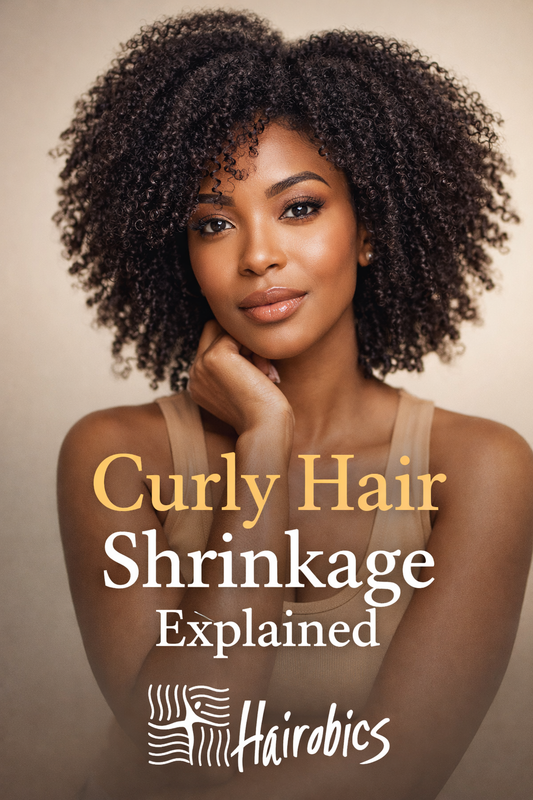
If you have natural curls, coils, or kinks, you’ve probably experienced this: your hair looks shoulder-length when wet… but once it dries, it “shrinks” to your chin or even shorter.
That’s curly hair shrinkage.
For many women with natural hair—especially Type 3 and Type 4 textures—shrinkage can feel confusing, frustrating, or even discouraging when you’re trying to measure growth. But here’s the truth:
Shrinkage is not a sign your hair isn’t growing. It’s actually a sign of healthy elasticity.
In this complete guide, we’ll break down:
-
What curly hair shrinkage really is
-
Why it happens (science + structure)
-
How shrinkage differs across curl types
-
The link between shrinkage and hair health
-
When shrinkage signals dryness or damage
-
How to reduce shrinkage safely (without breakage)
-
Protective styling tips for length retention
-
A healthy growth strategy for natural curls
If you run Hairobics All Natural or love building a premium natural hair routine, this topic is powerful for both education and product positioning—because shrinkage conversations always lead to moisture, elasticity, and scalp health.
Let’s dive in.
What Is Curly Hair Shrinkage?
Shrinkage is the difference between your hair’s stretched length and its natural, dry curl pattern length.
For example:
-
Wet or stretched hair: 14 inches
-
Fully dry in natural state: 9 inches
That’s 5 inches of shrinkage.
Shrinkage percentages vary:
-
Type 2 (wavy): 5–15%
-
Type 3 (curly): 25–50%
-
Type 4 (coily/kinky): 50–75% (sometimes more)
The tighter the curl pattern, the more dramatic the shrinkage.
Why Curly Hair Shrinks: The Science Behind It
Shrinkage is rooted in structure.
Each hair strand contains:
-
A cortex (inner strength layer)
-
A cuticle (outer protective layer)
-
Keratin proteins arranged in bonds
Curly and coily hair has an elliptical shape, unlike straight hair, which is round. That oval shape creates bends and curves along the strand.
The Key Factors Behind Shrinkage
-
Curl Geometry
-
Hydrogen Bonds
-
Elasticity
-
Moisture Retention Patterns
-
Strand Porosity
Let’s break these down.
1. Curl Geometry: The Spiral Effect
Curly hair grows in a spiral formation. The tighter the spiral, the more the strand coils back onto itself.
Think of a slinky:
-
When stretched, it looks long.
-
When released, it compresses.
That’s shrinkage in action.
Type 4 hair especially forms zig-zag or tightly packed coil patterns, which create maximum compression when dry.
2. Hydrogen Bonds and Water
Hydrogen bonds are temporary bonds in your hair that respond to water.
When hair is wet:
-
Hydrogen bonds break.
-
Hair elongates.
-
Curls loosen.
When hair dries:
-
Hydrogen bonds reform.
-
Hair contracts back into its curl pattern.
This cycle happens every wash day.
That’s why your twist-out looks longer while damp… but shrinks up as it dries.
3. Elasticity: The Good Kind of Shrinkage
Healthy hair stretches and returns.
If you gently pull a curl and it springs back without breaking, that’s elasticity. Elastic hair equals:
-
Balanced moisture
-
Strong protein structure
-
Healthy cuticle layers
Shrinkage often indicates strong elasticity.
Low shrinkage can sometimes mean:
-
Heat damage
-
Chemical damage
-
Loss of curl integrity
So shrinkage is often a positive sign.
4. Porosity and Shrinkage
High-porosity hair absorbs water quickly but loses it fast.
Low-porosity hair resists water penetration.
Both can shrink—but how they shrink differs:
-
High porosity may shrink rapidly and frizz.
-
Low porosity may shrink more gradually.
Managing moisture balance helps control how dramatic shrinkage appears.
Does Shrinkage Mean My Hair Isn’t Growing?
No.
Hair growth happens at the scalp.
Shrinkage happens along the strand.
You can grow ½ inch per month and still see no visible length if your curls tighten.
For many women with coily hair, it takes 12–18 months before visible length retention becomes obvious because shrinkage hides progress.
This is why measuring stretched length is more accurate than judging by appearance.
Is Shrinkage Bad?
Shrinkage is not bad.
But extreme shrinkage paired with dryness may signal:
-
Lack of moisture
-
Protein imbalance
-
Build-up blocking hydration
-
Over-manipulation
Healthy shrinkage = soft, elastic, springy.
Unhealthy shrinkage = brittle, rough, snapping.
How Shrinkage Differs by Curl Type
Type 2 (Wavy)
Minimal shrinkage. Waves may drop as hair grows longer.
Type 3 (Curly)
Moderate shrinkage. Defined spirals tighten when dry.
Type 4A
Tight coils. Noticeable length difference between wet and dry.
Type 4B & 4C
Maximum shrinkage. Hair may shrink up to 75%.
For Type 4 hair especially, length retention becomes more important than simply “growing” hair.
The Emotional Side of Shrinkage
Shrinkage can affect confidence.
Many women feel:
-
Their hair looks shorter than it is.
-
Growth feels invisible.
-
Protective styles are the only way to see length.
Understanding shrinkage shifts the mindset from frustration to strategy.
How to Reduce Shrinkage (Safely)
Reducing shrinkage doesn’t mean eliminating curls.
It means stretching hair gently without damage.
Here are the safest methods:
1. Banding Method
-
Section damp hair.
-
Wrap hair ties down the length.
-
Allow to air dry.
This stretches curls without heat.
2. African Threading
A traditional stretching technique using thread wrapped along the strand.
Benefits:
-
Minimal breakage
-
Excellent length reveal
-
Cultural heritage method
3. Twist-Outs and Braid-Outs
Larger twists = more stretch.
Smaller twists = more definition, more shrinkage.
4. Blow Drying (Low Heat, Tension Method)
Use low heat and a heat protectant.
Keep nozzle moving. Avoid high tension.
Excessive heat damages curl pattern permanently.
Moisture Is the Foundation of Shrinkage Control
If your hair is dry, it will:
-
Shrink unevenly
-
Tangle more
-
Break during stretching
A healthy routine should include:
-
Gentle cleansing
-
Deep conditioning
-
Leave-in hydration
-
Sealing oil
-
Scalp nourishment
Moisture balance improves elasticity and controlled shrinkage.
The Connection Between Shrinkage and Breakage
Stretching dry hair causes snapping.
Always stretch damp, conditioned hair.
Key rules:
-
Never stretch hair aggressively.
-
Never pull through tangles.
-
Use wide-tooth tools or fingers first.
Length retention matters more than forcing length.
Protective Styles and Shrinkage
Protective styles reduce daily manipulation.
Examples:
-
Flat twists
-
Box braids
-
Cornrows
-
Wigs (with proper scalp care)
-
Low buns
But tension at edges can cause traction alopecia.
Stretching should never come at the cost of scalp health.
How to Tell If Your Shrinkage Is Healthy
Healthy Shrinkage Signs:
-
Soft texture
-
Curl springs back
-
No snapping when stretched
-
Hair feels hydrated
Unhealthy Shrinkage Signs:
-
Crunchy feel
-
Breakage during stretch
-
Split ends
-
Excessive shedding
When in doubt, focus on moisture and scalp care.
Growth Strategy for Highly Shrinkage-Prone Hair
If your goal is visible length:
-
Prioritize scalp health.
-
Reduce daily manipulation.
-
Stretch hair gently 1–2 times weekly.
-
Trim strategically (not excessively).
-
Deep condition weekly.
Growth happens at the root.
Retention happens at the ends.
Myths About Shrinkage
Myth #1: Shrinkage means your hair is unhealthy.
Truth: It often means it’s elastic.
Myth #2: You must stretch hair daily to grow it.
Truth: Over-stretching increases breakage.
Myth #3: No shrinkage = long hair.
Truth: No shrinkage sometimes equals heat damage.
Should You Fight Shrinkage?
Not necessarily.
Shrinkage protects hair by:
-
Reducing friction
-
Minimizing environmental exposure
-
Preserving curl integrity
Many women now embrace shrinkage as a symbol of healthy coils.
The key is learning when to stretch and when to let curls thrive.
The Role of Scalp Health in Curl Performance
Healthy follicles produce stronger strands.
Poor scalp health leads to:
-
Weak new growth
-
Reduced elasticity
-
Increased breakage
Massaging the scalp increases circulation and supports growth cycles.
If your brand focuses on natural oils and scalp nourishment, this is where shrinkage education aligns perfectly with growth messaging.
Long-Term Perspective: Shrinkage and Hair Journey
In early stages of natural hair growth, shrinkage feels dramatic.
As hair gets longer:
-
Weight stretches curls slightly.
-
Shrinkage becomes less intense.
-
Length retention becomes visible.
The first 12 months are usually the most discouraging—but consistency changes everything.
Final Thoughts: Shrinkage Is Not the Enemy
Curly hair shrinkage is:
-
A structural reality
-
A sign of elasticity
-
A marker of curl health
-
Completely normal
Instead of fighting shrinkage, focus on:
-
Moisture balance
-
Gentle stretching
-
Scalp nourishment
-
Protective styling
-
Patience
Your curls are not shrinking your growth.
They’re simply showing their natural pattern.
And when properly cared for, shrinkage becomes proof that your hair is strong, hydrated, and thriving.