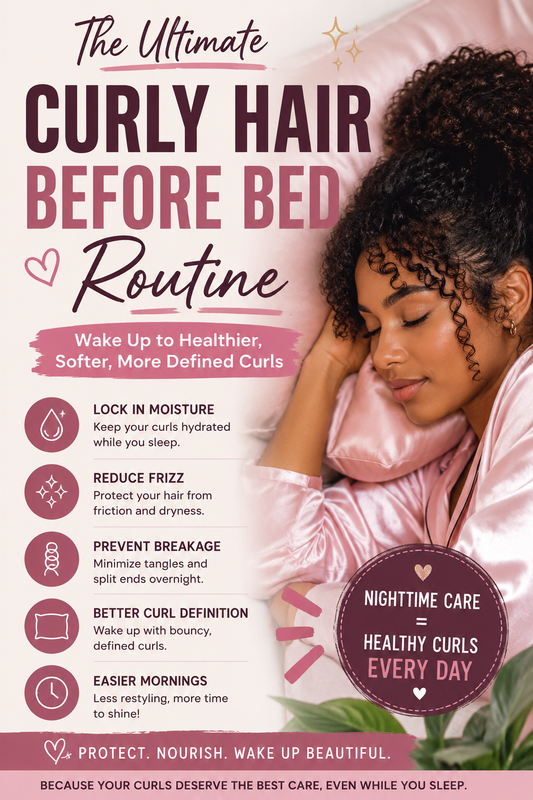
Your nighttime routine can make or break your curls.
If you wake up every morning with flattened curls, tangled hair, excessive frizz, or dry ends, your bedtime habits may be the reason.
Unlike straight hair, curly hair naturally struggles to retain moisture because scalp oils have difficulty traveling down the twists and bends of each strand. During sleep, friction against pillowcases, tossing and turning, and dry indoor air can remove even more moisture.
The good news?
A consistent curly hair before bed routine helps preserve curl definition, reduce tangles, minimize breakage, and keep hair healthier over time.
In this complete guide, you'll learn:
- Why curls need nighttime protection
- The ideal bedtime routine
- How to sleep with every curl type
- Mistakes that damage curls overnight
- Morning refresh tips
- Frequently asked questions
Why Curly Hair Needs Extra Care at Night
Curly hair is naturally more fragile than straight hair.
Each bend in the strand creates weak points where breakage can occur. Sleeping without protecting curls allows friction to roughen the cuticle, causing:
- Frizz
- Split ends
- Dryness
- Tangles
- Knotting
- Loss of curl definition
A proper bedtime routine reduces these issues dramatically.
Benefits of a Nighttime Curly Hair Routine
Following the same routine each night offers several benefits.
Better Curl Definition
Protected curls maintain their shape instead of becoming stretched or flattened.
Less Frizz
Reducing friction helps the hair cuticle stay smooth.
Fewer Tangles
Keeping curls gathered prevents knots from forming.
More Moisture
Nighttime moisturizing reduces dryness.
Stronger Hair
Less friction means fewer broken strands.
Faster Morning Routine
Healthy curls often require only a light refresh instead of complete restyling.
Step 1: Never Go to Bed with Soaking Wet Hair
Wet curls are extremely fragile.
Sleeping while hair is soaking wet can lead to:
- Breakage
- Flat curls
- Mildew odor
- Scalp irritation
- Tangles
Instead:
- Allow hair to air dry 80–90%
- Diffuse on low heat if needed
- Make sure the scalp is mostly dry
Step 2: Detangle Only If Necessary
Avoid brushing dry curls.
Instead:
- Finger-detangle gently
- Separate large knots
- Leave curl clumps intact
If detangling is needed, lightly mist hair first.
Step 3: Apply Light Moisture
Your nighttime products should hydrate without making hair greasy.
Good options include:
- Leave-in conditioner
- Water-based curl refresher
- Lightweight moisturizing cream
- Small amount of natural oil on dry ends
Avoid heavy product buildup every night.
Step 4: Seal Dry Ends
Hair ends lose moisture first.
Apply a tiny amount of:
- Jojoba oil
- Argan oil
- Avocado oil
- Lightweight hair butter
Focus only on the last few inches.
Step 5: Pineapple Your Hair
The pineapple is one of the most popular curly hair sleeping methods.
How:
- Flip hair forward
- Gather curls loosely at the top
- Use a satin scrunchie
- Avoid pulling tightly
Benefits include:
- Prevents flattening
- Preserves curl definition
- Reduces tangles
- Protects volume
Step 6: Wear a Satin Bonnet
A satin bonnet reduces friction throughout the night.
Benefits include:
- Less breakage
- Less frizz
- Better moisture retention
- Longer-lasting hairstyles
Choose one with a comfortable elastic that isn't too tight.
Step 7: Sleep on a Satin Pillowcase
Even if your bonnet slips off, satin pillowcases help protect curls.
Cotton pillowcases absorb moisture while creating friction.
Satin helps curls glide smoothly.
Step 8: Protect Long Curly Hair
Long curls benefit from additional protection.
Options include:
- Loose braid
- Pineapple
- Satin scarf
- Loose bun
- Bonnet
Avoid tight ponytails.
Step 9: Protect Short Curly Hair
Short curls can simply be covered with:
- Satin bonnet
- Satin scarf
- Satin pillowcase
No elaborate styling is necessary.
Step 10: Keep Your Bedroom Comfortable
Dry air removes moisture overnight.
Consider:
- Humidifier
- Moderate room temperature
- Staying hydrated
Environmental conditions matter more than many people realize.
Bedtime Routine for Type 2 Wavy Hair
For loose waves:
- Light leave-in conditioner
- Loose pineapple
- Satin pillowcase
- Refresh lightly in the morning
Avoid heavy creams.
Bedtime Routine for Type 3 Curly Hair
For spiral curls:
- Moisturize
- Pineapple
- Satin bonnet
- Sleep on satin pillowcase
Bedtime Routine for Type 4 Curly Hair
Tighter curls often need additional moisture.
Routine:
- Light leave-in
- Seal with oil
- Loose twists or braids
- Satin bonnet
- Satin pillowcase
Protective Styles to Sleep In
Excellent overnight options include:
Pineapple
Best overall.
Loose Twists
Reduce tangles.
Loose Braids
Great for stretched curls.
Satin Scarf
Excellent for shorter curls.
Bonnet
Works for nearly every curl pattern.
Hairstyles to Avoid Overnight
Avoid:
- Tight ponytails
- Tight buns
- Rubber bands
- Tight braids
- Metal hair ties
These increase tension and breakage.
Products That Work Well Before Bed
Look for products containing:
- Aloe vera
- Glycerin
- Marshmallow root
- Coconut water
- Panthenol
- Shea butter (light use)
- Avocado oil
- Jojoba oil
Avoid excessive alcohol-based products.
Common Bedtime Mistakes
Sleeping on Cotton
Cotton removes moisture.
Too Much Product
Heavy buildup leads to limp curls.
Tight Hairstyles
Excessive tension damages hair.
Wet Hair
One of the biggest causes of overnight damage.
Skipping Protection
Bare curls rub constantly against bedding.
Morning Refresh Routine
Instead of washing every morning:
- Remove bonnet.
- Shake curls loose.
- Mist lightly with water.
- Apply curl refresher if needed.
- Scrunch upward.
- Air dry.
Weekly Nighttime Deep Care
Once weekly:
- Deep condition
- Seal moisture
- Gentle scalp massage
- Protective overnight style
Weekly maintenance helps curls remain soft.
Nutrition Supports Healthy Curls
Hair health begins internally.
Focus on:
- Protein
- Iron
- Zinc
- Vitamin D
- Omega-3 fats
- Fruits
- Vegetables
- Plenty of water
Frequently Asked Questions
Should I moisturize curly hair every night?
Only if it feels dry. Hair that still feels hydrated usually doesn't need additional product.
Is sleeping with a bonnet really necessary?
While not mandatory, bonnets significantly reduce friction and help curls last longer.
Is pineapple hair good for every curl type?
Yes, though people with very short hair may benefit more from a satin bonnet alone.
Should I oil my curls every night?
Heavy oiling isn't necessary. Use only a small amount on dry ends when needed.
Is satin really better than cotton?
Yes. Satin creates less friction and absorbs far less moisture than cotton.
Sample Curly Hair Before Bed Routine
Monday
- Moisturize
- Pineapple
- Bonnet
Tuesday
- Light mist
- Bonnet
Wednesday
- Seal dry ends
- Pineapple
Thursday
- Refresh lightly
- Bonnet
Friday
- Deep moisture treatment
Saturday
- Loose braid
- Satin scarf
Sunday
- Wash day followed by full nighttime routine
Final Thoughts
Healthy curls don't stop needing care when the day ends. In fact, nighttime is one of the most important opportunities to protect your hair from unnecessary damage.
A simple bedtime routine—keeping curls mostly dry, adding light moisture when needed, gathering hair into a loose pineapple or protective style, and sleeping with a satin bonnet or on a satin pillowcase—can dramatically reduce frizz, preserve curl definition, and minimize breakage over time.
Consistency is the key. Small nightly habits add up, helping you wake up with softer, more manageable curls and making your morning routine faster and easier. By protecting your curls while you sleep, you're investing in stronger, healthier, and more beautiful hair every single day.