When it comes to maintaining healthy, moisturized natural hair, conditioner is one of the most important products in your hair care routine. However, not all conditioners serve the same purpose. Two products that frequently cause confusion are regular conditioner and deep conditioner.
Although both products help improve the condition of your hair, they are formulated for different purposes and often provide different levels of conditioning.
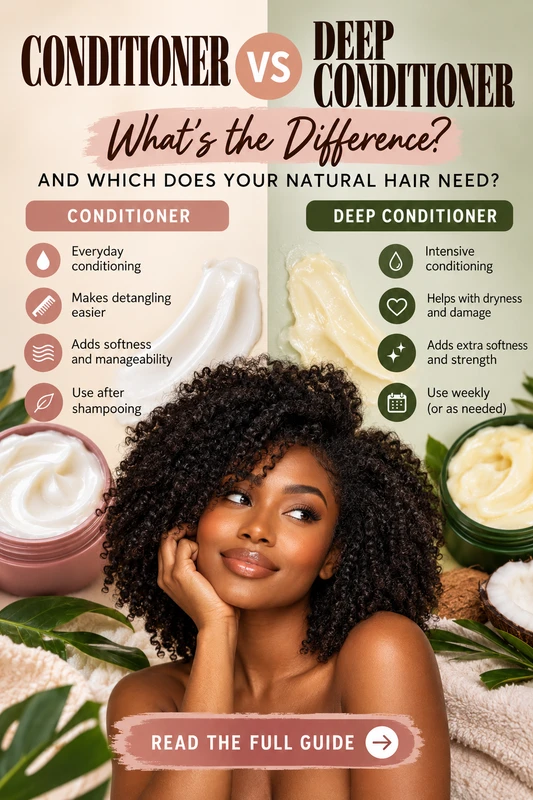
Regular conditioner is designed to provide everyday softness, improve manageability, and make detangling easier after shampooing. Deep conditioner, on the other hand, typically provides a more intensive conditioning experience, helping address dryness, roughness, and other concerns that may require additional attention.
For Black women with natural hair, understanding the difference between these products is especially important. Natural hair textures, particularly tightly coiled 4A, 4B, and 4C hair, can experience dryness because natural scalp oils have a more difficult time traveling along the bends and curves of the hair shaft.
Without an effective conditioning routine, natural hair may become difficult to detangle, more susceptible to breakage, and harder to maintain between wash days.
But does that mean you should deep condition every time you wash your hair? Can regular conditioner provide enough moisture? And is it possible to use too much deep conditioner?
In this comprehensive guide, we'll explore conditioner vs deep conditioner, explain how each product works, and help you determine how to incorporate both into a healthy natural hair care routine.
1. What Is Regular Conditioner?
Regular conditioner, sometimes called rinse-out conditioner, is a hair care product typically applied immediately after shampooing.
Its primary purpose is to improve the feel and manageability of the hair by depositing conditioning ingredients onto the hair shaft.
Shampoo removes dirt, excess oil, sweat, and product buildup. However, depending on the shampoo formulation and the condition of your hair, cleansing can leave strands feeling rough or tangled.
Conditioner helps restore softness and reduce friction between individual hair strands.
Most regular conditioners contain ingredients such as:
-
Fatty alcohols, including cetyl alcohol and cetearyl alcohol.
-
Conditioning agents that improve softness and manageability.
-
Humectants such as glycerin.
-
Plant-derived oils and emollients.
-
Silicone or silicone alternatives.
-
Ingredients that help reduce static and friction.
These ingredients work together to make hair feel smoother and easier to handle.
Benefits of Regular Conditioner
Regular conditioner provides several important benefits for natural hair.
Improves detangling: Conditioner creates slip, allowing your fingers or detangling tools to move through curls and coils more easily.
Reduces friction: Conditioning ingredients help reduce friction between strands, potentially minimizing mechanical damage during styling.
Improves softness: Hair that feels rough after shampooing can become noticeably softer after conditioning.
Supports moisture retention: Certain conditioning ingredients help hair maintain a more manageable moisture balance.
Makes styling easier: Properly conditioned hair is generally easier to section, braid, twist, and manipulate.
Regular conditioner is especially useful during wash day because it prepares your hair for the next steps in your routine.
2. What Is Deep Conditioner?
Deep conditioner is an intensive conditioning treatment formulated to provide additional softness, lubrication, and conditioning benefits.
Compared with many regular conditioners, deep conditioners often have richer textures and contain higher concentrations of certain conditioning ingredients.
They may include combinations of plant oils, fatty alcohols, humectants, proteins, and other ingredients designed to improve the feel and manageability of dry or damaged hair.
Deep conditioners are commonly left on the hair longer than regular conditioners, although the exact processing time depends on the manufacturer's instructions.
Some products recommend five minutes, while others suggest 15–30 minutes.
Despite their name, deep conditioners do not necessarily penetrate deeply into every layer of the hair shaft. Their effects depend on the formulation, ingredients, hair condition, and how the product interacts with the hair fiber.
Benefits of Deep Conditioning Natural Hair
Deep conditioning can be particularly helpful for natural hair that experiences frequent dryness, tangling, or roughness.
Potential benefits include:
-
Improving softness and flexibility.
-
Reducing friction during detangling.
-
Helping dry hair feel more manageable.
-
Temporarily improving the appearance of damaged strands.
-
Supporting easier styling.
-
Reducing the likelihood of mechanical breakage during manipulation.
-
Improving the overall feel of chemically treated or color-treated hair.
Deep conditioning is not a permanent solution for split ends or severely damaged hair. However, it can improve the cosmetic condition of strands and help make an existing hair care routine more effective.
3. Conditioner vs Deep Conditioner: Main Differences
Although regular conditioner and deep conditioner share several ingredients, their intended uses and application methods can differ.
Understanding these differences can help you avoid unnecessary product layering while ensuring your hair receives adequate conditioning.
|
Feature |
Regular Conditioner |
Deep Conditioner |
|---|---|---|
|
Main purpose |
Routine conditioning |
Intensive conditioning |
|
Typical texture |
Lightweight to creamy |
Often thicker and richer |
|
Application |
After shampooing |
Usually after shampooing |
|
Processing time |
Typically 1–5 minutes |
Typically 5–30 minutes |
|
Frequency |
Most wash days |
As needed, often weekly |
|
Primary benefits |
Softness and detangling |
Additional softness and manageability |
|
Best suited for |
Routine maintenance |
Hair needing extra conditioning |
|
Protein content |
Depends on formulation |
Depends on formulation |
|
Rinse out? |
Yes |
Usually yes |
One important distinction is that a product labeled deep conditioner is not automatically better than a regular conditioner.
A well-formulated rinse-out conditioner may provide excellent conditioning benefits, while a poorly formulated deep conditioner may not deliver noticeable improvements.
Choosing products based on your hair's actual needs is more important than relying exclusively on marketing labels.
4. Why Natural Hair Needs Conditioner
Natural hair has unique structural characteristics that influence how it responds to cleansing, conditioning, and styling.
The curlier or more tightly coiled the hair, the more challenging it can be for natural scalp oils to distribute evenly along the strands.
This can leave the ends feeling dry even when the scalp produces adequate sebum.
Additionally, the bends and curves of curly hair create points where strands may experience increased friction during detangling and manipulation.
Conditioning helps reduce this friction.
For women with 4C hair, maintaining a consistent conditioning routine can make a noticeable difference in how easily the hair can be handled.
However, curl pattern alone does not determine how much conditioner your hair needs.
Other factors include:
-
Hair porosity.
-
Strand thickness.
-
Hair density.
-
Chemical processing.
-
Heat styling habits.
-
Environmental exposure.
-
Product buildup.
-
Frequency of washing.
For example, someone with fine, low-porosity 4C hair may prefer lightweight conditioning products, while someone with coarse, high-porosity hair may benefit from richer formulations.
The goal is to find the right balance rather than automatically using the heaviest products available.
5. Does Deep Conditioner Moisturize Better Than Regular Conditioner?
Deep conditioner is often associated with superior moisturizing benefits, but the answer depends on the ingredients and your hair's needs.
Many deep conditioners contain a combination of water, humectants, emollients, and conditioning agents.
These ingredients can improve hair softness and reduce the rough feeling associated with dryness.
However, regular conditioners can contain many of the same ingredients.
The difference often lies in formulation, concentration, and intended application.
A rich regular conditioner may provide more conditioning than a lightweight deep conditioner.
Likewise, leaving a product on longer does not automatically make it more effective.
Understanding Moisture in Natural Hair
Water plays an important role in hair hydration.
Conditioning products can help improve how hair feels and behaves by reducing friction, coating strands, and influencing moisture exchange.
Ingredients such as glycerin and panthenol are commonly used in moisturizing hair products.
Oils and butters primarily provide lubrication and help reduce moisture loss rather than directly adding water to dry strands.
For this reason, a balanced routine often includes water-based conditioning products followed by appropriate leave-in products or styling creams.
If your hair constantly feels dry despite using rich conditioners, consider whether product buildup, environmental conditions, cleansing habits, or excessive manipulation may be contributing to the problem.
6. How Often Should You Use Regular Conditioner?
For most people with natural hair, regular conditioner can be used after every shampoo.
This helps restore manageability following cleansing and makes detangling easier.
If you wash your natural hair once a week, conditioning once a week may be sufficient.
If you shampoo twice weekly because of exercise, sweating, or scalp concerns, using conditioner after both washes may be appropriate.
There is no universal rule requiring everyone to follow the same conditioning schedule.
Suggested Conditioning Frequency
|
Hair Condition |
Suggested Frequency |
|---|---|
|
Healthy natural hair |
Every shampoo |
|
Dry natural hair |
Every shampoo |
|
Fine natural hair |
Every shampoo with a lightweight formula |
|
Color-treated hair |
Every shampoo |
|
High-porosity hair |
Every shampoo |
|
Low-porosity hair |
Every shampoo, adjusting product richness |
|
Protective styles |
Condition when washing is appropriate for the style |
If your hair becomes limp, excessively coated, or difficult to style, evaluate the amount and type of conditioner being used.
More product does not always produce better results.
7. How Often Should You Deep Condition Natural Hair?
Weekly deep conditioning is a common starting point for people with dry or tightly coiled natural hair.
However, weekly treatments are not necessary for everyone.
Some people experience excellent results from deep conditioning every two weeks, while others benefit from additional conditioning after heat styling or chemical treatments.
Your ideal frequency depends on how your hair responds.
Weekly Deep Conditioning
Weekly deep conditioning may be useful if your hair:
-
Frequently feels dry after washing.
-
Experiences significant tangling.
-
Has been chemically colored.
-
Is exposed to frequent heat styling.
-
Feels rough or difficult to manage.
-
Needs additional lubrication during detangling.
Every Two Weeks
Biweekly deep conditioning may be appropriate for hair that generally feels healthy and responds well to regular conditioner.
Monthly Deep Conditioning
Monthly treatments may be sufficient for people whose regular conditioner consistently provides adequate softness and manageability.
The most effective schedule is one that responds to your hair's condition rather than following a rigid calendar.
8. Conditioner vs Deep Conditioner for 4C Hair
One of the most common questions in natural hair care is whether 4C hair requires deep conditioner instead of regular conditioner.
The answer is that both products can serve useful purposes.
4C hair typically features tightly packed coils and significant shrinkage. These characteristics can make detangling and moisture management more challenging.
Regular conditioner helps provide slip after shampooing, making it easier to separate strands without unnecessary pulling.
Deep conditioner can provide additional softness when hair feels particularly dry or difficult to manipulate.
Recommended Routine for 4C Hair
Start by cleansing your scalp and hair with an appropriate shampoo.
Apply regular conditioner, concentrating on the lengths and ends.
Detangle gently in sections while the conditioner provides slip.
Rinse thoroughly.
If your hair needs additional conditioning, apply a deep conditioner according to the product instructions.
After rinsing, use a water-based leave-in treatment and finish with your preferred styling product.
Not everyone needs both a regular conditioner and deep conditioner during the same wash session. A well-formulated deep conditioner can sometimes replace regular conditioner.
The most important factor is how your hair feels after the process.
9. Can You Use Conditioner and Deep Conditioner Together?
Yes. Regular conditioner and deep conditioner can be used during the same wash day.
However, using both is optional.
Some people prefer to shampoo, apply a deep conditioner, rinse, and finish with a leave-in treatment.
Others prefer using regular conditioner first to detangle before applying their deep conditioning treatment.
Both approaches can work.
Option One: Deep Conditioner Only
-
Shampoo your hair.
-
Apply deep conditioner.
-
Leave it on for the recommended time.
-
Rinse thoroughly.
-
Apply leave-in conditioner.
-
Style as desired.
Option Two: Regular Conditioner Followed by Deep Conditioner
-
Shampoo thoroughly.
-
Apply regular conditioner.
-
Detangle gently.
-
Rinse.
-
Apply deep conditioner.
-
Follow the recommended processing time.
-
Rinse and style.
The second method may be helpful when your regular conditioner provides better detangling slip than your deep conditioner.
However, adding multiple products does not guarantee additional benefits.
If your hair already feels soft and manageable after one conditioner, an extra treatment may be unnecessary.
10. Can You Deep Condition Too Often?
Yes, excessive conditioning can sometimes leave hair feeling weighed down, coated, or difficult to style.
This is particularly relevant when using rich products that deposit substantial amounts of conditioning ingredients.
Fine hair may become limp when repeatedly exposed to heavy oils and butters.
Some people may also notice that their curls lose definition or that their hair takes longer to dry.
These changes do not necessarily indicate permanent damage.
Often, adjusting the amount of product or washing away accumulated residue can improve the situation.
Signs You May Be Overusing Deep Conditioner
Possible signs include:
-
Hair feels coated after rinsing.
-
Curls appear weighed down.
-
Hair becomes unusually limp.
-
Products accumulate quickly.
-
Styling products no longer perform as expected.
-
Hair feels greasy despite recent washing.
If these symptoms occur, reduce the frequency of deep conditioning and consider using a clarifying shampoo when appropriate.
You can then reassess your hair's needs before reintroducing richer treatments.
11. Moisturizing Deep Conditioner vs Protein Deep Conditioner
Not all deep conditioners are designed to address the same concerns.
Two common categories are moisturizing deep conditioners and protein-containing deep conditioners.
Understanding the distinction can help you choose products more effectively.
Moisturizing Deep Conditioner
Moisturizing deep conditioners typically emphasize ingredients that improve softness, lubrication, and manageability.
Common ingredients include:
-
Aloe vera.
-
Glycerin.
-
Panthenol.
-
Shea butter.
-
Avocado oil.
-
Fatty alcohols.
-
Conditioning polymers.
These formulations may be especially useful when hair feels dry, rough, or difficult to detangle.
Protein Deep Conditioner
Protein-containing deep conditioners may include hydrolyzed proteins or amino-acid-based ingredients.
Examples include:
-
Hydrolyzed wheat protein.
-
Hydrolyzed silk protein.
-
Hydrolyzed keratin.
-
Hydrolyzed rice protein.
-
Hydrolyzed soy protein.
Depending on the formulation, these ingredients may temporarily improve certain properties of the hair fiber.
Protein-containing products can be particularly useful for some types of chemically processed or damaged hair.
However, not every person needs frequent protein treatments.
If your hair becomes stiff or difficult to manage after using a particular protein treatment, reduce its frequency or switch to a different formulation.
There is no universally established schedule requiring everyone with natural hair to alternate protein and moisture treatments.
12. Conditioner vs Deep Conditioner for Low-Porosity Hair
Low-porosity hair is commonly described as hair that resists absorbing water or certain conditioning ingredients.
People with low-porosity hair may notice that products sit on the surface or that their hair takes considerable time to become fully saturated.
Heavy conditioning products can sometimes contribute to a coated feeling, particularly when multiple products are layered together.
For this reason, lightweight formulations may be preferable.
Low-Porosity Conditioning Tips
Choose products that provide softness without leaving excessive residue.
Apply conditioner to thoroughly wet hair.
Work in sections to distribute the product evenly.
Avoid applying large amounts of oil or butter simply because your hair feels dry.
Use a clarifying shampoo periodically when buildup becomes noticeable.
When deep conditioning, follow the manufacturer's instructions rather than automatically leaving the product on for an extended period.
Low-porosity hair can benefit from deep conditioning, but richer is not necessarily better.
13. Conditioner vs Deep Conditioner for High-Porosity Hair
High-porosity hair often experiences more rapid moisture exchange and may feel dry relatively quickly after washing.
Porosity can be influenced by genetics, chemical treatments, heat exposure, and accumulated damage.
Some high-porosity hair responds well to richer conditioning products that help improve lubrication and reduce friction.
Regular conditioner remains important after shampooing.
Deep conditioner can provide additional cosmetic benefits, especially when the hair has experienced coloring, bleaching, or repeated heat styling.
For high-porosity natural hair, consider using products containing a balanced combination of conditioning agents, humectants, and emollients.
A leave-in conditioner may also help maintain manageability between wash days.
Remember that conditioning treatments cannot permanently repair severely damaged hair.
Split ends and extensive structural damage may require trimming.
14. Should You Use Heat When Deep Conditioning?
Applying gentle warmth during deep conditioning is a common natural hair care practice.
Some people use a heated conditioning cap, warm towel, or hooded dryer.
Warmth may influence product distribution and how certain ingredients interact with the hair, depending on the formulation.
However, heat is not required for every deep conditioning treatment.
Many products are designed to work effectively at room temperature.
If you choose to use warmth, avoid excessive temperatures and follow the manufacturer's directions.
People with sensitive scalps should be especially cautious.
You do not need to sit under a dryer for an hour to achieve effective conditioning.
Longer processing times are not automatically better.
15. Can You Leave Deep Conditioner in Overnight?
Leaving deep conditioner in overnight is generally unnecessary unless the manufacturer specifically recommends extended use.
Most rinse-out deep conditioners are designed to deliver their intended benefits within a particular processing period.
Leaving them on for several additional hours does not guarantee better results.
Overnight application can also create practical problems, including product transfer onto bedding and prolonged scalp exposure to ingredients intended to be rinsed away.
If you want conditioning benefits that last between wash days, choose a product specifically formulated as a leave-in conditioner.
Leave-in treatments are designed to remain on the hair without rinsing.
This makes them more suitable for maintaining softness and manageability throughout the week.
16. Deep Conditioner vs Leave-In Conditioner
Another common source of confusion is the difference between deep conditioner and leave-in conditioner.
Although both products contain conditioning ingredients, they serve different purposes.
Deep conditioner is typically applied during wash day and rinsed out after a designated period.
Leave-in conditioner is applied after washing and remains on the hair until the next cleansing session.
Why Leave-In Conditioner Matters
A leave-in conditioner can help maintain manageability after your rinse-out conditioning treatment has been removed.
It may also improve detangling, reduce friction, and prepare hair for styling.
For people with natural hair, leave-in conditioner can be particularly helpful when creating twist-outs, braid-outs, wash-and-go styles, and protective hairstyles.

Support Your Natural Hair Routine With Hairobics
The Hairobics All Natural Leave-In Treatment can be incorporated into your post-wash styling routine to help maintain softness and manageability between wash days.
Visit Hairobics All Natural to explore natural hair care products.
17. How to Deep Condition Natural Hair Properly
Even a quality deep conditioner may produce disappointing results if it is not distributed properly.
Following a consistent application process can help you get the most from your treatment.
Step 1: Start With Clean Hair
Wash your hair using a shampoo appropriate for your scalp and hair condition.
Removing dirt, excess oil, and product buildup helps prepare the hair for conditioning.
Step 2: Divide Hair Into Sections
Separate your hair into four to eight sections, depending on its length and density.
Working in sections makes application easier and reduces unnecessary manipulation.
Step 3: Apply Deep Conditioner
Distribute the product throughout the lengths and ends.
Pay particular attention to areas that feel dry or rough.
Avoid applying excessive amounts directly to the scalp unless the product is specifically formulated for scalp use.
Step 4: Detangle Gently
Use your fingers or a suitable detangling tool.
Start near the ends and gradually work upward.
Avoid pulling aggressively through knots.
Step 5: Follow Processing Instructions
Leave the treatment on for the time specified on the product label.
Use gentle warmth only when appropriate.
Step 6: Rinse Thoroughly
Remove the conditioner with water.
Make sure the product is rinsed adequately, particularly if you have fine hair or experience buildup easily.
Step 7: Apply Leave-In Conditioner
Finish with a leave-in treatment suited to your hair's needs.
You can then apply a styling cream, gel, or other preferred styling product.
18. Common Conditioning Mistakes to Avoid
Even with a consistent wash-day routine, certain habits can prevent you from getting the results you want.
Using too much product: Applying excessive conditioner can leave residue without providing additional benefits.
Ignoring the ends: The oldest sections of your hair often experience the greatest accumulated wear. Make sure they receive adequate conditioning.
Skipping shampoo: Conditioner does not replace proper scalp cleansing. Consistent cleansing helps remove buildup that can interfere with styling and manageability.
Assuming thicker products are better: Texture alone does not determine product effectiveness.
Leaving treatments on too long: Follow the manufacturer's instructions rather than assuming overnight application will improve performance.
Using the same products regardless of hair changes: Seasonal conditions, coloring, heat styling, and changes in your routine may influence your conditioning needs.
19. Frequently Asked Questions About Conditioner vs Deep Conditioner
Is deep conditioner better than regular conditioner?
Not necessarily. Deep conditioner is generally intended to provide more intensive conditioning, while regular conditioner supports routine softness and detangling. The most suitable product depends on your hair's needs and the formulation.
Can I replace regular conditioner with deep conditioner?
Yes. Many deep conditioners can be used in place of regular conditioner during wash day. Follow the product instructions and monitor how your hair responds.
Should I deep condition every time I wash my 4C hair?
You can deep condition every wash day if your hair benefits from it, but it is not mandatory. Some people achieve excellent results using regular conditioner most weeks and deep conditioner periodically.
Does deep conditioner make natural hair grow faster?
Deep conditioner does not directly accelerate hair growth from the scalp. However, improved manageability and reduced mechanical breakage may help you retain more of the length your hair naturally grows.
Can deep conditioner repair split ends?
No conditioning treatment can permanently restore a split hair shaft. Products may temporarily smooth damaged strands, but trimming is generally necessary to remove split ends.
Should I use conditioner before or after deep conditioner?
Both approaches are possible, but you generally do not need both products. If you use regular conditioner to detangle first, rinse it out before applying your deep conditioning treatment.
Is deep conditioner necessary for short natural hair?
Short natural hair can benefit from deep conditioning, especially if it feels dry or rough. However, a good regular conditioner may be sufficient for some people.
How long should I leave regular conditioner in my hair?
Most rinse-out conditioners recommend approximately one to five minutes. Always follow the instructions on the specific product.
Can men with natural hair use deep conditioner?
Absolutely. Men with afros, curls, waves, and locs can benefit from appropriate conditioning products. Product selection should reflect the hairstyle and hair's individual needs.
What happens if I never deep condition my hair?
Nothing inherently harmful happens simply because you skip deep conditioning. If your regular conditioner provides adequate softness and manageability, additional treatments may not be necessary.
Final Thoughts: Conditioner vs Deep Conditioner — Which One Should You Choose?
Regular conditioner and deep conditioner are both valuable tools for maintaining healthy-looking natural hair, but they do not need to compete for a place in your routine.
Regular conditioner is designed to support everyday softness, detangling, and manageability after shampooing.
Deep conditioner offers an additional conditioning option when your hair needs extra attention.
For many Black women with natural hair, using regular conditioner after shampooing and incorporating deep conditioning treatments as needed provides a practical starting point.
The most important thing is to pay attention to how your hair responds.
Hair that feels soft, manageable, and easy to detangle may not require additional products simply because a particular treatment is popular.
On the other hand, hair that consistently feels dry, rough, or difficult to manipulate may benefit from adjusting its conditioning routine.
Remember that healthy natural hair care involves more than conditioning alone. Gentle detangling, appropriate cleansing, protective nighttime habits, and minimizing unnecessary manipulation all contribute to length retention.
The goal isn't to use more conditioner. It's to use the right conditioner, at the right time, for your hair's individual needs.
Explore natural hair care essentials at www.hairobicsallnatural.com and build a routine that helps keep your curls and coils looking and feeling their best.