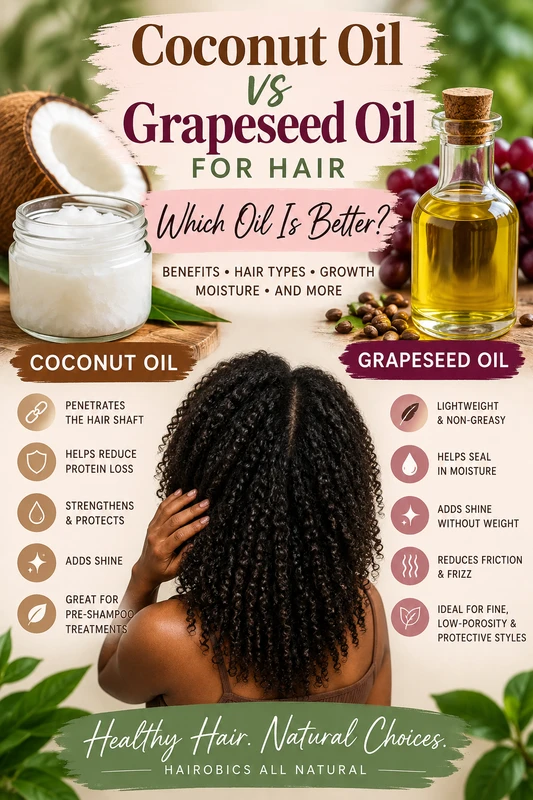
When it comes to natural hair care, oils can play an important role in keeping hair soft, manageable, shiny, and protected. Two oils that frequently appear in hair-care routines are coconut oil and grapeseed oil. Both are popular, both can be used on natural hair, and both offer benefits—but they do not behave the same way on your strands.
If you have ever wondered whether coconut oil or grapeseed oil is better for your hair, the answer depends largely on your hair's texture, porosity, condition, and what you are trying to accomplish.
Coconut oil is famous for its ability to penetrate the hair shaft and reduce protein loss. Grapeseed oil, on the other hand, is lightweight and works especially well as a sealing oil without making the hair feel excessively greasy or heavy.
For people with curly, coily, kinky, relaxed, braided, or loc'd hair, choosing the right oil can make a noticeable difference in how the hair looks and feels.
In this guide, we'll compare coconut oil vs grapeseed oil for hair, explain their benefits, discuss which oil may work better for different hair types, and show you how to incorporate them into a healthy natural hair routine.
Coconut Oil vs Grapeseed Oil: The Quick Difference
The biggest difference between coconut oil and grapeseed oil is how they interact with the hair.
Coconut oil is primarily known as a penetrating oil. Because of its fatty-acid composition, coconut oil can penetrate into the hair fiber to some extent rather than simply remaining on the surface.
Grapeseed oil works particularly well as a lightweight conditioning and sealing oil. It can coat the hair and help reduce the loss of moisture while adding softness and shine.
That distinction is important.
Natural hair needs water to stay hydrated. Oils do not replace water. Instead, oils are usually most useful when they support a moisturizing routine by lubricating strands, reducing friction, protecting the hair, and helping slow moisture loss.
Therefore, the question isn't simply:
"Which oil moisturizes hair better?"
A better question is:
Which oil performs the job my hair needs right now?
For strengthening and protecting the hair fiber, coconut oil can be useful.
For lightweight sealing, softness, and shine, grapeseed oil can be an excellent choice.
And for some people, using both oils at different stages of their routine may work better than choosing only one.
What Is Coconut Oil?
Coconut oil is extracted from coconuts and has been used for generations in hair and skin care.
One reason coconut oil receives so much attention in hair care is its high concentration of lauric acid. Lauric acid has a relatively low molecular weight and an affinity for hair proteins, which helps coconut oil penetrate the hair shaft more effectively than many oils.
This makes coconut oil somewhat different from oils that primarily coat the outside of the strand.
Coconut oil may be particularly useful before shampooing because it can help protect the hair during washing and reduce some of the swelling and stress associated with repeated wetting and drying.
For natural hair that is regularly washed, detangled, braided, twisted, or manipulated, reducing unnecessary damage can be extremely valuable.
However, coconut oil is not perfect for everyone.
Some people find that coconut oil leaves their hair feeling soft and strong. Others notice that their hair feels stiff, dry, rough, or coated after using it.
Your individual results matter.
Benefits of Coconut Oil for Hair
1. Coconut Oil Can Penetrate the Hair Shaft
One of coconut oil's most notable characteristics is its ability to penetrate the hair fiber.
Many oils remain mostly on the outside of the hair. That isn't necessarily bad—surface oils can provide lubrication and reduce friction.
Coconut oil, however, can penetrate the strand to a greater extent.
This makes it especially interesting as a pre-shampoo treatment.
Applying coconut oil before washing may help limit how much water the hair absorbs during the washing process. Hair repeatedly swelling when wet and contracting when dry can contribute to stress on the strand.
That can be particularly important for natural hair that is already fragile.
2. Coconut Oil May Help Reduce Protein Loss
Hair is primarily composed of a protein called keratin.
Everyday activities such as shampooing, heat styling, chemical processing, detangling, and environmental exposure can gradually damage the hair structure.
Coconut oil has been studied for its ability to reduce protein loss from hair.
That does not mean coconut oil is a protein treatment. However, its ability to penetrate the strand may help protect the hair fiber from some types of damage.
If your hair experiences frequent breakage, coconut oil may be worth experimenting with as part of a broader healthy-hair routine.
3. Coconut Oil Can Reduce Friction
Natural hair strands frequently rub against one another.
That friction contributes to:
Tangling, single-strand knots, split ends, roughness, and breakage.
Applying a small amount of coconut oil can provide lubrication that makes the strands easier to separate and manipulate.
Less friction during detangling can mean less unnecessary breakage.
4. Coconut Oil Can Add Shine
Dry or highly textured hair doesn't always reflect light easily.
A thin coating of oil can smooth the hair's surface and increase shine.
Coconut oil can provide a noticeable sheen, although using too much may make finer hair appear greasy or weighed down.
5. Coconut Oil Can Be Useful Before Shampooing
One of the best ways to use coconut oil is as a pre-poo.
A pre-poo is a treatment applied before shampooing.
You can distribute coconut oil through your hair, concentrating especially on your ends, and allow it to sit before washing.
For many people, approximately 20 to 60 minutes is enough.
Some people leave it on longer, but more time isn't automatically better.
The goal is simply to give the oil an opportunity to coat and penetrate the hair before shampooing.
Possible Downsides of Coconut Oil
Coconut oil can be beneficial, but it doesn't work beautifully for everyone.
Some natural-haired people report that coconut oil makes their hair feel unusually hard or brittle.
Others experience buildup or simply dislike how heavy it feels.
This is especially important if you have low-porosity hair.
Low-porosity hair has tightly arranged cuticle layers that can make it harder for water and products to move into the strand. Heavy applications of oils and butters can sometimes leave this hair feeling coated.
If coconut oil makes your hair feel worse rather than better, you do not need to force it into your routine.
Hair care is highly individual.
What Is Grapeseed Oil?
Grapeseed oil is extracted from grape seeds, which are a byproduct of winemaking.
It is generally lighter than coconut oil and has become popular among people who want the benefits of an oil without a heavy or greasy feeling.
Grapeseed oil contains a high proportion of linoleic acid and also contains vitamin E and other compounds naturally present in plant oils.
Its lightweight texture makes it particularly attractive for natural hair.
You can use grapeseed oil to help seal moisture into your strands, add shine, lubricate the hair, and reduce friction.
For people who dislike heavy oils, grapeseed oil can be one of the easiest oils to incorporate into a routine.
Benefits of Grapeseed Oil for Hair
1. Grapeseed Oil Is Lightweight
One of grapeseed oil's biggest advantages is its texture.
Compared with heavier oils and butters, grapeseed oil generally feels light on the hair.
This can be especially beneficial for:
Fine natural hair, low-density hair, looser curl patterns, low-porosity hair, and anyone whose hair becomes greasy easily.
You can often use a small amount without sacrificing volume or movement.
2. Grapeseed Oil Helps Seal in Moisture
One of the biggest misconceptions about oils is that they moisturize hair by themselves.
Water is the primary source of hydration for your hair.
Oil can help support that hydration.
After applying water or a water-based leave-in conditioner, applying a small amount of grapeseed oil can help coat the strands and slow the loss of moisture.
This is why grapeseed oil works well in moisturizing routines.
Think of it this way:
Water hydrates. Oil helps seal and protect.
If your natural hair constantly feels dry, simply adding more oil to already-dry hair may not solve the problem. Try applying your oil after water or a moisturizing leave-in treatment instead.
3. Grapeseed Oil Adds Shine Without Excessive Weight
If you want your curls, twists, braids, or locs to have a healthy-looking sheen without appearing greasy, grapeseed oil can be an excellent option.
Because it is relatively lightweight, you may be able to achieve shine while maintaining movement.
This makes grapeseed oil useful for finishing hairstyles.
After styling your hair, rub a few drops between your palms and lightly smooth them over your hair.
You don't need much.
4. Grapeseed Oil Can Reduce Friction
Like other plant oils, grapeseed oil can lubricate hair strands.
Lubrication matters because textured hair is particularly vulnerable to mechanical damage.
Every time you comb, brush, separate, twist, braid, or style your hair, the strands experience friction.
A light layer of grapeseed oil can make the hair feel smoother and easier to manipulate.
5. Grapeseed Oil Works Well for Protective Styles
Grapeseed oil can also be useful when wearing:
Box braids, knotless braids, twists, cornrows, locs, wigs, or other protective styles.
Because it is lightweight, it may be preferable to very thick oils when you want to avoid making your scalp and hair feel overly greasy.
However, remember that protective styles do not eliminate the need for moisture.
If your hair becomes dry while braided, use an appropriate water-based moisturizer first and then consider a small amount of oil.
Coconut Oil vs Grapeseed Oil for Natural Hair
So which oil is better for natural hair?
There isn't one universal winner.
Natural hair can range from fine and loosely curled to extremely dense and tightly coiled. Porosity, strand thickness, styling habits, climate, and previous damage also influence how an oil performs.
Coconut oil may be particularly useful when your priority is protecting the hair fiber and reducing protein loss.
Grapeseed oil may be particularly useful when your priority is lightweight sealing, lubrication, and shine.
If your hair loves rich products, you may prefer coconut oil.
If your hair becomes weighed down easily, grapeseed oil may be the better fit.
Coconut Oil vs Grapeseed Oil for Dry Hair
If your hair is dry, it can be tempting to pour oil onto it.
But dry hair usually needs hydration first.
Applying oil to extremely dry hair without adding water may simply coat dry strands.
A better approach is to apply a water-based moisturizer or leave-in treatment first.
Then follow with oil.
For this purpose, grapeseed oil can work extremely well because it provides a light seal over moisturized hair.
Coconut oil can also be used, but some people find it more effective as a pre-shampoo treatment rather than a daily sealing oil.
If your hair feels dry despite using oils regularly, consider whether you are actually providing enough water-based moisture.
Coconut Oil vs Grapeseed Oil for Low-Porosity Hair
Low-porosity hair can be challenging because products may sit on top of the strands instead of absorbing easily.
You may notice:
Products taking a long time to absorb, water beading on the hair, frequent buildup, hair taking a long time to become completely wet, or heavy products leaving a coated feeling.
Because grapeseed oil is relatively lightweight, it may be easier to use on low-porosity hair.
Apply only a small amount after your leave-in conditioner.
Coconut oil can still work for low-porosity hair, but you may need to experiment carefully with the quantity and method of application.
If coconut oil consistently leaves your hair feeling hard, greasy, or coated, grapeseed oil may fit your routine better.
Coconut Oil vs Grapeseed Oil for High-Porosity Hair
High-porosity hair has a more raised or damaged cuticle structure, allowing moisture to enter and leave relatively easily.
High-porosity hair may:
Dry quickly, absorb products quickly, become frizzy easily, tangle frequently, and require regular conditioning.
For high-porosity hair, sealing can be especially important.
Grapeseed oil can help provide a light seal after moisturizing.
However, some people with very porous or coarse hair may find that grapeseed oil alone is too light.
In that situation, coconut oil, a richer oil blend, cream, or butter may provide the feel and protection you prefer.
You can also layer products.
For example:
Water or leave-in treatment → cream → small amount of oil.
The important thing is to avoid using so much product that your hair becomes coated and difficult to cleanse.
Coconut Oil vs Grapeseed Oil for 4C Hair
4C hair often has tight coils and significant shrinkage.
Because of the bends and curves along the hair strand, natural scalp oils have difficulty traveling from the roots to the ends.
That is one reason the ends of tightly coiled hair can become dry.
Both coconut and grapeseed oil can have a place in a 4C hair routine.
Coconut oil may be useful as a pre-shampoo treatment, especially if your hair is prone to damage during wash day.
Grapeseed oil may work well after moisturizing to seal the hair without creating an extremely heavy coating.
For many people with 4C hair, the best approach isn't choosing one oil forever.
You might use coconut oil before washing and grapeseed oil after moisturizing.
That gives each oil a specific purpose.
Coconut Oil vs Grapeseed Oil for Hair Growth
This is one of the most important distinctions to understand.
Neither coconut oil nor grapeseed oil should be viewed as a miracle hair-growth treatment.
Hair growth occurs within the follicles underneath your scalp.
Applying oil to your strands does not suddenly cause follicles to produce dramatically longer hair.
However, maintaining healthy hair can help with length retention.
And length retention is extremely important.
Imagine that your hair grows normally from your scalp but continually breaks at the ends.
You may look in the mirror several months later and believe:
"My hair isn't growing."
The hair may actually be growing.
You simply aren't retaining the new length.
Reducing dryness, friction, tangles, and breakage can help you preserve more of the hair you grow.
That is where a healthy moisturizing and oiling routine can be useful.
Hair Growth vs Length Retention
Hair growth and length retention are often confused.
Hair growth happens at the scalp.
Length retention is your ability to keep the hair you've already grown from breaking off.
If your goal is longer natural hair, you need both.
Healthy follicles must produce hair, and your existing strands must survive long enough for you to see meaningful length.
That means your routine should focus on more than oils.
A strong length-retention routine generally includes gentle cleansing, regular conditioning, careful detangling, adequate moisture, reduced manipulation, limited excessive heat, protection of the ends, and nighttime protection.
Oil can support this routine, but it should not be expected to do everything.
Which Oil Is Better for Breakage?
If breakage is your primary concern, coconut oil has an interesting advantage because of its ability to penetrate the hair and reduce protein loss.
That makes coconut oil particularly useful as a pre-wash treatment.
However, breakage has many potential causes.
Your hair may break because of:
Dryness, rough detangling, tight hairstyles, excessive heat, chemical damage, split ends, friction, or simply handling the hair too frequently.
Oil cannot compensate for damaging hair-care habits.
If your ends are constantly snapping, examine your entire routine.
Which Oil Is Better for Shine?
For lightweight shine, grapeseed oil is an excellent choice.
You usually need only a few drops.
Rub the oil between your palms and lightly smooth it over your finished hairstyle.
Coconut oil can also add shine, but it may feel heavier depending on your hair type and how much you use.
Fine or low-density hair may especially benefit from the lighter feel of grapeseed oil.
Which Oil Is Better for Frizz?
Both oils can help reduce the appearance of frizz by coating and lubricating the hair.
Grapeseed oil may be particularly useful when you want frizz control without sacrificing volume.
However, frizz is not always a sign that your hair needs more oil.
Frizz can be influenced by humidity, styling technique, hair damage, moisture levels, and the natural structure of your curls.
If your hair becomes frizzy shortly after moisturizing, sealing with a small amount of oil may help.
Which Oil Is Better for the Scalp?
Neither oil needs to be applied heavily to the scalp.
Your scalp naturally produces sebum.
Some people enjoy applying small amounts of oil to their scalp, particularly when wearing protective styles. Others find that frequent scalp oiling leads to buildup or discomfort.
If you choose to oil your scalp, use a small amount.
Grapeseed oil's lightweight texture can make it appealing for scalp application.
Coconut oil may feel heavier and can solidify at cooler temperatures.
Most importantly, oil should not replace regular scalp cleansing.
A healthy scalp does not need to be covered in layers of oil.
Can Coconut Oil or Grapeseed Oil Fix an Itchy Scalp?
Not necessarily.
An itchy scalp can have many causes, including dryness, product buildup, irritation, dandruff, seborrheic dermatitis, sensitivity to hair products, or other scalp conditions.
Adding more oil can sometimes make certain scalp problems worse.
If you have persistent itching, severe flaking, sores, redness, pain, or unexplained hair loss, consider seeing a dermatologist rather than repeatedly applying different oils.
Coconut Oil vs Grapeseed Oil for Braids
Braids can reduce daily manipulation, but your natural hair underneath still needs care.
Grapeseed oil is often convenient for braids because it is lightweight.
You can moisturize your hair with a water-based spray or leave-in product and then use a small amount of grapeseed oil to help seal in moisture.
Avoid saturating your braids with oil.
Too much oil can combine with sweat, dead skin, and styling products and contribute to buildup.
Coconut oil can also be used, particularly before installing or after removing braids.
Before your braiding appointment, focus on cleansing, conditioning, detangling, and properly moisturizing your natural hair.
Coconut Oil vs Grapeseed Oil for Locs
People with locs often want moisture and shine without excessive buildup.
For that reason, grapeseed oil may be especially appealing.
Its lightweight consistency makes it easier to apply sparingly.
Remember that oil and moisture are not the same thing.
If your locs are extremely dry, applying oil alone may leave them shiny but still dehydrated.
Start with water or a lightweight water-based moisturizing spray.
Then use a small amount of oil if your hair responds well to it.
With locs, less can often be more because excessive product accumulation can become difficult to remove from inside mature locs.
Coconut Oil vs Grapeseed Oil for Fine Hair
If you have fine strands, grapeseed oil will often be easier to work with.
Fine hair can become weighed down quickly.
A heavy application of coconut oil may make the hair look flat or greasy.
Try placing two or three drops of grapeseed oil into your palms, rubbing your hands together, and gently applying it to your ends.
You can always add more.
Removing too much oil is much harder.
Coconut Oil vs Grapeseed Oil for Thick or Coarse Hair
Thick, coarse hair can sometimes tolerate richer products.
If your hair seems to absorb everything you apply and still feels dry, coconut oil may provide a heavier feel than grapeseed oil.
However, do not assume coarse hair automatically needs large amounts of oil.
Start small and adjust based on your results.
You can also combine oils with moisturizing creams and leave-in treatments instead of relying on oil alone.
Can You Mix Coconut Oil and Grapeseed Oil?
Yes.
There is no rule saying you have to choose only one.
Combining coconut and grapeseed oil gives you characteristics of both oils.
You might create a blend that contains more grapeseed oil for a lighter consistency with a smaller amount of coconut oil.
However, blending them isn't necessary.
You may get better results by giving each oil a separate job.
For example, use coconut oil before shampooing and grapeseed oil after styling.
This approach makes it easier to determine what each oil is actually doing for your hair.
How to Use Coconut Oil as a Pre-Poo
Before shampooing, divide your dry hair into manageable sections.
Apply a small amount of coconut oil to the lengths of your hair, paying special attention to the ends.
You do not need to saturate your scalp.
Gently work the oil through each section.
Allow it to sit for approximately 20 to 60 minutes before shampooing.
Then wash and condition your hair as usual.
Pay attention to how your hair feels afterward.
If your hair feels softer, smoother, and easier to detangle, coconut oil may work well for you.
If it repeatedly feels stiff or unpleasant, try another oil or skip the oil pre-poo altogether.
How to Use Grapeseed Oil to Seal Natural Hair
Start with clean or recently refreshed hair.
Apply water or a water-based moisturizing product.
For example, you can apply a quality leave-in treatment throughout your hair.
Divide your hair into sections so you can distribute the product evenly.
After applying your moisturizer, place a few drops of grapeseed oil into your hands.
Rub your palms together and gently smooth the oil over each section, concentrating on the ends.
Then style your hair as desired.
You do not need to see oil sitting on your strands for it to be effective.
Don't Forget Your Ends
If your goal is longer hair, your ends deserve special attention.
The ends are the oldest part of your hair.
If your hair is several years old, the ends have survived years of shampooing, styling, detangling, environmental exposure, friction, and manipulation.
They are naturally more vulnerable than your roots.
When applying grapeseed or coconut oil, concentrate a small amount on your ends.
You should also protect your ends through low-manipulation hairstyles and nighttime hair protection.
Retaining your ends is one of the keys to seeing longer natural hair.
Should You Apply Oil Every Day?
Not necessarily.
More oil does not automatically mean healthier hair.
If your hair still feels moisturized, flexible, and soft, there may be no reason to apply additional oil.
Continually layering oil onto your hair can eventually lead to buildup.
Instead of following a rigid rule, pay attention to your hair.
If it feels dry, determine whether it needs actual moisture rather than simply more oil.
You may need to refresh with water or a lightweight moisturizing product before adding another small amount of oil.
Signs You May Be Using Too Much Oil
Oil is helpful in moderation.
Using too much can leave your hair feeling:
Greasy, heavy, limp, coated, sticky, difficult to moisturize, or excessively dirty.
You may also notice that your hairstyles no longer have the same volume.
If that happens, clarify or thoroughly cleanse your hair as appropriate and reduce the amount of oil you're applying.
You usually don't need to completely eliminate oils.
Simply use less.
Oil Doesn't Replace Conditioner
Another common mistake is replacing conditioner with oil.
Conditioners and oils perform different functions.
A good conditioner helps improve manageability, softness, lubrication, and detangling after cleansing.
Oil can support your routine, but pouring coconut or grapeseed oil onto freshly shampooed hair is not necessarily equivalent to conditioning it.
For most natural-hair routines, you'll get better results from a balanced system:
Cleanse → condition → moisturize → seal/style → protect.
Coconut Oil vs Grapeseed Oil: Which Is Better for Wash Day?
Coconut oil may have the advantage before shampooing.
Grapeseed oil may have the advantage after moisturizing and styling.
That makes them complementary rather than direct competitors.
A wash-day routine might look something like this:
Before washing, apply a small amount of coconut oil to the lengths and ends.
Shampoo your scalp and hair thoroughly.
Apply conditioner and gently detangle.
Rinse.
Apply a water-based leave-in treatment.
Follow with a small amount of grapeseed oil.
Style your hair.
Protect your hairstyle at night.
This routine gives coconut oil and grapeseed oil separate jobs.
What About Coconut Oil for Low-Porosity Hair?
You may have heard that people with low-porosity hair should never use coconut oil.
Hair care is rarely that absolute.
Some people with low-porosity hair love coconut oil.
Others dislike it.
Instead of banning an ingredient solely because of your porosity category, pay attention to your hair's response.
Try a small amount.
Observe your hair over several wash days.
Does it feel softer?
Does detangling become easier?
Does your hair feel strong but flexible?
Or does it become stiff, rough, coated, or greasy?
Your actual results are more useful than a social-media rule.
What About Grapeseed Oil for High-Porosity Hair?
Grapeseed oil can absolutely be used on high-porosity hair.
The question is whether it provides enough sealing for your individual strands.
Some high-porosity hair may lose moisture quickly and benefit from richer products.
If grapeseed oil feels too light, you can combine it with a moisturizing cream or choose a slightly heavier sealing product.
Remember that porosity is only one characteristic of your hair.
Density, strand diameter, damage, styling habits, climate, and product use all matter.
Coconut Oil vs Grapeseed Oil for Kids' Natural Hair
When caring for children's natural hair, simplicity and gentleness are usually more important than using many products.
A lightweight oil such as grapeseed oil can be useful after moisturizing because it is less likely to make the hair excessively greasy.
Coconut oil can also be used if the child's hair responds well to it.
The biggest priority should be reducing unnecessary manipulation.
Keep detangling gentle, use plenty of slip, work in sections, and avoid excessively tight hairstyles.
Healthy hair habits matter much more than choosing a trendy oil.
Can Men Use Coconut Oil or Grapeseed Oil?
Absolutely.
Hair-care principles do not change simply because the person wearing the hairstyle is a man.
Black men with waves, curls, afros, twists, braids, or locs can use either oil depending on their needs.
Grapeseed oil is especially convenient if you want a lightweight oil that doesn't leave the hair looking extremely greasy.
For waves, a tiny amount can be applied after moisturizing before brushing.
For locs, a light application can add shine and reduce dryness without heavily coating the hair.
For afros, grapeseed oil can help seal moisture and provide lubrication during styling.
What Actually Makes a Good Natural Hair Routine?
The best oil in the world cannot compensate for an unhealthy routine.
If your goal is stronger, longer natural hair, focus on consistency.
Your routine should prioritize cleansing your scalp regularly, conditioning your strands, keeping the hair adequately moisturized, detangling gently, avoiding excessive tension, limiting damaging heat, protecting your ends, and sleeping with satin or silk protection when appropriate.
Your oil is one piece of that system.
Not the entire system.
Frequently Asked Questions About Coconut Oil vs Grapeseed Oil
Is grapeseed oil better than coconut oil for hair?
Neither oil is universally better.
Grapeseed oil is generally lighter and may be preferable for sealing moisture, adding shine, and avoiding a heavy feeling.
Coconut oil has a stronger reputation as a penetrating oil and may be useful before shampooing to help reduce protein loss.
The better choice depends on your hair and your goal.
Which is better for natural hair: coconut oil or grapeseed oil?
Both can work for natural hair.
If you have fine or easily weighed-down hair, consider grapeseed oil.
If you want an oil for pre-shampoo protection, consider coconut oil.
You can also use both.
Does grapeseed oil moisturize natural hair?
Grapeseed oil can support moisture retention, but oil itself should not be confused with water-based hydration.
For dry natural hair, apply water or a water-based moisturizer first and then use grapeseed oil as a sealant.
Is coconut oil good for 4C hair?
Coconut oil can work well for some people with 4C hair, particularly as a pre-shampoo treatment.
However, others find that coconut oil makes their hair feel stiff or coated.
Start with a small amount and judge the results based on your own hair.
Is grapeseed oil good for 4C hair?
Yes. Grapeseed oil's lightweight texture can make it a useful sealing oil for 4C hair.
Apply it after a water-based moisturizer, concentrating especially on the ends.
Which oil is better for hair growth?
Neither oil should be considered a guaranteed hair-growth treatment.
However, both may support a healthy hair-care routine that helps reduce breakage and improve length retention.
Coconut oil's ability to penetrate the hair shaft makes it interesting for protecting strands, while grapeseed oil can help lubricate and seal moisturized hair.
Can I leave grapeseed oil in my hair overnight?
A small amount of grapeseed oil can generally be left on the hair as part of your normal styling routine.
There is usually no need to saturate your hair with it overnight.
More oil does not necessarily produce better results.
Can I leave coconut oil in my hair overnight?
Some people do, but leaving coconut oil on overnight isn't required to benefit from it.
For a pre-shampoo treatment, a shorter application may be sufficient.
If overnight coconut oil makes your hair feel greasy, stiff, or difficult to cleanse, shorten the treatment.
Can I put grapeseed oil directly on dry hair?
You can, especially if you're using a tiny amount for shine or lubrication.
However, if your hair is genuinely dehydrated, consider applying water or a water-based moisturizer before sealing with grapeseed oil.
Can I use coconut oil and grapeseed oil together?
Yes.
You can blend them or use them at different stages of your routine.
One practical option is coconut oil before shampooing and grapeseed oil after moisturizing.
Coconut Oil vs Grapeseed Oil: Final Comparison
Coconut oil and grapeseed oil are both useful hair oils, but they have different strengths.
Coconut oil may be the better choice when you want a penetrating oil for pre-shampoo protection and help reducing protein loss.
Grapeseed oil may be the better choice when you want a lightweight oil for sealing, lubrication, softness, and shine.
People with fine, low-density, or easily weighed-down hair may especially appreciate grapeseed oil.
People looking for a pre-poo treatment may prefer coconut oil.
And people with dry, curly, coily, or 4C hair may discover that there is room for both.
Instead of asking which oil is universally better, ask what your hair needs.
If your hair needs hydration, start with water or a water-based moisturizing product.
If it needs a lightweight seal, try grapeseed oil.
If you want additional protection before shampooing, experiment with coconut oil.
If coconut oil leaves your hair feeling stiff, don't assume you are using it incorrectly. Your hair simply may respond better to another oil.
The best natural-hair routine is the one that keeps your hair clean, moisturized, flexible, manageable, and protected from unnecessary breakage.
Build a Moisture-Focused Natural Hair Routine
Healthy-looking natural hair doesn't come from one miracle ingredient. It comes from consistently giving your hair what it needs.
At Hairobics All Natural, we believe a strong hair-care routine should focus on the scalp, moisture, gentle handling, and protecting the strands you work hard to grow.
If your hair frequently feels dry, rough, or difficult to manage, start by improving your moisture routine rather than simply adding more oil.
Use a water-based leave-in product to help replenish moisture, pay special attention to your ends, and then use an appropriate oil when you want additional sealing and protection.
Whether you ultimately choose coconut oil, grapeseed oil, or both, consistency is what matters most.
Treat your strands gently.
Keep your scalp clean.
Moisturize before sealing.
Protect your ends.
And give your hair enough time to show the results of a healthier routine.
Over time, those simple habits can make a much bigger difference than constantly searching for the next miracle oil.