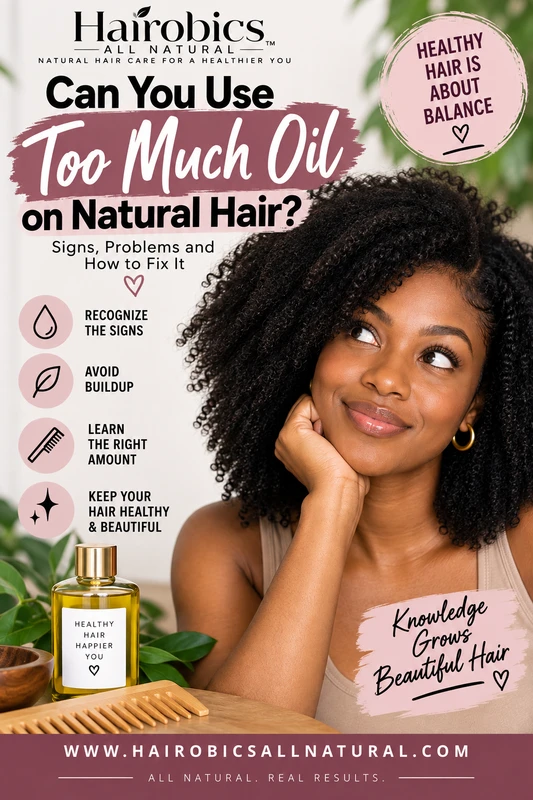
Oil is a staple in many natural hair routines. From castor oil and jojoba oil to avocado, grapeseed, coconut, and olive oil, oils are commonly used to help natural hair feel softer, look shinier, reduce friction, and retain moisture.
But can you use too much oil on natural hair?
Yes. It is absolutely possible to use too much oil on natural hair. Although oils can be helpful, applying excessive amounts or oiling too frequently can leave natural hair greasy, heavy, dull, coated, and difficult to moisturize. Too much oil can also contribute to buildup on the scalp and hair.
This is especially important to understand because oil and moisture are not the same thing.
Your hair may be covered in oil and still be dry underneath.
The key is learning how to use oil strategically rather than assuming that more oil automatically means healthier hair. In this guide, we'll explain what happens when you use too much oil, the signs of oil buildup, how often you may want to oil natural hair, how hair porosity affects oil use, and how to remove excess oil without stripping your hair.
Can You Put Too Much Oil on Natural Hair?
Yes.
Natural hair can benefit from oils, but there is a limit to how much your hair actually needs.
Once enough oil has been applied to coat the strands or help seal in moisture, adding significantly more oil doesn't necessarily provide additional benefits. Instead, the excess can sit on the surface of your hair.
You may notice:
- Greasy hair
- Limp curls
- Heavy strands
- Dull-looking hair
- Excessive scalp buildup
- Hair that attracts lint and debris
- Products that stop working as well
- Hair that feels oily but strangely dry
- Increased need for shampooing
This can create a frustrating cycle.
Your hair feels dry, so you add oil. It still feels dry, so you add more oil. Eventually, your hair becomes heavily coated without actually solving the underlying dryness.
Understanding why requires knowing what hair oil actually does.
Does Hair Oil Moisturize Natural Hair?
Not exactly.
One of the biggest misconceptions in natural hair care is that oil itself is a moisturizer.
Water is the primary source of moisture for hair. Water-based products, leave-in conditioners, moisturizing sprays, and conditioners can help introduce moisture into the hair.
Oil performs a different function.
Depending on the oil and how it is used, it can help:
- Lubricate hair strands
- Reduce friction
- Improve softness
- Add shine
- Reduce moisture loss
- Protect the ends
- Make detangling easier
- Support a smoother feel
This is why many people apply oil after a water-based moisturizer or leave-in treatment.
Think about oil as part of a moisture-retention strategy rather than the sole source of moisture.
If your hair is extremely dry, pouring additional oil onto it may make the outside greasy without providing the hydration your strands need.
What Happens When You Use Too Much Oil on Natural Hair?
Using slightly too much oil once probably won't cause a major problem. You can usually wash your hair and adjust your routine.
The bigger issue is repeatedly over-oiling your hair without adequately cleansing it.
Over time, layers of oil can accumulate on the strands and scalp.
1. Your Hair Can Become Greasy
This is the most obvious sign.
Healthy natural hair doesn't have to feel oily to be properly cared for.
If you touch your hair and your fingers are covered in oil, you're probably using more than necessary.
Oil shouldn't constantly transfer onto your:
- Hands
- Pillowcase
- Bonnet
- Headrest
- Clothing
- Furniture
A light amount may be perfectly normal after application, but your hair shouldn't remain saturated with oil.
2. Your Hair Can Feel Heavy
Natural curls depend on their structure and elasticity to maintain shape and movement.
Excessive amounts of oil can weigh the hair down.
Instead of looking full and fluffy, your hair may appear:
- Flat
- Limp
- Stringy
- Separated
- Less defined
This can be particularly noticeable on fine or low-density natural hair.
Someone with thick, coarse hair may tolerate considerably more oil than someone with very fine strands.
That's why there isn't one perfect amount for everyone.
3. Too Much Oil Can Contribute to Product Buildup
Oil doesn't disappear simply because several days have passed.
If you're continually applying oil without properly cleansing your hair, layers of product can accumulate.
This becomes even more noticeable when oil is combined with:
- Hair butter
- Gel
- Edge control
- Pomade
- Styling cream
- Leave-in conditioner
- Curl cream
Imagine applying several products every day but rarely washing them away.
Eventually, your hair becomes coated.
This buildup can make your hair look dull and feel strange even though you're applying products intended to improve it.
4. Your Hair Can Feel Oily and Dry at the Same Time
This sounds contradictory, but it's common.
You touch your hair and feel oil.
Yet when you manipulate your strands, they still feel:
- Rough
- Brittle
- Stiff
- Dry
Why?
Because the presence of oil does not automatically mean the hair is adequately hydrated.
If your hair needs water or a water-based moisturizer, repeatedly adding oil may not address the real problem.
This is one reason people sometimes mistakenly believe their natural hair "doesn't absorb products."
There may simply be too much buildup on the hair.
5. Your Curls May Lose Definition
Oil can improve shine and softness when used appropriately.
Too much can have the opposite effect on styling.
Heavy oil application can interfere with the performance of styling products and weigh down curls.
You may notice that your:
- Wash-and-go doesn't last as long
- Twist-out looks limp
- Braid-out lacks volume
- Curls separate strangely
- Hair doesn't hold its style
If your styling results suddenly become inconsistent, examine how much product you're layering onto your hair.
6. Your Hair May Look Dull Instead of Shiny
People frequently apply more oil because they want more shine.
Unfortunately, there's a point of diminishing returns.
A small amount of oil may create a beautiful sheen.
Too much product buildup can make hair look dull, coated, or dirty instead.
Healthy shine doesn't require your hair to be drenched in oil.
7. Your Scalp Can Become Oily and Coated
The scalp deserves special attention.
Some people oil their scalp because they enjoy the feeling or because scalp oiling is part of their hair-care tradition. However, repeatedly covering the scalp with heavy oils without cleansing can create buildup.
You may notice:
- Greasiness
- Visible residue
- Flakes mixed with product
- An uncomfortable coated feeling
- The need to scratch more frequently
If you experience persistent itching, irritation, sores, redness, or unusual flaking, don't simply keep adding oil. A dermatologist can help determine whether a scalp condition is involved.
How Do You Know If You're Using Too Much Hair Oil?
Your hair usually provides clues.
One of the easiest tests is simply touching your hair several hours after applying oil.
Your hair can feel soft and conditioned without leaving a thick layer of grease on your fingers.
Other signs include:
Hair feels greasy for days.
If your hair is still heavily oily several days after application, reduce the amount next time.
Oil runs down your forehead or neck.
You definitely don't need that much.
Your bonnet or pillowcase becomes saturated.
Some transfer can occur, but consistently greasy bedding is a sign you're probably overdoing it.
Hair looks flat immediately after oiling.
Try using half as much.
Your moisturizer stops seeming effective.
You may need to cleanse your hair rather than add another product.
You keep adding oil because your hair feels dry.
This is one of the most important warning signs.
Instead of reaching for more oil, your hair may need water, a moisturizing leave-in, conditioner, or a proper wash and conditioning session.
How Much Oil Should You Put on Natural Hair?
There is no universal measurement because natural hair varies tremendously.
Someone with:
- Waist-length hair
- High density
- Thick strands
will naturally use more product than someone with:
- Short hair
- Low density
- Fine strands
The best approach is to start with a small amount and add more only when necessary.
For a section of hair, begin with a few drops of liquid oil.
Spread the oil across your palms first.
Then gently distribute it through your hair, concentrating on areas that need it most.
You can always add another drop.
Removing excess oil is much harder.
How Often Should You Oil Natural Hair?
There isn't a universal schedule.
Some people may use a small amount several times per week, while others may only need oil after wash day.
The right frequency depends on:
- Hair porosity
- Strand thickness
- Hair density
- Hair length
- Hairstyle
- Climate
- Products already being used
- How frequently you shampoo
- How dry your hair becomes
Instead of automatically applying oil every day, pay attention to your hair.
Ask yourself:
Does my hair actually need oil today?
If it already feels soft, flexible, and conditioned, you may not need anything.
Natural hair care doesn't need to involve constantly applying products.
Sometimes leaving your hair alone is part of a good routine.
Is It Bad to Oil Natural Hair Every Day?
Not necessarily, but daily oiling isn't automatically beneficial either.
If you're applying a tiny amount to your ends and your hair responds well, daily use may not cause problems.
But heavily saturating your entire scalp and hair every day can quickly create buildup.
Consider why you're applying oil.
If you're doing it because:
"My hair is dry, so I need oil every day,"
you may need to rethink your moisture routine.
Try moisturizing first.
For example:
- Lightly mist your hair with water or a water-based moisturizing product.
- Apply your preferred leave-in or moisturizer.
- Use a small amount of oil if needed to help reduce moisture loss.
You don't necessarily need to complete all three steps every day.
The goal is to give your hair what it needs without continuously layering products.
Can Too Much Oil Cause Natural Hair Breakage?
Oil itself doesn't automatically cause hair breakage.
However, a poor routine built around excessive oil use can contribute indirectly to conditions that make hair management more difficult.
For example, heavy buildup may cause you to:
- Shampoo aggressively
- Detangle more forcefully
- Manipulate the hair excessively
- Use very hot water trying to remove residue
- Overuse clarifying shampoos
Those habits can increase dryness and mechanical stress.
The goal isn't to fear hair oil.
It's simply to use an appropriate amount.
Can Too Much Oil Clog Hair Follicles?
People often describe scalp buildup as "clogged follicles," but scalp conditions are more complicated than simply pouring oil onto the scalp.
What you can say with confidence is that excessive oil and product use can leave residue on the scalp.
That's a good reason to maintain regular scalp cleansing.
If you're experiencing:
- Significant hair loss
- Painful bumps
- Persistent scalp irritation
- Severe flaking
- Open sores
- Bald patches
don't assume oil buildup is the only explanation.
Consult a dermatologist, especially one experienced with textured hair and scalp disorders.
Low-Porosity Hair and Too Much Oil
People with low-porosity natural hair may notice oil buildup particularly quickly.
Low-porosity hair has a cuticle structure that can make product penetration more difficult. Heavy products may sit on the surface instead of giving you the lightweight feel you're looking for.
Signs that you're using too much oil on low-porosity hair include:
- Hair feels coated
- Products sit on top
- Hair takes a long time to get fully wet
- Curls become weighed down
- Hair feels greasy shortly after styling
If this sounds familiar, experiment with lightweight oils such as:
- Grapeseed oil
- Jojoba oil
- Argan oil
- Sweet almond oil
More importantly, reduce the quantity.
Switching to a lighter oil won't completely solve the problem if you're still applying far too much.
High-Porosity Hair and Oil
High-porosity natural hair behaves differently.
Because high-porosity hair tends to lose moisture more easily, some people find that oils and richer products are useful for maintaining softness.
Possible options include:
- Avocado oil
- Olive oil
- Castor oil
- Jojoba oil
But high-porosity hair can still become overloaded with oil.
Porosity isn't permission to saturate your hair continuously.
Focus first on hydration and conditioning, then use oils strategically to help your hair retain moisture and reduce friction.
Fine Natural Hair and Oil
Fine natural hair can become weighed down quickly.
If you have fine strands, heavy castor oil or thick butters may make your hair look significantly flatter.
Try using:
- Smaller quantities
- Lightweight oils
- Less frequent applications
Grapeseed, jojoba, or argan oil may feel lighter than thick castor oil.
You may discover that just a few drops are enough for an entire section.
Coarse Natural Hair and Oil
Coarse strands may tolerate richer oils and larger amounts better than fine strands.
But "coarse" doesn't mean unlimited oil.
Start small and observe how your hair responds.
If it remains soft, flexible, and manageable, your routine is probably working.
If it becomes greasy and stiff, reduce your oil usage.
Should You Oil Your Scalp or Your Hair?
These are two different practices.
Oiling the scalp
Scalp oil is applied directly to the scalp, usually in small amounts.
Oiling the hair
Oil is distributed across the strands, often focusing on the ends.
You don't necessarily need to oil both.
If your scalp naturally produces enough sebum and feels comfortable, additional scalp oil may not be necessary.
Meanwhile, your ends may benefit from a small amount because they're the oldest portion of your hair and experience significant friction.
Why Your Ends May Need More Attention
The ends of your hair have been exposed to:
- Washing
- Detangling
- Styling
- Clothing
- Weather
- Pillows
- Manipulation
for longer than the hair near your roots.
That's why the ends often become dry or fragile first.
Instead of coating your entire head with oil, consider concentrating a small amount on your ends.
This can be particularly useful when wearing:
- Twists
- Braids
- Buns
- Afro styles
- Wash-and-go styles
Protecting your ends can support length retention.
Can Too Much Oil Stop Hair Growth?
Using too much oil doesn't simply switch off hair growth.
Hair growth occurs within the follicle and is influenced by numerous factors, including genetics, age, nutrition, hormones, overall health, and scalp conditions.
Hair length is also affected by retention.
If your hair grows but repeatedly breaks at the ends, it may appear as though your hair isn't growing.
Oil can be one tool in a healthy length-retention routine, but it isn't a magic hair-growth solution.
For better length retention, focus on:
- Keeping hair appropriately moisturized
- Gentle detangling
- Limiting unnecessary manipulation
- Protecting your ends
- Regular cleansing
- Conditioning
- Avoiding excessive heat
- Minimizing tight hairstyles
- Maintaining a healthy scalp
No amount of oil can compensate for damaging hair practices.
How to Fix Hair With Too Much Oil
If you've accidentally used far too much oil, don't panic.
You probably just need a good wash.
Step 1: Shampoo Your Hair
Use a shampoo capable of removing excess oil and product buildup.
Focus on your scalp first.
Massage gently with your fingertips rather than scratching aggressively with your nails.
Allow the shampoo to work through the length of your hair as you rinse.
Step 2: Shampoo Again If Necessary
If your hair is extremely oily, one shampoo may not remove everything.
A second gentle wash may help.
The goal is clean hair—not squeaky, stripped hair.
Step 3: Clarify When Needed
If you've been layering oils, butters, gels, and creams for weeks, a clarifying shampoo may be helpful.
Clarifying shampoo is designed to remove stubborn product buildup more thoroughly than many everyday moisturizing shampoos.
How frequently you clarify depends on your routine.
Someone using heavy products regularly may need clarification more frequently than someone with a minimalist routine.
Step 4: Condition
After cleansing, use conditioner to restore softness and improve manageability.
This is especially important if you've used a strong clarifying shampoo.
Step 5: Detangle Gently
Work in sections.
Use your fingers, a wide-tooth comb, or your preferred detangling tool.
Start near the ends and gradually work upward.
Step 6: Start Your Routine Again With Less Product
After washing, resist the temptation to immediately cover your hair in another thick layer of oil.
Apply your moisturizer or leave-in first.
Then use a small amount of oil if your hair needs it.
This gives you a clean baseline from which you can determine how much product your hair actually needs.
Should You Clarify Natural Hair?
Clarifying can be extremely useful when you regularly use:
- Oils
- Butters
- Gels
- Pomades
- Edge control
- Silicone-containing products
- Heavy styling creams
Regular shampoo removes everyday dirt, sweat, oil, and product.
Clarifying shampoo provides a deeper reset when buildup becomes stubborn.
Signs you may need to clarify include:
- Hair remains greasy after shampooing
- Products aren't performing normally
- Hair feels coated
- Curls look unusually dull
- Hair feels heavy
- Water seems to sit on your strands
- You haven't clarified in a long time despite heavy product use
Don't automatically clarify every time your hair feels slightly dry.
Over-cleansing can create another problem.
Balance matters.
Oil vs Moisturizer: What's the Difference?
Understanding this difference can transform your natural hair routine.
Moisturizer
A good moisturizer usually contains water as a major ingredient and is intended to help hydrate and soften hair.
Oil
Oil is primarily used to lubricate, condition, add shine, and help reduce moisture loss.
You can use them together.
For example:
Water → Leave-in treatment → Small amount of oil
Some people call similar layering techniques the LOC or LCO method.
LOC means:
Liquid → Oil → Cream
LCO means:
Liquid → Cream → Oil
Neither method is automatically best for everyone.
Experiment and see what keeps your hair soft without excessive buildup.
Best Oils for Natural Hair
Different oils have different textures and characteristics.
Jojoba Oil
Jojoba is lightweight and popular for both scalp and hair applications.
It can be useful for people who dislike extremely heavy oils.
Grapeseed Oil
Grapeseed oil is another lightweight option that can add shine without the heavy feeling associated with thicker oils.
It can work particularly well for fine or low-porosity hair when used sparingly.
Argan Oil
Argan oil is frequently used as a finishing oil.
A few drops can help smooth the hair and improve shine.
Sweet Almond Oil
Sweet almond oil has a relatively light texture and can be used to lubricate and soften natural hair.
Avocado Oil
Avocado oil is richer than some lightweight alternatives and can work well for coarse or dry-feeling hair.
Olive Oil
Olive oil is widely available and commonly used in natural hair routines.
Because it can feel heavier, begin with a small quantity.
Castor Oil
Castor oil is extremely thick compared with many other oils.
A little goes a long way.
It's especially easy to overapply castor oil, so use it sparingly or mix it with a lighter oil if you prefer a thinner consistency.
How to Apply Oil to Natural Hair Correctly
Try this simple method.
Start with clean or reasonably clean hair.
Avoid continually adding fresh oil over weeks of old product.
Divide your hair into sections.
Sections make it easier to distribute a small amount evenly.
Moisturize first when necessary.
Use water or a water-based moisturizing product.
Put a small amount of oil in your palm.
Don't pour oil directly over your entire head.
Rub your hands together.
This spreads the product across your palms and fingers.
Smooth it through the hair.
Concentrate on your ends and dry areas.
Stop when your hair feels soft.
You don't need to continue until the hair looks wet with oil.
Does More Oil Make Natural Hair Grow Faster?
There is no simple rule that more oil equals faster hair growth.
This is an important distinction because the natural hair community is filled with hair-growth claims.
Healthy hair growth depends on much more than what oil you put on your scalp.
Your routine should support both scalp health and length retention.
That means paying attention to:
- Nutrition
- Hydration
- Stress management
- Scalp care
- Gentle styling
- Breakage prevention
- Proper cleansing
- Moisture balance
If you're experiencing unexplained or significant hair loss, talk with a healthcare professional rather than relying exclusively on cosmetic products.
Can You Sleep With Oil in Your Natural Hair?
Yes, you can leave many cosmetic hair oils on your hair overnight if the product is intended for leave-in use and your scalp tolerates it.
But you don't need to saturate your hair.
Use a reasonable amount and protect your bedding with a bonnet, scarf, or appropriate pillowcase.
If your bonnet is soaked with oil every morning, that's a strong sign to reduce the quantity.
Can You Oil Natural Hair Without Washing It?
Yes.
You don't need to shampoo every time you apply a tiny amount of oil.
However, continually layering oil without eventually cleansing your hair can create buildup.
Your wash schedule should reflect:
- Your scalp condition
- Your activity level
- Your hairstyle
- How much product you use
- How quickly buildup develops
Someone exercising heavily several days per week may need a different routine than someone who rarely sweats.
What If Your Natural Hair Is Still Dry After Oiling?
This is the question to ask if you're constantly reaching for oil.
If your hair remains dry after oiling, stop increasing the amount.
Try addressing hydration instead.
Your routine might look like:
Cleanse → Condition → Moisturize → Seal lightly
Pay particular attention to your conditioner and leave-in product.
Deep conditioning may also be useful depending on the condition of your hair.
If your hair is damaged from:
- Bleach
- Relaxers
- Permanent color
- Excessive heat
- Tight hairstyles
- Rough detangling
oil alone cannot reverse structural damage.
You may need to modify your overall hair-care routine.
How to Prevent Oil Buildup on Natural Hair
Prevention is easier than trying to remove months of buildup.
Keep your routine simple.
Use enough product to accomplish the job and stop there.
Remember these principles:
- Start with small quantities.
- Add more only if necessary.
- Don't confuse oil with moisture.
- Cleanse your scalp regularly.
- Clarify when buildup becomes significant.
- Use lighter oils if heavy oils weigh down your hair.
- Pay attention to your ends.
- Don't oil automatically just because it's part of your routine.
- Evaluate how your hair actually feels.
Natural hair doesn't need to be coated in products 24 hours a day to be healthy.
Frequently Asked Questions About Using Too Much Oil on Natural Hair
Can too much oil make natural hair dry?
Too much oil doesn't necessarily create dryness directly, but heavily coated hair can still lack adequate moisture. If you're repeatedly applying oil instead of water or a water-based moisturizer, your hair may feel greasy on the outside while remaining dry and rough.
How do you know when natural hair has too much oil?
Common signs include greasy strands, heavy hair, limp curls, oil transfer onto your hands or pillowcase, excessive buildup, dullness, and hair that doesn't respond normally to styling products.
Should natural hair be oily?
Natural hair doesn't need to feel heavily oily to be healthy. Your hair can be moisturized, soft, shiny, and flexible without leaving grease on your fingers.
Should you oil natural hair every day?
Not everyone needs daily oiling. Some people can use a tiny amount regularly without problems, while others develop buildup quickly. Base your frequency on your hair rather than following a rigid schedule.
What should I do if I put too much oil in my natural hair?
Shampoo your hair thoroughly. If the buildup is severe, you may need a second shampoo or a clarifying shampoo. Follow with conditioner and restart your routine using less product.
Which oil is best for natural hair?
There isn't one best oil for every person. Jojoba, grapeseed, argan, avocado, olive, sweet almond, and castor oils can all have a place in natural hair care. Choose according to your hair's thickness, porosity, styling needs, and personal preference.
Is castor oil too heavy for natural hair?
Castor oil is much thicker than oils such as grapeseed or jojoba. Some people with coarse or high-density hair enjoy it, while fine hair may become weighed down quickly. Use a small amount initially.
Can you use oil and leave-in conditioner together?
Yes. Many people apply a water-based leave-in first and then use a small amount of oil to help seal in moisture and improve softness.
Why does my natural hair feel greasy but dry?
You may be applying plenty of oil without enough hydration, or your hair may have accumulated product buildup. Try cleansing thoroughly, conditioning, and applying a water-based moisturizer before using additional oil.
Final Thoughts: Can You Use Too Much Oil on Natural Hair?
Yes, you can use too much oil on natural hair.
Hair oils can be useful tools for reducing friction, improving softness, adding shine, protecting your ends, and helping your hair retain moisture. But more oil doesn't automatically mean healthier, longer, or more moisturized hair.
The goal is balance.
If your hair feels greasy, heavy, coated, dull, or oily but still dry, consider reducing how much oil you're using.
Start with hydration.
Keep your scalp clean.
Condition regularly.
Use oil strategically rather than automatically.
And remember that a few drops may sometimes accomplish more than covering your hair with an entire handful of product.
When you understand what your natural hair actually needs, you can build a simpler routine that keeps your strands soft, manageable, moisturized, and protected without unnecessary buildup.