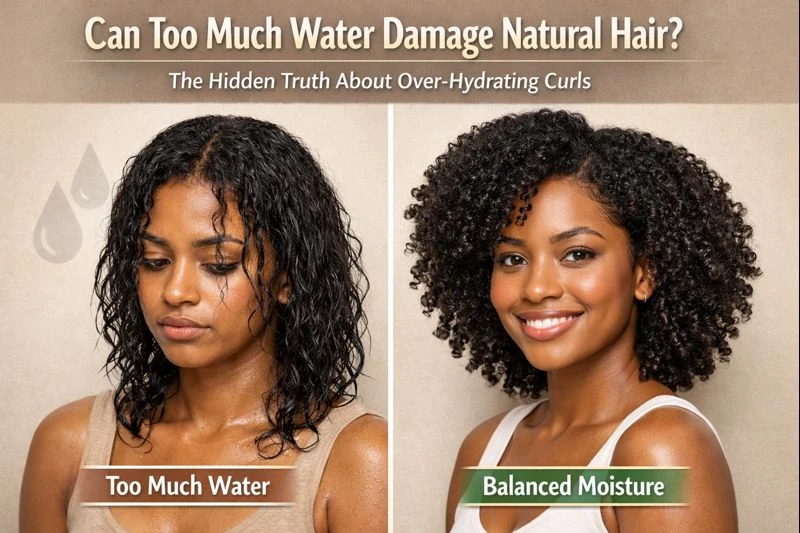
Water is usually painted as the hero of natural hair care.
“Moisture is water.”
“Hydrate your hair.”
“Drink more water for hair growth.”
So when your curls feel mushy, weak, dry after wash day, or break easily, the last thing you suspect is too much water.
But here’s the truth most people aren’t talking about:
Yes — too much water can damage natural hair.
And for many naturals, especially with tightly coiled or low-porosity hair, it’s one of the most overlooked causes of breakage.
Let’s break this down clearly, without fear-mongering, myths, or confusion.
The Role Water Actually Plays in Natural Hair
Water is essential.
It hydrates the hair cortex, gives curls elasticity, and allows hair to bend without snapping.
But water works only in balance.
Hair is made mostly of keratin proteins, and those proteins respond to water by swelling. That swelling isn’t always harmless.
When hair absorbs too much water, the internal structure becomes stressed — just like a sponge that’s soaked, squeezed, soaked again, and never allowed to fully recover.
What Is Water Damage in Natural Hair?
Water damage doesn’t mean water is “bad.”
It means hair is over-hydrated without enough structural support.
This happens when hair is exposed to water:
-
Too frequently
-
For too long
-
Without enough protein reinforcement
-
Without proper sealing afterward
Over time, the hair shaft weakens instead of strengthening.
Signs You May Be Over-Hydrating Your Natural Hair
Many people confuse water damage with dryness or protein damage. Here’s how to tell the difference.
Common Signs of Too Much Water Exposure
-
Hair feels mushy or overly soft when wet
-
Hair stretches too far and doesn’t bounce back
-
Breakage increases even though you “moisturize daily”
-
Curls lose definition and look limp
-
Hair feels dry shortly after wash day
-
Detangling causes excessive shedding
-
Hair snaps when styling, especially after wetting
If your hair feels weak rather than stiff, water overload may be the issue.
How Water Weakens the Hair Shaft
When hair absorbs water, the cuticle lifts slightly to allow moisture inside.
That’s normal.
But with repeated swelling and shrinking, the cuticle layers become stressed and start to lift permanently. This creates:
-
Rough cuticles
-
Increased friction
-
Higher breakage risk
-
Faster moisture loss
Think of it like bending a paper clip back and forth.
Eventually, it snaps — not because bending is bad, but because it never gets a break.
Wet Hair Is at Its Weakest State
This is one of the most important truths in hair science.
Hair can stretch up to 30% more when wet.
That elasticity feels nice — until it turns into weakness.
Excessive manipulation while hair is wet (detangling, tight styling, brushing) increases breakage dramatically, especially if the hair is constantly re-wetted.
Can Daily Water Spritzing Damage Natural Hair?
For some hair types, yes.
Daily water misting can cause problems when:
-
Hair never fully dries between sessions
-
You don’t seal moisture properly
-
You rarely use strengthening treatments
-
Your hair is low porosity or fine-stranded
Water without occlusives or proteins just swells the hair repeatedly and then evaporates — leaving the hair weaker and drier over time.
Low Porosity Hair Is Especially Vulnerable
Low porosity hair already struggles to absorb moisture.
When it finally does, it tends to hold water longer, causing prolonged swelling inside the strand.
This leads to:
-
Hair that feels soft but breaks easily
-
Product buildup that worsens weakness
-
Confusion because hair feels moisturized but isn’t strong
Low porosity hair needs controlled hydration, not constant wetness.
How Frequent Washing Can Lead to Water Damage
Wash day itself isn’t the enemy — overwashing without recovery is.
Problems arise when:
-
Hair is washed multiple times weekly
-
Deep conditioning is heavy on humectants but light on protein
-
Hair stays wet for hours under scarves, caps, or braids
-
Protective styles are installed on soaking wet hair repeatedly
Hair needs time to reharden and rebalance between wet states.
The Moisture–Protein Balance Most Naturals Miss
Water alone does not equal healthy hair.
Strong hair = moisture + protein + sealing
When hair gets water but no reinforcement:
-
Keratin bonds weaken
-
Elasticity turns into fragility
-
Breakage increases quietly over time
This is why hair can feel “soft” yet never retain length.
Hygral Fatigue: The Silent Hair Killer
Hygral fatigue happens when hair repeatedly swells (absorbing water) and contracts (drying) without enough structural support.
Over time, this leads to:
-
Fraying cuticles
-
Chronic breakage
-
Loss of curl pattern
-
Thinning ends
It’s common in naturals who:
-
Wet hair daily
-
Co-wash constantly
-
Skip protein treatments
-
Wear wet styles long-term
Can Protective Styles Worsen Water Damage?
Yes — especially when done on overly wet hair.
Braids, twists, and buns installed on soaking wet hair:
-
Trap water inside the strand
-
Prevent proper drying
-
Increase swelling time
-
Weaken hair before it’s secured
Protective styles should protect dry or lightly damp, sealed hair, not saturated hair.
Why Hair Can Feel Dry After Too Much Water
This confuses a lot of people.
Over-hydrated hair loses lipids and proteins, which causes water to evaporate faster later.
So hair feels:
-
Dry
-
Rough
-
Brittle
Even though it was just drenched hours earlier.
Hard Water Makes the Problem Worse
Hard water contains minerals like calcium and magnesium that:
-
Prevent proper moisture absorption
-
Leave buildup on the hair
-
Increase dryness after washing
-
Force people to over-wet hair trying to fix it
This creates a damaging cycle of repeated water exposure without real hydration.
How to Fix Water-Damaged Natural Hair
Good news: water damage is fixable.
Step 1: Reduce Constant Wetting
You don’t need daily water to have moisturized hair.
Aim for:
-
1–2 intentional hydration days per week
-
Minimal misting between wash days
Step 2: Add Protein Back Strategically
Use light to moderate protein treatments to rebuild strength.
Look for:
-
Hydrolyzed proteins
-
Amino acids
-
Rice, silk, or wheat protein
Avoid extremes — balance is key.
Step 3: Seal Moisture Every Time
After hydrating:
-
Use oils or butters to slow evaporation
-
Focus on ends first
Water without sealing is temporary hydration at best.
Step 4: Let Hair Fully Dry
Avoid:
-
Sleeping on soaking wet hair
-
Styling dripping-wet hair daily
-
Keeping hair wrapped while wet
Drying allows bonds to reharden.
The Right Way to Hydrate Natural Hair
Healthy hydration looks like:
-
Controlled water exposure
-
Intentional wash days
-
Balanced conditioners
-
Strengthening routines
-
Sealing every time
It does not look like constantly chasing moisture because hair “feels dry.”
Water Is Not the Enemy — Misuse Is
Water itself doesn’t damage hair.
Mismanagement does.
Natural hair thrives on balance, patience, and structure — not extremes.
If your hair keeps breaking despite “doing everything right,” water overload may be the missing piece no one told you about.
Final Takeaway: Should You Be Afraid of Water?
No — but you should respect it.
Too much water without strength leads to:
-
Weak strands
-
Chronic breakage
-
Length stagnation
-
Frustration
When you learn to hydrate intentionally instead of constantly, natural hair becomes stronger, thicker, and easier to manage.