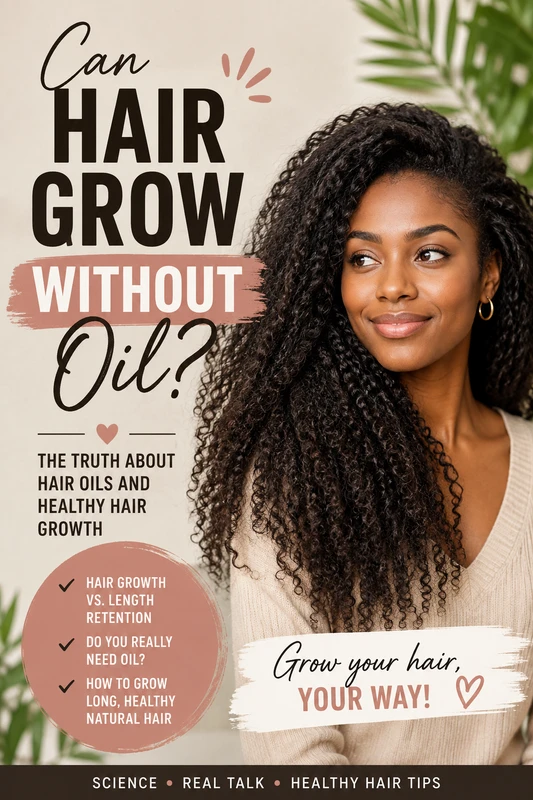
If you are trying to grow longer, stronger, healthier hair, you may have heard that oil is an essential part of the process. Castor oil, coconut oil, olive oil, jojoba oil, avocado oil, and countless hair-growth oil blends are promoted throughout the natural hair community. This can make it seem as though your hair simply cannot grow unless you regularly apply oil to your scalp and strands.
But can hair grow without oil?
Yes. Hair can absolutely grow without applying oil to your scalp or hair. Hair growth happens inside the hair follicle and is influenced by factors such as genetics, nutrition, age, hormones, overall health, and the condition of your scalp. Applying oil is not biologically required for a strand of hair to grow.
However, that does not mean hair oils are useless.
For Black hair, natural hair, curly hair, locs, braids, and other textures that are particularly vulnerable to dryness and breakage, the right oil can become a valuable part of a healthy hair-care routine. Oils may help reduce moisture loss, improve softness and manageability, decrease friction, and protect fragile ends.
This distinction is extremely important:
Oil does not have to make your hair grow from the follicle to help you grow longer hair.
Sometimes the biggest challenge isn't producing new hair—it is keeping the hair you have already grown from breaking off.
In this complete guide, we will explain how hair grows, what oils actually do, whether you need to oil your scalp, how to retain length without oil, and how to determine whether oil deserves a place in your natural hair routine.
Can Hair Grow Without Oil? Quick Answer
Yes, your hair can grow without oil.
Your follicles do not require you to put castor oil, coconut oil, or another cosmetic oil on your scalp before they can produce hair.
Hair growth originates beneath the surface of your scalp. Hair follicles receive nutrients through the body's blood supply, and new cells contribute to the formation of the hair shaft.
That process continues whether you apply hair oil or not.
The more useful question is:
Can oil help you maintain healthier hair and retain more of your growth?
For many people, the answer is yes.
This is especially relevant if your hair is naturally dry, tightly curled, frequently manipulated, chemically treated, braided, twisted, locked, or exposed to conditions that increase moisture loss.
Oil can be one tool in your routine—but it isn't the entire foundation of hair growth.
Understanding How Hair Actually Grows
Before deciding whether you need hair oil, it helps to understand where hair growth actually takes place.
The visible strand of hair above your scalp is composed primarily of keratinized cells. The active growth process takes place inside the follicle beneath the scalp.
At the base of a growing follicle, cells divide and eventually form the hair shaft. As additional cells are produced, the developing strand is pushed upward until it emerges through the scalp.
Once the hair is visible above the skin, it needs protection.
This is where hair-care practices become especially important.
Your body controls the biological production of the hair. Your hair-care routine can influence how well you preserve the strand after it emerges.
Think of these as two related but different processes:
Hair growth = producing new hair.
Length retention = keeping that hair from breaking.
Many people confuse the two.
Hair Growth vs. Length Retention
Imagine that your hair grows consistently for an entire year.
If the ends of your hair remain relatively healthy, your hair may become noticeably longer.
But imagine your hair is also constantly:
- Breaking
- Splitting
- Tangling
- Drying out
- Snapping during detangling
- Breaking around the edges
- Developing single-strand knots
Your follicles may still be producing hair normally, but your overall length may barely change.
You might conclude:
"My hair doesn't grow."
In reality, your hair could be growing while you are losing a similar amount of length through breakage.
That is why a successful hair-growth routine should focus on both supporting healthy scalp conditions and retaining existing length.
Oil may be helpful primarily in that second category.
What Does Hair Oil Actually Do?
Hair oils can perform several different functions depending on the specific oil, the amount used, your hair type, and how the oil is incorporated into your routine.
Oil may help:
- Lubricate hair strands
- Improve softness
- Reduce friction
- Increase shine
- Help seal in moisture
- Reduce moisture loss
- Make detangling easier
- Protect dry ends
- Improve manageability
- Reduce the rough feeling associated with dry hair
Notice something missing from this list?
Oil is not a magical fertilizer that automatically forces your follicles to produce inches of hair.
Instead, one of its greatest benefits may be protecting the hair you already have.
Does Oil Moisturize Hair?
This is one of the biggest misunderstandings in natural hair care.
Oil and water are not the same thing.
Water provides hydration. Oils generally function more as lubricants, conditioners, or barriers that can help slow moisture loss.
If extremely dry hair is coated with heavy oil without adequate hydration, the hair may feel oily while still feeling dry underneath.
This is why some people say:
"I oil my hair every day, but it's still dry."
More oil isn't always the solution.
Your hair may actually need moisture.
A routine could include:
- Adding water or a water-based moisturizing product.
- Applying an appropriate conditioner or leave-in product.
- Using a small amount of oil when beneficial to help reduce moisture loss.
Not every hair type needs all three steps, but understanding the role of water versus oil can completely change the way you approach dry natural hair.
Does Your Scalp Need Oil to Grow Hair?
Not necessarily.
Your scalp naturally produces sebum through sebaceous glands.
Sebum helps lubricate the skin and hair.
For people with straighter hair, natural scalp oils can often travel down the hair shaft relatively easily.
With tightly curled and coily hair, things can be different.
The curves and bends along the strand can make it more difficult for natural oils to spread from the scalp all the way to the ends.
As a result, your scalp might have enough natural oil while your ends still feel dry.
This is one reason Black hair and tightly textured natural hair often benefit from intentional moisture management.
But it does not automatically mean everyone with natural hair needs to pour oil directly onto the scalp.
What Happens If You Never Oil Your Scalp?
For some people, very little happens.
Their scalp may remain comfortable, balanced, and healthy without additional oil.
For others, eliminating scalp oil may leave their scalp or hair feeling drier, particularly if they have developed a routine in which a small amount of oil helps maintain comfort and manageability.
The key is observing how your scalp responds.
A healthy scalp shouldn't constantly feel as though it needs to be coated in oil.
If your scalp feels comfortable without oil, you don't necessarily need to add it simply because a natural hair routine online says you should.
Can Black Hair Grow Without Oil?
Absolutely.
Black hair does not require cosmetic oil to emerge from the scalp.
However, Black hair frequently has unique length-retention challenges because tightly curled strands can have numerous bends and curves. These areas may be vulnerable to dryness, tangling, friction, and mechanical breakage.
This makes the conversation around oils particularly important.
Oil may help some people maintain:
- Softer strands
- More manageable hair
- Protected ends
- Less friction
- Better moisture retention
So while Black hair can certainly grow without oil, some people may find that an appropriate oil helps them retain more of the length they grow.
Can Natural Hair Grow Without Oil?
Yes.
You could theoretically maintain a natural hair routine consisting of cleansing, conditioning, moisturizing, gentle styling, and protection without ever applying a traditional hair oil.
If your hair remains moisturized, strong, manageable, and relatively free of excessive breakage, there is no requirement to add oil.
Some people actually find that their hair performs better with fewer oils and heavy products.
Others notice significantly better softness and length retention when oils are included.
There is no single natural hair routine that works perfectly for everyone.
Can You Grow Long Natural Hair Without Oil?
Yes.
Long natural hair comes primarily from consistent growth plus successful length retention over time.
To retain length, focus on the fundamentals:
- Keep the scalp clean.
- Maintain adequate moisture.
- Condition regularly.
- Detangle gently.
- Limit unnecessary manipulation.
- Protect your ends.
- Minimize excessive heat.
- Avoid overly tight hairstyles.
- Reduce friction while sleeping.
- Eat a balanced diet.
- Maintain consistent hair-care habits.
Oil can complement these practices, but it cannot replace them.
Why Do So Many People Associate Oil With Hair Growth?
Oil has played an important role in hair and beauty practices across many cultures for generations.
There is also a practical reason people associate oils with growth.
Suppose someone begins using an oil and simultaneously becomes more consistent about:
- Massaging their scalp
- Moisturizing their hair
- Wearing protective styles
- Handling their ends gently
- Reducing heat
- Following a regular wash schedule
Several months later, their hair is noticeably longer.
They may attribute the entire improvement to the oil.
But the results could actually come from a combination of improved scalp care, reduced breakage, consistent moisture, less manipulation, and better overall hair-care habits.
The oil may have contributed—but it may not have been the only factor.
Can Hair Oil Help With Length Retention?
This is where oils can become especially useful.
Long hair is usually the result of years of accumulated growth.
That means your oldest ends have survived:
- Hundreds of wash days
- Detangling sessions
- Hairstyles
- Nights of sleeping
- Changes in weather
- Clothing friction
- Combing
- Brushing
- Heat exposure
The longer your hair becomes, the more important preserving older portions of the strand can become.
Using a suitable oil on your ends may help lubricate them and reduce friction.
This can make an oil valuable even though the oil isn't directly creating new follicles or forcing faster growth.
Can Oil Stop Hair Breakage?
No oil can guarantee that hair will never break.
Hair breakage can result from many causes, including:
- Excessive dryness
- Rough detangling
- Heat damage
- Chemical damage
- Tight hairstyles
- Excessive manipulation
- Split ends
- Friction
- Poor conditioning
- Weak or weathered strands
Oil may reduce some sources of friction and dryness, but it cannot repair every type of damage.
If hair is severely damaged, continually covering it with oil can sometimes mask the problem temporarily without addressing the underlying issue.
Can Too Much Oil Be Bad for Your Hair?
Yes.
More oil does not automatically equal healthier hair.
Excessive oil can contribute to:
- Heavy buildup
- Greasy hair
- Limp curls
- Dull-looking strands
- Product accumulation
- Difficulty cleansing
- Hair that feels coated
- Dirt and debris sticking more easily to hair
Heavy oil use can also make it difficult to understand what your hair actually needs.
For example, hair may feel rough, so you apply more oil.
It still feels rough.
You add even more.
Eventually, the hair becomes heavily coated while the underlying moisture problem remains.
This is why balance matters.
Should You Oil Your Scalp Every Day?
Most people do not automatically need to oil their scalp every day.
Daily oiling may work for certain routines, but it can be excessive for others.
Instead of following an arbitrary schedule, evaluate your scalp.
Ask yourself:
Does my scalp actually feel dry?
Does oil improve the condition?
Am I developing buildup?
Does my scalp itch more after applying oil?
How quickly does my scalp become greasy?
How often am I washing my hair?
If you are applying oil daily while washing infrequently, product accumulation can become a concern.
Your routine should be based on your scalp's needs rather than the assumption that daily oiling automatically creates faster hair growth.
Does Castor Oil Make Hair Grow?
Castor oil is one of the most famous oils in the Black hair and natural hair communities.
It is thick and can work well for sealing, lubricating, and protecting dry areas for some hair types.
However, it is important to separate anecdotal hair-growth claims from what is firmly established.
Applying castor oil does not guarantee faster follicular growth.
Where castor oil may become useful is in a broader routine designed to protect fragile hair and reduce moisture loss.
If your hair breaks less while using it, you may retain more length.
That can create the appearance that your hair is "growing faster," even if your biological growth rate has not dramatically changed.
Coconut Oil and Hair Growth
Coconut oil is another extremely popular natural hair oil.
One reason coconut oil receives so much attention is its interaction with the hair fiber. Research has found that coconut oil can reduce protein loss from hair in certain circumstances.
That makes coconut oil potentially useful for protecting the hair shaft.
However, coconut oil doesn't feel great on everyone's hair.
Some people report that it leaves their hair:
- Hard
- Stiff
- Dry-feeling
- Heavy
Others love it.
Your hair's response matters more than following a trend.
Olive Oil for Natural Hair
Olive oil is frequently used to add softness, lubrication, and shine.
It can be especially appealing for people with thick or dry-feeling hair.
Because olive oil can feel relatively heavy, you may only need a small amount.
If your hair becomes greasy or weighed down, reduce the quantity or concentrate the oil on the driest sections and ends.
Jojoba Oil for Hair
Jojoba oil is technically a wax ester rather than a conventional triglyceride oil.
It is popular in scalp and hair products because of its lightweight feel and conditioning properties.
People who dislike very thick oils may prefer lighter products containing jojoba.
Again, its main value should be viewed as part of hair and scalp conditioning rather than as a guaranteed follicle-growth treatment.
Avocado Oil for Natural Hair
Avocado oil is another popular choice for textured hair.
It is often included in natural hair products designed to improve softness, lubrication, and manageability.
It can be particularly useful when incorporated into a complete moisture routine instead of simply being poured onto dry hair.
What About Rosemary Oil?
Rosemary oil has become extremely popular on social media.
Unlike ordinary carrier oils, rosemary essential oil is highly concentrated and should not be treated as though it were the same thing as olive, coconut, or jojoba oil.
Essential oils should generally be appropriately diluted in a suitable formulation before topical use.
Although there has been research into rosemary oil and hair growth, it should not be portrayed as a guaranteed treatment for hair loss.
Persistent or unexplained hair loss deserves professional evaluation rather than relying exclusively on social-media hair-growth remedies.
Can You Moisturize Hair Without Oil?
Absolutely.
You can moisturize hair without traditional oils by using water-based products and conditioners designed to improve hydration, softness, and manageability.
A simple oil-free routine could look like this:
Step 1: Cleanse
Wash your scalp and hair on an appropriate schedule to remove sweat, debris, and product buildup.
Step 2: Condition
Use conditioner after cleansing to improve softness, slip, and manageability.
Step 3: Apply a Leave-In
A water-based leave-in conditioner can help maintain softness between washes.
Step 4: Style Gently
Choose hairstyles that don't place unnecessary tension on your scalp or ends.
Step 5: Protect at Night
Use a satin or silk bonnet, scarf, or pillowcase to minimize friction.
Step 6: Refresh When Necessary
If your hair becomes dry, use an appropriate water-based moisturizing product rather than automatically adding another layer of oil.
How to Grow Hair Without Using Oil
If you prefer an oil-free routine, focus on the habits that matter most.
1. Keep Your Scalp Clean
Healthy hair care begins with scalp care.
Cleansing removes:
- Sweat
- Excess sebum
- Dead skin
- Environmental debris
- Styling-product buildup
Avoid assuming that a dirty scalp automatically promotes growth because you are "leaving the natural oils alone."
Cleanliness and scalp health are more important than preserving weeks of buildup.
2. Keep Your Hair Moisturized
Natural hair needs appropriate moisture management whether or not you use oil.
Pay particular attention to the oldest parts of your hair—the ends.
If your ends constantly feel rough, tangled, or brittle, they may be more vulnerable to breakage.
3. Condition Regularly
Conditioner can improve slip and make detangling easier.
Less friction during detangling can mean fewer broken strands.
A good conditioner can therefore become one of the most important products in an oil-free length-retention routine.
4. Detangle Gently
Detangling technique can make a huge difference in length retention.
Whenever possible:
- Work in sections.
- Use adequate slip.
- Start near the ends.
- Gradually move upward.
- Avoid ripping through knots.
- Take your time.
The goal isn't simply to finish detangling quickly.
The goal is to finish with as much hair still attached to your head as possible.
5. Protect Your Ends
Your ends are the oldest and often most fragile portion of your hair.
Protect them from excessive:
- Friction
- Heat
- Manipulation
- Dryness
- Tangling
Styles that keep the ends controlled can help some people retain length.
6. Avoid Constant Tight Hairstyles
Protective styling should actually protect your hair.
A hairstyle is not truly protective if it causes:
- Scalp pain
- Headaches
- Bumps
- Extreme tension
- Broken edges
Braids, twists, ponytails, wigs, and other styles should not require excessive tension.
7. Reduce Excessive Heat
Heat can be useful for styling, but repeated high-temperature exposure can damage the hair shaft.
If retaining length is your goal, be strategic about heat use.
Use appropriate heat protection and avoid repeatedly applying extreme temperatures to already fragile hair.
8. Protect Your Hair While Sleeping
Cotton bedding can create friction against textured hair.
Using satin or silk can help reduce friction and preserve styles.
Options include:
- Satin bonnet
- Silk scarf
- Satin scarf
- Satin pillowcase
- Silk pillowcase
Nighttime protection is one of the simplest length-retention habits you can adopt—with or without oil.
Can Braids Grow Your Hair Without Oil?
Your hair continues growing while it is braided.
You do not need to oil your scalp for the follicles to keep producing hair.
However, braid care is still important.
While wearing braids:
- Keep the scalp reasonably clean.
- Avoid excessive tension.
- Maintain appropriate moisture.
- Protect the braids at night.
- Don't leave the style installed indefinitely.
- Pay attention to your edges.
If your scalp becomes dry, a lightweight scalp product may be useful, but heavy daily oiling is not automatically necessary.
Can Locs Grow Without Oil?
Yes.
Locs grow because your follicles continue producing hair.
Oil isn't required for loc growth.
In fact, excessive use of thick oils and products may contribute to buildup within locs.
For healthy loc care, prioritize:
- Scalp cleanliness
- Appropriate hydration
- Thorough drying
- Gentle maintenance
- Avoiding excessive tension
- Controlling buildup
If you use oil, use an amount appropriate for your scalp and locs rather than saturating them.
Can Men's Hair Grow Without Oil?
Yes.
Men's hair growth follows the same biological principles.
Whether you have:
- Waves
- Curls
- An afro
- Braids
- Cornrows
- Twists
- Locs
your follicles do not require external oil to produce hair.
Men should focus on scalp health, gentle grooming, proper moisture, adequate nutrition, and minimizing damage.
Can Kids' Hair Grow Without Oil?
Yes.
Children's hair does not need heavy oil applications to grow.
A child's hair routine can often remain relatively simple:
- Gentle cleansing
- Conditioning
- Moisturizing
- Careful detangling
- Low-tension hairstyles
- Nighttime protection when appropriate
Avoid assuming that more products will automatically make children's hair grow faster.
Consistency and gentle handling are often far more important.
Signs You May Be Using Too Much Oil
You may want to reduce your oil use if you notice:
- Hair always feels greasy.
- Hair looks dull despite being oily.
- Curls become weighed down.
- Your scalp develops frequent buildup.
- You need very strong cleansing to remove products.
- Hair feels coated instead of soft.
- Oil sits on top of your hair.
- Your scalp feels uncomfortable after application.
If these problems improve after reducing oil, your routine may have been unnecessarily heavy.
Signs Oil May Be Helping Your Hair
On the other hand, your oil routine may be working well if:
- Your hair feels softer.
- Detangling becomes easier.
- Your ends feel less rough.
- You experience less friction.
- Your hair maintains moisture longer.
- Your styles remain manageable.
- You aren't experiencing excessive buildup.
The key is results, not how much product you use.
Should You Put Oil on Wet or Dry Hair?
For many people with dry natural hair, applying a small amount of oil after a water-based moisturizing step makes more sense than repeatedly applying oil to completely dry hair.
Why?
Because the goal is often to help maintain existing moisture.
For example:
Water/moisture → leave-in or moisturizer → small amount of oil if needed.
However, your ideal order depends on your hair, products, porosity, style, and preferences.
Experiment with small amounts instead of saturating your hair.
Low-Porosity Hair and Oil
Low-porosity hair can sometimes become weighed down by heavy product layering.
If you have low-porosity hair and oils seem to sit on top of your strands, try:
- Using less oil
- Choosing lighter products
- Reducing the number of layers
- Clarifying when necessary
- Applying products in smaller sections
More product isn't always better.
High-Porosity Hair and Oil
High-porosity hair may lose moisture relatively quickly.
Some people with high-porosity hair find oils particularly useful for helping reduce moisture loss and improving softness.
However, oil should still be combined with an effective moisture and conditioning routine.
Oil alone cannot replace water.
Does Scalp Massage Work Without Oil?
Yes.
You don't need oil to massage your scalp.
A gentle scalp massage can be performed with clean fingertips on a dry scalp.
Oil mainly changes the lubrication and sensory experience of the massage.
If you enjoy oil, you can incorporate an appropriate amount.
If you dislike it, scalp massage doesn't suddenly become useless.
Be gentle and avoid scratching your scalp with your fingernails.
Why Your Hair May Not Be Getting Longer Even If You Use Oil
If you've been oiling your hair consistently but aren't seeing length, examine the rest of your routine.
Oil cannot compensate for:
Excessive Breakage
If your ends continually snap, your length may appear unchanged.
Heat Damage
Repeated high heat can weaken hair.
Tight Styles
Constant tension can damage fragile areas, particularly the hairline.
Rough Detangling
Aggressive combing can remove months of retained length surprisingly quickly.
Dry Hair
Oil may make hair shiny without resolving insufficient hydration.
Split Ends
Severely weathered ends can continue splitting and breaking.
Chemical Damage
Relaxers, bleach, permanent color, and other chemical services can weaken the hair shaft when improperly used or combined with other damaging practices.
The solution isn't always another oil.
Sometimes the entire routine needs adjustment.
What Really Helps Hair Grow?
If you want healthy hair growth, focus on the fundamentals.
Nutrition
Hair follicles depend on nutrients supplied by your body.
A balanced diet that provides adequate:
- Protein
- Iron
- Zinc
- Essential fatty acids
- Vitamins
- Minerals
supports normal bodily functions, including hair production.
Avoid megadosing supplements simply because a product promises faster hair growth.
Scalp Health
Pay attention to ongoing:
- Severe itching
- Inflammation
- Scaling
- Tenderness
- Sores
- Unexplained shedding
- Bald spots
These problems may require professional evaluation rather than simply applying more oil.
Consistency
Hair growth takes time.
A sustainable routine followed consistently for months is generally more valuable than switching products every week.
Low Manipulation
Every time you comb, brush, style, twist, braid, straighten, or detangle your hair, the strands experience mechanical stress.
You don't have to stop styling your hair.
Simply reduce unnecessary manipulation.
Moisture Balance
Hair should remain flexible enough to withstand normal handling.
If it constantly feels brittle, address the moisture and conditioning components of your routine.
How Fast Does Hair Grow?
Scalp hair commonly grows around half an inch per month on average, although individual rates vary.
That equals roughly six inches per year for someone averaging that rate.
But growing six inches doesn't necessarily mean you will retain all six inches.
If two inches break from the ends during the year, your visible length gain might only be around four inches.
If five inches break, it may seem like your hair barely grew.
This is why protecting existing hair is so important.
Can You Make Hair Grow One Inch Per Month With Oil?
Be cautious of products promising guaranteed extreme growth rates.
Hair-growth speed varies considerably between individuals.
A cosmetic oil cannot reliably override your genetics and biology to guarantee one inch, two inches, or several inches of growth every month.
A better goal is to create conditions that support healthy hair while minimizing preventable breakage.
That gives you a better chance of seeing the length your body naturally produces.
Is Hair Oil Necessary for a Hair-Growth Routine?
No.
Hair oil is optional.
But optional doesn't mean useless.
For someone whose hair responds beautifully to oil, it can be a valuable tool.
For someone whose hair becomes greasy, coated, itchy, or weighed down, using less oil—or no oil—may produce better results.
The goal isn't to build the longest possible product list.
The goal is to create the simplest routine that keeps your hair and scalp healthy.
A Simple Hair-Growth Routine With Oil
If your hair responds well to oils, consider a routine like this:
Wash Day
Cleanse your scalp thoroughly.
Condition
Apply conditioner and detangle gently.
Moisturize
Use a water-based leave-in or moisturizer.
Seal
Apply a small amount of your preferred oil, focusing on dry areas and ends.
Style
Choose a low-manipulation hairstyle.
Nighttime
Protect your hair with satin or silk.
Between Wash Days
Refresh moisture only when necessary instead of continually layering products.
A Simple Hair-Growth Routine Without Oil
Prefer to skip oils entirely?
Try this:
Wash Day
Cleanse your scalp and hair.
Condition
Use a moisturizing conditioner with adequate slip.
Leave-In
Apply a water-based leave-in conditioner.
Style
Choose a low-tension, low-manipulation hairstyle.
Nighttime
Use satin or silk protection.
Weekly Maintenance
Monitor your hair's moisture level and refresh as necessary.
Monthly Check
Look for excessive breakage, tangling, split ends, or scalp problems.
You can absolutely maintain long, healthy natural hair using a routine like this.
Frequently Asked Questions About Growing Hair Without Oil
Can hair grow if you never oil your scalp?
Yes. Hair follicles can continue producing hair even if you never apply cosmetic oil to your scalp.
Does hair need oil to grow?
No. External hair oil isn't biologically required for hair growth.
Does natural hair need oil?
Not necessarily. Natural hair needs appropriate cleansing, conditioning, moisture, gentle handling, and protection. Oil can be helpful for some people but isn't mandatory.
Can Black hair grow long without oil?
Yes. Black hair can grow long without oil if you maintain healthy hair-care practices and successfully retain length.
Can you moisturize natural hair without oil?
Yes. Water-based leave-ins, moisturizers, and conditioners can be used without adding traditional hair oil.
Should I oil my scalp every day?
Not automatically. Daily scalp oiling can be excessive for some people and may contribute to buildup.
Can I massage my scalp without oil?
Yes. Oil isn't required for a gentle scalp massage.
Does oil make hair grow faster?
Applying oil doesn't guarantee faster follicular growth. Oils may indirectly support length goals by improving lubrication and helping reduce some forms of breakage.
What is the best oil for hair growth?
There isn't one universal "best" oil. Different hair types respond differently to coconut, castor, jojoba, olive, avocado, and other oils.
Can too much oil stop hair growth?
Heavy product buildup can make scalp and hair care more difficult, but it is inaccurate to say that ordinary oil automatically "stops" follicles from growing. If you experience persistent scalp problems or unusual hair loss, seek professional evaluation.
Is water more important than oil for dry hair?
For hydration, yes. Water is the fundamental source of moisture. Oil may help reduce moisture loss but should not be confused with water.
Can you use leave-in conditioner without oil?
Yes. Many people successfully use a leave-in conditioner without following it with oil.
The Biggest Hair-Growth Mistake: Focusing Only on Products
One of the easiest mistakes to make is believing that your next bottle or jar will solve every hair-growth problem.
You buy an oil.
Then another oil.
Then a hair-growth butter.
Then a serum.
Then another moisturizer.
But your daily habits remain unchanged.
Products are tools.
Your habits determine how those tools are used.
Someone with a simple four-product routine who consistently protects their hair may retain more length than someone with 25 products who constantly manipulates, overheats, and roughly detangles their hair.
Never underestimate consistency.
Build a Routine Around Your Hair, Not Social Media Trends
Natural hair trends change constantly.
One year everyone is using coconut oil.
The next year people swear coconut oil is terrible.
Then castor oil becomes popular.
Then rosemary oil.
Then scalp serums.
Your hair doesn't know what is trending.
Pay attention to how it responds.
If your hair is:
- Soft
- Manageable
- Retaining length
- Experiencing minimal breakage
- Easy to detangle
- Maintaining moisture well
your routine may already be working.
Don't completely rebuild it simply because someone online uses different products.
When Hair Loss Is More Than a Hair-Care Problem
Not every hair-growth concern can be solved with better styling practices.
If you experience sudden, persistent, unexplained, or significant hair loss, thinning, bald patches, scalp inflammation, or other concerning changes, consider speaking with a dermatologist or qualified healthcare professional.
Hair changes can sometimes be associated with factors beyond your cosmetic hair routine.
Putting more oil on an unexplained thinning area may delay identifying the actual cause.
Final Thoughts: Can Hair Grow Without Oil?
So, can hair grow without oil?
Yes.
Your hair does not need coconut oil, castor oil, olive oil, jojoba oil, avocado oil, or another topical hair oil in order for your follicles to produce new strands.
Hair growth starts beneath your scalp.
But that doesn't mean oils have no place in a healthy hair-care routine.
For Black hair, natural hair, curly hair, braids, twists, and locs, oils may help improve lubrication, reduce friction, protect dry ends, and help slow moisture loss. These benefits can potentially reduce breakage and improve length retention.
And length retention is often what determines whether you actually see your growth.
The goal should not be:
"How much oil can I put on my hair?"
A better question is:
"What does my hair need to remain healthy enough to keep the length it grows?"
For some people, the answer includes oil.
For others, it doesn't.
Focus on a clean scalp, adequate moisture, regular conditioning, gentle detangling, protected ends, low-tension styling, nighttime protection, balanced nutrition, and consistency.
If oil makes those things easier, use it strategically.
If your hair thrives without it, there is no rule saying you have to add it.
Healthy hair growth is not about following every natural hair trend. It is about understanding your hair, protecting what you grow, and building a routine you can maintain for years.