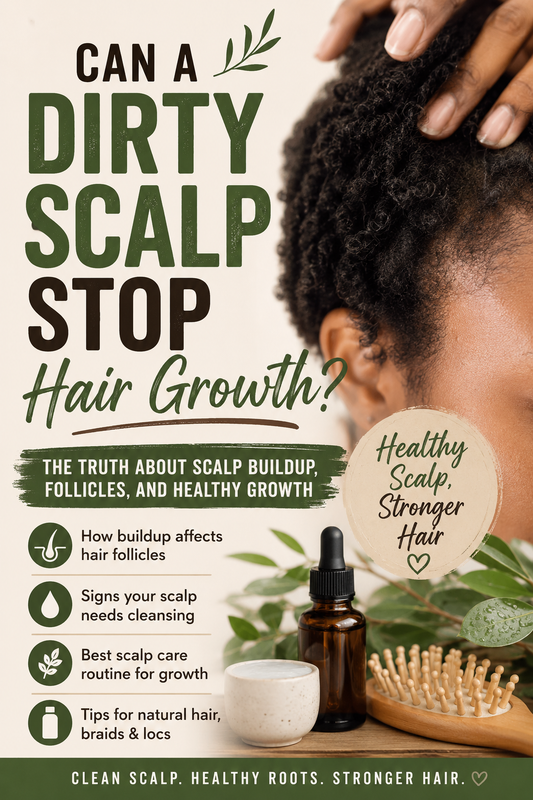
If you're trying to grow longer, thicker, healthier hair, you've probably invested in oils, growth serums, vitamins, protective styles, and moisturizing products. But there is one important factor many people overlook: scalp cleanliness.
A common question in the natural hair, braid, and loc community is:
Can a dirty scalp stop hair growth?
The short answer is yes—and no.
A dirty scalp does not completely stop hair follicles from producing hair, but excessive buildup, inflammation, clogged follicles, irritation, and poor scalp health can significantly reduce your ability to grow and retain healthy hair.
Many people believe their hair has "stopped growing" when the real issue is that their scalp environment is unhealthy. Hair may still be growing beneath the surface, but breakage, shedding, inflammation, and blocked follicles prevent them from seeing progress.
In this comprehensive guide, you'll learn:
- How hair grows from the scalp
- What happens when the scalp becomes dirty
- Whether buildup can clog follicles
- Signs your scalp needs cleansing
- How often to wash natural hair, braids, and locs
- The relationship between scalp health and hair growth
- The best scalp-care routine for maximum growth
By the end of this article, you'll understand why a healthy scalp is one of the most important foundations of healthy hair growth.
Understanding How Hair Growth Works
Before discussing dirty scalps, it's important to understand how hair grows.
Hair grows from structures called hair follicles located beneath the skin.
Each follicle goes through a cycle:
Anagen Phase (Growth)
This is the active growth stage.
Hair grows continuously during this phase, which can last:
- 2–7 years
- Sometimes longer in certain individuals
The longer this phase lasts, the longer hair can grow.
Catagen Phase (Transition)
A short period where growth slows and the follicle prepares for rest.
Telogen Phase (Resting)
Hair rests before eventually shedding.
Exogen Phase (Shedding)
Old hairs fall out and new hairs begin growing.
Healthy follicles repeat this cycle continuously.
The condition of your scalp directly affects how efficiently these follicles function.
What Is a Dirty Scalp?
A dirty scalp is not simply a scalp that hasn't been washed for a few days.
A scalp becomes problematic when there is excessive accumulation of:
- Oil (sebum)
- Sweat
- Product residue
- Dead skin cells
- Dirt and environmental pollutants
- Bacteria
- Yeast
- Fungal buildup
Over time these substances can create an unhealthy environment for hair follicles.
Can Dirt Actually Stop Hair Growth?
Technically, dirt alone doesn't permanently stop hair growth.
Hair follicles continue producing hair beneath the scalp.
However, excessive buildup can contribute to conditions that reduce growth potential.
These include:
- Follicle blockage
- Scalp inflammation
- Itching
- Excess shedding
- Hair breakage
- Poor moisture balance
- Scalp infections
The result is slower progress and difficulty retaining length.
How Scalp Buildup Affects Hair Growth
1. Clogged Hair Follicles
Hair follicles function best when the scalp is clean.
When thick layers of buildup accumulate, follicles may become partially obstructed.
Common buildup sources include:
- Heavy oils
- Butters
- Gels
- Edge control products
- Dry shampoo
- Sweat
- Dust
Over time, buildup can interfere with normal scalp function.
This creates an environment where hair struggles to thrive.
2. Scalp Inflammation
Inflammation is one of the biggest enemies of healthy hair growth.
A dirty scalp often leads to irritation.
Symptoms include:
- Redness
- Tenderness
- Burning
- Itching
- Flaking
Chronic inflammation can weaken follicles and increase shedding.
3. Increased Shedding
Scalp neglect can trigger excessive hair shedding.
When follicles become irritated, more hairs may enter the shedding phase prematurely.
This causes:
- Thinner hair
- Reduced density
- Slower visible growth
Many people mistake excessive shedding for slow growth.
4. Dandruff and Scalp Disorders
A dirty scalp creates an environment where dandruff-causing organisms thrive.
Conditions such as:
- Dandruff
- Seborrheic dermatitis
- Folliculitis
can interfere with scalp health.
Persistent scalp disorders often lead to:
- Scratching
- Inflammation
- Hair weakening
5. Breakage Near the Roots
When buildup accumulates around the scalp, hair can become dry and fragile.
The result is breakage close to the roots.
Many people think their hair isn't growing when they're actually losing new growth through breakage.
Signs Your Scalp Is Too Dirty
Watch for these warning signs.
Excessive Itching
Persistent itching often signals buildup or irritation.
Strong Scalp Odor
A noticeable odor may indicate bacterial growth.
Thick White Residue
Product accumulation commonly appears as visible flakes.
Tender Scalp
Pain or soreness can indicate inflammation.
Increased Hair Shedding
More hair than normal in brushes or combs may suggest scalp issues.
Greasy Appearance
Excess oil often traps dirt and debris.
Persistent Flaking
Not all flakes are dandruff.
Sometimes they're simply dead skin mixed with buildup.
The Myth That Dirty Hair Grows Faster
One of the most common hair myths is:
"Don't wash your hair because dirty hair grows faster."
This is false.
Hair follicles do not grow faster because dirt accumulates.
In reality:
- Healthy follicles perform better on a clean scalp.
- Clean scalps reduce inflammation.
- Clean scalps support moisture balance.
- Clean scalps improve overall hair health.
Washing your scalp appropriately supports growth rather than hindering it.
Can Overwashing Hurt Hair Growth?
While neglecting scalp hygiene is harmful, overwashing can also create problems.
Excessive washing may:
- Strip natural oils
- Cause dryness
- Increase breakage
- Irritate the scalp
The goal is balance.
Your scalp should be:
- Clean
- Comfortable
- Free from heavy buildup
without becoming excessively dry.
How Often Should You Wash Your Scalp?
The ideal schedule depends on your hair type and lifestyle.
Natural Hair
Typically every:
- 1–2 weeks
works well.
Oily Scalp
Often every:
- 5–7 days
is beneficial.
Locs
Usually every:
- 2–4 weeks
depending on lifestyle and buildup.
Braids
Typically every:
- 1–3 weeks
to prevent buildup around the scalp.
Active Lifestyle
If you exercise heavily, more frequent cleansing may be necessary.
The Relationship Between Sweat and Hair Growth
Sweat itself does not stop hair growth.
However, sweat mixed with:
- Dirt
- Oils
- Product residue
creates buildup.
When left on the scalp for extended periods, irritation can develop.
If you work out regularly:
- Cleanse your scalp consistently.
- Allow the scalp to dry properly.
- Avoid excessive product layering.
How Product Buildup Develops
Many people trying to grow hair use numerous products.
Examples include:
- Growth oils
- Leave-ins
- Butters
- Gels
- Edge controls
While these products can be helpful, overuse creates buildup.
Applying more products without cleansing often worsens scalp conditions.
Growth products work best on a clean scalp.
Can Oil Clog Hair Follicles?
Heavy oil use may contribute to buildup.
Common mistakes include:
- Applying oil daily
- Layering multiple oils
- Never clarifying the scalp
The scalp produces its own natural oils.
Adding excessive amounts can overwhelm follicles.
Moderation is key.
Why Scalp Health Matters More Than Hair Length
Many people focus exclusively on hair strands.
However, hair grows from the scalp.
Think of the scalp like soil.
Healthy soil grows stronger plants.
Healthy scalps support stronger hair.
When the scalp is neglected, hair quality often suffers.
Does a Dirty Scalp Cause Hair Loss?
In severe cases, scalp neglect can contribute to hair loss.
Potential conditions include:
Folliculitis
Inflamed follicles caused by bacteria.
Seborrheic Dermatitis
Chronic scalp inflammation and flaking.
Fungal Infections
Certain infections can damage scalp health.
Chronic Inflammation
Long-term irritation may weaken follicles over time.
These conditions require attention to prevent worsening hair loss.
Best Ingredients for a Healthy Scalp
Certain ingredients help maintain scalp health.
Aloe Vera
Helps soothe irritation and hydrate.
Tea Tree Oil
Supports a cleaner scalp environment.
Peppermint Oil
Provides a refreshing sensation and may improve circulation.
Rosemary Oil
Popular for scalp wellness routines.
Jamaican Black Castor Oil
Helps seal moisture and support healthier-looking hair.
The Best Scalp Routine for Hair Growth
Step 1: Cleanse
Use a gentle shampoo designed to remove buildup.
Focus on the scalp.
Step 2: Massage
Scalp massage helps loosen buildup and improve circulation.
Massage for:
- 3–5 minutes
during cleansing.
Step 3: Moisturize
Hydrate the scalp without overloading it.
A lightweight moisturizer often works best.
Step 4: Protect
Avoid excessive scratching and tension.
Step 5: Repeat Consistently
Consistency produces the best results.
Scalp Care for Braids
Braids make scalp care even more important.
Many people neglect cleansing while wearing protective styles.
This leads to:
- Buildup
- Itching
- Flaking
- Inflammation
To maintain growth:
- Clean the scalp regularly.
- Use lightweight moisturizers.
- Avoid excessive oil application.
Scalp Care for Locs
Loc wearers often worry that washing causes unraveling.
However, avoiding cleansing for long periods can create buildup.
Healthy loc maintenance includes:
- Regular washing
- Scalp hydration
- Buildup prevention
A clean scalp supports stronger, healthier locs.
Foods That Support Scalp Health
Scalp health also begins internally.
Focus on:
Protein
Supports hair structure.
Iron
Helps oxygen delivery to follicles.
Omega-3 Fatty Acids
Support skin and scalp health.
Zinc
Important for follicle function.
Water
Hydration supports healthy skin and scalp tissues.
Common Scalp Growth Mistakes
Avoid these mistakes.
Applying Oil Every Day
Too much oil can create buildup.
Never Clarifying
Periodic deep cleansing helps remove residue.
Scratching Constantly
Scratching causes inflammation.
Ignoring Flakes
Persistent flakes should be addressed promptly.
Using Too Many Products
More products do not automatically equal more growth.
The Connection Between Scalp Inflammation and Hair Growth
Research increasingly points to inflammation as a major contributor to hair problems.
Inflammation can:
- Shorten growth phases
- Increase shedding
- Weaken follicles
- Reduce hair density
Keeping the scalp clean helps reduce unnecessary inflammation.
Can Hair Grow Through Buildup?
Yes.
Hair can still grow beneath buildup.
However, the environment becomes less favorable.
Growth may appear slower because:
- Breakage increases
- Shedding increases
- Hair quality declines
This is why many people notice better growth after improving scalp care.
How Long Does It Take to See Improvement?
Once scalp health improves, many people notice:
Within 2–4 weeks:
- Less itching
- Less flaking
- Greater comfort
Within 2–3 months:
- Reduced shedding
- Healthier strands
- Better retention
Within 6 months:
- Noticeably improved hair thickness and length retention
Consistency matters more than quick fixes.
Why Length Retention Matters
Hair growth and length retention are different.
Most hair grows approximately:
- ½ inch per month
However, if breakage removes that growth, length gains disappear.
A dirty scalp often contributes to the cycle of:
Growth → Breakage → No Visible Progress
A healthy scalp helps break that cycle.
The Bottom Line
So, can a dirty scalp stop hair growth?
Not completely—but it can absolutely interfere with your ability to achieve healthy, visible hair growth.
A dirty scalp can contribute to:
- Buildup
- Inflammation
- Itching
- Excess shedding
- Breakage
- Scalp disorders
All of these factors make it harder to grow and retain long, healthy hair.
The healthiest hair journeys begin with a healthy scalp.
If you're serious about maximizing growth, focus on creating a clean, balanced scalp environment through regular cleansing, proper hydration, and consistent scalp care.
For those looking to support scalp health naturally, products like Hairobics Hair & Scalp Booster, Hairobics Raaw Roots Moisturizing Spray, and Hairobics Scalp Rejuvenator Oil can complement a healthy scalp-care routine by helping keep the scalp moisturized and nourished while supporting stronger, healthier-looking hair growth.
A clean scalp won't magically make hair grow overnight—but it can create the ideal foundation for your healthiest hair growth journey.