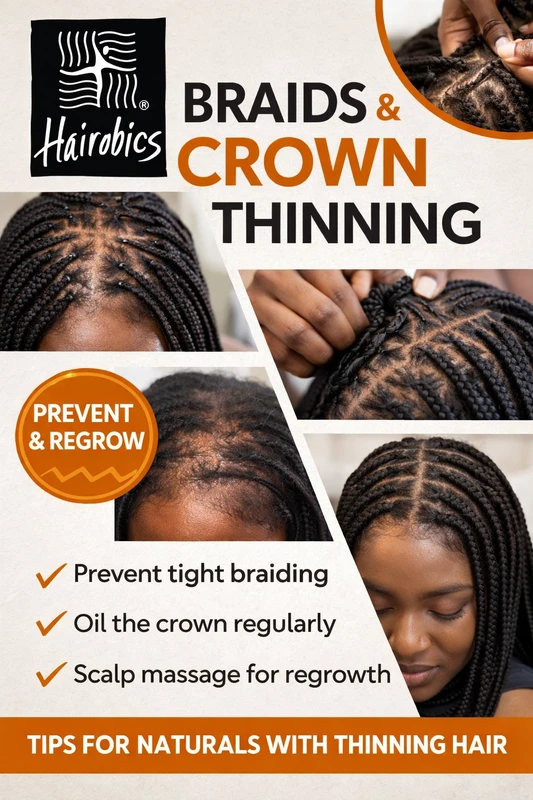
Braids are one of the most popular protective styles in natural hair care. From box braids and knotless braids to cornrows and twists, braided styles protect the ends of the hair and reduce daily manipulation. However, many people notice a troubling issue after months or years of wearing braids: thinning at the crown of the head.
Crown thinning can happen gradually and often goes unnoticed until the hair becomes visibly sparse. While braids can help retain length, improper braiding habits can damage follicles at the crown, leading to thinning or even permanent hair loss.
This complete guide explains:
-
Why crown thinning happens with braids
-
The science behind traction damage
-
Early warning signs
-
How to braid safely
-
How to regrow thinning crown hair
-
The best routine for protecting the crown
If you wear braids regularly, this article can help you prevent long-term crown damage and maintain thick, healthy natural hair.
What Is Crown Thinning?
The crown is the top-back area of the scalp where hair naturally forms a spiral pattern. This area is more fragile than many people realize.
Crown thinning refers to:
-
Reduced hair density at the top of the head
-
Visible scalp through braids or parts
-
Short broken hairs at the crown
-
Slow regrowth
-
Increased shedding
Unlike edge thinning, crown thinning often progresses quietly because the area is harder to see.
Many people discover crown thinning only after removing braids and noticing:
-
A wider part
-
A thin patch
-
Uneven thickness
-
Short broken strands
Why the Crown Is Vulnerable
The crown area is naturally more delicate for several reasons.
Spiral Growth Pattern
Hair at the crown grows in a circular pattern instead of straight rows. This makes braids at the crown:
-
Harder to distribute evenly
-
More likely to pull unevenly
-
More prone to tension points
When braids pull in multiple directions, follicles experience more stress.
Smaller Follicle Clusters
The crown often has:
-
Fewer follicle groupings
-
Lower density
-
Finer strands
This means crown hair can thin faster than other areas.
Daily Friction
The crown rubs against:
-
Pillowcases
-
Headrests
-
Hats
-
Scarves
When braided hair rubs repeatedly, strands weaken over time.
Tension Concentration
Braiders often start styles at the crown. This creates:
-
Strong anchor braids
-
Tight base tension
-
Repeated pulling
Over time, follicles weaken.
How Braids Cause Crown Thinning
Braids themselves do not cause thinning. The problem is excessive tension and repeated stress.
1. Tight Braiding
Tight braids pull hair at the root.
This creates inflammation around follicles.
Repeated inflammation leads to:
-
Weakened follicles
-
Slower growth
-
Thinner strands
Eventually follicles stop producing strong hair.
2. Heavy Braids
Large braids with added hair create downward pulling force.
The crown experiences the most weight because it sits at the highest point on the head.
Heavy braids cause:
-
Root stress
-
Micro-tearing
-
Gradual thinning
3. Repeated Styles
Many people braid continuously year-round.
Example cycle:
-
Braids for 8 weeks
-
Remove braids
-
Rebraid immediately
Without recovery time, follicles weaken.
4. Tight Parting
Small square parts at the crown concentrate tension into tiny areas.
This increases stress on individual follicles.
Larger parts reduce tension.
5. Braiding Damaged Hair
Dry or brittle hair breaks more easily.
When braids are installed on weakened hair, breakage increases.
Traction Alopecia and Crown Thinning
One major cause of crown thinning is traction alopecia, a form of hair loss caused by repeated pulling.
Signs include:
-
Soreness after braiding
-
Red bumps
-
Itching
-
Tender scalp
-
Shiny thinning areas
Early traction alopecia can be reversed.
Long-term traction damage may be permanent.
Early Signs of Crown Thinning
Crown thinning develops slowly.
Watch for:
Wider Parts
Parts appear wider after braid removal.
Short Broken Hairs
Tiny hairs appear at the crown.
These indicate breakage.
Visible Scalp
More scalp becomes visible in braids.
Slow Growth
Crown hair grows slower than the rest of the head.
Tenderness
Pain after braiding signals follicle stress.
Pain is never normal.
Braiding Styles That Increase Crown Thinning Risk
Some styles put more stress on the crown.
High-risk styles include:
Small Box Braids
Small parts create tension concentration.
Micro Braids
Micro braids pull on tiny sections of hair.
Tight Cornrows
Cornrows often anchor strongly at the crown.
Feed-In Braids
Feed-ins increase tension gradually.
Long Braids
Extra-long braids add weight.
Safer Braiding Styles
Lower-risk styles include:
Knotless Braids
Knotless braids reduce base tension.
Medium Parts
Larger parts distribute tension evenly.
Shorter Braids
Less weight means less pulling.
Loose Cornrows
Looser braids reduce stress.
Twists
Twists often create less tension than braids.
How Often Should You Wear Braids?
The safest braid schedule includes rest periods.
Ideal cycle:
-
Braids: 4–6 weeks
-
Break: 2–4 weeks
Continuous braiding increases thinning risk.
How to Protect the Crown While Wearing Braids
Reduce Tension
Tell your braider:
-
"No tight braids at the crown"
-
"Loose parts"
-
"Medium size braids"
Communication prevents damage.
Avoid Heavy Hair Extensions
Use lightweight braiding hair.
Heavy synthetic hair increases tension.
Oil the Crown Regularly
Healthy follicles need moisture.
Focus oiling on:
-
Crown
-
Parts
-
Roots
Keep the Scalp Clean
Dirty scalp causes inflammation.
Wash braids every 2–3 weeks.
Sleep Protection
Use:
-
Satin bonnet
-
Satin pillowcase
Reduces friction.
How to Regrow a Thinning Crown
Crown regrowth takes patience.
Hair grows about ½ inch per month.
Full recovery may take:
-
6 months
-
12 months
-
18 months
Consistency matters.
Step 1: Stop Tight Braiding
Reduce traction immediately.
Continuing tight braids slows recovery.
Step 2: Improve Scalp Health
Healthy follicles produce thicker hair.
Focus on:
-
Moisture
-
Circulation
-
Clean scalp
Step 3: Scalp Massage
Massage improves blood flow.
Massage the crown:
-
5 minutes daily
Use gentle pressure.
Step 4: Moisture Routine
Dry hair breaks faster.
Weekly routine:
-
Gentle wash
-
Deep condition
-
Leave-in conditioner
Step 5: Protein Balance
Weak hair needs structure.
Protein treatments strengthen strands.
Use every 4–6 weeks.
Step 6: Protective Styling Without Tension
Better options include:
-
Loose twists
-
Buns
-
Wigs with breaks
-
Low manipulation styles
Mistakes That Make Crown Thinning Worse
Avoid these common mistakes.
Ignoring Pain
Pain means damage.
Remove painful braids immediately.
Braiding Over Thin Areas
Thin areas need rest.
Braiding them worsens damage.
Using Edge Control on Crown
Heavy gels clog follicles.
Scratching the Crown
Scratching weakens roots.
Leaving Braids Too Long
Braids longer than 8 weeks increase breakage.
Nutrition and Crown Hair Thickness
Healthy hair requires nutrients.
Important nutrients include:
Protein
Hair is made from keratin.
Sources:
-
Eggs
-
Fish
-
Beans
Iron
Low iron slows growth.
Sources:
-
Spinach
-
Red meat
-
Lentils
Vitamin D
Low vitamin D affects follicles.
Omega-3s
Omega-3 supports scalp health.
Sources:
-
Salmon
-
Flaxseed
When Crown Thinning May Be Permanent
Permanent thinning happens when follicles scar.
Signs include:
-
Smooth shiny scalp
-
No tiny hairs
-
No regrowth after 12 months
Early action prevents permanent loss.
The Best Routine for Preventing Crown Thinning
Weekly
-
Clean scalp
-
Moisturize crown
Daily
-
Light scalp massage
-
Protect hair at night
Monthly
-
Check crown thickness
-
Adjust styling
Every Braid Install
-
Request loose tension
-
Avoid tiny parts
-
Reduce weight
Braids Can Still Be Safe
Braids are not the enemy.
Healthy braiding habits include:
-
Moderate tension
-
Rest periods
-
Scalp care
-
Lightweight hair
-
Moisture routines
Many people maintain thick crowns while wearing braids for years by braiding safely.
Final Thoughts
Braids are one of the best protective styles for natural hair, but improper braiding can lead to crown thinning over time.
The crown is naturally delicate and requires extra care. Tight braids, heavy extensions, and continuous styling can weaken follicles and lead to traction damage.
The good news is that early crown thinning can often be reversed with proper care, scalp health routines, and safer braiding techniques.
If you protect the crown, reduce tension, and maintain a healthy scalp routine, you can enjoy braids while still maintaining full, thick, healthy natural hair for years to come.