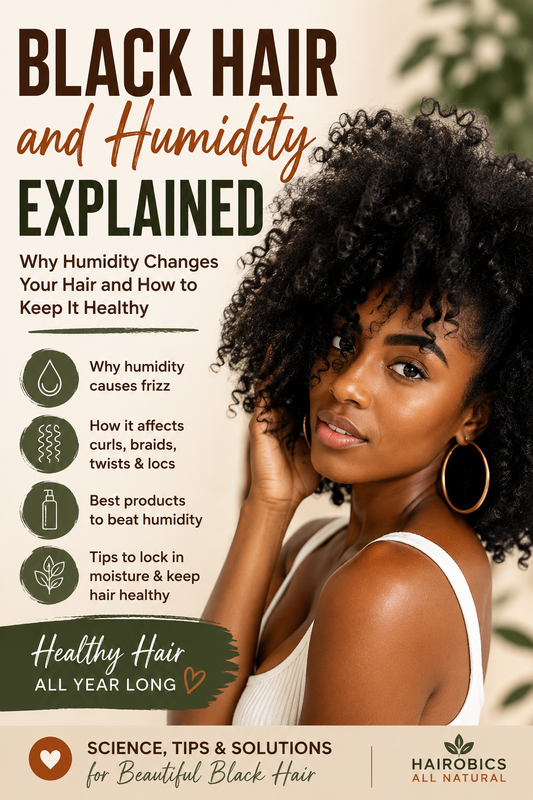
If you've ever spent an hour styling your natural hair only to step outside and watch it puff up within minutes, you're not alone. Humidity is one of the biggest challenges for people with Black hair. Whether you wear an afro, twist-out, braid-out, wash-and-go, silk press, braids, twists, or locs, moisture in the air can dramatically change your hairstyle.
The good news is that humidity isn't your enemy. Understanding how humidity works allows you to create a hair routine that works with your hair instead of against it.
In this complete guide, you'll learn exactly why humidity affects Black hair, how it impacts different hairstyles, and what you can do to keep your hair healthy, moisturized, and beautiful all year long.
What Is Humidity?
Humidity refers to the amount of water vapor in the air.
There are two common types:
- Relative humidity
- Absolute humidity
When meteorologists mention humidity, they're usually referring to relative humidity—the percentage of moisture the air is currently holding compared to the maximum amount it can hold.
The higher the humidity, the more moisture exists in the atmosphere.
Examples include:
- Rainy days
- Tropical climates
- Summer weather
- Coastal areas
Your hair constantly interacts with the surrounding air, making humidity one of the biggest environmental factors affecting Black hair.
Why Black Hair Is Sensitive to Humidity
Black hair has a unique structure.
Compared to straight hair, African American hair typically has:
- More curves
- More twists
- Tighter coils
- Fewer protective oil pathways
Natural scalp oils have a harder time traveling down curly strands.
This means Black hair naturally tends to be:
- Drier
- More porous
- More prone to shrinkage
- More likely to experience frizz
Humidity simply exaggerates these characteristics.
How Hair Absorbs Moisture
Hair is made primarily of keratin.
Keratin contains proteins connected by hydrogen bonds.
These hydrogen bonds constantly break and reform when exposed to water.
Humidity introduces tiny water molecules into the hair shaft.
As moisture enters the hair:
- Hair swells
- Curl patterns become stronger
- Straightened hair reverts
- Frizz increases
- Shrinkage becomes noticeable
This happens because your hair is trying to return to its natural state.
Why Humidity Causes Frizz
Frizz occurs when individual strands absorb uneven amounts of moisture.
Some hairs swell faster than others.
This causes:
- Raised cuticles
- Uneven texture
- Flyaways
- Puffiness
- Loss of definition
The rougher your cuticle layer, the more humidity your hair absorbs.
Understanding Hair Porosity
Hair porosity plays a huge role in humidity.
Low Porosity Hair
Low-porosity hair has tightly packed cuticles.
Benefits:
- Holds moisture longer
- Less prone to frizz initially
Challenges:
- Products may sit on top
- Takes longer to absorb water
Eventually, humidity can still penetrate low-porosity hair.
Medium Porosity Hair
Medium-porosity hair is considered balanced.
It usually:
- Absorbs moisture well
- Retains hydration
- Experiences moderate frizz
High Porosity Hair
High-porosity hair absorbs moisture extremely quickly.
This means humidity often causes:
- Major swelling
- Extreme frizz
- Loss of definition
- Tangles
- Breakage
High-porosity hair usually benefits the most from sealing products.
Humidity and Natural Curls
Curly hair naturally expands in humid weather.
This expansion causes:
- Larger curls
- More volume
- More shrinkage
- Less definition
Some people enjoy the extra fullness.
Others struggle with frizz.
The key is controlling how much moisture enters the hair.
Why Silk Presses Revert
A silk press temporarily straightens natural hair.
Heat breaks hydrogen bonds.
Humidity reforms them.
As soon as moisture reaches the hair:
- Roots puff first
- Hair bends
- Waves appear
- Curls return
This is called reversion.
It's completely normal.
Humidity and Wash-and-Go Styles
Wash-and-go styles often perform differently depending on humidity.
Low humidity:
- Better definition
- Less swelling
High humidity:
- Bigger curls
- Softer definition
- More volume
Many curl creams contain anti-humidity ingredients to reduce swelling.
Humidity and Twist-Outs
Twist-outs rely on stretched curls.
Humidity encourages curls to tighten again.
Results include:
- Less length
- More shrinkage
- Puffier roots
- Reduced definition
A light styling gel helps preserve the pattern longer.
Humidity and Braid-Outs
Braid-outs often become fluffier during humid weather.
While volume increases, definition may decrease.
Using lightweight oils after styling can help reduce excess moisture absorption.
Humidity and Protective Styles
Braids offer protection from humidity.
However, humid weather may still cause:
- Frizzy roots
- Loose edges
- Product buildup
- Itchy scalp
Keeping the scalp clean helps maintain freshness.
How Humidity Affects Locs
Locs respond differently than loose natural hair.
Humidity can cause:
- Swelling
- Longer drying times
- Mild frizz
- Softer locs
If locs stay damp too long, odor and mildew can become concerns.
Always dry locs thoroughly after washing.
Humidity and Shrinkage
Shrinkage is healthy.
It simply means curls are returning to their natural shape.
Many people mistake shrinkage for lack of growth.
In reality, your hair may still be several inches longer when stretched.
Humidity often increases shrinkage dramatically.
Why Some Products Fail in Humidity
Products fail for several reasons.
Some contain:
- Too much glycerin
- Heavy alcohols
- Excess water
- Weak hold
Others simply aren't designed for humid climates.
Look for products specifically labeled:
- Anti-humidity
- Humidity resistant
- Frizz control
The Role of Glycerin
Glycerin attracts moisture.
In moderate climates, this is beneficial.
In very humid climates, glycerin may pull excessive moisture into the hair.
This can increase:
- Puffiness
- Frizz
- Curl expansion
People living in tropical climates sometimes prefer glycerin-free products.
Oils That Help Fight Humidity
Certain oils create a light barrier that slows moisture absorption.
Popular options include:
- Jojoba oil
- Avocado oil
- Argan oil
- Jamaican black castor oil
- Grapeseed oil
These oils work best when applied over moisturized hair.
Butters That Protect Hair
Hair butters help seal moisture inside.
Popular choices include:
- Shea butter
- Mango butter
- Cocoa butter
Using too much may weigh down fine hair.
Should You Moisturize More During Humidity?
Not necessarily.
Hair is already exposed to moisture.
Instead, focus on:
- Sealing moisture
- Preventing excess absorption
- Using balanced hydration
Too much product can actually worsen buildup.
Summer Hair Care Tips
Summer routines should emphasize:
- Hydration
- UV protection
- Lightweight products
- Scalp cleansing
- Protective styling
Sweat and humidity together increase buildup.
Regular cleansing becomes even more important.
Sleeping During Humid Weather
Protect your hairstyle overnight by:
- Wearing a satin bonnet
- Sleeping on a satin pillowcase
- Pineappling curls
- Loosely banding stretched styles
This reduces friction and moisture loss.
Washing Frequency in Humid Weather
You may need to wash more often due to:
- Sweat
- Product buildup
- Increased scalp oil
- Environmental pollution
Choose a gentle sulfate-free shampoo to cleanse without stripping natural oils.
Common Humidity Myths
Myth 1: Humidity Damages Hair
Humidity itself doesn't damage hair.
Poor moisture balance and rough handling cause damage.
Myth 2: Frizz Means Your Hair Is Unhealthy
Healthy hair can still frizz.
Frizz simply means moisture entered the hair shaft.
Myth 3: Oil Moisturizes Hair
Oil seals moisture.
Water provides moisture.
Both are important.
Myth 4: Shrinkage Means No Growth
Shrinkage is a sign of healthy elasticity—not a lack of growth.
Best Hairstyles for Humid Weather
Styles that generally perform well include:
- Braids
- Twists
- Locs
- Bantu knots
- Puff styles
- Cornrows
- Low buns
- Wash-and-go styles with strong hold
Foods That Support Healthy Hair
Healthy hair starts internally.
Focus on:
- Salmon
- Eggs
- Spinach
- Sweet potatoes
- Walnuts
- Avocados
- Beans
- Berries
Hydration also supports scalp health.
Creating a Humidity-Proof Hair Routine
A simple routine might include:
- Cleanse regularly.
- Deep condition weekly.
- Apply a leave-in conditioner.
- Seal with a lightweight oil.
- Style with a humidity-resistant gel or cream.
- Protect hair overnight with satin.
- Avoid excessive touching throughout the day.
Consistency matters more than using dozens of products.
Signs Your Hair Needs More Protection
Watch for:
- Constant frizz
- Dry ends
- Breakage
- Tangling
- Puffy roots
- Dull appearance
- Loss of curl definition
Adjust your routine before damage develops.
Frequently Asked Questions
Is humidity good for Black hair?
Humidity isn't inherently good or bad. It adds moisture to the air, but too much can increase frizz and shrinkage. Managing moisture balance is the key.
Why does my silk press puff up so quickly?
Humidity reforms the hydrogen bonds that were temporarily altered during heat styling, causing your hair to return to its natural curl pattern.
Does humidity make hair grow faster?
No. Humidity doesn't increase hair growth, but it can make hair appear shorter due to shrinkage.
Why do my curls look bigger in summer?
Warm, humid air allows curls to absorb moisture, making them expand and appear fuller.
Should I oil my hair every day?
Daily oiling isn't necessary for most people. Apply oil as needed to seal moisture after moisturizing.
Final Thoughts
Humidity is a natural part of the environment, and Black hair is beautifully designed to respond to moisture. Instead of fighting your hair's natural behavior, build a routine that protects the cuticle, locks in hydration, and minimizes unwanted frizz.
Whether you wear your hair natural, in braids, twists, locs, or a silk press, understanding the science behind humidity helps you make smarter choices. By using the right cleansing routine, moisturizing properly, sealing with lightweight oils, and choosing humidity-resistant styling products, you can enjoy healthy, resilient hair in every season.
Your hair doesn't have to be unpredictable when the weather changes. With consistent care and the right products, you can embrace humidity while keeping your Black hair strong, moisturized, and beautifully styled.