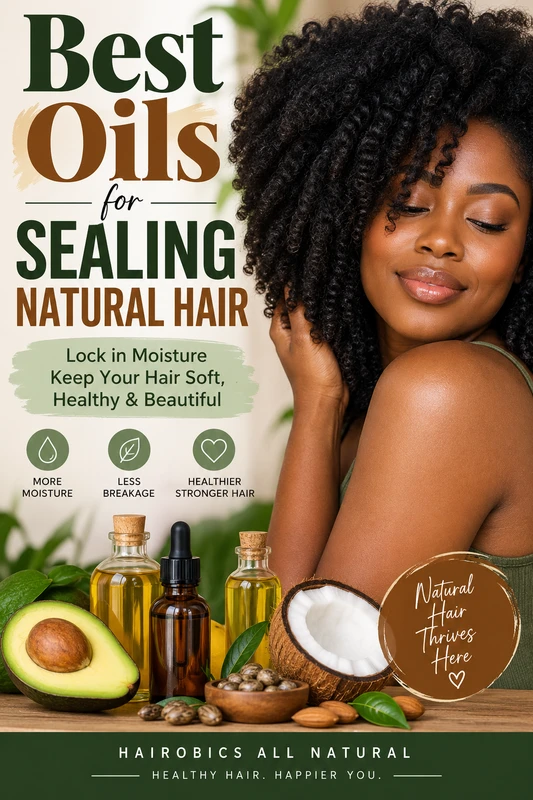
Natural hair can look healthy, soft, and moisturized immediately after wash day, only to feel dry again a day or two later. If this happens to you, the problem may not necessarily be that you're using too little moisture. You may simply need a better way to help your hair hold onto the moisture you've already added.
That's where sealing oils come in.
Using oil to seal natural hair is a popular technique for helping slow moisture loss after applying water, a leave-in conditioner, or another moisturizing product. The right oil can leave natural hair feeling softer, smoother, and easier to manage while helping reduce the roughness and friction that can contribute to tangles and breakage.
But not every oil behaves the same way.
Lightweight oils such as jojoba and grapeseed oil may be ideal for fine hair or people who dislike a greasy feeling. Heavier oils such as castor oil can provide a richer coating that may work better for thick, coarse, or very dry hair.
In this guide, we'll explore the best oils for sealing natural hair, how sealing works, which oils are best for different hair types and porosity levels, and how to build an effective moisture-sealing routine.
What Does It Mean to Seal Natural Hair?
Sealing natural hair means applying an oil or butter after you've added moisture to your hair.
The important distinction is that oil itself isn't the primary source of hydration.
Water provides hydration. Water-based leave-in conditioners and moisturizing products can also help hydrate and condition the hair.
Oil is generally used afterward to coat the hair and help reduce how quickly that moisture escapes.
Think about your natural hair routine as three basic steps:
Hydrate → Moisturize/condition → Seal
For example:
- Lightly dampen your hair with water.
- Apply a water-based leave-in conditioner.
- Apply a small amount of oil over the hair.
The oil forms a hydrophobic layer over the hair fiber that can help slow water loss.
This is why applying oil to extremely dry hair without first adding moisture doesn't always solve dryness.
If there's very little moisture inside the hair, you're essentially coating already-dry strands.
Why Should You Seal Natural Hair?
Natural hair—especially tightly curled and coily textures—can be prone to dryness.
One reason is the structure of curly hair.
Natural scalp oils, or sebum, can travel relatively easily down straight hair. With curls and coils, however, all those bends and curves make it harder for sebum to travel from the scalp to the ends.
As a result, the ends of natural hair can become particularly dry.
Sealing may help by providing an additional protective coating after moisturizing.
A good sealing routine can help your hair:
- Stay soft longer
- Feel smoother
- Retain moisture between wash days
- Reduce friction between strands
- Improve manageability
- Reduce tangling
- Protect dry ends
- Maintain styles longer
- Reduce the need for constant remoisturizing
Sealing can be particularly useful during cold or dry weather when moisture loss can become more noticeable.
10 Best Oils for Sealing Natural Hair
There's no single oil that's perfect for everyone. Your ideal sealing oil depends on your hair's thickness, density, porosity, environment, and personal preferences.
Here are some of the best options to consider.
1. Jojoba Oil
Jojoba oil is one of the most versatile oils for natural hair.
Technically, jojoba oil is a liquid wax rather than a traditional triglyceride oil. Its composition makes it particularly useful as a lightweight coating for hair.
One of jojoba oil's biggest advantages is how light it feels.
Some natural oils can leave fine or low-density hair looking greasy or weighed down. Jojoba tends to provide slip and softness without creating the same heavy coating.
Jojoba oil may be best for:
- Fine natural hair
- Low-porosity hair
- People who dislike heavy oils
- Daily or frequent sealing
- Protective styles
- Dry ends
After applying your leave-in conditioner, place a few drops of jojoba oil in your hands, rub your palms together, and smooth the oil over your hair.
Concentrate primarily on your ends.
You usually don't need much.
2. Jamaican Black Castor Oil
If your hair loves thick oils, Jamaican black castor oil deserves consideration.
Castor oil is considerably thicker than oils such as jojoba, argan, or grapeseed oil. That thickness makes it useful for people looking for a heavier seal.
However, the same characteristic can make it too heavy for some hair types.
Jamaican black castor oil may work well for:
- Thick natural hair
- Coarse strands
- High-porosity hair
- Extremely dry hair
- Dry ends
- Winter hair routines
- Twists and braids
A little goes a long way.
Rather than saturating your entire head with castor oil, start with a tiny amount and focus on your ends and the driest areas.
You can also mix castor oil with a lighter oil such as jojoba, grapeseed, or argan oil.
This gives you some of castor oil's richness without making the mixture quite as heavy.
3. Avocado Oil
Avocado oil is an excellent middle-ground option.
It's richer than some lightweight oils but typically isn't as thick as castor oil.
Avocado oil contains a high proportion of monounsaturated fatty acids, including oleic acid, and can provide excellent lubrication and softness to hair.
This makes it a useful option for natural hair that needs more than an extremely lightweight oil but becomes overwhelmed by very thick products.
Avocado oil may be useful for:
- Medium-to-thick natural hair
- Dry hair
- High-porosity hair
- Twist-outs
- Braid-outs
- Protective styles
- Sealing after deep conditioning
Try smoothing a small amount of avocado oil over damp, moisturized hair before styling.
4. Grapeseed Oil
Grapeseed oil is another great option if you want moisture retention without excessive heaviness.
It has a relatively lightweight texture and spreads easily across the hair.
That makes it especially useful for fine strands or low-porosity natural hair that tends to experience buildup.
Grapeseed oil may be best for:
- Fine natural hair
- Low-porosity hair
- Lightweight routines
- Summer hair care
- Twist-outs
- Braid-outs
- Frequent moisturizing
Because grapeseed oil spreads so easily, you may only need a small amount for each section of hair.
5. Argan Oil
Argan oil has become popular in hair products because of its lightweight feel and ability to add shine and lubrication.
It's an excellent finishing oil.
If your hair tends to look dull after styling, a few drops of argan oil can provide shine without requiring a heavy layer of product.
Argan oil may work particularly well for:
- Fine hair
- Medium strands
- Low-to-medium porosity hair
- Frizz-prone hair
- Twist-outs
- Braid-outs
- Wash-and-go styles
Argan oil can also be used after styling as a finishing oil.
Rub a few drops between your hands and lightly smooth them over your curls.
6. Olive Oil
Extra virgin olive oil is one of the easiest natural oils to find.
It's richer than grapeseed or argan oil and can be useful for people with thick, dry natural hair.
Olive oil contains predominantly oleic acid and can help lubricate strands and reduce friction.
Olive oil may work well for:
- Thick hair
- Coarse natural hair
- Dry hair
- High-porosity hair
- Winter routines
- Protective styles
If olive oil feels too heavy by itself, mix it with a lighter oil.
For example, you could combine:
1 part olive oil + 1 part jojoba oil
or
1 part olive oil + 2 parts grapeseed oil
Experiment until you find a consistency your hair likes.
7. Sweet Almond Oil
Sweet almond oil is another excellent all-around sealing option.
Its texture falls somewhere between extremely light and extremely heavy oils.
It provides lubrication and shine without necessarily making the hair feel coated.
Sweet almond oil may be useful for:
- Medium strands
- Dry natural hair
- Twist-outs
- Braids
- Braid-outs
- Protective styling
- Sealing dry ends
If you've never used sealing oils before, sweet almond oil can be a good starting point because it's relatively easy to work with.
People with nut allergies should exercise appropriate caution with nut-derived oils and discuss concerns with a healthcare professional.
8. Coconut Oil
Coconut oil deserves a special explanation because it behaves somewhat differently from many other oils.
Rather than functioning only as a surface coating, coconut oil has been studied for its ability to penetrate the hair fiber. Research has found that coconut oil can reduce protein loss from hair when used appropriately before or after washing.
Its high concentration of lauric acid contributes to this behavior.
That makes coconut oil valuable in natural hair routines, although it isn't necessarily the ideal sealing oil for everyone.
Some people find coconut oil leaves their hair feeling soft.
Others report that their hair feels stiff, hard, or dry after using it.
Coconut oil may work for:
- Pre-shampoo treatments
- Wash-day routines
- People whose hair responds well to coconut oil
- Reducing friction
- Protecting hair during washing
If coconut oil consistently makes your hair feel hard or brittle, there's no reason to force it into your routine.
Choose another oil.
9. Sunflower Oil
Sunflower oil is an underrated option for natural hair.
It's relatively lightweight and contains a high percentage of linoleic acid.
Because it doesn't feel as heavy as castor or some olive oils, sunflower oil can be particularly useful for people who want to seal their hair without sacrificing volume.
Sunflower oil may work well for:
- Fine strands
- Low-porosity hair
- Medium-porosity hair
- Summer routines
- Lightweight styling
- Dry ends
It's also easy to combine with heavier oils to create your own customized sealing blend.
10. Apricot Kernel Oil
Apricot kernel oil is another lightweight-to-medium oil that can provide softness and lubrication.
It spreads easily and generally doesn't have the extremely thick texture associated with castor oil.
Consider apricot kernel oil for:
- Fine-to-medium strands
- Dry ends
- Twist-outs
- Braid-outs
- Protective styles
- Lightweight sealing routines
If you're trying to move away from extremely heavy oils, apricot kernel oil is worth experimenting with.
Best Sealing Oils for Low-Porosity Natural Hair
Low-porosity hair has a relatively resistant cuticle structure and can be prone to product buildup.
Heavy layers of oils, creams, and butters may leave low-porosity hair feeling greasy without necessarily making it feel more moisturized.
For that reason, lightweight oils are often a better starting point.
Some good options include:
- Jojoba oil
- Grapeseed oil
- Argan oil
- Sunflower oil
- Sweet almond oil
The biggest mistake people with low-porosity hair can make is assuming that more product automatically equals more moisture.
It doesn't.
If your hair feels coated, sticky, or greasy, reduce the amount of oil you're applying.
You might need only a few drops per section.
Best Sealing Oils for High-Porosity Natural Hair
High-porosity hair tends to absorb water quickly but may also lose it relatively quickly.
Hair can naturally have higher porosity, but chemical treatments, excessive heat, weathering, and mechanical damage can also increase porosity.
Heavier sealing products may be useful because they provide a more substantial coating.
Good oils to experiment with include:
- Jamaican black castor oil
- Olive oil
- Avocado oil
- Sweet almond oil
- Castor oil blends
Some people with very high-porosity hair may find that an oil alone isn't enough.
In that case, a butter or thicker styling cream layered over a water-based moisturizer may provide longer-lasting softness.
Best Sealing Oils for 4C Hair
There isn't one oil specifically designed for 4C hair.
Hair type describes curl pattern, but it doesn't tell you everything about your strands.
Two people with 4C hair can have completely different:
- Strand thickness
- Density
- Porosity
- Oil tolerance
- Styling habits
However, tightly coiled hair frequently benefits from products that provide good lubrication because the numerous bends in the strand can create points vulnerable to mechanical stress.
Popular sealing oils for 4C hair include:
- Jamaican black castor oil
- Avocado oil
- Olive oil
- Jojoba oil
- Sweet almond oil
For thick, coarse 4C hair, try avocado or castor oil.
For fine 4C hair, start with jojoba or grapeseed oil.
Best Oil for Sealing the Ends of Natural Hair
Your ends are the oldest part of your hair.
If your hair is several years old, the ends have gone through years of:
- Washing
- Detangling
- Styling
- Weather exposure
- Clothing friction
- Sleeping
- Manipulation
That's why protecting your ends is so important for length retention.
A slightly heavier oil can work particularly well on the ends.
Try:
Castor oil for extremely dry ends.
Avocado oil for dry, medium-to-thick hair.
Jojoba oil for fine hair.
Olive oil for coarse hair.
You don't necessarily have to use the same oil everywhere.
For example, you could use jojoba oil throughout your hair and apply a tiny amount of castor oil specifically to the last inch of your ends.
How to Seal Natural Hair Properly
Technique matters just as much as oil choice.
Here's a simple sealing routine.
Step 1: Start With Clean Hair
You don't need to shampoo every time you seal your hair, but regular cleansing prevents excessive product buildup.
If your hair is covered in layers of old creams, gels, butters, and oils, adding another layer probably won't solve your dryness.
Sometimes what feels like dryness is actually buildup.
Cleanse according to your hair's needs.
Step 2: Add Water
Water is your primary source of hydration.
After washing, your hair is already wet.
Between wash days, you can lightly mist dry hair with water if it needs refreshing.
Your hair doesn't have to be dripping wet.
Slightly damp may be enough.
Step 3: Apply Leave-In Conditioner
Apply a water-based leave-in conditioner to your hair.
Work in sections so the product is distributed evenly.
Pay particular attention to:
- Ends
- Crown
- Hairline
- Areas that frequently become dry
Gently work the product through your strands.
Step 4: Apply Your Sealing Oil
Place a small amount of oil in your palm.
Rub your hands together.
Smooth the oil over your hair.
Start with less than you think you need.
You can always add more.
It's much harder to remove excess oil without washing your hair.
Step 5: Focus on Your Ends
Apply a little extra attention to the ends.
Smooth the oil downward rather than aggressively rubbing your hair.
This helps reduce unnecessary friction.
Step 6: Style Your Hair
You can then style your hair into:
- Twists
- Braids
- Bantu knots
- Puff
- Bun
- Wash-and-go
- Protective style
Low-manipulation styles can help your moisturizing routine last longer because you're touching and restyling your hair less frequently.
LOC vs LCO Method for Sealing Natural Hair
Two popular natural hair routines are the LOC and LCO methods.
LOC means:
Liquid → Oil → Cream
You apply water or leave-in first, followed by oil, and then cream.
LCO means:
Liquid → Cream → Oil
You apply water or leave-in, then a moisturizing cream, and finish with oil.
Neither method is universally better.
Your hair determines which one works best.
If your hair becomes greasy easily, you may not even need three separate layers.
A simple routine of:
Leave-in → small amount of oil
may be enough.
The goal isn't to follow a complicated acronym.
The goal is to keep your hair soft, manageable, and adequately conditioned without excessive buildup.
How Much Oil Should You Use?
One of the most common mistakes with sealing natural hair is using far too much oil.
More oil doesn't automatically mean better moisture retention.
Start conservatively.
For each section, try a few drops.
Thicker hair may need more, while fine hair may need considerably less.
After sealing, your hair should generally feel:
- Soft
- Flexible
- Smooth
- Lubricated
It shouldn't necessarily feel:
- Extremely greasy
- Sticky
- Heavy
- Stiff
- Saturated with oil
If your hands are covered in oil every time you touch your hair, you may be applying more than necessary.
How Often Should You Seal Natural Hair?
There's no universal schedule.
Some people may seal primarily after wash day.
Others may need to refresh their hair every few days.
Pay attention to how your hair feels.
You may need to remoisturize when your hair starts feeling:
- Rough
- Brittle
- Tangled
- Stiff
- Difficult to manipulate
Instead of automatically applying more oil, add a little water or water-based moisturizer first.
Then reseal if necessary.
Remember:
Moisture first. Oil second.
Should You Seal Natural Hair Every Day?
Usually, daily oil application isn't necessary for everyone.
Repeatedly applying oil without cleansing can create buildup.
This can leave the hair greasy, limp, or difficult to moisturize effectively.
If your hair becomes dry every single day despite applying water, leave-in conditioner, and oil, investigate the rest of your routine.
Potential contributors include:
- Harsh shampoo
- Excessive heat
- Product buildup
- Chemical damage
- Over-manipulation
- Split or weathered ends
- Dry indoor air
- Inadequate conditioning
Don't automatically assume you simply need more oil.
Can You Put Oil on Dry Natural Hair?
Yes, but understand what you're trying to accomplish.
Applying oil to dry hair can add:
- Shine
- Lubrication
- Slip
- Surface softness
But if your goal is hydration, you'll generally get better results by adding water or a water-based moisturizing product before sealing.
If your hair is extremely dry, try:
Water → leave-in → oil
instead of:
Dry hair → oil
This small change can make a noticeable difference.
Sealing Natural Hair in the Winter
Winter can be challenging for natural hair.
Cold outdoor temperatures combined with heated indoor environments can leave hair feeling dry.
You may find that you need richer products during winter.
Consider using:
- Avocado oil
- Olive oil
- Castor oil
- Rich creams
- Hair butters
You can also protect your hair from friction caused by coats, scarves, and sweaters.
Long natural hair constantly rubbing against wool or cotton clothing can experience unnecessary friction.
Try wearing your hair up occasionally or choose satin-lined accessories when practical.
Sealing Natural Hair in the Summer
Your summer routine may need to be lighter.
Heavy oils combined with sweat, styling products, and frequent refreshing can create buildup quickly.
Consider lightweight oils such as:
- Grapeseed oil
- Jojoba oil
- Argan oil
- Sunflower oil
You may also need to cleanse more frequently if you're exercising, swimming, or sweating heavily.
Oil vs Hair Butter: Which Is Better for Sealing?
Both can work.
Oils generally provide a lighter coating.
Butters tend to provide a thicker coating.
Examples of commonly used hair butters include:
- Shea butter
- Mango butter
- Cocoa butter
If you have fine or low-porosity hair, oil may feel better.
If you have thick, coarse, or highly porous hair, a butter may provide the richness you're looking for.
Some people use both:
Water → leave-in → cream → oil/butter
But again, don't assume more layers automatically equal healthier hair.
Use the minimum amount of product necessary to achieve softness and manageability.
Common Mistakes When Sealing Natural Hair
Even good oils won't help much if they're being used incorrectly.
Mistake #1: Applying Oil Instead of Moisture
This is probably the biggest mistake.
Your hair feels dry, so you grab oil.
It looks shiny for several hours but still feels dry underneath.
That's because shine and hydration aren't the same thing.
Add water or a water-based moisturizer first.
Mistake #2: Using Too Much Oil
You don't need to drench your hair.
Excessive oil can lead to:
- Buildup
- Greasiness
- Reduced volume
- Heavy-feeling strands
- More frequent cleansing
Start small.
Mistake #3: Choosing Oil Based Only on Curl Pattern
Knowing you have 4A, 4B, or 4C hair doesn't automatically tell you which oil you need.
Consider your:
- Porosity
- Strand thickness
- Density
- Climate
- Styling routine
These characteristics can be equally important.
Mistake #4: Never Clarifying Your Hair
If you're constantly applying leave-ins, creams, oils, gels, and butters, eventually you may experience buildup.
Regular shampooing is important.
If your usual shampoo isn't removing buildup effectively, occasional clarifying may help restore a cleaner surface.
Follow cleansing with conditioning to maintain softness and manageability.
Mistake #5: Ignoring Your Ends
People often concentrate products near the scalp because that's where they can see and feel their hair most easily.
But your ends usually need more protection.
When sealing, make sure you're reaching them.
Can Sealing Help Natural Hair Grow?
Sealing oil doesn't magically make hair grow faster.
Hair growth occurs at the follicle.
However, there's an important distinction between hair growth and length retention.
Your hair can be growing normally at the scalp while breaking at the ends.
If you're losing length through breakage at roughly the same rate you're gaining new growth, it can appear as though your hair isn't growing.
A good moisturizing and sealing routine may support length retention by helping hair remain lubricated, flexible, and easier to handle.
Combine that with:
- Gentle detangling
- Regular conditioning
- Limited excessive heat
- Low-manipulation styling
- Protection at night
- Proper cleansing
- Regular trimming when needed
The goal is to preserve more of the hair you're already growing.
Do Sealing Oils Prevent Breakage?
No oil can guarantee that your hair won't break.
However, oils can provide lubrication.
Lubricated strands generally experience less friction during manipulation.
That can be particularly useful during:
- Detangling
- Styling
- Braiding
- Twisting
- Taking down protective styles
The key is gentle handling.
Even perfectly moisturized hair can break if you're aggressively combing or pulling it.
Best Sealing Oil Combinations
You don't have to choose just one oil.
Blending oils allows you to adjust the weight and texture.
Here are a few simple combinations.
Lightweight Blend
Combine:
- 2 parts jojoba oil
- 1 part grapeseed oil
This may work well for fine or low-porosity hair.
Medium-Weight Blend
Combine:
- 1 part avocado oil
- 1 part sweet almond oil
This is a versatile option for medium-to-thick natural hair.
Heavy Sealing Blend
Combine:
- 2 parts avocado or olive oil
- 1 part castor oil
This creates a richer blend that may work well for coarse, high-porosity, or very dry hair.
Always patch-test new products if you have sensitive skin or a history of reactions.
How to Keep Natural Hair Moisturized Longer
Oil is only one part of moisture retention.
For longer-lasting softness, build a complete routine.
Wash Regularly
Clean hair can accept conditioning products more effectively than hair covered in layers of buildup.
Deep Condition
Regular conditioning helps improve softness, manageability, and lubrication.
Moisturize in Sections
Applying products in sections helps ensure you're actually coating all your hair rather than only the outer layer.
Seal Your Ends
Give your oldest hair extra attention.
Reduce Manipulation
Constant combing, brushing, and restyling can increase mechanical stress.
Protect Your Hair at Night
Sleep with a satin or silk bonnet, scarf, or pillowcase to reduce friction.
Pay Attention to Your Hair
Don't follow a routine simply because someone online says it works.
Your hair's response is the best feedback.
Frequently Asked Questions About Sealing Natural Hair
What is the best oil for sealing natural hair?
There isn't one universal winner. Jojoba and grapeseed oils are excellent lightweight choices, while avocado, olive, and castor oils provide progressively richer options.
What is the best sealing oil for 4C hair?
Jojoba, avocado, olive, sweet almond, and castor oils can all work for 4C hair. Choose according to your strand thickness and porosity rather than curl pattern alone.
What is the best oil for low-porosity hair?
Lightweight oils such as jojoba, grapeseed, argan, and sunflower oil are good starting points.
What is the best oil for high-porosity hair?
High-porosity hair may benefit from richer oils such as avocado, olive, or castor oil.
Should I apply oil to wet or dry natural hair?
If your primary goal is sealing in moisture, apply oil after water or a water-based moisturizing product.
Does oil moisturize natural hair?
Oil can condition, lubricate, and reduce moisture loss, but oils generally don't provide hydration in the way water does.
How often should I oil natural hair?
There's no universal frequency. Apply enough to support softness without creating excessive buildup. Some people seal primarily on wash day, while others refresh between washes.
Is Jamaican black castor oil good for sealing hair?
Yes, particularly if your hair responds well to thick oils. It can be too heavy for fine or low-density hair, so use it sparingly.
Can I mix oils together?
Yes. Mixing a heavy oil with a lightweight oil can make it easier to distribute and customize the feel.
Should I oil my scalp when sealing my hair?
Not necessarily. Sealing primarily refers to applying oil to the hair strands after adding moisture. Your scalp naturally produces sebum, and not everyone needs additional scalp oil.
Best Oils for Sealing Natural Hair: Quick Guide
Here's an easy way to choose.
Fine natural hair:
Jojoba, grapeseed, argan, or sunflower oil.
Low-porosity hair:
Jojoba, grapeseed, sunflower, or argan oil.
Medium-porosity hair:
Jojoba, sweet almond, avocado, or grapeseed oil.
High-porosity hair:
Avocado, olive, sweet almond, or castor oil.
Thick/coarse hair:
Avocado, olive, or Jamaican black castor oil.
Extremely dry ends:
Castor or avocado oil.
Lightweight summer routine:
Grapeseed or jojoba oil.
Rich winter routine:
Avocado, olive, or castor oil.
Final Thoughts: Finding the Best Sealing Oil for Your Natural Hair
Finding the best oil for sealing natural hair doesn't have to be complicated.
The biggest thing to remember is that oil and moisture aren't the same thing.
Start by giving your hair water and a quality water-based moisturizer or leave-in conditioner. Then apply a small amount of oil to help reduce moisture loss and provide lubrication.
If you have fine or low-porosity hair, begin with lightweight oils such as jojoba, grapeseed, argan, or sunflower oil.
If you have thick, coarse, very dry, or high-porosity hair, experiment with richer options such as avocado, olive, or castor oil.
Most importantly, pay attention to how your hair responds.
Your hair should feel soft, flexible, and manageable—not coated in layers of grease.
Once you find the right balance between hydration, conditioning, sealing, cleansing, and gentle handling, keeping natural hair moisturized becomes considerably easier.
Consistency matters more than using huge amounts of product.
Give your hair moisture, seal it appropriately, protect your ends, and handle your strands gently. Those simple habits can go a long way toward maintaining healthier-looking natural hair and retaining the length you work so hard to grow.