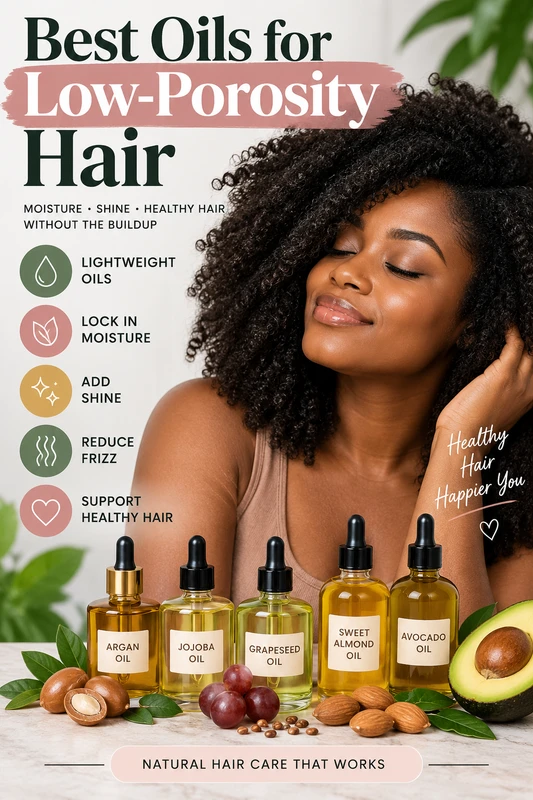
Low-porosity hair can sometimes feel like it has a mind of its own. You apply water, conditioner, leave-in products, and oils, yet your hair may still feel dry. Products may seem to sit on top of your strands instead of absorbing, and adding more product can leave your hair feeling coated or greasy without actually making it feel moisturized.
If that sounds familiar, your hair's porosity may be part of the reason.
Low-porosity hair has a relatively compact cuticle structure. Because the outer cuticle layers don't allow water and products to move through as readily, choosing the right products—and using them correctly—can make a major difference.
This is especially important when it comes to oils.
Heavy oils aren't automatically bad, and lightweight oils aren't automatically good. But many people with low-porosity hair find that lighter oils are easier to incorporate into their routine without creating excessive buildup.
So which oils should you try?
In this guide, we'll explore some of the best oils for low-porosity hair, how to use them, which oils may feel too heavy for some people, and how to build a moisture routine that leaves low-porosity natural hair soft, flexible, and manageable.
What Is Low-Porosity Hair?
Hair porosity refers to how readily your hair takes in and loses water.
Your hair's outermost layer is called the cuticle. You can think of the cuticle as overlapping protective scales surrounding the inner portions of each hair strand.
With low-porosity hair, the cuticle structure tends to be relatively compact.
This can make it harder for water and some conditioning ingredients to move into the hair quickly.
As a result, someone with low-porosity hair may notice:
- Water initially beads on the hair.
- Hair takes longer to become fully saturated.
- Products tend to sit on the surface.
- Thick creams can make the hair feel coated.
- Oils can quickly make the hair look greasy.
- Hair may take a long time to air-dry.
- Product buildup develops relatively easily.
- Hair may feel dry even after applying several products.
Low porosity does not mean unhealthy hair.
It simply describes a characteristic of your hair that can influence how it responds to water, conditioners, styling products, and oils.
Once you understand this characteristic, it becomes easier to select products and techniques that work with your hair rather than against it.
Why Oil Selection Matters for Low-Porosity Hair
Oil doesn't hydrate hair in the same way water does.
This distinction is important.
Water is the primary source of hydration. Oils are generally better thought of as lubricating, conditioning, and helping reduce moisture loss rather than directly "adding moisture."
If your low-porosity hair is dry, simply covering it with oil may not solve the problem.
In fact, repeatedly applying oil without adequately cleansing and hydrating the hair can contribute to buildup.
That's why the best approach is usually:
Water or a water-based product → conditioning/moisturizing product as needed → a small amount of oil
The oil can help improve softness, reduce friction, add shine, and support moisture retention.
For low-porosity hair, the key phrase is often:
A small amount.
You don't necessarily need to saturate your hair with oil to receive its benefits.
1. Argan Oil
Argan oil is one of the first oils worth considering if you have low-porosity hair.
Derived from the kernels of the argan tree, argan oil has become extremely popular in hair products because it can provide shine and lubrication without necessarily creating the extremely heavy feeling associated with some thicker oils.
Benefits of Argan Oil for Low-Porosity Hair
Argan oil may help:
- Improve shine
- Reduce the appearance of frizz
- Lubricate strands
- Make hair feel smoother
- Reduce friction during styling
- Improve manageability
- Seal in moisture
Because you usually don't need much argan oil, it's particularly useful for people whose hair becomes greasy easily.
How to Use It
After applying your leave-in conditioner or moisturizer, rub approximately 2–5 drops between your palms.
Smooth the oil lightly over your hair, concentrating on the ends.
For thick or very dense natural hair, you may need more.
Start small.
You can always add another drop or two.
2. Jojoba Oil
Jojoba oil is another excellent option for low-porosity hair.
Interestingly, jojoba is technically a liquid wax rather than a traditional triglyceride oil.
It has a light texture that makes it particularly attractive for people who dislike the feeling of thick oil sitting on their hair.
Benefits of Jojoba Oil
Jojoba oil can help:
- Lubricate dry strands
- Add shine
- Reduce friction
- Soften the hair
- Seal moisture
- Condition dry ends
- Support easier detangling
It's also versatile enough to use on both the hair and scalp.
How to Use Jojoba Oil
Apply a few drops to damp, moisturized hair.
Pay particular attention to your ends because they're the oldest portion of your hair and tend to experience the greatest amount of wear.
Jojoba oil can also be mixed with another lightweight oil if you prefer creating your own oil blend.
3. Grapeseed Oil
If heavy oils consistently leave your hair looking flat or greasy, grapeseed oil deserves a spot on your list.
Grapeseed oil is lightweight and spreads easily.
That makes it especially convenient for fine low-porosity hair.
Why Grapeseed Oil Works Well
Potential benefits include:
- Lightweight feel
- Improved shine
- Reduced friction
- Easier styling
- Softer-feeling hair
- Moisture sealing without excessive heaviness
Best for:
Grapeseed oil can be particularly useful for:
- Fine natural hair
- Low-density hair
- Low-porosity curls
- Low-porosity waves
- People prone to product buildup
Apply it sparingly after moisturizing.
4. Sweet Almond Oil
Sweet almond oil is another versatile option for natural hair.
It's generally lighter than extremely thick oils and can help improve the feel and appearance of dry strands.
Benefits of Sweet Almond Oil
Sweet almond oil can help:
- Improve softness
- Increase shine
- Lubricate strands
- Reduce friction
- Make detangling easier
- Seal moisture into the hair
It's especially useful when applied to slightly damp hair rather than completely dry hair.
Simple Method
After washing:
- Apply a water-based leave-in conditioner.
- Distribute it thoroughly.
- Apply a small amount of sweet almond oil.
- Concentrate on the ends.
- Style normally.
This approach provides hydration first and oil second.
5. Avocado Oil
Avocado oil is slightly richer than some of the oils we've discussed, but many people with low-porosity hair still enjoy it.
It contains fatty acids and fat-soluble components that make it popular in hair-care formulations.
Potential Benefits
Avocado oil can help:
- Improve softness
- Add shine
- Lubricate hair
- Reduce friction between strands
- Support manageability
- Seal moisture
Because it's somewhat richer, start with a very small amount.
If jojoba or grapeseed oil feels too light for your thick natural hair, avocado oil may provide the extra richness you're looking for.
6. Sunflower Oil
Sunflower oil doesn't always get the attention of argan or jojoba oil, but it can be an excellent lightweight option.
It's rich in linoleic acid and can help lubricate and soften hair.
Why Consider Sunflower Oil?
It can provide:
- Lightweight conditioning
- Shine
- Reduced friction
- Softer strands
- Moisture sealing
- Less greasy feel than some heavier oils
It can be especially helpful for fine or medium-textured low-porosity hair.
7. Apricot Kernel Oil
Apricot kernel oil is another relatively lightweight oil that can work nicely on curls, coils, and waves.
It's often overlooked, but its texture makes it worth considering for people who find heavier oils overwhelming.
Potential Benefits
Apricot kernel oil can:
- Improve softness
- Enhance shine
- Lubricate strands
- Help reduce roughness
- Support moisture retention
Try adding a few drops after your leave-in conditioner.
8. Squalane
Although it isn't usually the first ingredient people think of when discussing natural hair oils, squalane can be an interesting option for people who want an exceptionally lightweight emollient.
Squalane has a silky texture and spreads easily.
It may be particularly useful for fine hair that becomes weighed down easily.
Use only a few drops.
9. Baobab Oil
Baobab oil is derived from the seeds of the baobab tree and is increasingly found in natural hair products.
It has a richer texture than grapeseed or jojoba oil but may still work beautifully for thicker low-porosity hair when used sparingly.
Baobab Oil May Help:
- Soften hair
- Improve shine
- Lubricate strands
- Reduce friction
- Improve manageability
If your low-porosity hair is thick, coarse, or very dense, you may prefer a slightly richer oil such as baobab or avocado rather than extremely lightweight options.
10. Camellia Oil
Camellia oil has traditionally been used in beauty routines and has a relatively light, silky texture.
For low-porosity hair, it can work well as a finishing oil.
Apply a couple of drops after styling to smooth the hair and enhance shine.
Best Lightweight Oils for Low-Porosity Hair
If you're overwhelmed by all the choices, start with these:
Jojoba oil – Great all-around lightweight choice.
Argan oil – Excellent for shine and smoothing.
Grapeseed oil – Particularly useful for fine hair.
Sweet almond oil – Good balance between lightweight and conditioning.
Sunflower oil – Simple lightweight option.
Avocado oil – Better for people who want something slightly richer.
Your perfect oil will ultimately depend on your hair's density, strand thickness, styling routine, climate, and the other products you're using.
Is Coconut Oil Good for Low-Porosity Hair?
This is one of the most common questions about low-porosity hair.
The answer isn't simply yes or no.
Coconut oil has unique properties compared with many other oils and can penetrate hair to some extent. Research has also shown that coconut oil can help reduce protein loss from hair under certain conditions.
However, individual experiences vary significantly.
Some people love coconut oil.
Others say coconut oil leaves their hair feeling:
- Hard
- Stiff
- Dry
- Coated
- Greasy
If your low-porosity hair responds well to coconut oil, there's no universal rule saying you need to stop using it.
If your hair consistently feels stiff or unpleasant after using it, choose another oil.
Your hair's actual response matters more than a generalized porosity rule.
Is Castor Oil Good for Low-Porosity Hair?
Castor oil is extremely popular in natural hair care, particularly in routines focused on retaining length and maintaining the scalp.
But castor oil is thick.
That can be a disadvantage for low-porosity hair that already experiences buildup easily.
Using large amounts of castor oil can make some low-porosity hair feel:
- Sticky
- Heavy
- Greasy
- Coated
That doesn't mean castor oil is forbidden.
Try mixing a small amount with a lighter oil such as jojoba, grapeseed, or sweet almond oil.
For example:
1 part castor oil + 2–3 parts lightweight oil
This creates a thinner blend that's easier to distribute.
Is Olive Oil Good for Low-Porosity Hair?
Olive oil can be beneficial for hair, but it has a richer feel than some of the lightweight oils discussed earlier.
For thick, coarse, low-porosity hair, a small amount may work beautifully.
Fine low-porosity hair may become weighed down more easily.
If you use olive oil, start with less than you think you need.
Heavy Oils Aren't Automatically Bad
One common mistake in discussions about low-porosity hair is labeling certain ingredients as universally "bad."
Hair care isn't that simple.
Two people can both have low-porosity hair and need completely different routines.
One person may have:
- Fine strands
- Low density
- Loose curls
Another may have:
- Coarse strands
- Extremely high density
- Tight coils
The second person's hair may tolerate richer oils far better.
Instead of asking:
"Is this oil allowed for low-porosity hair?"
Ask:
"How does my hair respond to this oil?"
That's a much more useful question.
How to Apply Oil to Low-Porosity Hair Correctly
Choosing the right oil is only half the equation.
How you apply it matters just as much.
Step 1: Start With Clean Hair
Low-porosity hair can be particularly susceptible to buildup.
If your strands are already coated with layers of creams, gels, butters, and oils, applying another oil probably won't solve dryness.
Cleansing gives you a fresh foundation.
Step 2: Thoroughly Wet Your Hair
Don't rush this step.
Low-porosity hair may take longer to become completely saturated.
Allow warm—not excessively hot—water to run through your hair.
Gently separate sections so the water reaches everything.
Step 3: Condition
Apply conditioner evenly throughout the hair.
Working in sections can help if your hair is thick or dense.
Heat can sometimes improve the conditioning experience for low-porosity hair.
For example, you might use:
- A warm towel
- A heated conditioning cap
- A hooded dryer on an appropriate setting
Always follow the instructions for the product you're using.
Step 4: Apply a Water-Based Leave-In
After rinsing, apply your preferred leave-in conditioner.
The goal is to provide water and conditioning ingredients before adding oil.
Step 5: Apply Oil Sparingly
Now apply your chosen oil.
You don't need your hair to look drenched.
Start with several drops per section depending on your hair's length and density.
Focus particularly on your ends.
The LCO Method for Low-Porosity Hair
You may have heard of the LOC method:
Liquid → Oil → Cream
Another variation is:
Liquid → Cream → Oil
This is known as the LCO method.
Some people with low-porosity hair prefer LCO because the oil is applied last.
A routine might look like:
Liquid: Water or water-based leave-in
Cream: Lightweight moisturizing cream
Oil: Jojoba or argan oil
However, you don't have to follow either method rigidly.
Fine low-porosity hair may do better with only:
Leave-in + a few drops of oil
Adding a heavy cream may simply create buildup.
How Much Oil Should You Use?
There is no universal amount.
Your needs depend on:
- Hair length
- Density
- Strand thickness
- Curl pattern
- Climate
- Styling method
- Oil type
But here's a useful principle:
Start with less and increase gradually.
If your hair immediately becomes greasy, limp, or sticky, you've probably used too much.
Should You Oil Low-Porosity Hair Every Day?
Usually, daily oiling isn't necessary for everyone.
Applying oil every day can cause buildup, especially if you're layering oil over hair that isn't being rehydrated.
Instead, pay attention to your hair.
You might apply a small amount of oil:
- After wash day
- After moisturizing
- When refreshing your style
- When your ends feel rough
- Before certain protective styles
The goal isn't to follow an arbitrary schedule.
It's to respond to your hair's needs.
How to Moisturize Low-Porosity Natural Hair
Oil is only one part of a successful routine.
Here's a simple moisture strategy.
1. Cleanse Regularly
Product buildup can interfere with how your hair responds to water and conditioning products.
Wash often enough to maintain a clean scalp and hair.
Your exact frequency will depend on your lifestyle and styling routine.
2. Clarify When Necessary
If your hair suddenly seems resistant to everything, buildup may be involved.
Signs can include:
- Dullness
- Greasy roots
- Sticky strands
- Flakes
- Products sitting on the hair
- Hair feeling coated after washing
An occasional clarifying shampoo may help remove accumulated residue.
Don't automatically clarify constantly, however.
Use it when your hair actually needs deeper cleansing.
3. Use Water-Based Moisturizers
Look at the ingredient list.
Water should generally appear near the beginning of a moisturizing leave-in product.
Remember:
Oil isn't a substitute for water.
4. Use Warm Water During Wash Day
Warm water can help make the washing and conditioning process easier.
There's no need to use extremely hot water, which can be uncomfortable and potentially irritating to the scalp.
5. Consider Gentle Heat During Deep Conditioning
Low-porosity hair may respond well to gentle warmth during conditioning.
A heated cap or hooded dryer can be helpful when used according to the manufacturer's directions.
6. Don't Overload Your Hair
More products don't automatically equal more moisture.
You may not need:
Shampoo + conditioner + deep conditioner + leave-in + moisturizer + cream + butter + oil + gel.
For some low-porosity hair, that combination creates a coating rather than softness.
A simpler routine may perform better.
Low-Porosity Hair Wash-Day Routine
Here's an example.
Step 1: Cleanse
Use shampoo to remove sweat, oils, styling products, and buildup.
Step 2: Condition
Apply conditioner and detangle gently.
Step 3: Deep Condition When Needed
If you're using a deep conditioner, apply gentle warmth if appropriate.
Step 4: Rinse Thoroughly
Don't leave unnecessary residue behind.
Step 5: Apply Leave-In
Use a lightweight water-based leave-in.
Step 6: Add Oil
Apply a small amount of:
- Argan
- Jojoba
- Grapeseed
- Sweet almond
- Sunflower
Step 7: Style
Proceed with your twist-out, braid-out, wash-and-go, twists, braids, or other hairstyle.
Best Oils for Low-Porosity 4C Hair
Low porosity and curl pattern aren't the same thing.
You can have low-porosity 4C hair, high-porosity 4C hair, or something in between.
However, tightly coiled hair often benefits from lubrication because the shape of the strands can increase friction and make natural scalp oils less effective at coating the entire length.
Good oils to experiment with for low-porosity 4C hair include:
- Jojoba oil
- Argan oil
- Sweet almond oil
- Avocado oil
- Grapeseed oil
- Baobab oil
If your 4C hair is extremely dense or coarse, you may find slightly richer oils more satisfying than someone with fine strands.
Best Oils for Fine Low-Porosity Hair
Fine strands can become weighed down quickly.
Prioritize lightweight options such as:
- Grapeseed oil
- Jojoba oil
- Argan oil
- Sunflower oil
- Squalane
Use only a few drops at a time.
You may not need to oil your entire head every day—or even every few days.
Best Oils for Thick Low-Porosity Hair
Thick or coarse hair may tolerate richer oils.
Consider:
- Avocado oil
- Sweet almond oil
- Baobab oil
- Olive oil
- Jojoba oil
You can also create a custom blend combining lightweight and richer oils.
Common Low-Porosity Hair Mistakes
Mistake #1: Using Oil Instead of Moisturizer
Dry hair covered in oil is still dry hair.
Hydrate first.
Then use oil.
Mistake #2: Using Too Much Product
Low-porosity hair may become coated quickly.
Use enough product to achieve your goal—not enough to completely saturate the strand in residue.
Mistake #3: Avoiding Shampoo
Some people believe natural hair should rarely be shampooed.
But low-porosity hair can experience substantial product buildup.
Cleansing is important.
Mistake #4: Applying Heavy Butter Constantly
Shea butter and other rich ingredients can work beautifully for some people, but repeated heavy applications may overwhelm fine low-porosity hair.
Mistake #5: Following Porosity Rules Too Strictly
Porosity is useful information.
It's not your hair's entire identity.
Your curl pattern, strand thickness, density, damage level, climate, hairstyle, and personal preferences also matter.
How to Tell If Your Oil Is Too Heavy
Your oil may be too heavy—or you may simply be using too much—if:
- Hair looks greasy immediately.
- Strands feel sticky.
- Curls lose definition.
- Hair becomes limp.
- Your hands feel oily after touching your hair.
- You need to shampoo frequently to remove residue.
- Hair feels coated rather than soft.
Before abandoning the oil completely, try using less.
If the problem continues, switch to something lighter.
How to Tell If an Oil Works for Your Hair
A good oil should complement your routine.
After using it, your hair may feel:
- Softer
- Smoother
- More flexible
- Easier to style
- Less rough
- More manageable
Your hair may also have a healthy-looking shine without appearing excessively greasy.
Can You Mix Oils for Low-Porosity Hair?
Absolutely.
You can create a simple blend.
For example:
Lightweight blend:
- Jojoba oil
- Grapeseed oil
- Argan oil
Or:
Richer blend:
- Avocado oil
- Sweet almond oil
- Jojoba oil
There's no need to combine 10 or 15 oils.
A simple blend of two or three oils can be easier to evaluate because you'll know how your hair responds.
Oils and Protective Styles
Oils can also be incorporated into routines for:
- Box braids
- Knotless braids
- Two-strand twists
- Mini twists
- Cornrows
- Locs
But the same principle applies:
Don't confuse oil with hydration.
If your hair is in braids, for example, repeatedly coating the braids and scalp in oil without cleansing or adding water-based moisture can contribute to buildup.
Keep your routine balanced.
Do Oils Make Hair Grow Faster?
This deserves clarification because hair-growth claims are common online.
No ordinary cosmetic oil can guarantee dramatically faster hair growth.
Your growth rate is influenced by many factors, including genetics, age, nutrition, health, hormones, and hair-care practices.
However, a good hair-care routine can support length retention.
If lubrication reduces friction, tangling, and breakage, you may retain more of the length your scalp naturally produces.
That can make your hair become visibly longer over time.
Low-Porosity Hair and Product Buildup
Buildup is one of the biggest issues to watch for.
Every time you apply:
- Oil
- Butter
- Cream
- Gel
- Edge control
- Leave-in conditioner
- Styling product
some residue may remain on your hair.
Eventually, your strands may need more thorough cleansing.
If your usual moisturizing routine suddenly stops working, don't automatically add more products.
Sometimes the answer is shampoo.
Frequently Asked Questions
What is the best oil for low-porosity hair?
There isn't one universal winner, but jojoba, argan, grapeseed, sweet almond, sunflower, and avocado oils are all worth trying. Fine hair may prefer lighter oils, while thick or coarse hair may tolerate richer options.
What is the lightest oil for low-porosity hair?
Grapeseed, jojoba, argan, sunflower oil, and squalane are good lightweight options to explore.
Is jojoba oil good for low-porosity hair?
Yes, jojoba oil can be an excellent option because of its relatively lightweight texture and ability to lubricate hair without necessarily feeling extremely heavy.
Is argan oil good for low-porosity hair?
Argan oil is another popular option. Only a few drops may be needed to improve shine and smoothness.
Is avocado oil good for low-porosity hair?
It can be. Avocado oil is somewhat richer, so it may be particularly appealing to people with thick or coarse low-porosity hair.
Should I apply oil to wet or dry hair?
Applying oil after water or a water-based moisturizer often makes more sense when your goal is moisture retention. Oil can also be applied to dry hair in small quantities for shine or lubrication.
How often should I oil low-porosity hair?
There's no required schedule. Some people use oil primarily after wash day, while others occasionally apply a small amount to their ends between washes.
Can low-porosity hair use castor oil?
Yes, but castor oil is very thick. Use a small amount or dilute it with a lighter oil if your hair becomes weighed down easily.
Does low-porosity hair need oil?
Not necessarily. Oils are optional hair-care tools. If your hair looks and feels great without one, you don't have to add oil simply because you have low porosity.
Final Thoughts: Finding the Best Oil for Your Low-Porosity Hair
The best oils for low-porosity hair tend to be oils that provide lubrication, softness, and shine without leaving excessive residue.
Some excellent options to experiment with include:
Jojoba oil, argan oil, grapeseed oil, sweet almond oil, sunflower oil, avocado oil, apricot kernel oil, baobab oil, camellia oil, and squalane.
But there's an even more important lesson.
Don't rely on oil alone to fix dry hair.
A successful low-porosity hair routine should begin with proper cleansing, water, conditioning, and a suitable moisturizer. Oil can then be used strategically to lubricate the strands, enhance shine, and help reduce moisture loss.
If your hair feels greasy, coated, or heavy, reduce the amount of oil you're applying or switch to a lighter option.
If lightweight oils don't provide enough conditioning, experiment with a slightly richer oil such as avocado or baobab.
Most importantly, pay attention to how your hair responds.
Porosity can guide your routine, but it doesn't have to control it.
Once you find the right balance between hydration, conditioning, cleansing, and lightweight oils, low-porosity natural hair can become easier to manage while maintaining the softness, shine, and flexibility you're looking for.