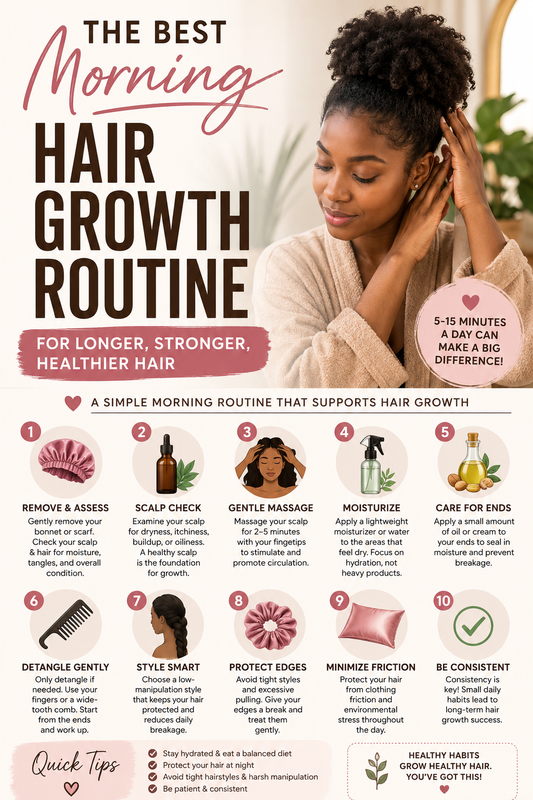
Growing longer, stronger, healthier hair isn't only about the products you use. Your everyday habits can have a major impact on how well you retain length, protect your strands, and maintain a healthy scalp.
That makes your morning hair growth routine especially important.
While hair growth happens naturally as part of the hair-growth cycle, your routine can help create conditions that support healthy hair while reducing the dryness, tangles, friction, and breakage that can make it seem like your hair isn't growing.
This is particularly important for Black hair, natural hair, curly hair, locs, braids, twists, and other textured hairstyles. These hair types can require extra attention to moisture and gentle handling because bends and curls can make it more difficult for natural scalp oils to travel down the entire hair shaft.
The good news is that an effective morning routine doesn't need to take an hour.
In many cases, 5–15 minutes of intentional hair care each morning is enough.
In this complete guide, we'll cover the best morning hair growth routine, what to do immediately after waking up, scalp care, moisturizing, protective styling, common mistakes, routines for different hairstyles, and simple habits that can help you retain more of the hair you grow.
What Is the Best Morning Hair Growth Routine?
A good morning hair growth routine focuses on five priorities:
- Protecting your hair from unnecessary breakage
- Maintaining appropriate moisture
- Keeping your scalp comfortable and healthy
- Minimizing excessive manipulation
- Protecting your ends throughout the day
Your routine doesn't need to involve applying five or six products every morning.
In fact, constantly manipulating your hair or layering too many products can sometimes work against your goals.
A simple routine might look like this:
Wake up → remove nighttime protection → gently separate or fluff hair → assess moisture → moisturize only if needed → give the scalp light attention → style with minimal manipulation → protect ends → go about your day.
The key phrase is "if needed."
Healthy hair care isn't about following the exact same steps every morning regardless of what your hair needs. It's about learning to evaluate your hair and respond appropriately.
Step 1: Remove Your Bonnet or Scarf Gently
Your morning hair routine actually begins with how you uncover your hair.
If you sleep in a satin or silk bonnet, scarf, or other nighttime hair covering, avoid ripping it off quickly.
Gently remove it so you don't snag your edges, braids, curls, twists, or locs.
Take a few seconds to look at your hair.
Ask yourself:
- Does my hair feel dry?
- Does my scalp feel dry or itchy?
- Are my ends tangled?
- Is my hair still moisturized from yesterday?
- Does my scalp feel oily?
- Is there noticeable product buildup?
- Does my hairstyle need refreshing?
This quick assessment helps determine what your hair actually needs that morning.
If your hair already feels soft and moisturized, you may not need to apply anything.
That's an important lesson.
More product does not automatically mean more hair growth.
Step 2: Check Your Scalp
Your scalp is the foundation from which your hair grows.
Before worrying about how your hairstyle looks, pay attention to how your scalp feels.
Look for signs such as:
- Excessive dryness
- Flaking
- Redness
- Tenderness
- Excessive oiliness
- Product buildup
- Persistent itching
A healthy scalp shouldn't require aggressive scratching or constant application of heavy oils.
If your scalp feels normal, you can usually leave it alone.
If it feels slightly dry, a small amount of an appropriate scalp product may help.
However, persistent itching, inflammation, scaling, pain, sores, or unusual hair loss shouldn't simply be covered with oil. These symptoms can have many causes and may warrant evaluation by a dermatologist or other qualified healthcare professional.
Step 3: Try a Gentle Morning Scalp Massage
One of the easiest additions to a morning routine is a short scalp massage.
You don't need to massage your scalp for 20 or 30 minutes.
Try approximately 2–5 minutes.
Use the pads of your fingertips rather than your fingernails.
Place your fingertips against your scalp and make small circular movements.
Work across:
- The front hairline
- Temples
- Sides
- Crown
- Back of the scalp
Keep the pressure comfortable.
The goal isn't to rub your scalp as hard as possible.
Aggressive rubbing can tangle the roots, disturb hairstyles, irritate the scalp, and potentially contribute to breakage.
Do scalp massages make hair grow faster?
Scalp massage is often promoted as a miracle hair-growth technique, but claims should be kept realistic.
A massage can be a relaxing part of a healthy scalp-care routine, but it shouldn't be viewed as a guaranteed cure for thinning or hair loss.
The bigger advantage is that a gentle massage encourages you to regularly pay attention to your scalp without excessive manipulation.
Step 4: Determine Whether Your Hair Needs Moisture
This is one of the most important parts of a morning routine for natural hair growth.
Textured hair frequently benefits from moisture management because its shape can make it more difficult for sebum to coat the entire strand.
But that doesn't mean your hair needs to be drenched every morning.
Touch several areas of your hair, particularly your ends.
Does it feel:
- Soft?
- Flexible?
- Rough?
- Brittle?
- Crunchy?
- Dry?
If your hair still feels moisturized, leave it alone.
If it feels dry, lightly refresh it.
Water is important
Remember that oils aren't the same thing as water.
Putting oil on extremely dry hair can make the hair feel coated without necessarily addressing its need for moisture.
Depending on your hairstyle, you might use:
- A light water-based moisturizing spray
- A leave-in conditioner
- A lightweight moisturizer
- A small amount of cream
- A light oil after moisturizing, if appropriate for your hair
The objective isn't to soak your hair.
Use enough product to improve softness and manageability without leaving the hair saturated.
Step 5: Pay Special Attention to Your Ends
If your goal is longer hair, your ends deserve special attention.
Why?
Because the ends are the oldest portion of your hair.
They've been through months—or potentially years—of:
- Washing
- Detangling
- Styling
- Weather exposure
- Clothing friction
- Pillow friction
- Heat
- Manipulation
Your scalp may continue producing new hair, but if your ends break at approximately the same rate, your overall length may appear unchanged.
This is why length retention matters so much.
After moisturizing, gently feel your ends.
If they're dry, concentrate a small amount of moisturizer there.
If appropriate, follow with a small amount of oil or another sealing product.
You don't need to make your ends greasy.
The goal is simply to keep them flexible and reduce unnecessary dryness.
Step 6: Detangle Only When Necessary
You do not necessarily need to completely detangle your hair every morning.
For many people with natural or curly hair, excessive detangling becomes unnecessary manipulation.
If you encounter a knot, avoid immediately pulling a brush through it.
Instead:
- Separate the surrounding hair.
- Use your fingers to locate the knot.
- Apply a little moisture or slip if necessary.
- Gently work the strands apart.
- Use a wide-tooth comb only when appropriate.
Start near the ends and gradually work upward when detangling larger sections.
Never make ripping through tangles part of your morning routine.
Step 7: Choose a Low-Manipulation Hairstyle
Your hairstyle can either support your length-retention efforts or make them more difficult.
A low-manipulation hairstyle minimizes the amount of brushing, combing, pulling, and restyling your hair experiences.
Examples include:
- Two-strand twists
- Loose buns
- Flat twists
- Braids
- Low ponytails
- Puffs
- Updos
- Loc styles
- Bantu knots
- Cornrows
The best hairstyle depends on your hair.
A style is only "protective" when it actually protects your hair.
If your bun is extremely tight or your braids are pulling on your hairline, the hairstyle may be doing the opposite.
Step 8: Protect Your Edges
Your edges can be particularly vulnerable because they're frequently manipulated.
Many morning styling routines involve:
- Brushing edges
- Applying edge control
- Pulling ponytails tightly
- Repeatedly slicking hair back
- Wearing tight headbands
- Creating tension around the hairline
Doing this occasionally may not be a problem for everyone, but repeating high-tension styling every day can place unnecessary stress on delicate areas.
If you're trying to grow and retain healthy hair, consider giving your edges a break.
Some mornings, simply allow them to exist naturally.
Your hairstyle doesn't have to look perfectly slick every day.
Step 9: Avoid Tight Morning Hairstyles
If your hairstyle causes pain, throbbing, bumps, or significant scalp tenderness, it's too tight.
This applies to:
- Braids
- Ponytails
- Buns
- Cornrows
- Loc styles
- Extensions
- Wigs
- Weaves
Repeated tension can contribute to hair breakage and, in some cases, traction alopecia.
Healthy hair growth shouldn't require sacrificing your hairline for a hairstyle.
Step 10: Protect Hair From Clothing Friction
This is one of the most overlooked causes of daily hair friction.
Long natural hair, braids, twists, and locs can repeatedly rub against clothing throughout the day.
Pay attention to rough materials around your:
- Shoulders
- Neck
- Back
- Coat collar
- Hoodie
- Sweater
If you're experiencing unexplained breakage around shoulder length, friction may be one of several factors worth considering.
Try wearing your hair up occasionally, especially when you're wearing rough fabrics.
The 10-Minute Morning Hair Growth Routine
Don't have much time?
Try this simplified routine.
Minute 1: Assess
Remove your bonnet or scarf and check your hair and scalp.
Minutes 2–4: Scalp
Perform a gentle fingertip scalp massage if desired.
Minutes 5–6: Moisturize
Lightly moisturize areas that feel dry.
Minute 7: Ends
Give your ends extra attention if necessary.
Minutes 8–10: Style
Create or refresh a low-manipulation hairstyle.
That's it.
You don't need an elaborate 45-minute routine every morning.
Consistency usually matters more than complexity.
Best Morning Routine for Natural Hair Growth
Natural hair often benefits from keeping manipulation relatively low.
A simple natural-hair routine might be:
1. Remove satin bonnet
Allow the hair to settle naturally.
2. Shake or separate
Use your hands rather than immediately reaching for a comb.
3. Check moisture
Pay particular attention to the ends.
4. Lightly refresh
Use a water-based moisturizer or leave-in if needed.
5. Separate curls or twists
Use your fingers.
6. Style
Choose a loose, comfortable style.
7. Protect your ends
Keep fragile ends from excessive friction when possible.
This can work especially well for twist-outs, braid-outs, stretched natural hair, and other textured styles.
Best Morning Routine for Curly Hair
Curly hair often looks different every morning.
One side might look perfect while the other has been flattened overnight.
You don't necessarily need to completely wet and restyle everything.
Try refreshing only the areas that need help.
Start by gently shaking your roots.
Use your fingers to separate flattened sections.
Mist individual curls rather than saturating your entire head.
Apply a tiny amount of curl product if necessary.
Then scrunch the curls back into shape.
Avoid brushing dry curls aggressively unless brushing is intentionally part of your styling method.
Morning Routine for Braids
One major benefit of braids is that your morning routine can be extremely simple.
After removing your scarf or bonnet:
- Check your scalp.
- Check your edges.
- Look for excessive tension.
- Apply a light moisturizer to your natural hair if needed.
- Apply scalp products only when necessary.
- Style your braids without excessive pulling.
Don't assume that because your hair is braided, it doesn't need attention.
Your natural hair still needs reasonable moisture and scalp care.
At the same time, avoid constantly soaking your braids or layering heavy products onto your scalp.
Buildup can become another problem.
Morning Routine for Locs
Locs generally don't need to be covered in heavy oil every morning.
Instead:
Remove your nighttime protection and allow your locs to fall naturally.
Check your scalp.
If your locs feel dry, consider a lightweight moisturizing mist.
Pay attention to your scalp without constantly adding product.
Then style your locs loosely.
Be particularly careful with ponytails and updos.
Heavy locs combined with tight styling can place considerable tension on the roots.
Morning Routine for Men With Black Hair
Men can follow the same basic principles.
For short natural hair:
- Check scalp condition.
- Lightly moisturize if necessary.
- Massage gently.
- Brush carefully if styling waves.
- Avoid excessive product buildup.
For longer natural hair:
- Moisturize dry areas.
- Finger-detangle when possible.
- Protect ends.
- Choose low-manipulation styles.
For locs:
- Lightly refresh when necessary.
- Keep the scalp clean.
- Avoid constantly twisting the roots.
- Don't retwist every morning.
Hair growth doesn't require constantly manipulating the hair.
Morning Routine for Kids' Natural Hair
Children's hair routines should be especially gentle.
A morning routine might include:
- Remove bonnet or scarf.
- Lightly mist dry sections.
- Finger-detangle small tangles.
- Refresh the existing hairstyle.
- Avoid unnecessary restyling.
Try not to take a child's hair completely down every morning if the existing style can simply be refreshed.
Low-manipulation styles can make mornings easier for both the child and caregiver.
Most importantly, hairstyles shouldn't hurt.
Extremely tight ponytails, braids, and elastics aren't necessary for neat-looking children's hair.
Should You Oil Your Scalp Every Morning?
Not necessarily.
Some people enjoy scalp oils and find that small amounts fit comfortably into their routine.
Others experience buildup or irritation from frequent oiling.
Your scalp already produces sebum naturally.
How frequently you add oil depends on factors including:
- Hair type
- Scalp condition
- Hairstyle
- Climate
- Wash frequency
- Products being used
If your scalp already feels oily, adding more oil simply because it's morning may not be helpful.
Pay attention to your scalp rather than following a rigid schedule.
Should You Wet Your Hair Every Morning?
Again, it depends.
Some curly hairstyles respond beautifully to a light morning mist.
Other hairstyles may become frizzy, shrink excessively, or take too long to dry.
You don't necessarily need to soak your hair every day.
Instead, apply moisture strategically.
Focus on the areas that actually feel dry.
Should You Brush Your Hair Every Morning?
Not everyone needs daily brushing.
The idea that everyone should brush their hair 100 strokes per day doesn't translate particularly well to every hair type.
For highly textured hair, unnecessary brushing can create additional manipulation.
Use tools when they serve a purpose.
For example, someone maintaining waves may use a brush regularly as part of their styling routine.
Someone wearing a twist-out may barely need a brush at all.
Match the tool to the hairstyle.
What Should You Put on Your Hair Every Morning for Growth?
There isn't one product that everyone needs to apply every morning.
Instead, think in categories.
Water-Based Moisture
Useful when hair feels dry.
Leave-In Conditioner
Can help improve softness and manageability.
Hair Oil
May be useful in small amounts for sealing, lubrication, or scalp care depending on your needs.
Cream or Butter
Thicker textures may prefer creams, especially on dry ends.
Scalp Product
Use according to your scalp's actual needs rather than automatically applying it every day.
The best routine is usually the smallest amount of product necessary to keep your hair feeling healthy and manageable.
Best Oils for a Morning Hair Routine
Oils are popular in natural hair care, and there are many options.
Common choices include:
Jojoba Oil
A relatively lightweight oil that many people prefer for scalp and hair care.
Coconut Oil
Popular for hair care, although it doesn't work equally well for everyone.
Castor Oil
A much thicker oil often used sparingly on the scalp or ends.
Olive Oil
Can provide lubrication and softness but may feel heavy on finer hair.
Avocado Oil
Another popular option for dry, textured hair.
Argan Oil
Often used in small quantities to add shine and reduce a dry feel.
Remember: oils don't magically force follicles to produce several extra inches of hair.
They should be viewed as tools within an overall hair-care routine.
Morning Hair Growth Routine for Low-Porosity Hair
Low-porosity hair can be prone to product sitting on the surface rather than absorbing easily.
Heavy layering every morning may lead to buildup.
Try keeping your morning routine lightweight.
Use a small amount of water-based moisture when necessary.
Avoid automatically applying heavy butter and oil every day.
If yesterday's product is still sitting on your hair, adding another layer probably isn't necessary.
Morning Hair Growth Routine for High-Porosity Hair
High-porosity hair may lose moisture relatively quickly.
You may find that your ends feel dry by morning even after moisturizing the previous day.
Try:
- Lightly misting dry areas
- Applying leave-in
- Adding cream if necessary
- Using a small amount of oil or butter to help reduce moisture loss
The exact layering method depends on your hair.
Experiment rather than assuming every popular method will work for you.
Morning Hair Growth Routine After Wash Day
The morning after wash day should usually be one of your easiest mornings.
Your hair has already been:
- Cleansed
- Conditioned
- Detangled
- Moisturized
- Styled
Don't immediately undo all that work.
Remove your bonnet, assess your style, separate or fluff if necessary, and leave the hair alone.
If your hair is still moisturized, don't add more product just because your routine says you should.
Morning Routine When Wearing a Protective Style
Protective styles can make morning routines much easier.
But don't turn "protective styling" into "ignore my hair completely."
Check your:
- Scalp
- Hairline
- Nape
- Exposed natural hair
- Roots
Pay particular attention to tension.
If a style becomes painful or starts pulling at your edges, address the problem.
A protective style should actually protect your hair.
Hair Growth Starts With the Scalp—but Length Depends on Retention
This distinction is extremely important.
Your hair grows from follicles in your scalp.
However, the length you see depends partly on how much of that growth you retain.
Imagine that your hair grows several inches over a period of time but repeatedly breaks at the ends.
You may conclude:
"My hair isn't growing."
But growth and length retention aren't exactly the same thing.
This is why a strong morning routine focuses heavily on reducing breakage.
15 Morning Habits That Can Help With Length Retention
Your entire lifestyle contributes to healthy hair—not just your styling products.
Consider these habits:
- Drink fluids throughout the day according to your body's needs.
- Eat a balanced diet.
- Consume adequate protein.
- Handle your hair gently.
- Avoid excessive tension.
- Keep your scalp clean.
- Moisturize according to your hair's needs.
- Protect fragile ends.
- Limit unnecessary heat.
- Avoid constantly restyling your hair.
- Pay attention to scalp changes.
- Protect hair from excessive friction.
- Be careful with tight hats and headbands.
- Use appropriate nighttime protection.
- Stay consistent.
No single habit guarantees rapid growth.
Together, however, healthy habits can help support your hair and reduce preventable damage.
Foods That Support Healthy Hair
Hair is largely composed of keratin, a protein.
That's one reason adequate nutrition matters.
A balanced diet can include foods providing:
- Protein
- Iron
- Zinc
- Essential fatty acids
- Vitamins
- Minerals
Examples include:
- Eggs
- Fish
- Chicken
- Beans
- Lentils
- Leafy greens
- Nuts
- Seeds
- Avocados
- Sweet potatoes
- Berries
- Whole grains
Supplements aren't automatically better than food.
Nutrient deficiencies can contribute to hair problems, but taking excessive supplements when you're not deficient isn't necessarily beneficial and can sometimes be harmful.
If you're experiencing unexplained or significant hair shedding, speak with a healthcare professional before assuming supplements are the solution.
Morning Mistakes That May Be Hurting Your Hair
Sometimes the best way to improve your routine is to stop doing things that create unnecessary damage.
Mistake #1: Brushing Aggressively
Rushing in the morning can make people brush harder and faster.
Slow down.
Hair doesn't become stronger because you brush through a knot forcefully.
Mistake #2: Applying Too Much Product
Your hair doesn't need six new layers of product every morning.
Excessive buildup can leave hair dull, sticky, or difficult to manage.
Mistake #3: Pulling Your Hair Back Too Tightly
A slick ponytail may look great, but extreme daily tension isn't ideal for your hairline.
Alternate hairstyles.
Mistake #4: Ignoring Your Ends
If your goal is waist-length hair, your ends need to survive long enough to reach your waist.
Give them attention.
Mistake #5: Manipulating Hair Constantly
Combing, brushing, twisting, untwisting, slicking, and restyling several times per day increases opportunities for mechanical damage.
Sometimes the healthiest thing you can do is leave your hair alone.
Mistake #6: Using Heavy Oil on a Dirty Scalp
More oil doesn't equal a healthier scalp.
If your scalp has significant buildup, it may be time for cleansing rather than another layer of oil.
Mistake #7: Ignoring Hair Loss
There's an important difference between normal shedding, breakage, and certain types of hair loss.
If you're noticing sudden thinning, bald patches, scalp pain, significant shedding, or a rapidly changing hairline, consider consulting a dermatologist.
Don't spend months covering symptoms with oil while an underlying problem goes unaddressed.
Morning Hair Routine vs. Night Hair Routine
Your nighttime and morning routines should work together.
At Night
Focus on:
- Moisture when necessary
- Protecting ends
- Reducing friction
- Preserving your hairstyle
- Using satin or silk protection when appropriate
In the Morning
Focus on:
- Assessing your hair
- Refreshing only what needs refreshing
- Gentle scalp care
- Minimal manipulation
- Preparing hair for the day
When your nighttime routine is effective, your morning routine becomes much easier.
A Weekly Routine That Supports Your Morning Routine
Morning hair care works best as part of a larger system.
Your week might include:
Wash Day
Cleanse your scalp and hair according to your needs.
Conditioning
Use conditioner to improve manageability and help with detangling.
Detangling
Detangle carefully using appropriate tools and products.
Moisturizing
Apply moisture according to your hair type and hairstyle.
Styling
Choose hairstyles that don't create excessive tension.
Nightly Protection
Protect your style and reduce friction.
Morning Refresh
Make only the adjustments necessary.
This approach keeps you from trying to accomplish your entire hair-care routine every morning.
How Long Does Hair Take to Grow?
Hair growth is gradual.
Scalp hair is commonly estimated to grow around half an inch per month on average, though individual growth rates vary.
That works out to roughly six inches per year as a general estimate.
But that doesn't mean everyone will see six additional inches of visible length every year.
Why?
Because hair can also experience:
- Breakage
- Trimming
- Split ends
- Chemical damage
- Heat damage
- Mechanical damage
Your goal should therefore be twofold:
Support healthy growth + retain as much healthy length as possible.
Can a Morning Routine Make Your Hair Grow Faster?
A morning routine can't override genetics or the biology of your hair follicles.
You shouldn't expect a particular oil, massage technique, or hairstyle to suddenly make your hair grow three inches in a month.
However, a well-designed routine can help you:
- Reduce breakage
- Maintain moisture
- Protect your ends
- Avoid excessive tension
- Maintain your scalp
- Reduce unnecessary manipulation
Over several months, better length retention can make a substantial difference in how long your hair becomes.
30-Day Morning Hair Growth Challenge
Want to turn your routine into a habit?
Try following these principles for 30 days.
Every Morning
Step 1: Gently uncover your hair.
Step 2: Examine your scalp.
Step 3: Massage for 2–5 minutes if desired.
Step 4: Check your moisture level.
Step 5: Moisturize only when necessary.
Step 6: Check your ends.
Step 7: Style gently.
Step 8: Avoid excessive tension.
Every Night
Protect your hair from friction.
At the end of 30 days, evaluate:
- Breakage
- Dryness
- Tangling
- Scalp comfort
- Manageability
- Overall hair condition
Don't obsess over measuring growth every day.
Hair growth takes time.
Best Morning Routine for Growing Hair to Waist Length
Long-hair goals require patience.
If you're trying to grow your hair significantly longer, focus less on finding a "miracle" product and more on keeping your existing hair intact.
Your morning priorities should be:
Moisture + gentle handling + protected ends + low manipulation + healthy scalp habits.
The longer your hair becomes, the older your ends become.
That means preventing unnecessary breakage becomes increasingly important.
How to Know Your Morning Routine Is Working
Don't judge your routine solely by how many inches you see immediately.
Look for other improvements.
After several weeks or months, you may notice:
- Less breakage
- Fewer knots
- Softer ends
- Easier detangling
- Less dryness
- Better hairstyle longevity
- Reduced need for constant manipulation
- Better length retention
These are meaningful signs of progress.
Frequently Asked Questions About Morning Hair Growth Routines
What should I do to my hair every morning to help it grow?
Focus on keeping your scalp healthy, maintaining appropriate moisture, handling your hair gently, protecting your ends, and avoiding excessive tension. You don't necessarily need to apply products every morning.
Should I oil my scalp every morning?
Not necessarily. Frequency depends on your scalp, hairstyle, products, and personal needs. If your scalp is already oily or experiencing buildup, adding more oil may not help.
Should I massage my scalp every morning?
You can incorporate a gentle 2–5 minute scalp massage if it feels comfortable. Avoid scratching or aggressive rubbing.
What is the best morning hairstyle for hair growth?
There's no single best hairstyle. Choose comfortable, low-manipulation styles that don't place excessive tension on your scalp or hairline.
Should I moisturize natural hair every morning?
Only when necessary. Some hair needs refreshing daily, while other hair remains moisturized for several days.
Should I put water on my natural hair every morning?
Not necessarily. A light mist may work well for some styles and hair types, while others require less frequent refreshing.
How can I grow my hair faster naturally?
Focus on overall health, adequate nutrition, scalp care, minimizing damage, and length retention. Be cautious of products promising unrealistically fast growth.
Does protective styling make hair grow?
Protective styles don't force follicles to grow faster. Their main potential advantage is helping reduce manipulation and breakage when installed and maintained correctly.
How often should I wash my hair for growth?
There isn't one universal schedule. Your ideal wash frequency depends on scalp oiliness, activity level, hairstyle, product use, and hair needs. The goal is to keep your scalp and hair clean without creating unnecessary dryness or damage.
Why is my hair growing but not getting longer?
Breakage may be occurring at approximately the same rate that new length is being produced. Pay attention to your ends, detangling technique, moisture balance, heat exposure, chemical processing, and styling tension.
Can I grow my hair without using oils?
Yes. Hair follicles don't require topical hair oils in order to produce hair. Oils are optional hair-care tools.
What is the most important part of a morning hair growth routine?
Consistency and gentle handling. Protecting the hair you already have is one of the most important parts of achieving longer-looking hair over time.
The Best Morning Hair Growth Routine Is Simple
It's easy to believe that growing long natural hair requires an enormous collection of products.
It doesn't.
A good morning hair growth routine can be surprisingly simple:
Check your scalp.
Check your moisture.
Moisturize only when needed.
Protect your ends.
Handle your hair gently.
Avoid excessive tension.
Choose low-manipulation hairstyles.
Then leave your hair alone.
Hair growth is a long-term process.
You probably won't notice a dramatic difference after three mornings.
But what happens when you repeat healthier hair habits for three months, six months, one year, or several years?
That's where consistency can make a difference.
Instead of chasing unrealistic overnight growth, build a routine designed to support healthy hair and help preserve the length you're already growing.
Your morning routine doesn't have to be complicated.
It simply needs to be consistent, gentle, and appropriate for your hair.
Final Thoughts: Build a Routine Your Hair Can Thrive With
The best morning hair growth routine isn't necessarily the routine with the most steps.
It's the routine that helps you maintain a healthy scalp while protecting your strands from unnecessary damage.
For Black hair, natural hair, curls, braids, twists, and locs, length retention is especially important.
Every time you prevent unnecessary breakage, protect a fragile end, avoid an overly tight hairstyle, or gently work through a knot instead of ripping through it, you're helping preserve the hair you've worked so hard to grow.
Start with the basics:
Healthy scalp. Healthy strands. Moisturized ends. Gentle styling. Consistency.
Give your routine time.
Track your progress monthly rather than daily.
Take photographs every 30–60 days under similar lighting and with your hair styled similarly. This can make it easier to see gradual changes that may otherwise go unnoticed.
Most importantly, pay attention to what your own hair is telling you.
Your hair doesn't need to follow someone else's routine.
It needs a routine that works for you.
And sometimes the best morning hair-growth strategy is also the simplest:
Moisturize when necessary, protect your ends, keep your styles comfortable, and stop manipulating your hair more than you need to.