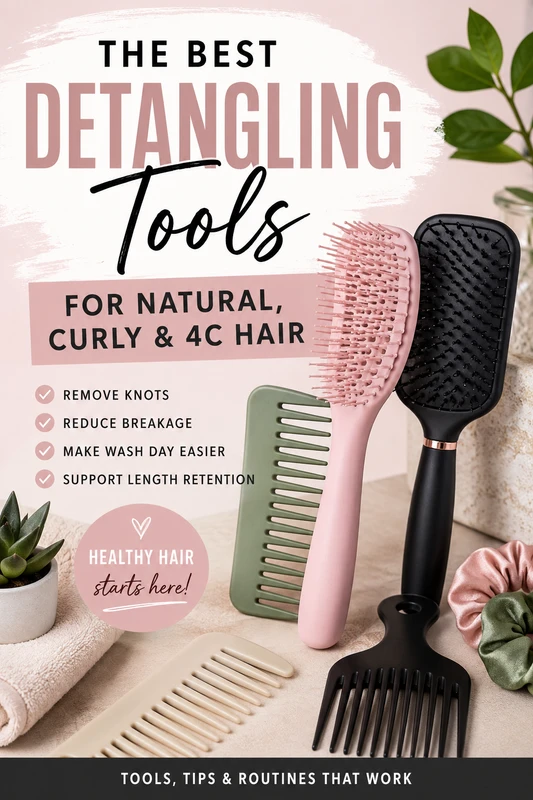
Detangling can be one of the most important—and sometimes most frustrating—parts of caring for natural, curly, coily, and textured hair. Using the wrong tool can turn a normal wash day into a long process filled with snagging, unnecessary shedding, broken strands, and frustration. The right detangling tools, however, can make it much easier to remove knots while helping you preserve length and keep your hair healthy.
The best detangling tools are designed to separate tangled strands without aggressively pulling on the hair. For Black hair in particular, choosing the right tool matters because curls and coils can naturally wrap around one another, creating knots that require patience and proper technique.
Whether you have loose curls, thick 4C coils, long natural hair, children's hair, locs, or you're transitioning from relaxed to natural hair, your detangling method can have a major effect on how your hair looks and feels.
In this complete guide, we'll cover the best detangling tools for natural hair, how each tool works, which tools may work best for different textures, and how to detangle your hair with less breakage.
Table of Contents
- Why the Right Detangling Tool Matters
- What Causes Natural Hair to Tangle?
- What Makes a Good Detangling Tool?
- Fingers
- Wide-Tooth Comb
- Flexible Detangling Brush
- Paddle Brush
- Shower Detangling Brush
- Detangling Comb
- Detangling Pick
- Rat-Tail Comb
- Shampoo Brush and Scalp Massager
- Best Detangling Tools for 4C Hair
- Best Tools for Thick Natural Hair
- Best Tools for Fine Natural Hair
- Best Tools for Curly Hair
- Best Detangling Tools for Kids
- Wet vs. Dry Detangling
- How to Detangle Natural Hair Correctly
- Common Detangling Mistakes
- How Often Should You Detangle?
- How to Prevent Tangles
- Frequently Asked Questions
- Final Thoughts
Why the Right Detangling Tool Matters
Detangling isn't simply about making it possible to run a comb through your hair. The real goal should be to separate tangled strands while minimizing unnecessary stress.
Natural hair can be especially vulnerable to mechanical damage when excessive pulling, brushing, or combing is used.
Every time a tool passes through your hair, some friction occurs.
If the tool repeatedly catches on knots, that friction and tension can contribute to:
- Split ends
- Single-strand knots
- Breakage
- Frizz
- Rough-feeling ends
- Excessive shedding during wash day
- Difficulty retaining length
A good detangling tool should move through the hair gradually rather than ripping through resistance.
Remember: detangling should remove knots—not remove healthy hair.
Why Does Natural Hair Tangle So Easily?
Natural hair often tangles because of its shape.
Straight strands generally have fewer opportunities to wrap around neighboring strands. Curly and coily hair bends and twists repeatedly along the hair shaft.
These bends allow individual strands to interact with each other more frequently.
This becomes even more noticeable with tightly coiled textures.
For example, 4C hair can experience significant shrinkage. As the hair shrinks, strands become more compact and can wrap around neighboring strands.
Tangles can also become worse because of:
- Shed hairs remaining trapped in the hair
- Sleeping with loose hair
- Excessive manipulation
- Dryness
- Split ends
- Rough ends
- Washing hair without sections
- Wearing loose styles for extended periods
- Wind
- Friction from clothing
- Cotton pillowcases
- Product buildup
- Going too long between detangling sessions
One of the main purposes of detangling is actually removing shed hairs.
Humans naturally shed hair. With straight hair, those strands may simply fall away.
With highly textured hair, shed strands can remain caught inside the curls.
During wash day, you may therefore see a noticeable amount of shed hair even when your hair is perfectly healthy.
What Makes a Good Detangling Tool?
The best detangling tool depends on your texture, density, length, styling routine, and personal preference.
However, several characteristics are generally helpful.
Flexible Teeth or Bristles
Flexibility allows a brush to move around difficult knots rather than immediately pulling against them.
This can be particularly useful for thick, curly, and coily hair.
Smooth Edges
Avoid combs with rough seams or damaged teeth.
Tiny rough areas can catch strands and potentially contribute to breakage.
Comfortable Grip
If you have thick or long hair, detangling can take time.
A comfortable handle gives you better control while working through individual sections.
Proper Spacing
The tighter the teeth are positioned together, the more difficult it can be to pass the tool through highly textured hair.
This is why wide-tooth combs are so popular for natural hair.
1. Your Fingers
One of the best detangling tools doesn't cost anything.
Your fingers.
Finger detangling allows you to physically feel knots before applying significant tension.
If you encounter a knot, you can stop and carefully separate the individual strands instead of forcing a comb through them.
This can be extremely beneficial for people focused on length retention.
Benefits of Finger Detangling
Finger detangling can:
- Reduce unnecessary pulling
- Help preserve fragile ends
- Allow you to identify knots
- Give you greater control
- Work well before combing
- Help reduce aggressive manipulation
Finger detangling is particularly useful for tightly coiled natural hair.
How to Finger Detangle
Apply water and a slippery conditioner or detangling product.
Divide your hair into sections.
Start near the ends.
Use your fingers to gently separate large tangles.
Gradually move upward toward the roots.
Once your fingers move through the section relatively easily, you can follow with a wide-tooth comb or detangling brush if needed.
2. Wide-Tooth Comb
The wide-tooth comb is one of the most useful tools you can own if you have natural hair.
Unlike traditional fine-tooth combs, the teeth are spaced farther apart.
That extra space allows thicker sections of curly hair to move between the teeth.
Best For
Wide-tooth combs work particularly well for:
- Natural hair
- 3C hair
- 4A hair
- 4B hair
- 4C hair
- Thick hair
- Long hair
- Transitioning hair
- Wash day detangling
How to Use a Wide-Tooth Comb
Never automatically begin at the roots.
Start at the ends.
Detangle a few inches.
Move slightly higher.
Continue working upward until you've reached the roots.
This technique prevents you from pushing multiple tangles together toward the ends.
3. Flexible Detangling Brush
Flexible detangling brushes have become extremely popular within the natural hair community.
Instead of having completely rigid rows, many versions contain flexible sections or bristles that move as the brush passes through the hair.
This flexibility can make detangling thick hair easier.
Benefits
A flexible detangling brush may:
- Move through curls more easily
- Reduce pulling
- Separate curls
- Help distribute conditioner
- Work through large sections
- Make wash day faster
They're particularly useful when hair is saturated with water and conditioner.
Best For
Flexible brushes are excellent for:
- 3B–4C textures
- Thick natural hair
- Long natural hair
- Wash-and-go routines
- Conditioner distribution
However, even a flexible brush should never be forced through a stubborn knot.
4. Paddle Brush
A paddle brush has a wide, flat surface containing multiple bristles.
It can be useful when detangling long or stretched natural hair.
The larger surface area allows the brush to cover more hair than smaller tools.
However, paddle brushes should generally be used after major tangles have already been removed.
If you immediately run a paddle brush through severely tangled 4C hair, you may experience unnecessary pulling.
Instead, finger detangle first.
Then use the paddle brush for additional smoothing.
5. Shower Detangling Brush
A shower detangling brush is designed to be used around water and conditioner.
This can be one of the easiest ways to detangle curly hair because conditioner provides slip.
Slip allows strands to slide past each other with less resistance.
Ideal Wash-Day Routine
Try:
Water → Conditioner → Finger Detangle → Detangling Brush → Rinse
This combination can significantly simplify the process for many natural hair textures.
Shower brushes can also help distribute deep conditioner throughout the hair.
6. Detangling Comb
Detangling combs are specifically designed with wider or specially positioned teeth to help separate knots.
Some have multiple rows.
Others have curved or flexible teeth.
They're often somewhere between a traditional comb and a detangling brush.
The key is choosing one that does not contain sharp edges.
Run your fingers across the teeth before using it.
If you feel rough plastic seams, those same seams could potentially catch your hair.
7. Detangling Pick
Hair picks are generally associated with creating volume, but a wide pick can also be useful for gently separating certain textures.
A pick shouldn't necessarily be your primary detangling tool.
Instead, it can be useful for:
- Lifting roots
- Separating stretched hair
- Creating volume
- Loosening small sections
- Preparing hair for styling
Avoid aggressively pulling a pick from the roots through tangled ends.
8. Rat-Tail Comb
A rat-tail comb is not the best choice for detangling an entire head of natural hair.
However, it deserves a place in your detangling kit.
Why?
Sectioning.
The pointed end makes it easier to create sections before detangling.
Working in sections is one of the biggest secrets to easier natural hair detangling.
Instead of trying to detangle your entire head at once, create four, six, or eight sections.
Then work on one section at a time.
9. Shampoo Brush or Scalp Massager
A shampoo brush isn't technically a traditional detangling tool, but it can help keep your wash-day routine organized.
Use it primarily on your scalp rather than aggressively dragging it through the length of your hair.
A scalp brush can help distribute shampoo around the scalp while your hair remains divided into sections.
This reduces the temptation to pile your hair on top of your head and scrub—which can create unnecessary tangles.
Best Detangling Tools for 4C Hair
4C hair deserves special attention because its tight coils can shrink significantly and easily wrap around neighboring strands.
For many people with 4C hair, the best detangling routine combines several tools instead of relying on one.
A good combination is:
Fingers + Wide-Tooth Comb + Flexible Detangling Brush
Start with your fingers.
Remove the largest knots.
Next, use the wide-tooth comb.
Finally, use a flexible brush if you want additional definition or smoother detangling.
You may not need all three every wash day.
If finger detangling gets the job done, there's no rule requiring you to brush afterward.
Less manipulation can sometimes be beneficial.
Best Detangling Tools for Thick Natural Hair
Thick natural hair requires tools that can handle larger sections without creating excessive tension.
Consider:
- Flexible detangling brushes
- Large wide-tooth combs
- Large sectioning clips
- Fingers
Sectioning clips are particularly underrated.
If you have extremely dense hair, divide it into six to eight sections.
Twist each completed section before moving to the next one.
This prevents freshly detangled hair from tangling again.
Best Detangling Tools for Fine Natural Hair
Fine hair requires a gentler approach.
Individual fine strands can break more easily when excessive tension is applied.
Finger detangling can therefore be especially helpful.
You can also use a flexible brush, but avoid repeatedly brushing the same section.
If your hair is already detangled, stop brushing.
More brushing doesn't necessarily mean better detangling.
Best Detangling Tools for Curly Hair
Loose and medium curls may respond especially well to detangling brushes.
People with Type 3 curls often use brushes to detangle while simultaneously distributing conditioner and encouraging curl clumping.
A good routine might be:
- Saturate hair with water.
- Apply conditioner.
- Separate hair into sections.
- Finger detangle major knots.
- Brush from ends upward.
- Rinse carefully.
If you want curl definition, you may also use your brush while applying styling products.
Best Detangling Tools for Kids' Natural Hair
Detangling children's hair requires extra patience.
Aggressive detangling can make children dread wash day.
Use gentle tools such as:
- Fingers
- Wide-tooth comb
- Flexible detangling brush
- Sectioning clips
- Spray bottle
Keep the hair damp and slippery.
Work with small sections.
Most importantly, never rush through difficult knots.
If the comb stops moving, stop pulling.
Add more moisture or conditioner and work through the knot with your fingers.
Should You Detangle Natural Hair Wet or Dry?
For many people with curly and coily hair, detangling damp or wet hair with conditioner provides the easiest experience.
The conditioner provides slip while the water makes the hair easier to manipulate.
However, soaking-wet hair can also be more fragile because hair fibers swell when wet.
The goal isn't simply "wet is always better."
The important factor is minimizing resistance and tension.
Some people successfully detangle stretched or slightly damp hair before shampooing.
Others prefer detangling completely in the shower.
Experiment carefully to determine which method results in the least breakage for your hair.
How to Detangle Natural Hair Correctly
Your technique matters just as much as your tools.
Here's a simple detangling routine.
Step 1: Divide Your Hair Into Sections
Create four to eight sections depending on your hair's thickness and length.
Thicker hair generally benefits from more sections.
Step 2: Add Moisture
Lightly mist the section with water if necessary.
Hair that is extremely dry may be harder to manipulate.
Step 3: Apply Conditioner or Detangler
Apply enough product to give the hair slip.
Work it through the section with your hands.
Step 4: Finger Detangle
Separate large knots with your fingers.
Remove visible shed hairs.
Step 5: Hold the Hair
Hold the section several inches above where you're detangling.
This reduces the amount of pulling you feel at the scalp.
Step 6: Start at the Ends
Never begin by aggressively combing from root to tip.
Start with the last few inches.
Once those are detangled, move upward.
Step 7: Slowly Move Toward the Roots
Continue working upward until the tool moves through the entire section.
Step 8: Twist the Section
Once the section is finished, twist or braid it.
This prevents it from tangling again while you work on the rest of your hair.
How to Detangle Matted Natural Hair
Severely tangled or matted hair requires extra patience.
Do not immediately reach for scissors.
First, saturate the tangled area with water and a conditioner with good slip.
Allow the conditioner to sit for several minutes.
Use your fingers to locate the outside edges of the knot.
Slowly remove individual strands from the knot.
Think of it as taking the knot apart rather than trying to pull through it.
Once the knot becomes smaller, use a wide-tooth comb.
If you encounter resistance, return to finger detangling.
Severe matting may require professional assistance, especially if the hair has been tangled for an extended period.
Best Products to Use With Detangling Tools
Tools work better when paired with products that provide lubrication and slip.
Look for products such as:
- Rinse-out conditioner
- Deep conditioner
- Leave-in conditioner
- Detangling spray
- Moisturizing spray
The product should make the hair feel slippery enough that strands can move around one another.
For extremely dry natural hair, adding moisture before attempting to detangle can make a major difference.
Common Detangling Mistakes
Even expensive detangling tools won't help if they're used incorrectly.
Starting at the Roots
This is one of the biggest mistakes.
Starting at the roots pushes existing tangles toward the ends.
You can eventually create one large knot.
Start at the ends instead.
Detangling Huge Sections
The thicker your hair, the smaller your sections should generally be.
Trying to force a brush through half of your hair at once creates unnecessary tension.
Detangling Extremely Dry Hair
Dry hair may have less flexibility and lubrication.
Adding moisture can make manipulation easier.
Using Too Much Force
A brush should not require extreme force.
If the tool stops, there's probably a knot.
Stop.
Remove the tool.
Use your fingers.
Using Damaged Combs
Throw away combs with:
- Broken teeth
- Sharp edges
- Cracks
- Rough seams
Saving a few dollars on an old comb isn't worth damaging your ends.
Rushing
Detangling is one area of natural hair care where speed shouldn't be the only goal.
A 15-minute aggressive detangling session can potentially cause more breakage than a slower, careful routine.
How Often Should You Detangle Natural Hair?
There isn't one perfect schedule.
Many people detangle whenever they wash their hair.
That might mean every:
- 5–7 days
- 7–10 days
- 10–14 days
The ideal frequency depends on your hairstyle.
If you're wearing a wash-and-go, your hair may need more frequent detangling.
If you're wearing two-strand twists, your hair may remain separated longer.
Protective styles such as braids may mean going several weeks without fully detangling the hair.
However, be prepared for more shed hair when the style is removed.
Why You See So Much Hair During Detangling
Seeing hair in your brush can be alarming.
But not everything in your brush represents breakage.
Some of it is naturally shed hair.
The difference can sometimes be identified by examining the strand.
A long strand with a small bulb at one end may have naturally shed from the scalp.
Shorter pieces without a root bulb may indicate breakage.
If you wear protective styles for several weeks, naturally shed hairs can remain trapped inside the hairstyle.
When you finally take the style down, you may see weeks of shed hair at once.
That can make the amount appear unusually large.
How to Prevent Tangles Between Wash Days
Good detangling begins before wash day.
The less tangled your hair becomes during the week, the easier your next wash day can be.
Sleep With Your Hair Protected
Use a satin or silk bonnet, scarf, or pillowcase.
This can reduce friction while you sleep.
Don't Sleep With Loose, Tangled Hair
Consider dividing long natural hair into several twists or braids before bed.
This helps keep individual strands separated.
Keep Hair Moisturized
Dry, rough strands may catch on one another more easily.
Maintain a moisturizing routine that works for your hair.
Protect Your Ends
Your ends are the oldest part of your hair.
They are also particularly vulnerable to knots.
Regular trimming when needed and protective styling can help keep ends manageable.
Avoid Excessive Manipulation
Constantly combing, brushing, restyling, and touching your hair can increase mechanical stress.
You don't necessarily need to detangle your hair every day.
Detangling Tools for Protective Styles
Protective styles require a slightly different approach.
Braids
Before installing braids, thoroughly detangle your natural hair.
After removing braids, finger detangle before shampooing.
This is important because weeks of shed hairs can remain trapped inside the style.
Immediately shampooing heavily tangled hair can potentially make those tangles worse.
Twists
Two-strand twists can help keep natural hair stretched and separated.
When removing twists, carefully separate each section before washing.
Locs
Locs should not be combed or brushed apart like loose natural hair.
If you have locs, your "detangling" routine primarily involves keeping loose hair around the roots managed according to your maintenance method.
Do not attempt to run a traditional detangling brush through mature locs.
Wide-Tooth Comb vs. Detangling Brush
Which is better?
It depends.
Wide-Tooth Comb
Best when you want:
- Simple detangling
- Less contact with individual strands
- Control
- A tool for very thick hair
- Easy cleaning
Detangling Brush
Best when you want:
- Thorough detangling
- Conditioner distribution
- Curl clumping
- Smoothing
- Faster detangling of larger sections
You don't necessarily have to choose.
Many people use both.
Use the wide-tooth comb for major tangles and the brush afterward for additional smoothing.
Finger Detangling vs. Brushes
Finger detangling offers the greatest control.
You can physically feel a knot before pulling through it.
Brushes, however, are much faster.
For many people, the best compromise is combining them.
Finger detangle first → Brush second.
That gives you the precision of finger detangling with the speed of a brush.
Best Detangling Routine for Length Retention
If your goal is growing longer natural hair, focus on retaining the hair you've already grown.
Hair can grow normally from the scalp while appearing to remain the same length because the ends continue breaking.
Reducing unnecessary detangling damage may improve length retention.
Try this routine:
Step 1: Divide hair into six sections.
Step 2: Apply water.
Step 3: Apply a conditioner or moisturizing detangler.
Step 4: Finger detangle.
Step 5: Remove shed hairs.
Step 6: Use a wide-tooth comb from ends to roots.
Step 7: Use a flexible brush only if necessary.
Step 8: Twist the completed section.
Step 9: Repeat.
Step 10: Handle your ends carefully during styling.
The objective isn't to eliminate every single broken strand forever.
Some breakage is inevitable.
The objective is reducing unnecessary breakage.
How Long Should Detangling Take?
Detangling time varies dramatically.
Someone with short, loose curls might finish in five minutes.
Someone with waist-length, dense 4C hair might need considerably longer.
Factors include:
- Hair length
- Density
- Texture
- Shrinkage
- Previous hairstyle
- Time since last detangling
- Amount of shed hair
- Product buildup
- Moisture level
Instead of focusing on speed, focus on efficiency.
A good detangling routine should become easier as you learn how your hair behaves.
Do Expensive Detangling Brushes Work Better?
Not necessarily.
Price doesn't automatically determine how gentle a tool will be.
A relatively inexpensive wide-tooth comb can be one of the most effective tools in your entire natural hair routine.
Pay more attention to:
- Tooth spacing
- Flexibility
- Smoothness
- Handle comfort
- Durability
- How your hair responds
The best brush is the one that gets through your hair with minimal snagging and unnecessary breakage.
How to Clean Detangling Tools
Clean tools are an overlooked part of healthy hair care.
Brushes and combs collect:
- Shed hair
- Conditioner
- Oils
- Styling products
- Dead skin
- Dust
- Product residue
Remove trapped hair after each major detangling session.
Periodically wash your combs and appropriate brushes with warm water and gentle soap.
Allow them to dry completely.
Follow the manufacturer's cleaning instructions for brushes containing special materials or cushioned bases.
When Should You Replace a Detangling Tool?
Replace your comb or brush when you notice:
- Missing teeth
- Bent teeth
- Sharp edges
- Cracked plastic
- Loose bristles
- Damaged handles
- Rough surfaces
Run your fingertips across your comb occasionally.
If something feels sharp enough to scratch your skin, you probably don't want it repeatedly rubbing against your hair.
Frequently Asked Questions About Detangling Tools
What Is the Best Detangling Tool for Natural Hair?
For many people, a combination of finger detangling, a wide-tooth comb, and a flexible detangling brush works well.
The best option ultimately depends on your texture and density.
What Is the Best Detangling Tool for 4C Hair?
Finger detangling and wide-tooth combs are excellent starting points for 4C hair.
Flexible detangling brushes can also work well when the hair is properly moisturized and divided into sections.
Should I Comb 4C Hair Every Day?
Generally, there's no need to completely comb and detangle 4C hair every day.
Excessive manipulation can increase mechanical stress.
Is a Brush or Comb Better for Natural Hair?
Neither is automatically better.
Wide-tooth combs provide excellent control, while flexible brushes may provide faster and more thorough detangling.
Should I Detangle Before Shampooing?
This can be especially helpful when taking down braids, twists, or another long-term protective style.
Removing trapped shed hairs before shampooing may prevent additional tangling.
Should I Detangle With Conditioner?
Many people find conditioner makes detangling much easier because it provides slip.
Can I Detangle Dry Natural Hair?
You can, but extremely dry natural hair may be more difficult to manipulate.
Many people prefer damp hair or hair coated with a slippery product.
Why Does My Hair Keep Knotting After I Detangle It?
Common reasons include shrinkage, loose styling, split ends, sleeping without protecting the hair, dryness, or failing to secure completed sections.
Twisting each detangled section can help.
How Can I Detangle Faster?
Use more sections, keep the hair adequately moisturized, finger detangle major knots first, and prevent tangles between wash days.
Does Detangling Help Hair Grow?
Detangling doesn't directly increase the biological rate of hair growth.
However, gentler detangling can help reduce breakage, which may improve length retention.
When you retain more of the hair you're growing, your hair may become noticeably longer over time.
The Best Detangling Tools: Final Ranking
If you're building a complete natural hair detangling kit, prioritize these tools:
1. Fingers — Best Overall for Gentle Detangling
Nothing gives you more control over knots than your own fingers.
2. Wide-Tooth Comb — Best Essential Tool
Affordable, simple, and effective for virtually every natural hair routine.
3. Flexible Detangling Brush — Best for Thick Hair
Excellent for quickly working through curls and coils when used with plenty of slip.
4. Shower Detangling Brush — Best for Wash Day
Ideal for detangling while conditioner is in the hair.
5. Paddle Brush — Best for Stretched Hair
Useful for smoothing longer, already partially detangled hair.
6. Sectioning Clips — Best Supporting Tool
Technically not a detangler, but they make the entire process much easier.
7. Rat-Tail Comb — Best for Creating Sections
Perfect for organizing the hair before detangling and styling.
Final Thoughts: Finding the Best Detangling Tool for Your Hair
Finding the best detangling tools for natural hair doesn't have to mean purchasing an entire collection of expensive brushes.
Start with the basics.
Your fingers and a quality wide-tooth comb can handle a significant portion of the job.
If you have thick, long, curly, or 4C hair, adding a flexible detangling brush can make wash day easier and faster.
But remember that the tool is only part of the equation.
Your technique matters even more.
Work in sections. Add moisture. Use a product with plenty of slip. Start at your ends. Move toward your roots. Stop whenever you encounter resistance instead of forcing your way through the knot.
Healthy natural hair isn't just about how quickly your hair grows. It's also about how much of that growth you're able to keep.
By reducing unnecessary breakage during detangling, you can protect your ends, improve length retention, make wash day easier, and maintain healthier-looking natural hair.
Whether you're caring for loose curls, thick 4C coils, children's natural hair, or transitioning hair, the best detangling routine is ultimately the one that leaves more hair on your head and less hair in your brush.