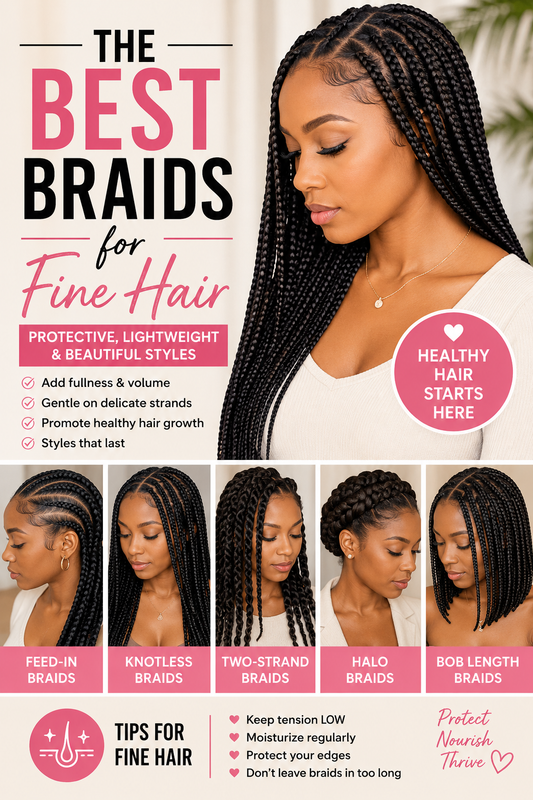
If you have fine hair, choosing the right braided hairstyle can make a huge difference. The wrong braid style can place excessive tension on delicate strands, causing breakage, thinning edges, and unnecessary hair loss. On the other hand, the best braids for fine hair protect your strands, create the illusion of fullness, and allow your hair to retain moisture while it grows.
Fine hair doesn't mean you can't enjoy beautiful protective styles. In fact, many braid styles work exceptionally well for people with naturally fine, low-density, or thinning hair—as long as they're installed correctly.
In this complete guide, you'll learn:
- The best braid styles for fine hair
- Which braids to avoid
- How to prepare fine hair before braiding
- Tips for making braids look fuller
- How long to keep braids installed
- Daily maintenance routines
- Ways to prevent traction alopecia
- Hair care products that support healthy braided hair
Whether your hair is natural, relaxed, transitioning, or color-treated, these tips can help you enjoy braids while protecting every strand.
What Is Fine Hair?
Many people confuse fine hair with thin hair.
They're actually different.
Fine hair refers to the diameter of each individual strand.
Each strand is smaller in width than medium or coarse hair.
Fine hair often:
- Feels silky
- Breaks easier
- Gets oily faster
- Doesn't hold volume long
- Requires gentle handling
Someone can have:
- Fine but thick hair
- Fine and low-density hair
- Fine curly hair
- Fine 4C hair
- Fine locs
Understanding your hair type helps determine the safest braid style.
Why Protective Braids Help Fine Hair
Proper protective styles can:
- Reduce daily manipulation
- Prevent split ends
- Lock in moisture
- Protect fragile ends
- Minimize friction
- Reduce tangles
- Encourage length retention
The key is choosing lightweight styles instead of heavy braids.
Characteristics of the Best Braids for Fine Hair
The best braid styles should:
✓ Feel lightweight
✓ Use medium or small sections
✓ Have minimal tension
✓ Avoid excessive added hair
✓ Protect fragile edges
✓ Be comfortable immediately
If your scalp hurts after braiding, the style is too tight.
Pain is never normal.
1. Knotless Braids
Knotless braids are one of the safest options for fine hair.
Unlike traditional box braids, knotless braids begin with your natural hair before extension hair is gradually added.
Benefits include:
- Less scalp tension
- Natural movement
- Reduced pulling
- Lightweight feel
- Lower risk of breakage
Medium knotless braids work especially well.
Avoid extremely long or extra-large knotless braids because they become heavy.
2. Small Box Braids
Small box braids distribute weight more evenly than jumbo braids.
Advantages include:
- Less tension per section
- Fuller appearance
- Longer-lasting style
- Easy scalp access
- Lightweight
Fine-haired individuals should avoid making sections too tiny because extremely small sections may still experience tension.
3. Halo Braids
Halo braids use your natural hair wrapped around the head.
Benefits:
- Elegant appearance
- No heavy extensions
- Low manipulation
- Great for special occasions
- Protective overnight style
4. Crown Braids
Crown braids create volume while protecting fragile ends.
Because they rely mostly on natural hair, they're gentle on delicate strands.
5. Feed-In Braids
Feed-in braids gradually add extension hair.
This creates:
- Natural-looking hairline
- Less stress
- Reduced tension
- Fuller appearance
Feed-in cornrows are excellent for people with thinning edges.
6. Medium Cornrows
Cornrows can be safe when installed properly.
Choose:
- Medium size
- Loose tension
- Minimal extension hair
Avoid extra-tight "snatched" braids.
7. Two-Strand Braids
Simple natural hair braids without extensions are perfect for fine hair.
Advantages:
- Extremely lightweight
- Minimal breakage
- Easy maintenance
- Great moisture retention
8. Goddess Braids (Lightweight Version)
Traditional goddess braids can become heavy.
Instead, choose:
- Fewer extensions
- Medium length
- Lightweight synthetic hair
9. Bob-Length Braids
Long braids increase weight dramatically.
Bob-length braids:
- Reduce tension
- Feel lighter
- Swing naturally
- Protect ends
10. Mini Braids
Mini braids created using only natural hair help retain length while avoiding extension weight.
Many natural hair enthusiasts wear mini braids for several weeks.
Braids to Avoid with Fine Hair
Some styles can place excessive stress on delicate strands.
Avoid:
Jumbo Braids
Heavy sections increase pulling.
Waist-Length Braids
Length equals more weight.
Tight Traditional Box Braids
Knots create immediate tension.
Oversized Goddess Braids
Heavy extensions strain follicles.
Braids with Large Beads
Beads add unnecessary weight.
How to Prepare Fine Hair Before Braiding
Healthy preparation reduces breakage.
Clarify
Remove product buildup.
Deep Condition
Hydrated hair bends instead of snapping.
Trim Ends
Healthy ends braid better.
Moisturize
Use water-based products before installation.
Stretch Hair Gently
Stretched hair braids more smoothly.
How Tight Should Braids Be?
The answer is simple:
Not tight at all.
Signs your braids are too tight:
- Headaches
- Red bumps
- Scalp soreness
- Difficulty sleeping
- Hairline pain
Ask your stylist to loosen the tension immediately.
Choosing the Right Braiding Hair
Select lightweight synthetic fibers.
Avoid:
- Excessively thick bundles
- Heavy extension packs
- Multiple packs per braid
Less weight equals healthier follicles.
How Long Should Fine Hair Stay in Braids?
Ideal timeframe:
4–6 weeks
Leaving braids in too long can cause:
- Tangling
- Breakage
- Dryness
- Shedding buildup
Moisturizing Braids
Fine hair still needs moisture.
Try this routine:
2–4 times weekly
Mist with:
- Water
- Aloe vera juice
- Leave-in conditioner
Seal lightly using natural oils.
Sleep Protection
Always protect braided hair at night.
Use:
- Satin bonnet
- Silk scarf
- Satin pillowcase
These reduce friction and moisture loss.
Keep Your Scalp Healthy
Healthy hair begins with a healthy scalp.
Wash your scalp every 2–3 weeks using a diluted shampoo.
Follow with:
- Lightweight conditioner
- Moisturizing spray
Avoid scratching aggressively.
Foods That Support Strong Hair
Nutrition matters.
Eat foods rich in:
Protein
Eggs
Fish
Beans
Spinach
Sweet potatoes
Avocados
Nuts
Seeds
Vitamin C-rich fruits
Iron-rich vegetables
Hydration is equally important.
Common Mistakes with Fine Hair Braids
Many people unknowingly damage their hair.
Avoid these mistakes:
- Braiding wet hair
- Tight installations
- Heavy extensions
- Wearing braids too long
- Ignoring scalp buildup
- Skipping moisturizing
- Pulling styles into tight buns
- Sleeping without satin protection
Can Braids Make Fine Hair Look Thicker?
Yes.
Braids create the illusion of density by:
- Adding structure
- Increasing texture
- Creating volume
- Reducing flatness
- Enhancing fullness
Choosing the right braid size makes an enormous difference.
Hair Growth While Wearing Braids
Braids don't directly make hair grow faster.
Instead, they help retain length by reducing:
- Daily manipulation
- Breakage
- Split ends
- Mechanical damage
Healthy retention creates the appearance of faster growth.
Fine Hair Maintenance Routine
Morning
- Check scalp
- Apply light moisturizing spray if needed
- Avoid pulling hair tightly
Evening
- Moisturize lightly
- Wear satin bonnet
- Massage scalp gently
Weekly
- Refresh moisture
- Clean scalp if needed
- Check braid tension
Frequently Asked Questions
Are knotless braids better for fine hair?
Yes. Knotless braids typically place less stress on the scalp than traditional box braids.
Can fine hair handle extensions?
Yes, when lightweight extension hair is used in moderation.
Should fine hair get jumbo braids?
Generally no. Jumbo braids can be too heavy for delicate strands.
Do braids help hair grow?
Braids support length retention by protecting hair from everyday damage.
How often should I moisturize braided fine hair?
Usually 2–4 times each week, depending on your hair's needs and climate.
Can braids cause hair loss?
Only if they are installed too tightly, worn too long, or are excessively heavy.
Final Thoughts
Fine hair deserves protective styles that prioritize health over tension. The best braids for fine hair are lightweight, comfortable, and installed with care. Styles such as knotless braids, medium box braids, feed-in braids, halo braids, and natural mini braids can help protect fragile strands while creating the appearance of fuller, thicker hair.
Remember that healthy hair starts before the braids are installed. Cleanse, deep condition, moisturize, and trim your hair regularly. During your protective style, keep your scalp clean, hydrate your hair, and avoid excessive tension. With consistent care, braids can become an effective part of a long-term hair care routine that promotes stronger, healthier hair and excellent length retention.