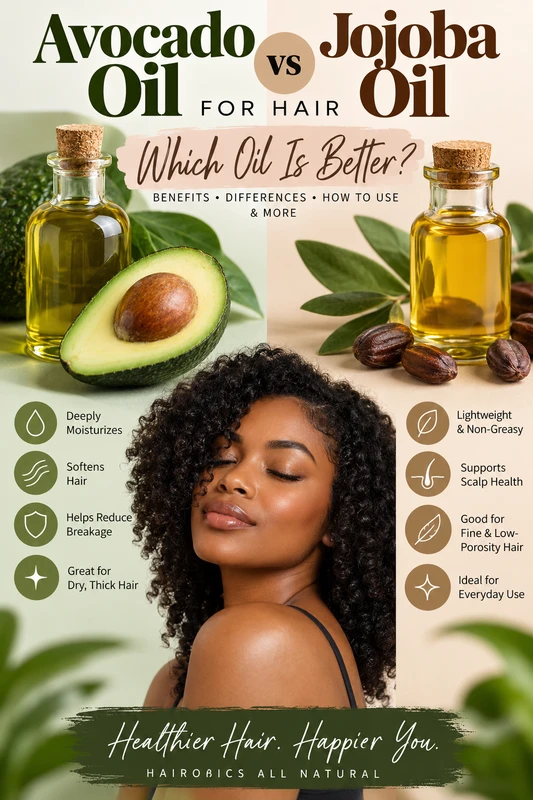
When it comes to caring for natural hair, choosing the right oil can make a major difference in how your hair feels, looks, and retains moisture. Two oils that frequently appear in natural hair routines are avocado oil and jojoba oil.
Both can be useful for dry hair, curly hair, coily hair, protective styles, and scalp care, but they aren't identical.
Avocado oil is a rich plant oil that can help soften hair, reduce friction, and seal in moisture. Jojoba oil is technically a liquid wax ester and is especially popular because its lightweight texture works well for both the hair and scalp.
So when comparing avocado oil vs jojoba oil for hair, which one should you choose?
The answer depends on your hair's porosity, density, dryness level, styling routine, and what you're trying to accomplish.
In this complete guide, we'll compare avocado oil and jojoba oil for natural hair, dry hair, scalp care, breakage prevention, low- and high-porosity hair, protective styles, and more.
What Is Avocado Oil?
Avocado oil is produced from the flesh of the avocado fruit. Unlike many plant oils that are extracted primarily from seeds, avocado oil comes largely from avocado pulp.
It contains fatty acids, particularly oleic acid, along with smaller amounts of linoleic acid and other naturally occurring compounds.
For hair care, avocado oil is valued primarily as an emollient and sealing oil.
It can coat the hair shaft, improve softness, reduce friction between strands, and help slow the loss of moisture from the hair.
This can be particularly useful for naturally curly and coily hair because the structure of textured hair can make it more difficult for natural scalp oils to travel from the roots to the ends.
The ends may therefore become dry even when the scalp isn't.
Avocado oil can be used to provide additional lubrication and softness to these vulnerable areas.
What Is Jojoba Oil?
Jojoba oil comes from the seeds of the jojoba plant, Simmondsia chinensis.
Although we commonly call it an oil, jojoba oil is technically composed largely of liquid wax esters.
This gives jojoba some characteristics that distinguish it from traditional plant oils.
Jojoba oil is typically lightweight, smooth, and easy to distribute. It can be applied to the scalp, hair, or ends without necessarily creating the heavy coated feeling associated with thicker oils.
This makes it especially appealing to people who want the benefits of an emollient without weighing their hair down.
Jojoba oil is frequently found in scalp oils, conditioners, leave-in products, hair serums, and moisturizers.
Avocado Oil vs Jojoba Oil for Hair: Quick Comparison
Although both oils can have a place in a healthy hair routine, they often work best for different purposes.
Avocado oil tends to be better suited for:
- Very dry hair
- Thick natural hair
- High-porosity hair
- Dry ends
- Sealing moisture
- Pre-shampoo treatments
- Reducing friction
- Adding softness to coarse-feeling hair
Jojoba oil tends to be better suited for:
- Lightweight sealing
- Scalp application
- Fine or low-density hair
- Low-porosity hair
- Protective styles
- Frequent application
- People who dislike heavy oils
- Refreshing dry hair between wash days
Neither oil is automatically "better." Your ideal choice depends on your hair.
Is Avocado Oil Good for Natural Hair?
Avocado oil can be an excellent addition to a natural hair routine, particularly when dryness is one of your biggest concerns.
Curly and coily hair often needs additional lubrication because the bends and curves in the strand increase friction.
Hair strands rub against one another, clothing, pillows, combs, brushes, and styling tools.
Over time, excessive friction can contribute to tangling and mechanical breakage.
Applying a small amount of avocado oil after a water-based moisturizer or leave-in conditioner can help create a smoother surface.
This may make the hair feel softer and more manageable.
However, remember an important distinction:
Oil isn't the same thing as moisture.
Water provides hydration. Oil primarily helps condition the hair and reduce moisture loss.
If your natural hair is extremely dry, pouring more avocado oil onto already dehydrated hair may leave you with hair that feels oily but still dry underneath.
A better approach is often:
Water or water-based leave-in → moisturizer/conditioner → small amount of avocado oil.
Is Jojoba Oil Good for Natural Hair?
Jojoba oil is also an excellent option for natural hair, especially when you want something lighter.
Some natural hair routines become unnecessarily complicated because people apply multiple heavy products on top of one another.
For example:
Leave-in conditioner.
Then cream.
Then butter.
Then oil.
Then gel.
While layering products can work for some people, others end up with greasy, dull, or weighed-down hair.
Jojoba oil offers an alternative for people who want to seal their hair without applying a particularly heavy layer.
A few drops can often be distributed over a relatively large section of hair.
This makes jojoba particularly useful for refreshing twists, braids, curls, locs, or other styles between wash days.
Avocado Oil vs Jojoba Oil for Dry Hair
For extremely dry hair, avocado oil may have the advantage.
Its richer feel can provide additional lubrication and softness to hair that feels rough or brittle.
Suppose your hair feels soft immediately after moisturizing but becomes rough several hours later.
Your problem may not necessarily be that you're using the wrong moisturizer.
Your hair may simply be losing water quickly.
After moisturizing, applying a small amount of avocado oil can create an additional layer that helps slow moisture loss.
Jojoba can perform a similar role but generally feels lighter.
That makes jojoba attractive for mildly dry hair or hair that becomes greasy easily.
Think of the difference this way:
Very dry, thick hair: avocado oil may feel better.
Slightly dry or easily weighed-down hair: jojoba may feel better.
Avocado Oil vs Jojoba Oil for Hair Growth
This is where it's important to separate hair-care benefits from exaggerated internet claims.
Neither avocado oil nor jojoba oil should be viewed as a guaranteed treatment that suddenly makes hair follicles produce dramatically faster growth.
Human scalp hair typically grows gradually, and growth rates vary among individuals.
However, your ability to retain the hair you grow matters enormously when you're trying to achieve longer hair.
Imagine your scalp produces six inches of new growth over a period of time, but several inches repeatedly break from the ends.
It may appear that your hair "isn't growing."
In reality, the problem may be length retention.
Both avocado and jojoba oil can contribute to a hair-care routine designed to reduce dryness, friction, and unnecessary manipulation.
That may indirectly support your length-retention goals.
So instead of asking:
"Which oil makes hair grow fastest?"
A better question is:
"Which oil helps me maintain healthier-feeling hair and retain more of the length I'm already growing?"
That is a much more realistic way to evaluate hair oils.
Which Oil Is Better for Hair Breakage?
If your hair frequently breaks because it is extremely dry, avocado oil may be particularly helpful as part of a moisture-retention routine.
Dry strands tend to have less flexibility.
When you comb, brush, twist, braid, or manipulate them, they can snap more easily.
Lubrication is especially important during detangling.
Applying conditioner or a detangling product first, followed by a small amount of oil when appropriate, can reduce friction between your fingers, comb, and strands.
Jojoba oil can also help with lubrication.
The advantage of jojoba is that you can often apply it more frequently without making your hair feel as heavily coated.
Remember, however, that persistent or severe breakage can have many causes. Oil alone isn't always the solution.
Avocado Oil vs Jojoba Oil for Low-Porosity Hair
Low-porosity hair often requires a slightly different approach.
The cuticle layers tend to resist water penetration, and excessive product layering can leave low-porosity hair feeling coated.
People with low-porosity hair commonly complain that products seem to sit on top of their hair.
If that describes you, jojoba oil may be the easier option.
Its relatively lightweight feel makes it easier to use sparingly.
Start with only a few drops.
Rub them between your palms and gently smooth them over damp, moisturized hair.
Avocado oil isn't forbidden for low-porosity hair.
The key is quantity.
If you love avocado oil but your hair becomes greasy easily, try applying dramatically less.
You don't need your hair to look oily for an oil to be useful.
Avocado Oil vs Jojoba Oil for High-Porosity Hair
High-porosity hair often loses moisture relatively quickly.
The cuticle may be more raised or damaged, allowing water to move into and out of the strand more readily.
This is where richer products can sometimes be useful.
Avocado oil may be particularly suitable for high-porosity hair because of its richer texture.
Try applying it after a moisturizing leave-in or cream.
Pay particular attention to the ends.
Jojoba oil can still work for high-porosity hair, especially if you prefer lighter products.
Some people even combine the two.
For example, you could use jojoba oil primarily on your scalp and a richer oil such as avocado oil on your ends.
Which Is Better for the Scalp?
For regular scalp application, many people will find jojoba oil more convenient.
One reason is its texture.
Applying thick layers of heavy oils directly to the scalp can contribute to buildup, especially if you're applying oil repeatedly without cleansing the scalp adequately.
Jojoba oil's lightweight consistency makes controlled application easier.
That doesn't mean avocado oil can't be used on the scalp.
It certainly can.
But if you have fine hair, an oily scalp, or easily clogged-up roots, jojoba may be the more comfortable choice.
And remember:
A dry scalp isn't always caused by a lack of oil.
Flaking and itching can have numerous causes, including irritation, product buildup, dandruff, and certain scalp conditions.
If scalp symptoms are persistent, severe, painful, or accompanied by hair loss, consider speaking with a dermatologist rather than repeatedly applying more oil.
Avocado Oil vs Jojoba Oil for Black Hair
Both oils can be useful for Black hair.
The question is less about ethnicity itself and more about your individual hair characteristics.
Black hair encompasses an enormous range of:
Curl patterns.
Densities.
Porosities.
Strand thicknesses.
Scalp conditions.
Styling habits.
Someone with fine, low-density 3C hair may have completely different product needs from someone with dense, coarse-feeling 4C hair.
For thicker, extremely dry natural hair, avocado oil may provide the richer coating you prefer.
For finer natural hair or people who want something light enough for frequent use, jojoba may be ideal.
Which Oil Is Better for 4C Hair?
There is no single oil that every person with 4C hair needs.
However, many people with tightly coiled hair struggle with dryness and tangling.
The ends can be especially vulnerable.
Avocado oil can work beautifully when applied over a moisturizing leave-in conditioner.
For example:
Wash and condition your hair.
Apply a water-based leave-in.
Work in sections.
Apply a small amount of avocado oil, concentrating on the ends.
Then style your hair into twists, braids, or another low-manipulation style.
If your 4C hair is fine or becomes weighed down easily, substitute jojoba oil.
Your curl pattern alone shouldn't determine your product routine.
Avocado Oil vs Jojoba Oil for Fine Hair
Jojoba usually has an advantage for fine hair because it tends to feel lighter.
Fine strands can become weighed down surprisingly quickly.
Too much oil can make the hair appear flat and greasy.
If you have fine hair, try placing only two or three drops of jojoba oil in your palms.
Rub your hands together.
Then lightly smooth them over your ends.
You can always add more.
Removing excess oil is much more difficult.
Avocado Oil vs Jojoba Oil for Thick Hair
Thick, dense hair may tolerate avocado oil extremely well.
When you have a large amount of hair, distributing enough product to keep all sections manageable can be challenging.
A richer oil can help provide lasting softness.
Apply it section by section instead of pouring oil over your entire head.
This ensures more even distribution while reducing waste.
Which Oil Is Better for Hair Ends?
If your ends are constantly dry, rough, and prone to tangling, try avocado oil.
Your ends are the oldest portion of your hair.
If you have long natural hair, those ends may have experienced years of washing, detangling, styling, environmental exposure, and friction.
They deserve special attention.
After moisturizing your hair, smooth a small amount of avocado oil onto the final few inches.
Jojoba oil is an excellent alternative when you want to refresh your ends frequently without excessive buildup.
Avocado Oil vs Jojoba Oil for Braids
Both oils can work with braids, but jojoba oil may be easier for routine use.
When you're wearing box braids, knotless braids, feed-in braids, or similar protective styles, you don't want to continuously saturate the scalp with heavy products.
That can contribute to buildup.
Instead, keep your routine simple.
Cleanse when needed.
Use a lightweight moisturizing spray on the exposed natural hair when appropriate.
Then apply a small amount of jojoba oil if you want additional lubrication.
If the ends of your natural hair inside the braids are especially dry, avocado oil can be useful during the initial braid preparation process.
Avocado Oil vs Jojoba Oil for Locs
Locs require careful product selection because excessive buildup can become difficult to remove from the interior of mature locs.
For that reason, lighter products are often preferred.
Jojoba oil can be a useful choice for the scalp because only a small amount is necessary.
Avocado oil can still be used, but moderation becomes especially important.
Avoid saturating locs with large amounts of oil.
Your locs shouldn't have to feel greasy in order to feel soft.
And remember that oil doesn't replace water.
If your locs feel dry, a water-based moisturizing spray may be more useful than simply adding another layer of oil.
Can You Use Avocado Oil as a Pre-Poo?
Yes.
Avocado oil can work well as part of a pre-shampoo treatment.
A pre-poo is applied before shampooing to help reduce the stripped or rough feeling that some people experience after cleansing.
You can apply a modest amount of avocado oil to the lengths and ends before washing.
Let it sit while you prepare for wash day.
Then shampoo your scalp and hair normally.
This technique may be particularly useful for hair that becomes extremely tangled during washing.
Can You Use Jojoba Oil as a Pre-Poo?
Yes, although its lightweight nature means it may not provide the same rich coating as avocado oil.
If your hair is fine or doesn't tolerate heavy oils, that can actually be an advantage.
Apply jojoba oil primarily to your ends before shampooing.
Then wash and condition normally.
Experiment with both oils and observe how your hair responds.
Can You Mix Avocado Oil and Jojoba Oil?
Absolutely.
You don't necessarily have to choose only one.
Combining avocado and jojoba oils can give you a balance between richness and spreadability.
For example, you might combine:
1 part avocado oil + 1 part jojoba oil.
If that's too heavy, increase the jojoba proportion.
If it's too light, increase the avocado portion.
However, don't assume that combining more oils automatically produces better results.
A simple routine that you use consistently is usually more practical than mixing ten different oils together.
How to Use Avocado Oil on Natural Hair
One of the easiest methods is using avocado oil as the final step after moisturizing.
Step 1: Start With Clean Hair
Product buildup can prevent your hair from responding the way you expect.
Wash your hair according to your normal schedule.
Step 2: Add Water-Based Moisture
Apply a leave-in conditioner or moisturizer.
Work in sections to ensure even coverage.
Step 3: Add Avocado Oil
Put a small amount in your palm.
Rub your hands together.
Smooth it over each section.
Step 4: Concentrate on the Ends
Your ends usually need more protection than your roots.
Step 5: Style
Twists, braids, buns, and other low-manipulation styles can help reduce unnecessary handling.
How to Use Jojoba Oil on Natural Hair
Jojoba oil can be used in a similar way.
Apply your water-based moisturizer first.
Then use a few drops of jojoba oil.
Because jojoba spreads easily, start with less than you think you'll need.
You can use it on:
Your ends.
Your hairline.
Your scalp.
Twists.
Braids.
Locs.
Wash-and-go styles.
Protective styles.
The key is moderation.
Should You Put Avocado or Jojoba Oil on Wet or Dry Hair?
For moisture retention, slightly damp or freshly moisturized hair is generally the more logical time to apply oil.
Why?
Because you're trying to retain existing moisture.
Putting oil on completely dehydrated hair doesn't magically introduce significant water into the strand.
Think about oil as a finishing step rather than your primary source of hydration.
A simple routine could look like this:
Water → leave-in conditioner → oil.
However, tiny amounts of oil can also be applied to dry hair for shine, lubrication, or reducing friction.
How Often Should You Use Hair Oil?
There is no universal schedule.
Some people may need a small amount several times per week.
Others may need oil only after wash day.
Pay attention to your hair.
If it feels dry, first determine whether it needs water/moisture rather than simply more oil.
If your hair feels greasy, coated, limp, or unusually dull, you may be using too much.
More isn't automatically better.
Signs You're Using Too Much Oil
Your hair may feel:
Greasy.
Heavy.
Sticky.
Coated.
Dull.
Difficult to moisturize.
Your curls may lose definition.
Your scalp may also accumulate product more quickly.
If this happens, don't continue adding additional products in an attempt to fix the problem.
Cleanse your hair and simplify your routine.
Which Oil Is Better for Winter?
Cold weather, indoor heating, and low humidity can contribute to dry-feeling hair.
During winter, some people prefer richer products.
Avocado oil can therefore be an excellent seasonal option.
You might use a richer leave-in conditioner followed by a thin layer of avocado oil, concentrating on your ends.
If avocado becomes too heavy, switch to jojoba.
Which Oil Is Better for Summer?
During hot weather, many people prefer lighter products.
Jojoba oil can be particularly useful during summer because it can provide lubrication without making the hair feel excessively coated.
However, climate matters.
Someone living in a very dry climate may still prefer avocado oil year-round.
Avocado Oil vs Jojoba Oil for Detangling
Neither oil should necessarily replace a proper detangling conditioner.
However, both can add lubrication.
If your hair is extremely thick, dry, and tangled, avocado oil may provide more slip.
For fine hair or lighter tangles, jojoba may be enough.
Always detangle patiently.
Work in manageable sections.
Start at the ends and gradually work upward.
Avoid ripping a comb through knots.
Your technique matters just as much as the product.
Which Oil Is Better for Protective Styles?
Jojoba oil has a slight advantage for ongoing protective-style maintenance because of its lighter texture.
When hair is braided, twisted, or loc'd, repeatedly applying thick products can cause buildup.
Jojoba allows you to use very small amounts.
Avocado oil may be better before installing the protective style.
Moisturize your natural hair thoroughly and seal the ends before braiding.
This gives your hair a solid moisture foundation before it is tucked away.
Avocado Oil vs Jojoba Oil for Softness
If your primary goal is making extremely dry, coarse-feeling hair softer, avocado oil is worth trying first.
Its richer texture can leave strands feeling smoother and more conditioned.
If your hair already feels relatively soft but you want additional shine and lubrication, jojoba may be all you need.
Which Oil Gives More Shine?
Both can increase the appearance of shine by smoothing and coating the hair surface.
Jojoba often creates a lighter sheen.
Avocado can create a richer appearance when used appropriately.
But shine shouldn't be confused with hydration.
Hair can look shiny and still be dehydrated.
Likewise, healthy textured hair doesn't necessarily have to look extremely glossy.
Avocado Oil vs Jojoba Oil: Which Is Better for Your Hair?
Here's a simple way to decide.
Choose Avocado Oil If:
Your hair is extremely dry.
Your strands feel rough.
Your hair is thick or dense.
You have high-porosity hair.
Your ends lose moisture quickly.
You want a richer sealing oil.
You want an oil for pre-poo treatments.
Choose Jojoba Oil If:
Your hair becomes greasy easily.
You have fine hair.
You have low-porosity hair.
You want a lightweight scalp oil.
You wear braids or locs frequently.
You want something for regular use.
You dislike heavy product buildup.
Consider Using Both If:
Your scalp prefers lightweight oils but your ends need something richer.
You could apply jojoba oil sparingly to your scalp while using avocado oil on the oldest, driest parts of your hair.
Common Mistakes When Using Hair Oils
Mistake #1: Using Oil Instead of Moisturizer
Oil isn't a substitute for water.
If your hair is dehydrated, start with moisture.
Mistake #2: Applying Too Much
Natural hair doesn't need to be drenched in oil.
Start small.
Mistake #3: Ignoring Product Buildup
Oils accumulate.
Regular cleansing remains important.
Mistake #4: Assuming Oil Automatically Causes Hair Growth
Hair growth begins inside the follicle.
Oils can support a healthy hair-care routine, but they shouldn't be marketed or treated as guaranteed miracle growth products.
Mistake #5: Ignoring Your Hair Type
A product your favorite influencer loves may be terrible for your hair.
Pay attention to your own results.
Frequently Asked Questions About Avocado Oil vs Jojoba Oil
Is avocado oil heavier than jojoba oil?
Avocado oil generally feels richer and heavier on the hair than jojoba oil.
Jojoba is often preferred when a lightweight finish is desired.
Can I leave avocado oil in my hair overnight?
Some people use avocado oil as an overnight pre-shampoo treatment. However, leaving oils on longer isn't necessarily more effective. If overnight treatments irritate your scalp or make cleansing difficult, shorten the treatment.
Can I leave jojoba oil in my hair?
Yes. Small amounts of jojoba oil are commonly used as a leave-in finishing oil.
Can jojoba oil be used every day?
It can be, but daily use isn't automatically necessary. If your hair remains soft and your scalp feels comfortable, there's no need to keep adding oil simply because another day has passed.
Does avocado oil moisturize hair?
Avocado oil primarily acts as an emollient and helps reduce moisture loss. For actual hydration, use water or a water-based product first.
Does jojoba oil moisturize hair?
Jojoba oil can help hair feel softer and reduce moisture loss, but it shouldn't replace water-based hydration.
Which oil is better for dry ends?
Avocado oil may be preferable for extremely dry ends because of its richer texture.
Which oil is better for oily hair?
Jojoba is often the more practical choice because it can be used very sparingly.
Can I put either oil directly on my scalp?
Yes, provided your scalp tolerates it. Use a small amount and maintain a regular cleansing routine.
Can avocado and jojoba oil repair split ends?
No oil can permanently fuse a genuinely split hair strand back together. Oils may temporarily smooth the appearance and reduce friction, but split ends eventually need to be trimmed.
Building a Better Natural Hair Routine
Choosing between avocado and jojoba oil is only one part of maintaining healthy natural hair.
Your overall routine matters far more than any individual oil.
A balanced routine should focus on several fundamentals.
Cleanse Consistently
A clean scalp provides a better foundation for your hair-care routine.
You don't have to shampoo every day, but allowing months of oils, gels, creams, sweat, and environmental debris to accumulate isn't beneficial either.
Condition Your Hair
Conditioner improves softness, lubrication, and manageability.
Moisturize
Use water and water-based products when your hair needs hydration.
Seal When Necessary
This is where avocado or jojoba oil can become useful.
Protect Your Ends
Your ends are the oldest and often most fragile portion of your hair.
Reduce Excessive Manipulation
Constant combing, brushing, restyling, and tight styling can contribute to breakage.
Protect Hair at Night
A satin or silk bonnet, scarf, or pillowcase can help reduce friction while you sleep.
Trim Damaged Ends
Holding onto severely split ends doesn't necessarily help you achieve healthier-looking long hair.
Avocado Oil vs Jojoba Oil for Hair: Final Thoughts
Both avocado oil and jojoba oil deserve a place in the conversation about natural hair care.
The biggest difference comes down to richness versus lightness.
Avocado oil is generally the better starting point when your hair is thick, extremely dry, high porosity, or constantly struggling to retain softness.
Jojoba oil is particularly attractive when you have fine hair, low-porosity hair, locs, braids, or simply want a lightweight oil that can be applied sparingly.
But you don't have to choose sides.
Your scalp and hair ends can have different needs.
You might discover that jojoba works beautifully on your scalp while avocado oil gives your ends the extra softness they need.
Most importantly, don't rely on oil alone.
Healthy-looking natural hair usually comes from the combination of proper cleansing, conditioning, moisture, gentle detangling, low manipulation, nighttime protection, and consistent care.
The best oil isn't necessarily the one with the biggest reputation.
It's the one that fits comfortably into a routine your hair responds well to.