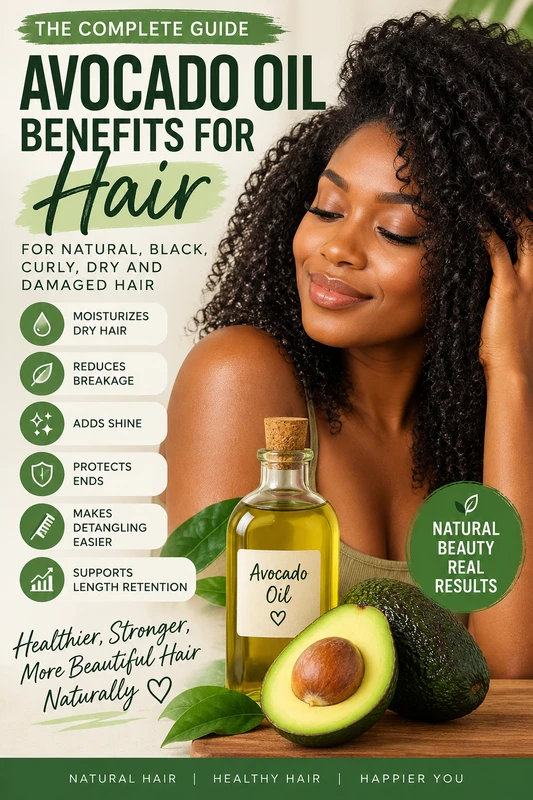
Avocado oil has become one of the most popular natural oils used in hair care—and for good reason. Lightweight compared with many heavier oils, rich in fatty acids, and naturally packed with nutrients, avocado oil can be a useful addition to routines for natural hair, curly hair, protective styles, locs, dry hair, and damaged hair.
For people with Black and textured hair, maintaining moisture and reducing unnecessary breakage are often major parts of a healthy hair routine. Because tightly curled and coiled strands can make it more difficult for natural scalp oils to travel from the roots to the ends, the hair may become dry more easily. Avocado oil can help support a routine designed to keep the hair conditioned, soft, manageable, and protected.
But what exactly does avocado oil do for your hair? Can it help dry hair? Is it good for the scalp? Can you use it on braids and locs? And how often should you apply it?
This complete guide explores the benefits of avocado oil for hair, how to use it, who may benefit most, and how to incorporate it into a healthy natural hair routine.
What Is Avocado Oil?
Avocado oil is an oil extracted from the flesh of avocados. Unlike many oils that are extracted primarily from seeds, avocado oil comes largely from the fruit's pulp.
It contains a combination of fatty acids and naturally occurring compounds, including oleic acid, linoleic acid, vitamin E, carotenoids, and phytosterols.
These characteristics make avocado oil especially appealing in cosmetic and hair-care formulations.
When applied to hair, an oil does not literally "feed" the strand in the way food nourishes the body. Hair outside the scalp is primarily made of keratin and is not living tissue.
Instead, avocado oil can work as a conditioning and lubricating ingredient. It can coat the hair, improve softness and slip, reduce friction, and help slow moisture loss.
Those effects can make an important difference for dry, curly, coily, and fragile hair.
15 Avocado Oil Benefits for Hair
1. Helps Keep Dry Hair Moisturized
One of the biggest reasons people use avocado oil is to manage dry hair.
It is important to understand that oil itself is not the same thing as water. Applying oil to extremely dry hair without adding moisture first may make the hair feel smoother, but it does not replace water.
A better approach is to apply avocado oil after water, a water-based moisturizer, or a leave-in conditioner.
The oil can then help reduce moisture loss from the hair.
For natural hair, this can be particularly useful because curls and coils often experience dryness faster than straight hair.
Try applying a small amount of avocado oil to damp hair, concentrating on the mid-lengths and ends.
2. Helps Reduce Hair Breakage
Hair breakage is one of the biggest obstacles to retaining length.
Your hair may be growing normally from the scalp while repeated breakage at the ends makes it appear that your hair is not growing.
Dryness, friction, aggressive detangling, heat styling, tight hairstyles, chemical treatments, and excessive manipulation can all contribute to breakage.
Avocado oil can improve lubrication between strands.
Better lubrication means strands can move against one another with less friction. This may make detangling easier and reduce some of the mechanical stress placed on the hair.
Avocado oil cannot repair severely damaged hair permanently, but using it as part of a gentle routine may help protect vulnerable strands from additional damage.
3. Softens Natural Hair
Soft hair is often easier to style, detangle, and manage.
Avocado oil can leave textured hair feeling softer because of its emollient properties.
This is particularly helpful for hair that feels rough after shampooing.
After washing and conditioning, apply your leave-in conditioner followed by a small amount of avocado oil.
You don't need to saturate your hair.
Start with a few drops per section and increase only when necessary.
The goal is soft, flexible hair—not oily hair.
4. Adds Natural-Looking Shine
Healthy-looking shine is another popular avocado oil benefit.
When the outer surface of the hair becomes rough, light reflects unevenly and the hair can look dull.
A thin coating of oil can smooth the surface temporarily and improve the appearance of shine.
This can be especially noticeable on twists, braids, curls, and locs.
Instead of coating the hair heavily, rub several drops between your palms and lightly smooth them over your finished hairstyle.
This gives hair a polished appearance without making it unnecessarily greasy.
5. Helps Protect the Ends of Your Hair
The ends are the oldest part of your hair.
If your hair is several years old, the ends have experienced years of shampooing, styling, combing, brushing, weather exposure, and friction.
That's why split, rough, and thin ends are common.
Avocado oil can be particularly useful as an ends-sealing oil.
After moisturizing your hair, smooth a small amount over your ends.
Paying special attention to your ends can help them stay lubricated and reduce friction against clothing, pillows, and other strands.
However, oil cannot permanently repair split ends.
If your ends are severely split or damaged, trimming is usually the most effective solution.
6. Makes Detangling Easier
Detangling natural hair without enough slip can lead to unnecessary breakage.
Avocado oil may help improve slip by lubricating the strands.
You can add a small amount to your conditioner or apply it to damp sections before detangling.
Work from the ends upward instead of starting at the roots.
Use your fingers or a wide-tooth detangling tool and avoid pulling through stubborn knots.
The combination of water, conditioner, avocado oil, and patient detangling can make wash day significantly easier.
7. Works Well for Pre-Poo Treatments
A pre-poo is a treatment applied before shampooing.
Natural oils are frequently used for this purpose.
Shampoo is necessary for removing dirt, excess oils, sweat, and product buildup, but some shampoos can leave already-dry hair feeling stripped.
Applying avocado oil before shampooing can provide extra lubrication during the washing process.
To create a simple avocado oil pre-poo:
- Divide your dry or slightly damp hair into sections.
- Apply a modest amount of avocado oil from the mid-lengths to the ends.
- Gently work it through each section.
- Leave it on for approximately 15–30 minutes.
- Shampoo and condition normally.
You do not need to leave avocado oil on overnight to benefit from using it as a pre-shampoo treatment.
8. Can Complement Deep Conditioning
Avocado oil can also be incorporated into deep-conditioning routines.
If your favorite deep conditioner works well but you want slightly more lubrication, mix a few drops of avocado oil into the amount of conditioner you're using for that wash day.
Alternatively, apply your deep conditioner normally and smooth a small amount of avocado oil over particularly dry areas.
Cover your hair and follow the conditioner manufacturer's instructions.
More oil does not automatically mean more moisture.
Using too much can leave the hair coated and make your next cleansing session more difficult.
9. Can Help Reduce Frizz
Frizz is completely normal for curly and natural hair, but people who prefer a smoother style may find avocado oil useful.
Humidity, dryness, friction, damaged cuticles, and manipulation can all affect frizz.
A small amount of avocado oil applied after styling can help smooth flyaways and create a more polished finish.
For twist-outs and braid-outs, put one or two drops on your fingertips before separating each twist or braid.
This reduces friction during takedown while adding shine.
10. Supports Length Retention
Avocado oil is sometimes described online as a hair-growth oil.
That description needs context.
There is not strong evidence that simply putting avocado oil on your scalp causes dramatically faster hair growth.
However, hair growth and length retention are different things.
Your scalp produces new hair, while your hair-care routine influences how much of that length you retain.
If avocado oil helps you:
- Reduce dryness
- Detangle more gently
- Limit friction
- Protect your ends
- Reduce unnecessary breakage
then you may retain more of the length you naturally grow.
Over time, improved length retention can make your hair appear to grow better because less hair is breaking away.
11. Works Well With Protective Styles
Avocado oil can also fit into routines for braids, twists, cornrows, and other protective styles.
One common mistake with protective styling is neglecting the natural hair underneath.
Your hair still needs appropriate cleansing and moisture while it is protected.
A lightweight routine might include:
Step 1: Lightly mist the natural hair with water or a water-based moisturizing product.
Step 2: Apply a small amount of leave-in product if needed.
Step 3: Use several drops of avocado oil to help reduce moisture loss.
Avoid pouring large quantities of oil directly onto your scalp.
Excessive oil can combine with sweat, dead skin, and styling products and contribute to buildup.
Protective styling should make your routine simpler—not eliminate scalp cleansing altogether.
12. Can Be Used on Locs
Avocado oil may also be suitable for locs when used sparingly.
Locs can become dry, particularly toward the ends.
After lightly misting your locs with water or a moisturizing spray, smooth a very small amount of avocado oil over them.
Because locs can hold product internally, less is usually better.
Avoid repeatedly saturating locs with heavy quantities of oil.
Regular cleansing remains essential.
13. Useful for Curly Hair
Avocado oil isn't limited to tightly coiled hair.
People with looser curl patterns can also benefit.
The main difference is the amount used.
Fine or loose curls may become weighed down easily. Start with one or two drops and concentrate them on the ends.
People with dense, coarse, or very dry curls may prefer slightly more.
Your ideal amount depends more on your hair's density, strand thickness, porosity, styling routine, and current condition than on curl pattern alone.
14. Can Help Hair Feel More Manageable
Manageability is an underrated part of healthy hair care.
When hair feels extremely rough, tangled, and difficult to handle, people are more likely to pull, tug, brush aggressively, or over-manipulate it.
Avocado oil's lubricating properties may help strands feel smoother and easier to work with.
This can make sectioning, detangling, twisting, braiding, and styling easier.
15. Can Be Used for Scalp Massage
Avocado oil can be used as a scalp-massage oil if your scalp tolerates oils well.
Place a few drops on your fingertips and gently massage your scalp with the pads of your fingers.
You do not need to scratch your scalp or apply heavy pressure.
A gentle scalp massage can feel relaxing and provides a convenient opportunity to pay attention to your scalp.
However, avocado oil should not be treated as a cure for scalp conditions.
Persistent itching, scaling, pain, sores, significant dandruff, or unexplained hair loss should be evaluated by an appropriate healthcare professional.
Avocado Oil Benefits for Black Hair
Avocado oil can be particularly useful in Black hair routines because textured hair frequently requires careful moisture management and protection from mechanical damage.
The bends and curves in curly and coily strands make it more difficult for natural scalp oils to coat the entire length of the hair.
As a result, the ends may feel dry even when the scalp feels oily.
Avocado oil gives you the ability to target the areas that need extra lubrication.
Instead of automatically applying oil everywhere, concentrate it where your hair needs it most.
For many people, that's the mid-lengths and ends.
A simple Black hair moisturizing routine could look like this:
Cleanse → Condition → Leave-In → Avocado Oil → Protective Style
The oil is not replacing your conditioner or moisturizer.
It complements them.
Avocado Oil for Low-Porosity Hair
Low-porosity hair has a cuticle structure that can make product absorption more challenging.
People with low-porosity hair often notice that heavy creams and oils sit on the surface.
Avocado oil may work for low-porosity hair, but quantity matters.
Start with very little.
Apply it while your hair is damp and warm after washing rather than coating completely dry hair with large amounts.
If your hair quickly becomes greasy, limp, or coated, reduce the amount or frequency.
Low-porosity hair often responds better to a lighter product strategy.
Avocado Oil for High-Porosity Hair
High-porosity hair tends to take in moisture easily but may lose it quickly.
Porosity can be naturally higher or increase because of heat, chemical processing, coloring, weathering, and mechanical damage.
Avocado oil can be helpful as the oil step following a moisturizing product.
Apply water or a water-based leave-in first, then use avocado oil to help slow moisture loss and reduce friction.
High-porosity hair may tolerate slightly more oil than fine low-porosity hair, but there is no universal rule.
Watch how your own hair responds.
Avocado Oil for Damaged Hair
If your hair has been damaged by bleach, relaxers, excessive heat, tight styling, or repeated manipulation, avocado oil can improve how the strands feel temporarily.
It may make damaged hair feel:
- Softer
- Smoother
- More flexible
- Easier to detangle
- Less rough
But avocado oil cannot reverse severe structural damage.
Hair that is severely split, melted from chemical processing, or extensively broken may need trimming.
The best strategy is usually to combine conditioning with damage prevention.
Reduce unnecessary heat, avoid overlapping chemical treatments, use gentle hairstyles, condition regularly, and protect fragile ends.
Avocado Oil vs. Coconut Oil
Avocado oil and coconut oil are both popular, but they aren't identical.
Coconut oil has been extensively used as a pre-shampoo oil and can work very well for certain hair types.
However, some people find that coconut oil makes their hair feel stiff or dry.
Avocado oil often feels softer and lighter.
If coconut oil doesn't work well for your hair, avocado oil may be worth trying.
You can also use both at different times.
There is no rule requiring you to choose one oil forever.
Avocado Oil vs. Olive Oil
Olive oil tends to have a heavier feel than avocado oil.
That can be useful for thick, very dry hair, but it may overwhelm fine strands.
Avocado oil is often easier to distribute in smaller amounts.
If you like olive oil but find it too heavy for daily or frequent use, avocado oil can be a lighter alternative.
Avocado Oil vs. Castor Oil
Castor oil is considerably thicker.
Many natural hair routines use castor oil around the scalp, edges, and ends because its thick consistency creates a substantial coating.
Avocado oil is usually easier to spread.
Some people combine the two.
For example, mixing a small amount of castor oil with avocado oil creates a blend that is less thick than straight castor oil.
Avocado Oil vs. Jojoba Oil
Jojoba oil is technically a wax ester and has a lightweight texture that many people enjoy for scalp and hair applications.
Avocado oil has a richer fatty-acid profile and can feel more conditioning on dry lengths and ends.
People with very fine hair may prefer jojoba, while people with dry or coarse hair may appreciate avocado oil.
Again, personal preference matters.
How to Use Avocado Oil for Hair
There are several ways to add avocado oil to your routine.
Method 1: Seal Moisture
This is one of the simplest methods.
Wash and condition your hair.
Apply your favorite leave-in conditioner.
While your hair is still damp, rub a few drops of avocado oil between your hands and distribute it through each section.
Pay particular attention to the ends.
Then style normally.
Method 2: Pre-Poo
Apply avocado oil to your hair before shampooing.
Leave it on for 15–30 minutes and then wash normally.
This is especially useful when your hair feels dry before wash day.
Method 3: Add It to Conditioner
Put your normal amount of conditioner into your hand and mix in a few drops of avocado oil.
Apply it to your hair and follow the conditioner directions.
This can increase lubrication without creating an entirely separate treatment.
Method 4: Twist-Out or Braid-Out Takedown
Place one or two drops on your fingertips before unraveling twists or braids.
This reduces friction and can create additional shine.
Method 5: Ends Treatment
Lightly moisturize your ends and apply avocado oil over them.
This can be done between wash days when the ends begin feeling dry.
Method 6: Scalp Massage
Apply a few drops to your fingertips and gently massage your scalp.
Avoid drenching the scalp.
DIY Avocado Oil Hair Treatment
You don't need a complicated recipe.
Try this simple pre-shampoo oil blend:
Ingredients
- 2 tablespoons avocado oil
- 1 tablespoon olive oil or jojoba oil
Directions
Mix the oils together.
Apply a modest amount to the lengths and ends of your hair.
Massage the remainder lightly over the scalp if desired.
Leave the mixture on for 15–30 minutes.
Shampoo thoroughly and follow with conditioner.
Always patch-test unfamiliar products and discontinue use if irritation occurs.
How Often Should You Use Avocado Oil?
There isn't one schedule that works for everyone.
Some people can use a tiny amount several times per week.
Others may only need it on wash day.
Your hair will usually tell you when you're using too much.
Signs you may be overusing oil include:
- Greasy strands
- Limp curls
- Excessive buildup
- Hair that feels coated
- Products no longer working as expected
- Frequent need for stronger cleansing
If that happens, reduce your oil usage and cleanse your hair thoroughly.
Should You Put Avocado Oil on Wet or Dry Hair?
For moisture retention, avocado oil generally makes the most sense on damp hair or after a water-based moisturizing product.
Remember:
Water provides moisture. Oil helps reduce moisture loss.
Putting avocado oil on dry hair can still provide lubrication, softness, and shine.
But if your goal is combating dehydration, introduce water first.
Can You Leave Avocado Oil in Your Hair Overnight?
You can, but it usually isn't necessary.
Leaving an oil on longer doesn't automatically produce better results.
For a pre-shampoo treatment, 15–30 minutes may be sufficient for your routine.
If you decide to use avocado oil overnight and experience scalp irritation, clogged-feeling hair, or excessive buildup, switch to shorter applications.
Does Avocado Oil Grow Hair?
This is one of the most common questions about avocado oil.
Avocado oil should not be considered a guaranteed treatment for faster hair growth.
Your rate of hair growth is influenced by factors such as genetics, age, nutrition, hormones, health, and your hair-growth cycle.
What avocado oil can do is support the condition and manageability of your existing strands.
By helping reduce friction, dryness, tangling, and breakage, avocado oil can contribute to better length retention.
That distinction is important.
Healthy-looking long hair isn't only about how quickly hair grows.
It's also about how much of that growth you keep.
Does Avocado Oil Help Thinning Hair?
Avocado oil can make dry, fragile hair feel softer and better conditioned, but unexplained thinning should not be treated with oil alone.
Hair thinning can have many possible causes.
If you're experiencing sudden shedding, bald patches, a rapidly widening part, scalp pain, or significant unexplained thinning, consider speaking with a dermatologist or qualified healthcare professional.
Early evaluation can be particularly important when hair loss is progressing.
Can Avocado Oil Clog the Scalp?
Any oil or styling product can contribute to buildup when applied excessively.
This is why your scalp does not need to be saturated in avocado oil.
If you regularly use oils, gels, edge controls, creams, pomades, and styling sprays, cleansing becomes even more important.
Shampoo according to the needs of your scalp and hairstyle.
If your hair still feels coated after washing, an occasional clarifying shampoo may help remove accumulated product.
Who Should Use Avocado Oil?
Avocado oil may be worth trying if you have:
- Natural hair
- Black hair
- Curly hair
- Coily hair
- Dry hair
- High-porosity hair
- Heat-damaged hair
- Color-treated hair
- Braids
- Twists
- Locs
- Dry ends
- Hair prone to tangling
- Hair prone to mechanical breakage
However, people with fine hair should start with very small amounts.
How Much Avocado Oil Should You Use?
Less than you probably think.
Fine hair might need only one to three drops.
Thick, dense, or coarse hair may need more.
Instead of pouring oil directly onto your hair, place a small amount in your palms first.
Rub your hands together and then distribute it.
You can always add more.
Removing too much oil is harder.
Choosing Avocado Oil for Hair
When buying avocado oil specifically for DIY hair use, look at the ingredient label.
If you want pure avocado oil, the ingredient list should primarily identify avocado oil rather than a long list of fillers.
Cold-pressed and unrefined varieties are popular choices, although refined avocado oil can also function as an emollient.
Store the oil according to the manufacturer's instructions, away from excessive heat and light.
If its smell, appearance, or texture changes substantially, it may be time to replace it.
Building an Avocado Oil Natural Hair Routine
Here is a simple weekly routine.
Wash Day
Cleanse your scalp and hair thoroughly.
Condition
Apply conditioner and gently detangle your hair in sections.
Deep Condition When Needed
Use a deep-conditioning treatment according to your hair's needs.
Apply Leave-In
Apply a water-based leave-in conditioner to damp hair.
Seal
Smooth a small amount of avocado oil over your strands, concentrating on the ends.
Style
Choose a low-manipulation hairstyle such as twists, braids, a bun, or another comfortable protective style.
Protect at Night
Sleep with a satin or silk bonnet, scarf, or pillowcase to reduce friction.
During the week, don't automatically add more oil every day.
Check your hair first.
If it still feels soft and flexible, leave it alone.
If it feels dry, lightly reintroduce moisture before adding more oil.
Common Avocado Oil Mistakes
Using Too Much
More isn't better.
Excess oil can make your hair greasy and contribute to buildup.
Applying Oil Instead of Moisture
Oil cannot replace water.
If your hair is dehydrated, moisturize it first.
Never Shampooing the Oil Out
Your scalp and hair still need cleansing.
Repeatedly layering oil without washing can eventually make the hair feel coated.
Expecting Overnight Hair Growth
Avocado oil isn't a magic growth treatment.
Focus on healthy hair practices and length retention.
Ignoring Your Ends
Many people focus heavily on their scalp while their oldest hair receives very little attention.
Protect your ends.
Using Oil to Treat Scalp Problems
Persistent scalp problems may require proper diagnosis and treatment.
Don't rely on oils alone for unexplained itching, inflammation, scaling, sores, or hair loss.
Frequently Asked Questions About Avocado Oil for Hair
Is avocado oil good for natural hair?
Yes. Avocado oil can be a useful emollient for natural hair. It can improve softness, lubrication, shine, and manageability while helping reduce friction.
Is avocado oil good for 4C hair?
It can be. Many people with tightly coiled hair appreciate oils that provide lubrication without being as thick as castor oil. Apply avocado oil after a water-based moisturizing product for better moisture retention.
Can I use avocado oil every day?
You can use a small amount frequently if your hair tolerates it, but daily application isn't necessary for everyone. Too much can cause buildup.
Does avocado oil moisturize hair?
Avocado oil conditions hair and helps reduce moisture loss, but water is the primary source of hydration. For best results, use avocado oil after water or a water-based moisturizer.
Can avocado oil repair split ends?
No oil can permanently fuse severely split ends back together. Avocado oil can temporarily make rough ends feel smoother and reduce friction, but damaged ends may ultimately require trimming.
Can I put avocado oil directly on my scalp?
Yes, provided your scalp tolerates it. Use a small amount rather than saturating your scalp.
Is avocado oil good for braids?
Yes. Use it sparingly alongside a water-based moisturizer to help care for your natural hair while it is braided.
Is avocado oil good for locs?
It can be. Apply a small amount to moisturized locs to improve softness and shine while minimizing buildup.
Is avocado oil too heavy for fine hair?
It can be if overapplied. Fine hair may need only one or two drops concentrated on the ends.
Can you mix avocado oil with castor oil?
Yes. Avocado oil can make thick castor oil easier to distribute. Start with a small amount of each.
Avocado Oil and a Complete Healthy Hair Routine
No single oil determines whether your hair becomes long and healthy.
Your overall routine matters much more.
For healthier natural hair, focus on consistent habits:
Keep your scalp clean.
Regular cleansing helps remove sweat, dirt, oil, dead skin, and styling products.
Condition after shampooing.
Conditioner improves slip and makes detangling easier.
Keep your hair moisturized.
Use water-based products when your hair needs hydration.
Protect your ends.
Your ends are the oldest and often most fragile part of your hair.
Limit unnecessary manipulation.
Constant combing, brushing, restyling, and pulling can increase breakage.
Be careful with heat.
Excessive temperatures can permanently damage the hair fiber.
Avoid excessively tight hairstyles.
Protective styles should protect—not hurt.
Protect your hair while sleeping.
A satin or silk surface can reduce friction overnight.
Trim damaged ends when necessary.
Holding onto severely damaged ends can make detangling and styling more difficult.
Avocado oil can complement all of these habits, but it shouldn't replace them.
Final Thoughts: Is Avocado Oil Good for Hair?
Avocado oil can be an excellent addition to a natural hair routine, particularly for people dealing with dryness, roughness, tangling, frizz, or breakage-prone ends.
Its biggest advantages are its ability to condition the hair, improve lubrication, increase softness and shine, reduce friction, and help slow moisture loss.
For Black, natural, curly, and coily hair, avocado oil works especially well when it is applied after water or a water-based moisturizing product.
Think of avocado oil as a protective finishing step rather than the entire moisture routine.
A little goes a long way.
Apply it to damp hair, focus on fragile ends, cleanse regularly to prevent buildup, and combine it with a consistent routine that prioritizes moisture, gentle handling, scalp care, and low-manipulation styling.
When those habits work together, you create an environment that supports stronger-looking, softer, more manageable hair—and better length retention over time.