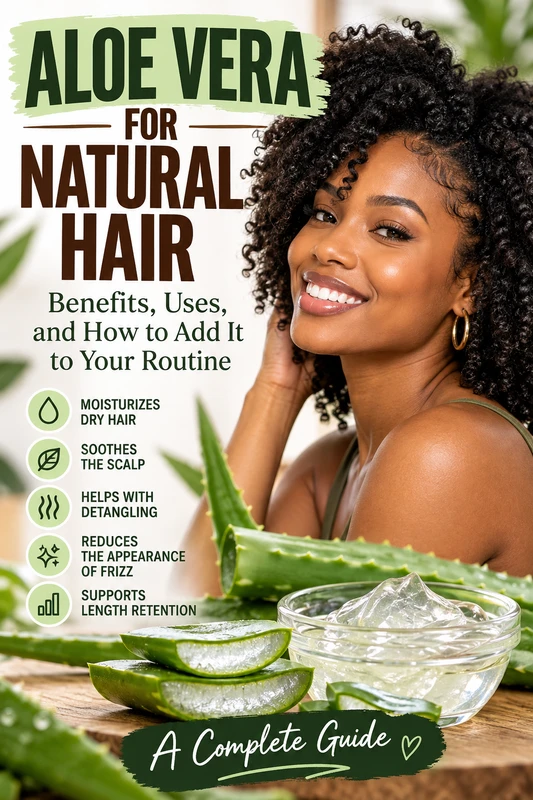
Aloe vera is one of those simple natural ingredients that has been used for generations for skin, scalp, and hair care. If you have natural hair, you may have seen aloe vera listed in moisturizing sprays, leave-in conditioners, shampoos, scalp treatments, and curl products. But what exactly does aloe vera do for natural hair?
Aloe vera can be especially useful for natural hair because it contains a large amount of water and naturally occurring compounds that can help hydrate the hair and soothe the scalp. It may help dry hair feel softer, improve manageability, reduce the appearance of frizz, and make detangling easier when it is used correctly.
However, aloe vera isn't a miracle hair-growth treatment, and it won't work exactly the same way for everyone. Your hair's porosity, density, styling habits, climate, and the products you combine with aloe vera can all influence your results.
In this guide, we'll cover the benefits of aloe vera for natural hair, how to use it, whether it can help with hair growth, how often you should apply it, and some of the mistakes you should avoid.
What Is Aloe Vera?
Aloe vera is a succulent plant known for the clear, gel-like substance found inside its thick leaves. The plant has been widely used in cosmetic and personal-care products because of its moisturizing and soothing properties.
Fresh aloe vera gel contains a high percentage of water. It also contains various naturally occurring vitamins, minerals, sugars, amino acids, and plant compounds.
When it comes to natural hair, one of aloe vera's biggest advantages is simple: moisture.
Natural hair often has difficulty retaining moisture because the twists and bends of curly and coily strands can make it harder for natural scalp oils to travel from the roots to the ends.
That is why ingredients and products that help hydrate and condition the hair can be particularly useful in a natural-hair routine.
Benefits of Aloe Vera for Natural Hair
Aloe vera can serve several purposes depending on how you use it.
1. Aloe Vera Can Help Hydrate Dry Natural Hair
Dryness is one of the most common concerns among people with natural hair.
Aloe vera gel is primarily water, which means it can provide hydration directly to the hair. When incorporated into a properly formulated moisturizing product, it can help hair feel softer and more flexible.
There is an important distinction between hydrating and sealing your hair.
Water-based ingredients such as aloe vera can provide hydration, while oils and heavier products can help reduce moisture loss.
For example, someone with very dry natural hair might use a water-based moisturizing spray or leave-in product and then apply a small amount of oil or pomade afterward.
The first product adds moisture. The second helps keep the hair from losing that moisture too quickly.
2. Aloe Vera May Make Natural Hair Feel Softer
Natural hair that lacks moisture can sometimes feel rough, stiff, or brittle.
Aloe vera can help improve the way the hair feels by adding hydration and helping the strands become more manageable.
Softness is particularly important when you're detangling or styling natural hair. Hair that is extremely dry and stiff may be more difficult to manipulate without causing unnecessary breakage.
Aloe vera isn't going to permanently change the texture of your hair. Instead, it may help properly moisturized hair feel softer and easier to work with.
3. Aloe Vera Can Help With Detangling
Anyone with tightly curled or coily hair knows that detangling can become one of the longest parts of wash day.
Aloe vera-based products can provide moisture and slip, depending on the overall formulation.
Slip helps your fingers or detangling tool move through your hair with less resistance.
For easier detangling:
- Divide your hair into sections.
- Lightly dampen each section.
- Apply your moisturizing or detangling product.
- Start at the ends.
- Slowly work toward the roots.
- Hold the section above knots when necessary to reduce pulling.
- Avoid ripping a comb through stubborn tangles.
Keeping natural hair properly moisturized between wash days can also help prevent severe tangling from developing in the first place.
4. Aloe Vera May Help Reduce the Appearance of Frizz
Frizz is completely normal with curly and coily hair, and eliminating every frizzy strand shouldn't necessarily be the goal.
However, aloe vera may help hair appear smoother when it is incorporated into a balanced moisturizing routine.
Hydrated hair often behaves differently from extremely dry hair. It may clump more easily and feel more flexible.
If frizz is one of your biggest concerns, remember that aloe vera is only one part of the equation.
Your styling technique, humidity, hair porosity, product combinations, drying method, and nighttime routine can all influence frizz.
5. Aloe Vera Can Be Useful for the Scalp
Hair care starts with the scalp.
Aloe vera is frequently used in skin and scalp products because of its soothing properties. The cooling sensation of aloe-based products may feel especially refreshing on a dry or uncomfortable scalp.
However, persistent itching, redness, pain, sores, heavy scaling, or unusual hair loss shouldn't automatically be treated as simple dryness.
Those symptoms can have many causes, and persistent scalp problems may require evaluation by a dermatologist or another qualified healthcare professional.
6. Aloe Vera May Help Improve Manageability
One of the underrated benefits of moisture is manageability.
Natural hair that is properly moisturized may be easier to:
- Detangle
- Twist
- Braid
- Style
- Separate
- Refresh
- Put into protective styles
This matters because excessive manipulation can contribute to breakage.
When your hair is easier to work with, you may spend less time pulling, combing, brushing, and repeatedly manipulating the strands.
Is Aloe Vera Good for Black Hair?
Yes, aloe vera can be a useful ingredient for Black hair, particularly when dryness is a concern.
Black hair isn't one single texture or hair type. It can range from loose curls to extremely tight coils, and individual strands may be fine, medium, or coarse.
Hair can also have low, medium, or high porosity.
This means there isn't one universal aloe vera routine that will work for every person.
Some people may love using an aloe-based moisturizing spray several times per week. Others may prefer aloe vera only as an ingredient in their shampoo, conditioner, or leave-in treatment.
Pay attention to how your individual hair responds rather than assuming that every popular natural ingredient must work for you.
Is Aloe Vera Good for 4C Hair?
Aloe vera can work well for 4C hair when it is used as part of a complete moisturizing routine.
Because tightly coiled hair can be prone to dryness, hydration is particularly important.
Try applying your moisturizer in sections so that you don't only coat the surface of your hair.
For example:
Step 1: Divide your hair into four to eight sections.
Step 2: Apply a small amount of water-based moisturizer to one section.
Step 3: Work it gently through the hair.
Step 4: Pay special attention to the ends.
Step 5: Follow with an appropriate sealing or styling product if your hair needs it.
Step 6: Twist or braid the section to reduce tangling.
Repeat until all of your hair has been moisturized.
Does Aloe Vera Grow Natural Hair?
This is where it's important to separate hair-care benefits from exaggerated claims.
Aloe vera should not be viewed as a guaranteed hair-growth treatment.
Hair growth primarily occurs within the follicle, and numerous factors can influence growth and hair loss, including genetics, age, hormones, nutrition, health conditions, medications, scalp conditions, and styling practices.
However, aloe vera may indirectly support your length-retention goals by helping you maintain hydrated, manageable hair.
Why does that matter?
Because growing hair and retaining hair are not exactly the same thing.
Your hair may be growing from the scalp while breaking from the ends.
Imagine your hair grows approximately half an inch during a particular month but excessive breakage causes you to lose a significant portion of that new length. It may appear that your hair isn't growing even though growth is occurring.
A routine that keeps the hair moisturized and reduces unnecessary breakage can help you retain more of the length you grow.
That's a much more realistic way to think about aloe vera and hair growth.
Aloe Vera for Hair Growth and Length Retention
If your goal is longer natural hair, don't rely on a single ingredient.
Focus on an overall healthy-hair strategy.
That includes:
- Keeping your scalp clean
- Washing your hair appropriately
- Conditioning regularly
- Moisturizing when necessary
- Detangling gently
- Protecting your ends
- Limiting excessive heat
- Avoiding extremely tight hairstyles
- Sleeping with satin or silk protection
- Trimming damaged ends when necessary
- Eating a balanced diet
Aloe vera can fit into this strategy as a moisturizing and conditioning ingredient.
Aloe Vera for Dry Natural Hair
If your natural hair constantly feels dry, aloe vera may be worth trying.
But you should also determine why your hair is becoming dry so quickly.
Common contributors can include:
- Infrequent moisturizing
- Harsh cleansing
- Excessive heat
- Environmental conditions
- Product buildup
- Chemical processing
- Sleeping without hair protection
- Not conditioning sufficiently
- Damaged ends
- Using products that don't work well with your hair
You may also be adding water to your hair without doing enough to help retain that moisture.
For extremely dry natural hair, try moisturizing in sections and concentrating on the ends.
The ends are the oldest part of your hair and often need the most attention.
Aloe Vera for Low-Porosity Hair
Low-porosity hair has cuticles that tend to resist the absorption of water and products.
If you have low-porosity hair, you may notice that products seem to sit on top of your strands rather than absorb easily.
Heavy product application can make this worse.
An aloe vera-based lightweight moisturizer may work well for some people with low-porosity hair because it can provide hydration without requiring a large amount of heavy butter or oil.
Use small amounts at first.
You can always add more product, but applying too much may leave low-porosity hair feeling coated.
Also remember that porosity can vary across different areas of your head.
Aloe Vera for High-Porosity Hair
High-porosity hair tends to absorb moisture relatively easily but may also lose it quickly.
This means hydration alone may not be enough.
If aloe vera is part of your moisturizing routine, you may benefit from following it with a product that helps reduce moisture loss.
High-porosity hair can result from genetics, but chemical treatments, heat, and physical damage can also increase porosity.
Pay attention to your ends in particular.
If they remain extremely rough, split, or damaged despite conditioning and moisturizing, they may need trimming.
Fresh Aloe Vera vs Aloe Vera Hair Products
You essentially have two options: use aloe vera directly from the plant or purchase a hair product formulated with aloe.
Both approaches have advantages and disadvantages.
Fresh Aloe Vera
Fresh aloe vera gives you access to the gel directly from the plant.
However, homemade aloe mixtures don't contain the professional preservative systems found in properly formulated commercial products.
That means you shouldn't make a huge batch and leave it sitting around for weeks.
Fresh plant material can also leave particles in the hair if it isn't prepared and strained carefully.
Aloe Vera Hair Products
Professionally formulated products are usually more convenient.
They may combine aloe with other useful ingredients such as conditioning agents, humectants, oils, botanical extracts, and preservatives.
They are also easier to incorporate into a consistent routine.
Don't judge a product based solely on the words "aloe vera" on the front label, though.
Look at the complete ingredient list and consider the overall formulation.
How to Use Aloe Vera on Natural Hair
There are several ways to incorporate aloe into your routine.
Method 1: Use an Aloe-Based Moisturizing Spray
This is one of the easiest methods.
Separate your hair into sections and lightly mist each section.
You don't necessarily need to soak your hair.
Gently work the moisturizer through your strands, focusing on areas that feel particularly dry.
Then style your hair as usual.
Method 2: Use Aloe Before Detangling
Apply an aloe-based moisturizing or detangling product to slightly damp hair.
Work in small sections.
Use your fingers first to separate major tangles before using a wide-tooth comb or detangling brush.
Start at your ends and gradually move upward.
Method 3: Use Aloe in Your Wash-Day Routine
Aloe vera can be found in shampoos, conditioners, masks, and leave-in treatments.
Instead of adding raw aloe to everything you use, you may find it easier to choose professionally formulated products that already contain it.
Method 4: Refresh Dry Hair Between Wash Days
You don't necessarily need a complete wash day every time your hair begins to feel slightly dry.
A light moisturizing spray can help refresh your hair between washes.
Focus on the areas that actually need moisture rather than automatically saturating your entire head.
Can You Leave Aloe Vera in Natural Hair?
This depends on the product.
If you're using a leave-in hair product formulated with aloe vera, follow the manufacturer's directions.
A leave-in product is designed to remain on your hair.
Pure aloe vera gel is different.
Applying large amounts of raw aloe and leaving it on indefinitely may not give you better results. It may leave some hair feeling stiff, coated, or sticky.
More isn't always better.
How Often Should You Use Aloe Vera on Natural Hair?
There is no universal schedule.
Some people may use an aloe-based moisturizer several times per week, while others only need it occasionally.
Let your hair tell you what it needs.
Ask yourself:
Does my hair feel dry?
Are my ends rough?
Does my hair feel stiff?
Is my hair becoming difficult to manipulate?
If your hair still feels soft and moisturized, you don't necessarily need to add another layer of product simply because a certain number of days have passed.
Can Aloe Vera Be Used on Locs?
Yes, aloe-based products can be used on locs, but product selection matters.
One of the biggest concerns with locs is buildup.
Thick products that don't rinse away easily may accumulate inside or on the surface of locs over time.
A lightweight, water-based moisturizing product may therefore be preferable to repeatedly applying large amounts of thick raw gel.
When moisturizing locs, focus on hydration without oversaturating them.
And make sure your locs dry thoroughly after washing or becoming heavily wet.
Aloe Vera for Braids and Protective Styles
Aloe vera-based moisturizing products can also be useful when wearing braids, twists, and other protective styles.
Protective styling doesn't mean your natural hair stops needing care.
Your scalp and exposed natural hair may still become dry.
A lightweight moisturizing spray can make it easier to target your hair without covering your braids in heavy creams.
Avoid soaking your braids unnecessarily.
A light application is often sufficient.
Aloe Vera and Oils: Which Comes First?
A common question is whether aloe vera should be applied before or after oil.
In most cases, it makes more sense to apply the water-based moisturizing product first.
For example:
Moisture → Oil
rather than:
Oil → Moisture
Why?
Oil itself doesn't provide water to dry hair.
If your goal is hydration, start with a water-based product. You can then apply an oil or sealing product if your hair needs additional moisture retention.
This concept is especially important if you've been repeatedly applying oil to hair that still feels dry.
Your hair may need hydration rather than another layer of oil.
Aloe Vera for Natural Hair at Night
Nighttime hair care can make a major difference in moisture retention.
After moisturizing your hair, protect it while you sleep.
Depending on your hairstyle, you might:
- Put your hair into large twists
- Pineapple your curls
- Use loose braids
- Cover your hair with a satin bonnet
- Wear a satin scarf
- Sleep on a satin or silk pillowcase
Cotton pillowcases can create friction and absorb some moisture and oils from the hair.
Protecting your natural hair at night can help preserve both your style and your moisture routine.
Common Aloe Vera Mistakes
Aloe vera is relatively straightforward, but there are still some mistakes to avoid.
Using Too Much
More aloe doesn't automatically mean more moisture.
Excess product can create buildup or leave your hair feeling coated.
Ignoring the Rest of Your Routine
No single ingredient can compensate for an unhealthy hair routine.
If you're constantly using high heat, wearing extremely tight hairstyles, neglecting conditioning, or roughly detangling your hair, aloe vera alone isn't going to solve those problems.
Assuming Aloe Vera Guarantees Hair Growth
Aloe vera can be part of a healthy hair routine, but avoid expecting dramatic overnight growth.
Focus on scalp care, moisture, breakage prevention, and length retention.
Keeping Homemade Aloe Mixtures Too Long
Fresh homemade products don't automatically have the same shelf life as professionally formulated cosmetics.
Make small quantities and pay careful attention to storage and cleanliness.
Applying Oil Instead of Moisture
If your hair feels dry, repeatedly adding oil may only coat the strands.
Start with hydration.
How to Build a Moisture Routine for Natural Hair
A simple routine is often easier to maintain than an overly complicated one.
Wash Day
Cleanse your scalp and hair to remove sweat, dirt, oils, and product buildup.
Follow with conditioner.
Detangle carefully.
Rinse and apply your leave-in or moisturizing products.
Between Wash Days
Check how your hair feels.
If necessary, apply a lightweight water-based moisturizer or moisturizing spray.
Pay extra attention to your ends.
At Night
Protect your hair with satin or silk.
If necessary, loosely twist or braid your hair to reduce tangling.
When Your Hair Feels Coated
Don't automatically apply more product.
Your hair may need cleansing.
Layers of oils, creams, gels, butters, and styling products can eventually interfere with the way your hair feels and behaves.
Aloe Vera vs Water for Natural Hair
Water remains the fundamental source of hydration.
So why use an aloe vera hair product?
Because a well-formulated moisturizer can provide more than plain water. It may contain conditioning ingredients and humectants that help improve softness, slip, and manageability.
Plain water can certainly refresh natural hair, but some people find that water alone evaporates quickly and leaves their hair feeling dry again.
The goal isn't to replace water with aloe.
Instead, aloe can be one component of a water-based moisturizing formula.
Does Aloe Vera Work for Men's Natural Hair?
Absolutely.
The basic principles of hair care don't change simply because someone is male.
Men with afros, waves, curls, twists, braids, and locs can all experience dryness.
A lightweight aloe-based moisturizer can be especially convenient for shorter natural hairstyles because it can be distributed quickly without requiring a complicated routine.
Men with locs should also pay attention to buildup and choose products that don't leave excessive residue.
Is Aloe Vera Good for Children's Natural Hair?
A simple moisturizing routine can help keep children's natural hair soft and manageable, but products should always be selected with the child's age, sensitivities, and manufacturer's instructions in mind.
Gentle detangling is especially important.
Never rush through severe tangles by pulling harder.
Instead, add moisture and slip, divide the hair into smaller sections, and work slowly from the ends upward.
Who Should Be Careful With Aloe Vera?
Natural doesn't automatically mean irritation-free.
Some people can be sensitive to aloe or other ingredients in aloe-containing products.
If you're trying a new product, consider testing a small area first.
Stop using the product if you experience significant burning, itching, swelling, rash, or irritation.
Persistent scalp symptoms or unexplained hair loss should be evaluated by an appropriate healthcare professional rather than repeatedly covered with cosmetic products.
Frequently Asked Questions About Aloe Vera for Natural Hair
Is aloe vera good for natural hair?
Aloe vera can be a useful moisturizing and conditioning ingredient for natural hair. It may help improve hydration, softness, manageability, and detangling.
Can aloe vera make natural hair grow faster?
There isn't strong evidence that simply applying aloe vera to your hair will dramatically increase your natural rate of hair growth. However, keeping your hair moisturized and reducing breakage may help you retain more length.
Can I put aloe vera directly on my hair?
Some people use fresh aloe gel directly, but professionally formulated hair products can be more convenient and have appropriate preservation systems. Always watch for irritation.
Can I leave aloe vera in my hair overnight?
If you're using a leave-in product containing aloe, follow the product directions. There is usually no need to cover your hair in large quantities of raw aloe overnight.
Is aloe vera good for 4C hair?
It can be. Aloe vera may help provide hydration and improve manageability for tightly coiled hair, but results vary from person to person.
Does aloe vera moisturize dry hair?
Aloe vera contains a large amount of water and can contribute to hydration, particularly as part of a properly formulated moisturizing product.
Can I use aloe vera every day?
You can use an aloe-containing hair product as frequently as your hair needs it and as directed by the manufacturer. Daily application isn't necessary for everyone.
Is aloe vera good for low-porosity hair?
Some people with low-porosity hair prefer lightweight aloe-based products because they can provide moisture without relying heavily on thick oils and butters. Avoid overapplying products if your hair is prone to buildup.
Can aloe vera be used on locs?
Yes. Lightweight aloe-based moisturizers may be useful for locs, but avoid products that create excessive buildup.
Should I apply aloe vera before oil?
When aloe is part of a water-based moisturizing product, applying the moisturizer before oil generally makes sense. Hydrate first, then use oil or another product if needed to help retain moisture.
Final Thoughts: Is Aloe Vera Worth Using on Natural Hair?
Aloe vera can be a valuable ingredient in a natural-hair routine, especially if you're dealing with dryness, roughness, tangling, or hair that is difficult to manage.
Its greatest value isn't that it magically makes hair grow overnight. Instead, aloe vera can contribute to the conditions that make maintaining healthy natural hair easier.
When your hair is hydrated, soft, and manageable, you're less likely to rely on aggressive detangling and excessive manipulation. Reducing unnecessary breakage can ultimately help you retain more of the length your hair naturally grows.
The key is to think about your complete routine rather than searching for one miracle ingredient.
Cleanse your scalp regularly, condition your hair, moisturize when needed, protect your ends, minimize unnecessary manipulation, and protect your hair while you sleep.
Aloe vera can be one useful part of that routine.