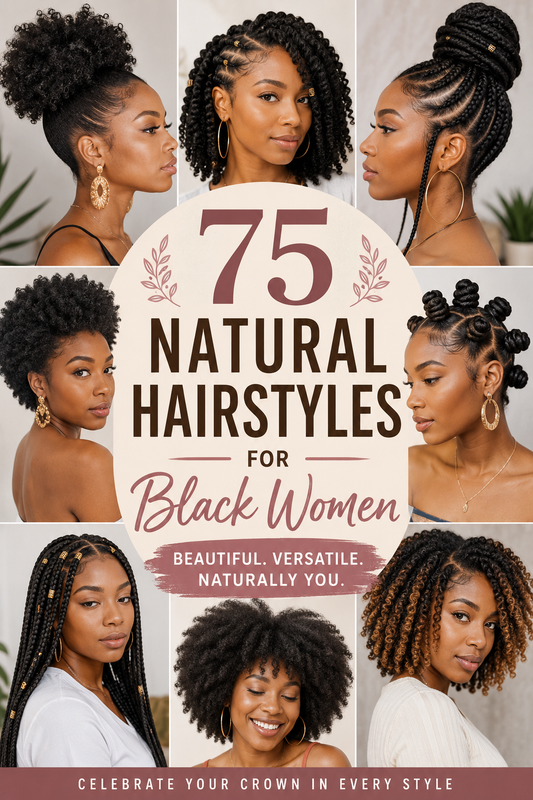
Natural hair offers incredible versatility. From defined wash-and-go curls and fluffy twist-outs to elegant updos, braided styles, Afro puffs, Bantu knots, and protective hairstyles, Black women have countless ways to wear their natural texture beautifully.
Whether your hair is short, medium-length, or long, the right natural hairstyle can help you express your personality while making your daily hair routine easier. Some styles are ideal when you want to show off your curls, while others can help reduce daily manipulation and protect your ends.
The best part is that natural hairstyles don't have to be complicated.
Some of the most beautiful looks can be created with a few basic tools, a moisturizing product, a styling cream or gel, and a little creativity.
In this complete guide, we'll explore 75 natural hairstyles for Black women, including styles for Type 3 and Type 4 hair, short natural hair, long natural hair, work, vacations, special occasions, protective styling, and everyday wear.
Why Natural Hairstyles Are So Popular
Natural hairstyles celebrate the curls, coils, waves, and kinks that make textured hair unique.
For many Black women, wearing natural hair also provides freedom from constantly trying to alter the hair's natural texture. Instead of fighting shrinkage or trying to make every strand perfectly straight, natural styling allows you to work with your texture.
Natural hairstyles can also be extremely versatile.
You might wear a twist-out on Monday, an Afro puff later in the week, and transition into a sleek bun when you want something quick and polished.
A good natural hair routine can make this versatility much easier.
The key is finding hairstyles that complement your hair's:
- Texture
- Density
- Length
- Shrinkage
- Porosity
- Lifestyle
- Styling preferences
There isn't one "perfect" natural hairstyle. The best style is the one that looks good, feels comfortable, and works with your hair.
75 Best Natural Hairstyles for Black Women
1. Classic Wash-and-Go
The wash-and-go is one of the most recognizable natural hairstyles.
Instead of stretching or manipulating your curls into another pattern, this style emphasizes your natural curl or coil definition.
Start with freshly washed and conditioned hair. Apply your preferred leave-in conditioner and styling product while your hair is still damp or wet.
Work in sections so every area receives enough product.
You can air-dry or use a diffuser.
The final result will depend heavily on your natural curl pattern, styling technique, and products.
One of the biggest benefits of the wash-and-go is its simplicity. Once you find a routine that works, it can become one of your easiest everyday hairstyles.
2. Defined Twist-Out
The twist-out is a natural hair classic for a reason.
Two-strand twists temporarily reshape the hair, producing a more uniform curl or wave pattern once the twists are removed.
Apply moisturizer and styling cream before dividing the hair into sections. Twist each section from roots to ends and allow the hair to dry completely.
Once dry, carefully unravel the twists.
Separating each twist into smaller sections creates additional volume.
For maximum definition, avoid excessive separation.
3. Fluffy Twist-Out
If volume is your priority, try a fluffy twist-out.
The basic technique is similar to a regular twist-out, but the finished style is intentionally separated and fluffed.
After unraveling your twists, gently separate the sections with your fingers.
Use an Afro pick near the roots to increase volume without disturbing the definition on the ends.
This creates a big, soft natural hairstyle that can look even better as the days pass.
4. Chunky Twist-Out
Chunky twist-outs are excellent when you don't want to install dozens of small twists.
Instead, divide your hair into approximately 6–12 large sections.
Larger twists generally create a looser, fuller pattern rather than extremely small, defined curls.
Chunky twist-outs can also reduce styling time, making them perfect for busy naturalistas.
5. Braid-Out
A braid-out uses braids instead of twists to create texture.
Braiding stretches the hair while producing a beautiful crimped or wavy pattern.
For the best results, braid moisturized hair and allow it to dry completely before unraveling.
Braid-outs are especially helpful for women who want additional stretching.
6. Flat Twist-Out
Flat twists are attached to the scalp similarly to cornrows, but they're created using a twisting technique.
Once removed, they can produce beautiful definition from the roots all the way to the ends.
This makes flat twist-outs particularly attractive to women who struggle with puffy or undefined roots.
7. Perm Rod Set
You don't need chemically relaxed hair to use perm rods.
Perm rods can create gorgeous curls on natural hair.
Different rod sizes produce different curl sizes.
Small rods create tighter curls, while larger rods create softer, more voluminous curls.
The most important step is allowing the hair to dry completely before removing the rods.
8. Flexi-Rod Set
Flexi rods are another excellent heat-free curling option.
They can produce soft spiral curls with plenty of bounce.
For a stretched result, start with slightly stretched hair. For tighter curls, apply the rods to damp hair.
Once completely dry, separate and fluff the curls.
9. Roller Set on Natural Hair
A traditional roller set can create smooth, stretched curls without requiring direct heat from a flat iron.
Large rollers create more stretch and volume, while smaller rollers provide additional curl.
Roller sets can also serve as the foundation for buns and other updos.
10. Finger Coils
Finger coils are particularly beautiful on short to medium-length natural hair.
Take a small section of damp hair, apply styling product, and wrap the section around your finger until the curl forms.
Repeat throughout your entire head.
Although finger coils can take time to install, they may last considerably longer than a basic wash-and-go.
11. Shingled Curls
Shingling is a styling technique used to maximize individual curl definition.
Instead of simply smoothing gel over large sections, styling product is worked through smaller sections of hair.
The technique can produce highly defined curls with less frizz.
It works especially well for naturals who want maximum definition from a wash-and-go.
12. Natural Afro
Few hairstyles are as timeless as the Afro.
The Afro showcases natural texture and volume without requiring elaborate styling.
You can wear your Afro perfectly rounded, slightly stretched, or intentionally free-form.
The shape can also be customized to complement your face.
Regular trims may help maintain your desired silhouette.
13. Stretched Afro
Love the look of an Afro but want more length?
Try a stretched Afro.
You can stretch natural hair using methods such as:
- African threading
- Banding
- Braiding
- Twisting
- Roller setting
- Carefully using a blow-dryer
Once stretched, gently pick and shape the hair.
The result is a larger Afro with less visible shrinkage.
14. Tapered Natural Cut
A tapered cut keeps the sides and back shorter while leaving additional length toward the top.
This creates a beautiful shape that can highlight your facial features.
The longer section can be curled, twisted, coiled, or worn fluffy.
Tapered cuts are especially popular among women transitioning from very short natural hair into longer styles.
15. TWA
A TWA, or teeny weeny Afro, celebrates very short natural hair.
Despite its simplicity, a TWA can be incredibly stylish.
You can wear your texture naturally, add finger coils, create a defined wash-and-go, or accessorize with headbands and statement earrings.
Short natural hair can make wash day significantly faster as well.
16. TWA With Defined Curls
If you want additional definition, transform your TWA with curl-enhancing products.
Work your styling product through damp hair using your fingers or a small styling brush.
The finished result highlights your individual curls while maintaining the convenience of short hair.
17. Natural Frohawk
The frohawk gives natural hair an edgy, dramatic appearance without requiring you to shave your sides.
Smooth or pin the sides upward toward the center of your head while leaving the middle section full.
The center can be worn curly, twisted, stretched, or fluffy.
It's an excellent special-event hairstyle.
18. Afro Puff
The Afro puff may be one of the quickest natural hairstyles ever created.
Gather your hair upward and secure it with a stretchy hair tie, headband, or puff cuff.
Fluff the loose hair until you achieve your preferred shape.
You can position the puff high, low, or somewhere in between.
19. High Puff
The high puff moves the hair toward the crown of the head.
It's ideal for showcasing your natural texture while keeping hair away from your face.
A high puff can also rescue an older twist-out or wash-and-go.
Instead of completely restyling your hair, simply gather it upward and refresh the exposed curls.
20. Low Puff
For a softer appearance, wear your puff toward the nape.
Low puffs work beautifully for casual days, professional settings, and elegant occasions.
You can slick the front for a polished appearance or leave your edges and roots more textured.
21. Double Afro Puffs
Why wear one puff when you can wear two?
Part the hair down the middle and create one puff on each side.
Double puffs are playful, youthful, and extremely easy to create.
They work particularly well on medium-length natural hair.
22. Side Puff
Move your Afro puff slightly to one side for an easy variation of the traditional puff.
The asymmetrical placement gives the style additional personality without adding much styling time.
23. Half-Up, Half-Down Natural Hair
Can't decide whether you want your hair up or down?
Do both.
Separate the top portion of your hair and secure it into a ponytail or puff while leaving the remaining hair loose.
The bottom can be worn in a twist-out, braid-out, wash-and-go, or stretched texture.
24. Half-Up Afro Puff
Instead of creating a regular ponytail on top, leave the upper section full and fluffy.
This creates a mini Afro puff while the remaining curls fall naturally around the shoulders.
It's an excellent style for second- or third-day natural hair.
25. Pineapple Hairstyle
The pineapple isn't only a nighttime preservation technique.
It can also become a cute daytime hairstyle.
Gather your curls loosely toward the top of your head and allow them to fall forward.
This creates an effortless curly updo that's particularly attractive with bangs or face-framing curls.
26. High Natural Bun
The high bun is simple, polished, and versatile.
Gather stretched or moisturized hair toward the crown and secure it without excessive tension.
Wrap the loose hair into a bun and pin it into place.
You can make the bun sleek and structured or large and fluffy.
27. Low Natural Bun
A low bun is an elegant choice for work, weddings, dinners, and everyday wear.
Part your hair down the middle or on the side before gathering it near the nape.
Avoid pulling the hair unnecessarily tight around the hairline.
28. Messy Natural Bun
Natural hairstyles don't have to look perfectly polished.
A messy bun embraces texture, volume, and intentionally loose pieces.
Gather the hair loosely and secure it into a bun while allowing a few curls to frame your face.
It's quick, easy, and stylish.
29. Top Knot
A top knot positions the bun directly on top of the head.
Stretching the hair beforehand can make it easier to gather and shape.
Top knots pair beautifully with hoop earrings and other statement accessories.
30. Double Buns
Part your natural hair down the middle and create one bun on each side.
The buns can be positioned high for a playful appearance or lower for a more subtle style.
31. Space Buns
Space buns are a fun variation of double buns.
Position both buns high on the head and leave the remaining hair sleek, textured, or accessorized.
You can even leave a few curls loose around your face.
32. Sleek Natural Ponytail
A sleek ponytail gives natural hair a polished appearance.
Apply a moisturizing styling product or gel around the perimeter before gently smoothing the hair.
Secure your ponytail without pulling excessively.
The ponytail itself can remain textured, stretched, twisted, or curled.
33. Low Natural Ponytail
The low ponytail is one of the easiest styles for medium or long natural hair.
It can be sleek and polished or soft and textured.
Add a deep side part for extra sophistication.
34. High Natural Ponytail
A high ponytail puts your curls on full display.
Gather the hair near the crown and allow the ends to remain big and textured.
This is another great option for extending an older twist-out.
35. Bubble Ponytail
Transform a basic ponytail into something more interesting by adding hair ties at intervals down its length.
Gently pull each section outward to create a rounded "bubble" effect.
Avoid placing the elastics too tightly.
36. Two-Strand Twists
Two-strand twists are among the most versatile natural hairstyles for Black women.
They can be worn as a finished hairstyle or unraveled later for a twist-out.
Twists can be:
- Mini
- Medium
- Chunky
- Short
- Long
- Stretched
- Curled
Keep your hair moisturized during installation and pay particular attention to your ends.
37. Mini Twists
Mini twists involve dividing the hair into many small sections.
Installation takes longer, but the style can be extremely versatile.
You can wear mini twists loose, put them into a ponytail, create buns, or style them into updos.
Because you're not restyling loose hair every day, mini twists may also help reduce manipulation.
38. Chunky Two-Strand Twists
Chunky twists offer a faster alternative to mini twists.
Use larger sections to create thick, juicy twists.
They can be worn loose or pinned into an updo.
When unraveled, they can also produce a voluminous twist-out.
39. Flat Twists
Flat twists lie close to the scalp and can be styled in countless patterns.
You can flat twist the entire head or combine them with loose curls.
They're also a useful option when you want your natural hair tucked away for several days.
40. Flat Twist Updo
Direct your flat twists toward the center, crown, or back of the head and pin the ends into an updo.
The result can look sophisticated enough for formal occasions while remaining practical for everyday wear.
41. Flat Twists With Curly Ends
You don't have to twist the entire length of your hair.
Flat twist the roots and leave the ends loose.
Define the ends with finger coils, perm rods, or flexi rods.
This gives you the structure of flat twists combined with the softness of curls.
42. Crown Twist
Create a large twist around the perimeter of the head to form a crown-like effect.
This elegant hairstyle keeps most of the hair tucked away while beautifully framing the face.
Add decorative pins for special occasions.
43. Halo Twist
The halo twist is similar to the crown style, wrapping around the head like a halo.
It's sophisticated, protective, and works particularly well on stretched natural hair.
44. Natural French Roll
Natural hair can create gorgeous French rolls because its texture provides fullness and volume.
Gather the hair toward the back, roll it inward, and secure it with pins.
Leave the front sleek or add volume for a softer finish.
45. Tucked Natural Updo
A tucked updo hides the ends inside the hairstyle.
This can be beneficial when you're trying to minimize daily handling of fragile ends.
Use bobby pins strategically instead of creating excessive tension.
46. Rolled and Tucked Updo
Divide your hair into several sections and roll each section inward before pinning it into place.
The result looks far more complicated than it actually is.
This hairstyle works beautifully for weddings, work events, and date nights.
47. Pompadour Updo
The pompadour creates dramatic volume toward the front of the head.
Smooth the sides and back upward while leaving the front section large and elevated.
It's an excellent choice for women who enjoy vintage-inspired hairstyles.
48. Faux Bang With Natural Hair
You don't necessarily have to cut your hair to experiment with bangs.
Position curls toward your forehead and secure the remaining hair so that the ends create the appearance of bangs.
This temporary transformation allows you to see how bangs complement your face before committing to a haircut.
49. Curly Natural Bangs
If you already have bangs, embrace their natural texture.
Curly bangs pair beautifully with Afros, wash-and-gos, buns, and twist-outs.
Because shrinkage affects the final length, natural bangs should be cut carefully.
50. Side-Part Twist-Out
A simple part can completely transform your twist-out.
Create a deep side part before styling or gently reposition the hair after unraveling your twists.
The asymmetry adds shape and movement.
51. Middle-Part Twist-Out
A middle part creates symmetry and allows curls to frame both sides of the face.
This style looks especially beautiful with medium and long natural hair.
52. Side-Swept Natural Curls
Move the majority of your curls toward one side.
Secure the opposite side with pins if necessary.
Side-swept curls can instantly turn an everyday wash-and-go or twist-out into an evening hairstyle.
53. Claw Clip Natural Hairstyle
Large claw clips can be extremely useful for natural hair.
Gather your hair toward the back and secure it with a clip while allowing the ends to remain loose.
Choose a clip large and strong enough to accommodate your hair's density without pulling.
54. Natural Hair With Headband
Sometimes the easiest way to refresh natural hair is with an accessory.
A headband can push curls away from the face while adding color or texture to your hairstyle.
It's particularly useful when your roots no longer look as defined as they did on wash day.
55. Natural Hair With Headwrap
Headwraps are functional and fashionable.
You can cover all of your hair or allow a puff, curls, or bangs to remain visible.
Headwraps can also be useful on days when you don't have time for extensive styling.
56. Bandana Natural Hairstyle
A bandana can instantly transform a basic Afro, puff, or wash-and-go.
Fold it into a strip and tie it around the hairline, or use it to cover a larger portion of your hair.
57. Natural Hair With Decorative Clips
Decorative clips, barrettes, and pins can elevate even the simplest natural hairstyle.
Use them along a side part, around an updo, or to pin one side of your curls back.
58. Beaded Natural Twists
Add beads to the ends of two-strand twists for a beautiful decorative finish.
Wooden, metallic, clear, and colorful beads can all create completely different looks.
Make sure the accessories aren't excessively heavy.
59. Bantu Knots
Bantu knots are both a finished hairstyle and a method for creating curls.
Divide your hair into sections, twist each section, and wrap it around itself to form a small knot.
The knots can be arranged in neat geometric sections or styled more freely.
60. Bantu Knot-Out
After wearing Bantu knots, unravel them to create a Bantu knot-out.
The resulting curls are often springy and defined.
Separate gently for volume.
As with most natural sets, the hair should be completely dry before unraveling.
61. Cornrows Into Afro Puff
Cornrow the front or sides of your hair while leaving the remaining hair loose in a puff.
This combination provides the detail of braids without requiring your entire head to be braided.
62. Cornrows With Natural Curls
Cornrow a section of the hair and leave the remaining curls loose.
You might braid one side, the front, or several small sections.
This gives a wash-and-go or twist-out a more creative appearance.
63. Side Cornrows With Afro
Create several cornrows on one side while leaving the opposite side full and voluminous.
The contrast between sleek braids and a large Afro creates a dramatic hairstyle.
64. Braided Natural Updo
Braids can be incorporated into an updo using your own natural hair.
Braid several sections and pin them into a bun, crown, or sculpted design.
This keeps the ends tucked away while creating a sophisticated look.
65. Milkmaid Braids
Create two large braids and wrap them across the top of the head.
Pin them securely to create a crown-like appearance.
Milkmaid braids work particularly well on stretched medium-to-long natural hair.
66. Natural Mohawk With Flat Twists
Flat twist the sides upward and leave the middle section loose.
The center can be styled into curls, coils, twists, or a fluffy Afro.
This creates a dramatic mohawk effect without cutting or shaving your hair.
67. Braided Front With Twist-Out
Braid the front section of your hair while leaving the back in a twist-out.
This is useful when the front of your twist-out isn't cooperating but the rest of your hair still looks great.
68. Stretched Natural Hair
Sometimes the hairstyle is simply about showing off your length.
Stretching reduces shrinkage and creates a different silhouette without necessarily straightening the hair completely.
Heat-free stretching techniques include:
- Banding
- Braiding
- Twisting
- African threading
If you use heat, keep the temperature appropriate for your hair and avoid repeated passes.
69. Blowout Afro
A blowout Afro creates major volume.
After washing and conditioning, gently stretch the hair with a blow-dryer using controlled heat.
Once stretched, shape the hair using your hands or an Afro pick.
Remember that maximum volume doesn't require maximum heat.
70. Heatless Stretched Afro
If you're avoiding heat, you can still create a large stretched Afro.
Section damp hair and use banding, braids, twists, or threading overnight.
Once dry, release the sections and gently separate them.
Pick the roots for additional volume.
71. Natural Hair Side Bun
Instead of positioning your bun directly in the center, move it slightly to one side.
The asymmetry makes a basic bun more interesting and can create an elegant formal hairstyle.
72. Twisted Low Bun
Create several twists before gathering them toward the nape.
Wrap the twists together and pin them into a low bun.
Because the hair is already twisted, the finished bun has additional texture and detail.
73. High Puff With Bangs
Combine a high Afro puff with natural bangs or strategically positioned front curls.
The contrast between the large puff and face-framing curls creates a fun, youthful appearance.
74. Twist-Out Updo
Your twist-out doesn't always have to stay loose.
After enjoying your curls for several days, transform them into an updo.
Pin the sides upward while leaving some curls visible toward the top.
This is one of the easiest ways to extend your hairstyle before wash day.
75. Free-Form Natural Hair
Finally, don't underestimate the beauty of simply allowing your natural hair to do what it wants.
Not every curl needs perfect definition.
Not every edge needs to be slicked.
And not every strand has to sit in exactly the right place.
Free-form natural hair embraces texture, shrinkage, volume, frizz, and individuality.
Sometimes the most beautiful natural hairstyle is the one that looks unmistakably like you.
Best Natural Hairstyles for Short Hair
Short natural hair provides far more styling options than many people realize.
Some of the best choices include:
- TWA
- Defined TWA
- Finger coils
- Wash-and-go
- Bantu knots
- Mini twists
- Tapered cut
- Frohawk
- Flat twists
- Headband styles
If your hair is extremely short, focus on definition, shape, and accessories rather than trying to recreate styles designed for long hair.
A beautifully shaped short Afro can be just as dramatic as waist-length curls.
Best Natural Hairstyles for Medium-Length Hair
Medium-length natural hair provides tremendous versatility because there's usually enough length for updos without the additional styling time that comes with extremely long hair.
Great options include:
- Twist-outs
- Braid-outs
- Afro puffs
- Double puffs
- Half-up styles
- Two-strand twists
- Bantu knots
- Flat twists
- High buns
- Frohawks
- Perm rod sets
- Flexi-rod sets
Medium-length hair is also ideal for experimenting with different stretched styles.
Best Natural Hairstyles for Long Hair
Long natural hair opens the door to more elaborate styles.
Popular options include high buns, low buns, large Afros, ponytails, crown twists, halo twists, braided updos, chunky twists, mini twists, and dramatic twist-outs.
However, longer hair also requires additional attention to the ends.
The ends are the oldest portion of your hair and have experienced the most washing, detangling, styling, and environmental exposure.
Keeping them moisturized and minimizing unnecessary manipulation can help preserve length.
Easy Natural Hairstyles for Busy Mornings
You don't need an hour every morning to make natural hair look good.
Some styles can be completed within minutes when your hair is already moisturized and detangled.
Three particularly useful options are the Afro puff, high bun, and half-up style.
Accessories can make quick hairstyles look more intentional.
Try adding a headband, scarf, decorative clip, or barrette when you don't have time for a complete styling session.
Planning ahead also helps.
A twist-out installed at night may give you a ready-made hairstyle the following morning, while mini twists can eliminate the need to manipulate loose hair every day.
Professional Natural Hairstyles for Black Women
Natural hair can be worn professionally in virtually any texture or length.
Professional natural hairstyles may include:
- Low buns
- High buns
- Twist-outs
- Wash-and-gos
- Tapered cuts
- Mini twists
- Flat twist updos
- Afro puffs
- Ponytails
- French rolls
- Crown twists
- Afros
Professionalism doesn't require eliminating your natural texture.
Instead, choose a hairstyle that makes you feel comfortable and confident in your environment.
Natural Hairstyles for Weddings and Special Occasions
Natural hair can create stunning formal hairstyles.
Consider styles such as a rolled updo, halo twist, crown twist, pompadour, side-swept curls, rod set, sculpted Afro, or decorated low bun.
Hair accessories can elevate the style further.
Pearls, decorative pins, flowers, jeweled clips, and headbands can turn an everyday hairstyle into something appropriate for a wedding or formal celebration.
If you're styling your own hair for an important event, practice beforehand.
Knowing how long the hairstyle takes and how your hair responds can prevent unnecessary stress on the day of the event.
Natural Hairstyles for Vacation
Vacation hair should ideally be manageable enough that you aren't spending half your trip styling your hair.
Mini twists, flat twists, buns, puffs, two-strand twists, cornrow combinations, and headwrap styles can all work well.
If you'll be swimming, remember that your hair may be exposed to chlorine, saltwater, sun, wind, and repeated wetting.
Plan your hair care accordingly.
Rinse your hair after swimming when practical and restore moisture as needed.
Protective Natural Hairstyles
A protective hairstyle generally reduces how much the ends of the hair are exposed and manipulated.
Examples can include:
- Mini twists
- Two-strand twists
- Flat twists
- Tucked updos
- Crown twists
- Halo twists
- Braided updos
- Buns
However, simply calling a hairstyle "protective" doesn't automatically make it healthy.
A style that's extremely tight, excessively heavy, or left in too long may create problems instead of protecting the hair.
Protective styling should still prioritize scalp comfort, moisture, and gentle handling.
How to Choose the Best Natural Hairstyle for Your Hair
With 75 options available, choosing a hairstyle might feel overwhelming.
Start with your lifestyle.
If you exercise frequently, you may prefer styles that can be quickly refreshed.
If you have limited styling time, mini twists, puffs, and buns may work better than elaborate rod sets.
If definition is your priority, consider:
- Wash-and-gos
- Finger coils
- Twist-outs
- Braid-outs
- Perm rod sets
- Bantu knot-outs
If volume is your priority, consider:
- Afros
- Fluffy twist-outs
- Blowout Afros
- Stretched Afros
- Afro puffs
If low manipulation is your priority, consider:
- Twists
- Flat twists
- Tucked updos
- Buns
- Crown styles
The best hairstyle should fit your actual life—not just look good in a photograph.
How to Prepare Natural Hair Before Styling
Beautiful natural hairstyles often begin before the styling process.
Start With Clean Hair
Product buildup, sweat, oil, and debris can accumulate on the hair and scalp.
How often you shampoo will depend on your hair, scalp, products, and lifestyle, but regular cleansing should be part of your routine.
Focus shampoo primarily on the scalp while allowing the cleanser and water to move through the length.
Condition Your Hair
Conditioner helps improve softness and manageability, which can make detangling easier.
Apply enough conditioner to coat your strands and distribute it throughout your hair.
Detangle Carefully
Natural hair should be handled patiently.
Divide your hair into manageable sections.
Begin detangling near the ends before gradually moving toward the roots.
Use your fingers or a suitable detangling tool.
If you encounter a difficult knot, don't immediately rip through it. Work through it carefully.
Add Moisture
Moisturized hair generally feels softer and is easier to manipulate.
Depending on your routine, you may use water, a leave-in conditioner, moisturizing spray, cream, or another moisturizing product before styling.
Work in Sections
Trying to style your entire head at once can lead to tangles and uneven product distribution.
Sections make the process more manageable.
The thicker and denser your hair is, the more helpful sectioning may become.
How to Make Natural Hairstyles Last Longer
Creating the hairstyle is only half the job.
Preserving it overnight can dramatically reduce how often you need to restyle.
Protect Your Hair at Night
Consider using a satin or silk bonnet, scarf, or pillowcase.
The goal is to reduce unnecessary friction while you sleep.
Use the Pineapple Method
For loose curls, gather your hair loosely toward the top of your head before sleeping.
This may help prevent you from crushing the curls underneath your head.
Don't Over-Manipulate
Constantly touching, separating, brushing, and rearranging your hairstyle can create frizz and shorten its lifespan.
Once you achieve the appearance you want, allow your hair to be.
Refresh Strategically
You don't necessarily need to soak your entire head every morning.
Sometimes a small amount of water or moisturizing product applied to specific sections is enough.
Focus on areas that actually need refreshing.
How to Reduce Breakage While Styling Natural Hair
Natural hair can be strong and resilient, but individual strands can still break when they're repeatedly handled roughly.
Gentle styling matters.
Avoid aggressively combing through tangled hair.
Don't repeatedly pull tight ponytails around the hairline.
Be careful with rubber bands and accessories that catch individual strands.
When removing braids or twists, take your time.
The goal isn't to avoid touching your hair completely. The goal is to make each styling session as gentle and purposeful as possible.
Should You Style Natural Hair Wet or Dry?
It depends on the hairstyle.
Wash-and-gos and finger coils are commonly created on wet or damp hair because water helps the natural curl pattern form.
Twist-outs and braid-outs can also be installed on damp hair.
However, soaking-wet hair can take significantly longer to dry.
For stretched hairstyles, you may prefer working with hair that has already been dried and stretched.
The key is understanding how your hair responds.
Experiment with different moisture levels until you determine which technique produces your preferred result.
How Often Should You Change Natural Hairstyles?
There isn't a universal schedule.
You might change your Afro puff every day while keeping mini twists installed for significantly longer.
Instead of following an arbitrary number of days, pay attention to your hair and scalp.
It may be time to change or remove a hairstyle if:
- Your scalp needs cleansing.
- Your hair feels excessively dry.
- The style has become tangled.
- Your roots have significant buildup.
- The hairstyle feels uncomfortable.
- You're experiencing excessive pulling.
- Your ends need attention.
Hair health should always take priority over trying to make a hairstyle last a certain number of days.
Natural Hair Styling Mistakes to Avoid
Styling Too Tightly
A hairstyle doesn't have to hurt to look polished.
Excessive tension can make a style uncomfortable and put unnecessary stress on the hairline.
Using Too Much Product
More product doesn't automatically create more moisture or definition.
Excessive layering can sometimes leave natural hair sticky, greasy, flaky, or weighed down.
Start with a reasonable amount and add more only where necessary.
Ignoring Your Ends
Your ends deserve special attention.
They're the oldest part of your hair and may be particularly vulnerable to dryness, tangling, and breakage.
Restyling Every Day
Constant manipulation can become counterproductive.
Choose hairstyles that can be preserved for multiple days whenever possible.
Trying to Eliminate All Shrinkage
Shrinkage is a normal characteristic of curly and coily hair.
Stretching can be useful when you want additional length or easier styling, but shrinkage itself isn't automatically a problem.
Copying Someone Else's Hair Exactly
A hairstyle can look completely different depending on texture, density, length, haircut, and shrinkage.
Use inspiration photos as inspiration—not as a guarantee of an identical result.
How to Keep Natural Hair Moisturized Between Hairstyles
Maintaining moisture can make natural styling significantly easier.
First, learn what dryness actually feels like on your hair.
Some textures naturally feel different from straight or loosely curled hair, so softness doesn't always mean the same thing for everyone.
When your hair needs moisture, apply an appropriate moisturizing product and concentrate on areas that feel dry.
Don't forget your ends.
You may also find that keeping your hair in larger sections or twists at night reduces tangling and makes refreshing easier.
Most importantly, build a consistent routine instead of waiting until your hair feels extremely dry.
Natural Hairstyles and Hair Growth
No hairstyle can magically force your hair follicles to grow dramatically faster.
However, your styling habits can influence how much length you retain.
Hair growth occurs at the scalp, while length retention depends partly on preventing excessive breakage along the hair shaft.
This is why gentle styling can be valuable.
If your hair grows but your ends continuously break, it may appear as though your hair isn't getting longer.
Styles that reduce unnecessary manipulation may make retaining length easier for some people.
That doesn't mean you must wear protective hairstyles constantly.
A balanced routine can include loose natural hairstyles, protective styles, trims when needed, cleansing, conditioning, moisture, and gentle detangling.
Frequently Asked Questions About Natural Hairstyles for Black Women
What is the easiest natural hairstyle for Black women?
The Afro puff is one of the easiest hairstyles for medium-to-long natural hair because it can often be created within minutes.
For shorter hair, a defined TWA or wash-and-go may be easier.
What natural hairstyles help protect your ends?
Twists, tucked updos, buns, flat twists, crown twists, and similar styles can keep the ends tucked away and reduce daily manipulation.
They should still be installed without excessive tension.
What natural hairstyle lasts the longest?
Longevity varies considerably, but mini twists, two-strand twists, flat twists, and some braided natural hairstyles may last longer than loose styles.
Your nighttime routine also influences how long the hairstyle remains neat.
How can I style my natural hair without heat?
You have many options.
Try:
- Twist-outs
- Braid-outs
- Bantu knots
- Flexi rods
- Perm rods
- Banding
- African threading
- Puffs
- Twists
- Flat twists
- Buns
Heat is not required to create beautiful natural hairstyles.
What hairstyle is best for natural hair growth?
There isn't one hairstyle scientifically guaranteed to produce faster growth.
Instead, prioritize hairstyles and routines that minimize unnecessary breakage and excessive tension.
Are Afro puffs protective hairstyles?
They may reduce manipulation compared with constantly restyling loose hair, but repeatedly pulling the puff extremely tight can create unnecessary tension around the perimeter.
Keep the style comfortable.
How can I make my natural hair look fuller?
Try fluffing the roots with an Afro pick, separating twist-outs, experimenting with larger styling sections, or using stretched styles.
Haircuts can also create shapes that make natural hair appear fuller.
Can I wear natural hairstyles every day?
Absolutely.
You can rotate between loose styles, twists, puffs, buns, Afros, updos, and other hairstyles based on your hair's needs.
What's the best hairstyle for 4C natural hair?
4C hair can be incredibly versatile.
Popular options include Afros, twist-outs, braid-outs, mini twists, flat twists, Afro puffs, Bantu knots, buns, stretched styles, and updos.
Rather than focusing exclusively on your curl classification, consider your density, length, shrinkage, and styling preferences.
How do I make a twist-out last all week?
Start with properly moisturized hair, make sure the twists are completely dry before unraveling, protect the style while sleeping, and minimize unnecessary manipulation.
You may also retwist several larger sections at night if your hair responds well to that technique.
Building a Simple Natural Hair Styling Routine
With so many hairstyle options, it's easy to think natural hair care needs to be complicated.
It doesn't.
A basic routine might look like this:
Step 1: Cleanse.
Wash your scalp and hair as needed to remove buildup.
Step 2: Condition.
Use conditioner to improve softness and manageability.
Step 3: Detangle.
Work carefully in sections.
Step 4: Moisturize.
Apply your preferred moisturizing products.
Step 5: Style.
Choose a hairstyle appropriate for your schedule and goals.
Step 6: Protect overnight.
Use your preferred nighttime method to reduce friction and preserve the hairstyle.
Step 7: Refresh when necessary.
Focus on the areas that actually need attention instead of automatically restyling your entire head.
Consistency usually matters more than creating an extremely complicated routine.
Final Thoughts: Celebrate the Versatility of Natural Hair
One of the greatest things about natural hair is that there isn't only one way to wear it.
You can embrace maximum shrinkage one day and stretch your hair the next.
You can wear a huge Afro, defined finger coils, a sophisticated low bun, chunky twists, mini twists, an Afro puff, Bantu knots, or an elegant natural updo.
Your hair doesn't need to look identical every day.
Natural hair changes with humidity, products, styling techniques, wash day routines, and even the way you sleep. That's part of its versatility.
Experiment with different styles until you discover what works best for your texture, density, length, lifestyle, and personality.
Some hairstyles may become special-occasion favorites. Others may become dependable everyday styles you can create almost automatically.
Most importantly, prioritize healthy styling practices.
Keep your hair clean and conditioned, moisturize according to its needs, detangle patiently, protect your ends, avoid unnecessary tension, and handle your strands with care.
With the right routine and a little creativity, the styling possibilities are nearly endless.
Whether you're rocking a short TWA, shoulder-length coils, or long natural hair, these 75 natural hairstyles for Black women provide plenty of inspiration for your next look.