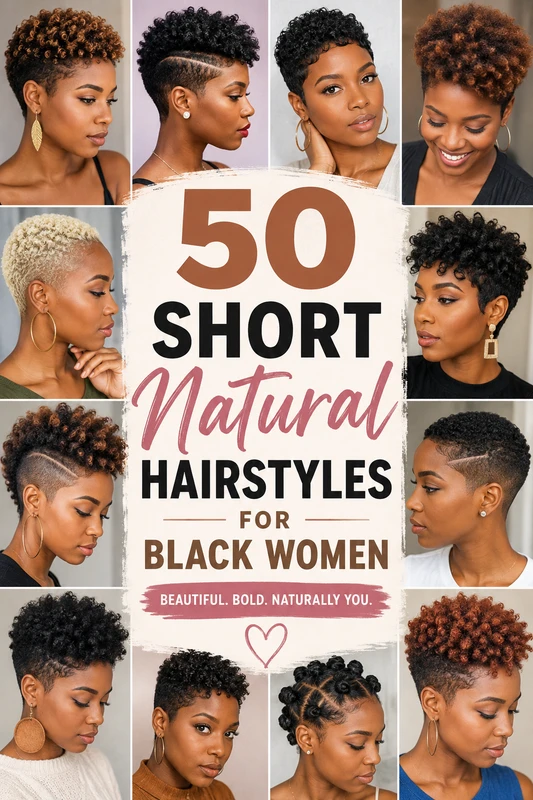
Short natural hair is bold, beautiful, versatile, and full of personality. Whether you recently did the big chop, have been wearing your natural texture for years, or simply want a low-maintenance hairstyle that celebrates your curls, coils, and kinks, there are countless short natural hairstyles for Black women to explore.
One of the biggest misconceptions about short natural hair is that there are not many styling options. In reality, short hair can be shaped, twisted, curled, braided, tapered, accessorized, stretched, defined, or worn in its natural Afro texture. Even a small change in your part, curl definition, edges, accessories, or volume can create an entirely different look.
The right hairstyle can also make your natural hair routine easier. Shorter hair may require less time to detangle, wash, moisturize, and style, although every head of hair is different. The key is choosing styles that work with your texture, density, length, lifestyle, and personal preferences.
If you're searching for inspiration, this guide covers 50 short natural hairstyles for Black women, including TWA styles, tapered cuts, twist-outs, finger coils, mini twists, short Afros, protective styles, and more.
Why Short Natural Hair Is So Popular
Short natural hair has become a favorite choice for women who want to embrace their texture while keeping their styling routine relatively simple.
For some women, going short begins with the big chop after transitioning away from relaxers or other chemical treatments. For others, a short haircut is simply a fashion choice.
There is something powerful about allowing your curls and coils to become the main attraction.
Short natural hairstyles can offer several advantages:
- Less hair to detangle
- Faster wash days for many women
- Easier access to the scalp
- Less dependence on heat styling
- Plenty of opportunities to experiment with color
- Easy ways to showcase earrings and makeup
- Numerous styling options for different curl patterns
- The ability to remove damaged ends and start fresh
Most importantly, short natural hair can be customized. You don't have to wear the same TWA every day.
Here are 50 styles worth trying.
1. Classic TWA
The teeny weeny Afro, commonly called a TWA, is one of the most iconic short natural hairstyles for Black women.
A TWA allows your natural curl or coil pattern to take center stage without requiring complicated styling. Depending on your texture, you can wear your TWA fluffy and soft or use styling products to create more definition.
Keeping the hair moisturized is particularly important because short hair is often exposed rather than tucked away inside a protective style.
Refresh your TWA in the morning with a light moisturizing spray when needed, gently shape the hair with your fingers, and you're ready to go.
2. Defined TWA
If you love your TWA but want your curl pattern to appear more defined, try a defined TWA.
Apply a leave-in product followed by a curl-defining cream, mousse, or gel appropriate for your hair. Work in small sections to encourage the curls to clump together.
Finger-coiling individual sections can provide even greater definition.
The result is a polished hairstyle that still celebrates your natural texture.
3. Fluffy TWA
Not every curl needs to be perfectly defined.
A fluffy TWA focuses on softness, volume, and texture. Instead of trying to create individual curls, gently fluff your hair using your fingers or an Afro pick.
Pick primarily near the roots rather than pulling through the entire strand. This can help create volume while minimizing unnecessary manipulation of your ends.
A fluffy TWA is particularly beautiful when you want an effortless, everyday hairstyle.
4. Tapered Natural Haircut
A tapered cut is one of the most popular short natural hairstyles because it creates a beautiful shape.
The sides and back are typically cut shorter while more length remains on top. This gives you enough hair to create curls, coils, twists, or volume at the crown.
A good barber or stylist who understands textured hair can customize the taper to complement your face and preferred styling routine.
5. Tapered Cut With Defined Curls
Take your tapered haircut to another level by defining the curls on top.
The contrast between closely cut sides and defined curls creates an eye-catching silhouette.
You can use finger coils, a curl sponge, shingling, or your preferred curl-defining technique.
This hairstyle can work especially well when you want short hair without cutting everything to exactly the same length.
6. High Tapered Afro
A high tapered Afro leaves noticeably more volume toward the top of the head.
The sides gradually become shorter, producing a taller silhouette.
This is an excellent option if you love Afro hairstyles but also want a more sculpted shape.
Use an Afro pick to gently lift the roots and create your desired height.
7. Short Rounded Afro
The rounded Afro is timeless.
Rather than emphasizing maximum volume, the hair is carefully shaped into a rounded silhouette.
A professional trim can make a significant difference because uneven or damaged ends may prevent the Afro from maintaining the desired shape.
Once the haircut is established, daily styling can be surprisingly simple.
Moisturize, fluff, shape, and go.
8. Mini Afro
If your hair is between the TWA and medium-length stages, embrace a mini Afro.
A mini Afro showcases your texture while providing slightly more volume than a traditional TWA.
It is also incredibly versatile.
You can add headbands, clips, scarves, side parts, decorative pins, or other accessories whenever you want to change the look.
9. Side-Parted Afro
Sometimes a simple part can completely transform short natural hair.
Create a clean side part using the end of a rattail comb and arrange your curls or coils toward either side.
You can keep the part subtle or make it deeper for a more dramatic effect.
This style works particularly well when you want to change your look without manipulating your hair extensively.
10. Short Afro With Laid Edges
Combine a fluffy short Afro with carefully styled edges.
The contrast between the textured Afro and smooth hairline can give the style a polished finish.
Use only the amount of edge-control product you need, and avoid excessive brushing or pulling around your hairline.
Your edges are delicate and should be handled gently.
11. Finger Coils
Finger coils are an excellent way to define short natural hair.
Start with damp, moisturized hair. Apply your preferred styling product to a small section, then wrap that section around your finger until a coil forms.
Repeat throughout the head.
Although finger coils can take time to install, the finished style can last for several days with proper nighttime protection.
12. Tiny Finger Coils
Smaller finger coils create even more definition.
Instead of working with medium sections, divide your hair into tiny sections and coil each individually.
The process requires patience, but smaller coils can provide impressive definition and styling longevity.
At night, protect the coils with a satin or silk bonnet or scarf to reduce friction.
13. Finger Coil-Out
Your finger coils don't have to end when you unravel them.
Once the coils are completely dry and have been worn for several days, carefully separate them to create a finger coil-out.
Use a small amount of oil or another product that provides slip on your fingertips if desired.
Separate gently to minimize frizz.
The result is a soft, textured hairstyle with beautiful curl definition.
14. Short Twist-Out
The twist-out remains one of the most popular natural hairstyles for good reason.
Divide damp hair into sections and create two-strand twists. Allow the hair to dry completely before unraveling.
Separate the twists according to the amount of volume you want.
Smaller twists generally create more definition, while larger twists can create a looser pattern.
15. Chunky Twist-Out
Prefer volume over tiny curls?
Try a chunky twist-out.
Create larger two-strand twists and allow them to dry completely. When you unravel them, gently fluff the roots.
Chunky twist-outs are ideal for women who want a soft, full appearance without spending hours installing dozens of small twists.
16. Mini Twist-Out
For maximum definition, create smaller twists.
Mini twist-outs take longer to install, but the smaller sections can produce highly defined texture.
The most important step is allowing your hair to dry completely before unraveling.
Taking twists down while the hair is still damp can cause the definition to disappear quickly.
17. Short Braid-Out
A braid-out offers another way to create texture without direct heat.
Instead of two-strand twists, braid damp or moisturized sections of hair.
Once completely dry, unravel the braids and gently separate the resulting waves.
Braid-outs often produce a slightly different pattern than twist-outs, so experimenting with both methods can help you discover which one works best for your hair.
18. Flat Twist-Out
Flat twists keep the hair closer to the scalp during the setting process.
Create several flat twists across your head and allow them to dry.
Once unraveled, the hair can have beautiful definition from root to tip.
Flat twist-outs can be especially useful if you struggle to get root definition from traditional two-strand twists.
19. Wash-and-Go
The wash-and-go is a natural hair favorite.
Despite the name, the style usually involves more than simply washing your hair and walking out the door.
A typical wash-and-go may include cleansing, conditioning, applying a leave-in product, adding curl-defining products, and allowing the hair to air-dry or using a diffuser.
The exact routine depends on your hair.
20. Defined Wash-and-Go
For maximum definition, apply your styling products in small sections.
Techniques such as shingling, finger-raking, smoothing, and finger-coiling can encourage curl clumping.
Avoid touching your hair excessively while it dries.
Once completely dry, gently lift the roots to add volume without disturbing the defined ends.
21. Voluminous Wash-and-Go
If you prefer bigger hair, focus less on perfect curl definition and more on volume.
After your wash-and-go has completely dried, gently separate some curl clumps and lift the roots using an Afro pick.
The combination of definition and volume creates a beautiful, full hairstyle.
22. Short Natural Pixie
A natural pixie combines the elegance of a classic pixie haircut with the beauty of textured hair.
The sides and back are usually kept relatively short, while slightly more length remains toward the top.
The result can be sleek, curly, fluffy, or edgy depending on how you style it.
23. Curly Pixie Cut
A curly pixie leaves enough length on top for your curls to remain visible.
Apply a lightweight curl-defining product and shape the curls with your fingers.
This style can beautifully frame the face while keeping your daily hair routine relatively simple.
24. Short Natural Hair With Shaved Sides
Want something bold?
Shaved sides can instantly transform a basic natural haircut.
Leave more length on the top while cutting the sides very low.
The difference in length creates dramatic contrast and allows the curls on top to become the focal point.
25. Natural Mohawk
A short natural mohawk creates volume through the center of the head while keeping the sides shorter.
You don't necessarily need to shave your sides.
Depending on your hair length, you can pin or flat-twist the sides upward toward the center.
This creates a temporary mohawk effect without permanently changing your haircut.
26. Frohawk
The frohawk combines an Afro with the shape of a mohawk.
Smooth or pin the sides toward the center while allowing the curls or coils in the middle to remain full.
Add decorative pins or clips along the sides for extra personality.
A frohawk can work for casual events, nights out, or special occasions.
27. Flat-Twist Frohawk
Instead of simply pinning the sides, create flat twists that travel upward toward the center.
Leave the center section loose and curly.
The flat twists add detail while helping keep the sides secure.
This is a great option when you want something more intricate than a basic frohawk.
28. Short Mini Twists
Mini twists are one of the most versatile styles for short natural hair.
Divide the hair into small sections and create two-strand twists throughout the head.
Depending on your length, you can wear the twists loose, side-parted, accessorized, or pinned.
Mini twists also reduce the amount of daily manipulation your loose strands receive.
29. Chunky Two-Strand Twists
If mini twists require more time than you want to spend, try chunky twists.
Larger sections make installation faster.
Chunky twists have a casual, textured appearance and can later be unraveled into a twist-out.
That essentially gives you two hairstyles from one styling session.
30. Side-Parted Mini Twists
Adding a side part can make mini twists look completely different.
Create the part before installing the twists so that the finished hairstyle naturally falls into position.
You can tuck one side behind your ear or add decorative clips for additional detail.
31. Flat Twists With Loose Curls
Flat-twist the front or sides of your hair while leaving the remaining hair loose.
Define the loose section using finger coils, a twist-out, or your natural curl pattern.
This half-flat-twisted look combines structure with volume.
It is also a useful option when you want to keep hair away from your face.
32. Flat-Twist Side Style
Create several flat twists on one side of the head while leaving the opposite side loose.
The asymmetrical appearance makes short natural hair look instantly more dramatic.
You can add beads, cuffs, or decorative pins to the twisted side.
33. Short Natural Hair With Headband
A headband may be one of the easiest ways to change your hairstyle in seconds.
Choose thin headbands for a subtle appearance or wide fabric headbands for more coverage.
Push the headband slightly backward to showcase your curls while keeping hair away from your face.
This is especially useful on days when you want a quick style.
34. Short Natural Hair With Headscarf
Headscarves provide practically endless styling possibilities.
Fold a scarf into a band and tie it around your hairline, or use a larger scarf to cover more of the head while allowing some curls to remain visible.
Scarves are available in countless patterns, textures, and colors, making them an easy way to coordinate your natural hair with your outfit.
35. Short Natural Hair With Gold Cuffs
Gold hair cuffs can instantly elevate twists, braids, or coils.
Place a few cuffs throughout the hairstyle rather than covering every section.
The metallic details look especially beautiful against dark hair.
Make sure the accessories are smooth and don't snag your strands.
36. Short Natural Hair With Beads
Beads aren't reserved for long braids.
Short twists and small braids can also be decorated with beads.
Wooden beads can create an earthy natural look, while metallic or colorful beads provide a more dramatic effect.
Be mindful of weight. Heavy accessories can place unnecessary tension on delicate strands.
37. Short Natural Hair With Hair Clips
Decorative clips offer one of the simplest styling upgrades.
Place several clips along one side of your hair, near a part, or above the ear.
This works especially well with a wash-and-go, TWA, twist-out, or short Afro.
38. Short Natural Hair With Deep Side Part
A deep side part creates an asymmetrical silhouette that can beautifully frame your face.
Move more hair toward one side and define the curls around the front.
The style can look particularly striking with tapered cuts and curly pixies.
39. Short Natural Hair With Middle Part
Middle parts aren't only for long hair.
If you have enough length, create a clean center part and allow your curls to frame both sides of your face.
This simple change can give your everyday hairstyle an entirely different appearance.
40. Brushed-Back Short Natural Hair
Sometimes you want your hair completely away from your face.
Gently smooth the front backward using a moisturizing styling product and a soft brush.
Allow the back and crown to remain textured.
Avoid pulling the hair excessively tight, especially around your edges.
41. Short Natural Hair With Side Cornrows
Add several small cornrows to one side while leaving the rest of your hair loose.
This creates the appearance of a partially shaved side without actually removing any hair.
Wear the loose section as an Afro, twist-out, finger coils, or wash-and-go.
42. Cornrows With Curly Top
Cornrow the sides or back while leaving the top section loose.
Define the top using your favorite curl technique.
The contrast between the neat cornrows and voluminous curls makes this hairstyle stand out.
Keep the braids comfortably secure rather than excessively tight.
43. Bantu Knots on Short Natural Hair
Bantu knots are both a hairstyle and a setting method.
Divide your hair into sections, twist each section, and wrap it around itself to create a small knot.
The size and number of knots depend on your hair length and density.
Wear the knots as-is or unravel them later.
44. Bantu Knot-Out
After wearing Bantu knots, carefully unravel them to reveal curls.
A Bantu knot-out can create springy, defined texture without direct heat.
For the best definition, allow your hair to dry completely before taking the knots down.
Separate carefully and fluff the roots until you reach your desired volume.
45. Sponge Curls
A curl sponge can help create small coils on short natural hair.
Apply a moisturizing or styling product, then gently move the sponge across the hair using consistent circular motions.
Avoid pressing too hard or rubbing aggressively.
Because friction can contribute to tangling or breakage, use the tool gently and pay attention to how your hair responds.
46. Short Natural Hair With Color
A new color can make a simple haircut feel completely different.
Popular options include:
- Honey blonde
- Auburn
- Copper
- Burgundy
- Caramel brown
- Golden brown
- Platinum blonde
- Red
- Chocolate brown
Remember that permanent hair color and lightening processes can affect the hair's condition. Colored natural hair may require extra attention to conditioning, moisture, and breakage prevention.
47. Copper Short Afro
Copper tones can look striking on a short Afro.
The warm color emphasizes the shape and texture of the hairstyle while creating a bold overall appearance.
You can color the entire head or add copper highlights for a subtler effect.
If your hair has been chemically lightened, prioritize gentle handling and regular conditioning.
48. Blonde TWA
A blonde TWA makes a major statement.
Because the hair is very short, the combination of texture and color becomes the center of attention.
Blonde shades range from honey and caramel to golden and platinum tones.
Going significantly lighter often requires bleaching, so consider working with a professional colorist experienced with textured hair.
49. Gray Short Natural Hair
Gray natural hair can be absolutely beautiful.
Instead of covering silver strands, many women choose to make them part of their signature look.
A gray TWA, tapered Afro, finger-coil style, or curly pixie can look sophisticated and modern.
Gray hair can sometimes feel different in texture from pigmented strands, so adjust your moisturizing routine based on how your hair actually responds.
50. Salt-and-Pepper Tapered Cut
A salt-and-pepper tapered cut combines natural gray strands with a sculpted short haircut.
Keep the sides neatly tapered while allowing more curls or coils on top.
The variation between dark and silver strands naturally creates dimension, making even a simple hairstyle visually interesting.
How to Choose the Best Short Natural Hairstyle
With so many options available, choosing a style can feel overwhelming.
Instead of choosing solely based on a photo, think about how the hairstyle will work with your actual hair and routine.
Consider Your Hair Length
A woman with a one-inch TWA will have different styling options than someone with five inches of natural hair.
If your hair is extremely short, consider:
- TWAs
- Finger coils
- Sponge curls
- Tapered cuts
- Short Afros
- Headband styles
As you gain more length, you can experiment with mini twists, flat twists, Bantu knots, frohawks, braid-outs, and other styles.
Consider Your Hair Density
Density describes how many strands of hair grow on your scalp.
High-density hair may naturally create more volume, while lower-density hair may appear less full.
Neither is better.
The goal is to choose a haircut and styling technique that complements your natural density rather than constantly trying to force your hair to behave like someone else's.
Consider Your Curl Pattern
Curl pattern can influence how a hairstyle appears, but it should not be used as a strict rulebook.
Type 3 curls may hang differently than tight Type 4 coils. Even within one person's head, multiple curl patterns are common.
Experiment with techniques instead of assuming a hairstyle won't work simply because your texture looks different from the model's.
Consider Your Lifestyle
Ask yourself how much time you realistically want to spend styling your hair.
If you prefer extremely quick mornings, a shaped TWA or tapered Afro may be ideal.
If you enjoy styling your hair and want definition, finger coils or mini twists may be worth the extra installation time.
Your hairstyle should fit your life—not make your life more difficult.
How to Maintain Short Natural Hair
Short hair doesn't mean no maintenance.
Healthy-looking short natural hair still benefits from consistent cleansing, conditioning, moisturizing, gentle detangling, and nighttime protection.
1. Keep Your Scalp Clean
Product buildup, sweat, oil, and environmental debris can accumulate on your scalp.
Cleanse your hair and scalp on a schedule that works for your needs.
Someone who exercises frequently or uses a lot of styling products may need a different washing schedule from someone who uses minimal products.
Pay attention to your scalp rather than following an arbitrary number of days.
2. Condition Your Hair
Conditioning helps improve softness, manageability, and slip.
After shampooing, apply conditioner throughout your strands and gently detangle if necessary.
Deep conditioning can also be incorporated according to your hair's needs.
3. Moisturize When Needed
Natural hair can become dry when it loses moisture.
Water-based leave-in products and moisturizing sprays can help refresh hair between wash days.
The amount and frequency needed will vary.
Rather than automatically applying large amounts of product every day, check your hair first.
If it still feels moisturized, you may not need to add more.
4. Don't Forget Your Ends
Your ends are the oldest part of your hair.
Even with short hair, they deserve gentle treatment.
Avoid excessive manipulation, aggressive combing, and constantly allowing your ends to rub against rough fabrics.
Regular trims can help remove split or damaged ends and maintain the shape of your haircut.
5. Protect Your Hair at Night
Cotton pillowcases can create friction against the hair.
Consider sleeping with a satin or silk bonnet, scarf, or pillowcase.
Nighttime protection can also help preserve hairstyles such as finger coils, wash-and-gos, and twist-outs, reducing how much restyling you need in the morning.
Best Products for Short Natural Hair
You don't necessarily need ten different styling products to maintain short natural hair.
A simple routine might include:
Shampoo: Removes dirt, sweat, buildup, and excess product.
Conditioner: Adds slip and makes detangling easier.
Leave-in conditioner: Provides additional conditioning and can make hair easier to style.
Moisturizer: Helps keep dry hair feeling soft.
Curl cream: Can enhance definition depending on your texture.
Gel: Provides hold for wash-and-gos, coils, edges, and other defined styles.
Oil: Can be used in small amounts for lubrication, shine, or as part of your preferred routine.
The best products are the ones that work for your individual hair.
More product doesn't automatically mean better results.
How to Make Short Natural Hair Look Fuller
If your goal is to create the appearance of more volume, styling technique can make a big difference.
Start by focusing on your roots.
After your hairstyle has dried, gently use an Afro pick to lift the hair near the scalp without pulling through the ends.
Separating curls can also increase volume, although excessive separation can create frizz.
Haircut shape matters too.
A professionally shaped Afro or tapered cut can sometimes make natural hair appear more balanced and intentionally full.
How to Define Short Natural Hair
For more definition, style your hair while it is damp.
Divide it into manageable sections and distribute your styling products evenly.
You can then use techniques such as:
- Finger-coiling
- Shingling
- Smoothing
- Raking
- Two-strand twisting
- Braiding
- Bantu knots
Allow your hair to dry completely before separating or manipulating it.
The right amount of product is important. Too little may not provide enough hold, while too much can leave buildup or weigh your curls down.
Experiment until you find the balance that works for you.
How to Style Short Natural Hair in the Morning
Morning styling doesn't need to take an hour.
If you protected your hair properly overnight, you may only need a few minutes.
Remove your bonnet or scarf and give your hair time to settle.
Use your fingers to reshape any flattened sections.
If necessary, lightly mist dry areas with water or a moisturizing product.
Fluff your roots and reposition your curls.
Add an accessory if desired.
That's often enough to refresh a short style without starting over.
How to Protect Short Natural Hair at Night
Your nighttime routine can determine how much work you'll need to do the next morning.
For very short hair, simply covering your hair with a satin bonnet may be enough.
For longer short styles, loosely sectioning the hair can help prevent flattening.
Avoid going to bed with soaking-wet hair whenever possible, especially when your hairstyle needs to maintain definition.
Make nighttime protection a consistent habit.
Short Natural Hairstyles for Work
Natural hair can be styled in countless polished ways for professional environments.
Consider:
- Defined TWA
- Tapered cut
- Finger coils
- Mini twists
- Rounded Afro
- Curly pixie
- Flat-twist styles
- Side-parted wash-and-go
There is no requirement for natural hair to be straightened to look polished or professional.
Healthy, intentionally styled curls, coils, Afros, twists, and locs can all be appropriate professional hairstyles.
Short Natural Hairstyles for Special Occasions
Short hair can also look glamorous for weddings, birthdays, anniversaries, dinners, and formal events.
Try dressing up your hairstyle with decorative accessories.
Gold cuffs, pearl pins, rhinestone clips, floral accessories, elegant headbands, and statement earrings can completely transform a short hairstyle.
You can also create extra curl definition before the event using finger coils, Bantu knots, or a twist-out.
Short Natural Hairstyles for Women Over 40
Women over 40 have countless options for short natural hair.
A tapered Afro can provide structure while still showcasing natural texture.
Finger coils create definition.
A curly pixie offers a chic silhouette.
Salt-and-pepper curls can also become a major feature rather than something to hide.
Hair doesn't suddenly come with age restrictions.
Choose the style that makes sense for your preferences, lifestyle, and hair.
Short Natural Hairstyles for Women Over 50
Short hairstyles are especially popular among women who want manageable routines while maintaining plenty of style.
Some beautiful options include:
- Gray TWA
- Salt-and-pepper Afro
- Tapered curls
- Curly pixie
- Finger coils
- Short twists
- Rounded Afro
- Wash-and-go
Regular shaping can keep short hair looking intentional while removing damaged ends.
Short Natural Hairstyles for Women Over 60
Natural gray and silver hair can look incredible in short styles.
Consider embracing your natural color with a silver Afro, gray tapered cut, salt-and-pepper pixie, or soft finger coils.
Because hair texture and density can change over time, choose styling practices based on what your hair needs now rather than what worked years ago.
Gentle manipulation should always be a priority.
Short Natural Hairstyles for Thin Hair
If your hair has lower density, certain styling techniques can create the appearance of more fullness.
A strategically shaped haircut is often helpful.
Shorter lengths may reduce the contrast between fuller and thinner areas, while curls can create visual dimension.
Try:
- Soft finger coils
- Fluffy TWA
- Short layered curls
- Tapered styles
- Small twist-outs
Avoid extremely tight hairstyles that place unnecessary tension on your scalp or hairline.
If you experience sudden, unexplained, or significant hair thinning, consider speaking with a qualified healthcare professional or dermatologist.
Short Natural Hairstyles for Thick Hair
High-density natural hair can create incredible volume even at shorter lengths.
A rounded Afro is a classic choice.
Tapered cuts can remove some bulk around the sides while preserving volume on top.
Mini twists are another excellent option because they organize the hair into manageable sections.
Don't be afraid of volume.
A well-shaped short Afro can turn natural density into the main feature of your hairstyle.
Short Natural Hairstyles for 4C Hair
4C hair is incredibly versatile.
Its tight coils can create beautiful sculpted shapes and impressive volume.
Great short styles for 4C hair include:
- TWA
- Afro
- Tapered Afro
- Finger coils
- Mini twists
- Flat twists
- Twist-outs
- Bantu knots
- Frohawks
- Sponge coils
Focus on gentle detangling and adequate moisture during styling.
Shrinkage is a normal characteristic of tightly coiled hair and doesn't mean your hair isn't growing.
Short Natural Hairstyles for 4B Hair
4B hair can create beautifully defined textured styles.
Finger coils, twist-outs, Bantu knot-outs, mini twists, and Afros are all excellent choices.
Because 4B hair can shrink significantly, the final hairstyle may appear considerably shorter than the stretched length.
You can embrace the shrinkage or gently stretch the hair using heat-free techniques when you want additional length.
Short Natural Hairstyles for 4A Hair
4A hair often forms visible coils that respond beautifully to curl-defining techniques.
Wash-and-gos, finger coils, curly pixies, tapered cuts, and defined TWAs can showcase the natural pattern.
Experiment with different amounts of styling product.
The goal is to encourage definition without leaving the hair excessively stiff or coated.
Short Natural Hairstyles Without Gel
You don't have to use gel to style short natural hair.
If you prefer softer hold, try:
- Twist-outs
- Braid-outs
- Mini twists
- Bantu knot-outs
- Fluffy Afros
- Headband styles
- Headscarf styles
- Soft finger coils
Creams, mousses, foams, or leave-in products may provide enough styling support depending on your hair.
Low-Maintenance Short Natural Hairstyles
If your priority is saving time, choose styles that don't require daily resetting.
Some of the easiest options include:
TWA: Moisturize, shape, and go.
Tapered cut: The haircut itself provides much of the style.
Mini twists: Install once and maintain them for multiple days.
Finger coils: Properly installed coils can remain defined for several days.
Rounded Afro: Regular shaping makes everyday styling straightforward.
Low maintenance doesn't mean zero maintenance. Your scalp still needs cleansing, and your hair still benefits from conditioning and gentle care.
Protective Short Natural Hairstyles
Protective styling doesn't require waist-length braids.
Short natural hair can be worn in low-manipulation and protective configurations too.
Mini twists, flat twists, cornrows, and certain tucked styles can help reduce daily manipulation.
However, a hairstyle isn't automatically protective just because it contains braids or twists.
If the style is too tight, excessively heavy, installed roughly, or neglected for too long, it may work against your hair goals.
Comfort should always come first.
How Often Should You Trim Short Natural Hair?
There isn't one trimming schedule that works for everyone.
Your ideal schedule depends on:
- Your haircut
- Styling habits
- Heat usage
- Chemical processing
- Condition of your ends
- Hair goals
If you're maintaining a precise tapered cut or pixie, you may need shaping more frequently than someone growing out a TWA.
Pay attention to your ends and the overall shape of your hairstyle.
How to Grow Out Short Natural Hair
Growing out short natural hair requires patience.
Hair growth doesn't always look dramatic because shrinkage can hide length.
Instead of constantly measuring your hair, focus on retaining the length you grow.
That means reducing unnecessary breakage.
Build a consistent routine involving cleansing, conditioning, detangling, moisturizing as needed, nighttime protection, and gentle styling.
Avoid constantly changing products because you think one product will suddenly make your hair grow several inches.
Hair growth is gradual.
The Awkward Stage Isn't Actually Awkward
Many women describe the period between a TWA and longer natural hair as the "awkward stage."
But this length can actually be one of the most creative stages of your natural hair journey.
Your hair may be long enough for:
- Twist-outs
- Mini twists
- Bantu knots
- Frohawks
- Headband styles
- Small flat twists
- Finger coils
- Mini Afros
Instead of waiting for your hair to become longer before enjoying it, experiment with the length you have right now.
Common Short Natural Hair Mistakes to Avoid
Even though natural hair routines are highly individual, a few habits can make short hair harder to manage.
Using Too Much Product
Short hair usually requires less product than long hair.
Applying large amounts can create buildup quickly.
Start with a small amount and add more only when necessary.
Manipulating Your Hair Constantly
Short hair is easy to touch because it is accessible.
But constantly twisting, pulling, fluffing, and restyling your hair can create unnecessary manipulation.
Once you've created your hairstyle, try to leave it alone.
Ignoring Your Scalp
Because short hair makes the scalp more visible, it is tempting to continuously add oils and styling products.
But your scalp also needs regular cleansing.
Product buildup isn't the same thing as moisture.
Skipping Nighttime Protection
Even short hair can become flattened, tangled, or dry from nighttime friction.
A satin bonnet, scarf, or pillowcase can help.
Comparing Your Texture to Someone Else's
Two people can follow the exact same wash-and-go routine and get completely different results.
Hair texture, density, porosity, length, haircut, climate, products, and technique all influence the finished hairstyle.
Use inspiration photos as ideas—not standards your hair has to copy perfectly.
Frequently Asked Questions About Short Natural Hairstyles for Black Women
What is the easiest hairstyle for short natural hair?
A TWA is one of the easiest options because the haircut does much of the styling work. A shaped Afro, tapered cut, or simple wash-and-go can also be relatively low maintenance depending on your texture.
Can short natural hair be protective styled?
Yes. Mini twists, flat twists, small cornrows, and certain tucked styles can reduce daily manipulation. Make sure the hairstyle isn't excessively tight.
How do I make my short natural hair look cute?
Experiment with your part, curl definition, volume, accessories, edges, and haircut shape. Even a simple headband or decorative clip can completely change a short hairstyle.
How do I style short 4C natural hair?
Try finger coils, mini twists, twist-outs, sponge coils, Bantu knots, flat twists, TWAs, tapered Afros, and frohawks.
How can I style short natural hair without heat?
Most of the hairstyles in this guide don't require direct heat. Twist-outs, braid-outs, Bantu knot-outs, finger coils, mini twists, Afros, and flat twists can all be created without a flat iron or curling iron.
Can you do a twist-out on very short hair?
Yes, provided you have enough length to create small two-strand twists. If your hair is extremely short, finger coils or sponge curls may be easier.
How do you keep short natural hair moisturized?
Use a routine appropriate for your hair that includes regular cleansing and conditioning. Apply a water-based moisturizer or leave-in when your hair needs it, and protect your hair from excessive nighttime friction.
Are short natural hairstyles good for summer?
They can be. Many women enjoy short hair during warm weather because there is less hair around the neck and shoulders. However, exposed hair still needs proper care, particularly when spending significant time in the sun or swimming.
What hairstyle makes short natural hair look longer?
Stretching techniques such as braid-outs, twist-outs, banding, or gentle tension stretching can reveal more of your actual length by reducing shrinkage.
What hairstyle makes short natural hair look fuller?
Afros, separated twist-outs, fluffy wash-and-gos, finger coil-outs, and strategically shaped tapered cuts can all create the appearance of additional volume.
Creating a Simple Weekly Routine for Short Natural Hair
A natural hair routine doesn't have to be complicated.
You might begin your week with a thorough wash and conditioning session.
After cleansing, apply your preferred leave-in and styling products.
Choose a hairstyle that can last for several days, such as finger coils, mini twists, or a defined wash-and-go.
Protect the hairstyle each night.
During the week, refresh only when necessary.
By reducing the need to completely restyle your hair every morning, you can save time and minimize manipulation.
Your exact schedule should always depend on your scalp, hair, activities, and product use.
Embrace Shrinkage
Shrinkage is often treated like a problem, particularly for women with tightly coiled natural hair.
But shrinkage is a normal feature of curly and coily hair.
Hair that stretches several inches may appear dramatically shorter when wet or allowed to shrink naturally.
That doesn't mean you've lost your length.
Some hairstyles in this guide intentionally stretch the hair, while others celebrate shrinkage.
You can enjoy both.
One day you might wear a compact TWA.
Another day you might wear a stretched twist-out.
Both styles represent your natural hair.
Accessories Can Transform Short Natural Hair
One advantage of short natural hair is how noticeable accessories become.
Because there isn't a large amount of hair competing for attention, a single accessory can make a significant visual impact.
Try:
- Satin scarves
- Patterned headbands
- Gold cuffs
- Decorative clips
- Pearls
- Beads
- Flowers
- Statement earrings
Accessories are particularly useful when you're growing your hair out and want to create different looks without changing the actual haircut.
Building Confidence With Short Natural Hair
For women accustomed to long hairstyles, extensions, braids, wigs, or straightened hair, seeing yourself with very short natural hair can initially feel different.
Give yourself time to experiment.
Try different earrings.
Change your makeup.
Experiment with headbands.
Play with curl definition.
Try a side part.
Let your Afro become fluffy.
Wear your TWA exactly as it grows.
Eventually, you may discover that having less hair gives you even more freedom to focus on your natural texture and personal style.
There isn't one correct way for Black women to wear natural hair.
Your hair doesn't have to be long to be feminine.
It doesn't have to be perfectly defined to be beautiful.
And every strand doesn't have to remain frizz-free for your hairstyle to look good.
Final Thoughts: 50 Short Natural Hairstyles for Black Women
The best thing about short natural hairstyles for Black women is their versatility.
A short haircut can be simple one day and dramatic the next.
You can wear a classic TWA on Monday, define your coils later in the week, add a headband on the weekend, and eventually grow your hair into mini twists or a larger Afro.
From short 4C hairstyles and tapered natural haircuts to finger coils, twist-outs, mini twists, wash-and-gos, Afros, Bantu knots, frohawks, and curly pixies, there are plenty of ways to make short natural hair your own.
The most important thing is to work with your natural texture rather than constantly fighting against it.
Keep your scalp clean, condition regularly, moisturize according to your hair's needs, handle your strands gently, and protect your hair at night.
Most importantly, enjoy every stage of your natural hair journey—including the short stage.
Your TWA doesn't have to be something you're simply waiting to grow out.
It can be a hairstyle worth celebrating all by itself.