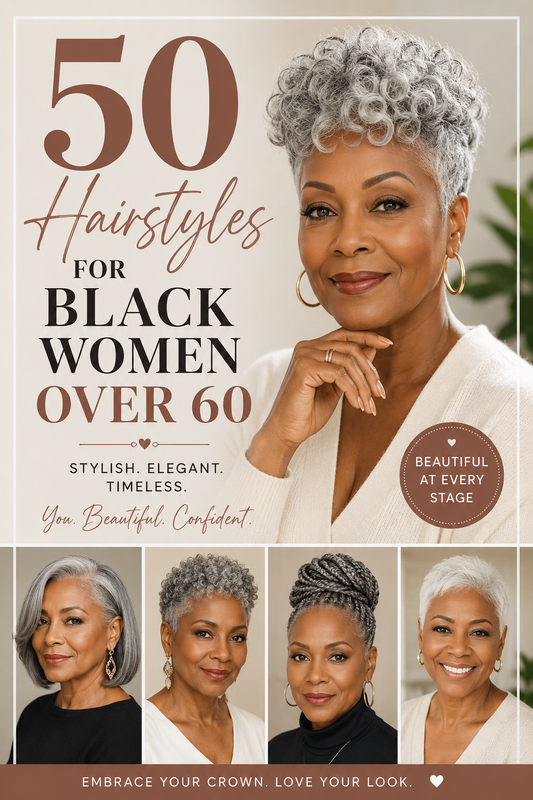
Finding the perfect hairstyle after 60 is about much more than following trends. The best hairstyle should make you feel confident, complement your face, work with your natural texture, and fit comfortably into your everyday routine. For Black women over 60, there are countless beautiful options—from short natural cuts and sophisticated gray hairstyles to locs, braids, twists, curls, and protective styles.
One of the biggest advantages of Black hair is its versatility. Natural coils can be shaped into a tapered cut one month and allowed to grow into a soft afro the next. Locs can be worn loose, pinned into an elegant updo, or styled into a bob. Braids and twists provide protective options, while relaxed or straightened hair can be shaped into polished pixies, bobs, and layered styles.
And gray hair does not have to be hidden. Silver, salt-and-pepper, white, and naturally gray strands can become part of the hairstyle itself, creating a striking and sophisticated look.
This guide covers 50 hairstyles for Black women over 60, including options for natural hair, thinning hair, short hair, medium-length hair, long hair, gray hair, locs, braids, and protective styles. You'll also find practical tips for choosing a flattering hairstyle and keeping mature Black hair moisturized, strong, and manageable.
Why Hairstyles Can Change After 60
Hair can change considerably with age. A hairstyle that worked beautifully at 40 or 50 may require adjustments later because the hair's density, moisture level, texture, or growth pattern may have changed.
Some women notice that their strands become finer. Others experience increased dryness, particularly around the ends. Gray strands may also feel different from pigmented hair. They can sometimes feel wiry or coarse, while other women find that their gray hair becomes softer or finer.
Because of these changes, a great hairstyle after 60 should ideally balance four things:
Beauty, comfort, manageability, and hair health.
You don't have to cut your hair short simply because you've reached a certain age. Long natural hair, braids, locs, twists, afros, and flowing curls can all look beautiful on older women.
The goal is to find a style that works for your hair as it is today.
1. Short Tapered Natural Cut
A short tapered natural cut is one of the most flattering hairstyles for Black women over 60 because it combines simplicity with style.
The hair is kept shorter around the sides and back while leaving slightly more length on top. The additional hair on top can be curled, coiled, twisted, or simply allowed to show its natural texture.
This cut beautifully frames the face and can highlight your cheekbones, eyes, earrings, and glasses.
It is also relatively easy to maintain. Instead of spending hours detangling longer hair, you can focus on keeping the scalp clean and the short strands properly moisturized.
Women with naturally gray or salt-and-pepper hair can make this style especially striking by allowing the contrasting shades to become part of the finished look.
2. Classic TWA
The TWA—or teeny weeny afro—is a timeless choice for women who enjoy short natural hair.
It requires very little daily styling and puts your natural texture front and center.
A TWA can be worn extremely short or grown out slightly for more volume. Adding a clean shape around the perimeter can make the hairstyle appear polished without making it overly structured.
This is also an excellent option for women transitioning away from relaxers, permanent color, or years of heat styling.
Moisture remains important even when the hair is short. Apply a lightweight leave-in moisturizer as needed and protect your hair at night with satin or silk.
3. Silver TWA
Why cover your gray when you can make it the star of your hairstyle?
A silver TWA is sophisticated, modern, and beautifully simple.
Natural gray hair can contain several different tones at once, including charcoal, silver, white, and darker strands. On short textured hair, these variations can create beautiful natural dimension.
Keep the cut shaped and the strands moisturized to help your silver hair look vibrant and healthy.
4. Rounded Afro
The classic rounded afro remains one of the most iconic Black hairstyles ever created.
And there is absolutely no age limit.
A carefully shaped afro gives the hair volume while celebrating its natural texture. The style can be kept relatively short for easier maintenance or grown larger if your density and personal preference allow.
Regular shaping can prevent the silhouette from becoming uneven.
When styling, avoid excessive manipulation. Gently fluff the roots rather than repeatedly combing through the ends.
5. Soft Mini Afro
If a large afro requires more maintenance than you want, consider a smaller version.
A soft mini afro gives you natural volume without requiring as much detangling or styling.
It works particularly well for women who have recently completed a big chop or who simply prefer keeping their hair several inches long.
The softer shape creates a relaxed, elegant appearance that works for everyday wear.
6. Natural Pixie Cut
The natural pixie is short, chic, and sophisticated.
Instead of completely straightening the hair, the cut allows some of your natural wave, curl, or coil pattern to remain visible.
The top can be slightly longer for texture while the sides stay neatly tapered.
A pixie can also be customized according to face shape. A little extra height on top can elongate the face, while soft curls around the forehead can create a gentler appearance.
7. Curly Pixie
If your hair naturally forms curls or coils, a curly pixie lets them shine.
The hairstyle is short enough to be convenient but long enough to provide visible texture.
You can define curls with a moisturizing styling product or wear them softer and less structured.
The result is youthful without trying to look overly trendy.
8. Salt-and-Pepper Pixie
A salt-and-pepper pixie combines two beautiful features: a sophisticated short haircut and naturally multidimensional color.
Instead of constantly coloring gray roots, some women decide to embrace the transition.
Short hair can make that transition easier because previously colored ends can gradually be trimmed away.
The mixture of dark and silver strands gives the pixie natural contrast and dimension.
9. Finger Coils
Finger coils are an excellent option for short to medium-length natural hair.
Small sections of damp hair are wrapped around the finger to encourage defined coils. Once dry, the coils can remain neatly separated or be gently pulled apart for additional volume.
Finger coils can reduce the amount of daily manipulation required because the definition can last for several days with proper nighttime protection.
A satin bonnet or scarf can help preserve the style.
10. Defined Wash-and-Go
For women whose curls respond well to wash-and-go styling, this can be one of the easiest ways to showcase natural texture.
The process typically involves applying moisturizing and defining products to freshly washed hair before allowing the curls to dry.
The key for mature hair is avoiding products that leave the strands excessively stiff or dry.
Soft definition usually looks and feels better than extremely hard, crunchy curls.
11. Twist-Out
A twist-out is one of the most versatile natural hairstyles for Black women over 60.
After washing and moisturizing the hair, divide it into sections and create two-strand twists. Once the hair is completely dry, carefully unravel the twists.
The result is soft, defined waves or curls.
You can create chunky twists for larger curls or smaller twists for tighter definition.
For extra volume, gently lift the roots without disturbing the ends.
12. Braid-Out
A braid-out works similarly to a twist-out but uses braids to create the pattern.
Braids often produce slightly more stretched results than twists, making this technique useful for women who want to reduce the appearance of shrinkage.
A braid-out can be worn with a center part, side part, or swept away from the face.
13. Flat-Twist-Out
Flat twists can create gorgeous definition while keeping the hair relatively stretched.
Once the twists are unraveled, the hair often has a beautiful wavy pattern.
This technique can be especially helpful if you find individual two-strand twists difficult to maintain overnight.
The final style can last several days when properly protected.
14. Side-Parted Natural Curls
Sometimes changing your part is enough to completely transform your hairstyle.
A deep side part can add instant sophistication to natural curls.
Allow the fuller side to fall softly around the forehead and cheek while keeping the opposite side slightly flatter.
This creates a flattering asymmetrical appearance without requiring a dramatic haircut.
15. Natural Curly Bob
A curly bob is a beautiful compromise between very short and longer natural hair.
The hair generally falls somewhere between the ears and shoulders, depending on your curl pattern and shrinkage.
A rounded or slightly layered shape helps prevent the style from appearing too heavy.
Curly bobs look especially beautiful with gray or salt-and-pepper strands.
16. Chin-Length Bob
A chin-length bob is polished, timeless, and easy to customize.
It can be worn straight, curled, relaxed, pressed, or naturally textured.
Women who want a classic hairstyle without going extremely short may find this length ideal.
A side part can soften the appearance, while a center part creates a more structured look.
17. Layered Bob
Layers add movement and prevent a bob from looking too heavy.
For women with curls, layers can also help distribute volume more evenly throughout the hairstyle.
If your hair has become somewhat finer with age, carefully placed layers may create the appearance of additional movement and fullness.
However, extremely aggressive layering can make already-thin ends appear even thinner, so the haircut should be customized to your density.
18. Shoulder-Length Natural Curls
There is no rule saying women over 60 need short hair.
Shoulder-length natural curls can be elegant, feminine, and versatile.
This length gives you enough hair for buns, twists, puffs, and updos while remaining more manageable than very long hair.
Regular trims can help prevent thin, weathered ends from taking away from the overall shape.
19. Soft Gray Curls
Naturally gray curls can be stunning.
Instead of trying to make every curl perfectly defined, consider allowing the hair to have a softer, fuller appearance.
Silver strands catch light differently than darker hair, which can make curly texture particularly noticeable.
Keeping gray hair moisturized is important because dryness can make it appear dull.
20. Silver Afro
A full silver afro makes a beautiful statement.
This style combines natural texture with one of the most distinctive characteristics of mature hair.
The contrast created by silver, white, gray, and darker strands can give the afro tremendous visual dimension.
Focus on moisture and gentle handling rather than trying to make every strand behave identically.
21. Salt-and-Pepper Afro
If your hair hasn't turned completely gray, embrace the mixture.
A salt-and-pepper afro showcases the transition rather than hiding it.
The darker sections can make lighter strands stand out beautifully.
Keeping the afro professionally shaped can give the hairstyle a deliberate, polished appearance.
22. Natural High Puff
The high puff remains a quick and beautiful natural hairstyle at any age.
The hair is gently gathered toward the crown while the curls remain loose.
Avoid pulling the edges excessively tight. Mature edges can sometimes be more delicate, and repeated tension can contribute to breakage.
A slightly looser puff can look just as elegant while being gentler on your hairline.
23. Low Natural Puff
A low puff provides a softer alternative to the high puff.
Gather your hair near the nape and allow the textured ends to create fullness.
This is an excellent option for casual days when you want your hair controlled without spending much time styling it.
Add a side part or leave a few soft curls around the front for variation.
24. Low Bun
Few hairstyles are as timeless as the low bun.
It works beautifully for church, work, weddings, dinners, vacations, and everyday life.
The hair can be smoothed gently toward the nape and secured without excessive tension.
If your natural hair is shorter, a small bun can still look elegant. There is no need to create an oversized bun.
25. Textured Low Bun
Instead of slicking every strand completely flat, embrace texture.
A textured low bun maintains the natural character of Black hair while still providing an elegant updo.
Allow some volume around the crown before gathering the ends into a bun.
This can be particularly flattering for women who prefer softer hairstyles around the face.
26. Natural Updo
A natural updo can transform curls, coils, or stretched natural hair into an elegant formal hairstyle.
Sections can be twisted, tucked, and pinned into place.
Because updos can be customized, they work for a variety of hair lengths.
The most important consideration is tension. Pins should secure the style without causing scalp discomfort.
27. Flat-Twist Updo
Flat twists are perfect for creating sophisticated protective hairstyles.
The hair can be flat-twisted upward from the sides and back before the remaining hair is arranged into curls, twists, or a small bun at the crown.
This creates visual interest while keeping much of the hair tucked away.
28. Two-Strand Twists
Two-strand twists are among the most practical hairstyles for mature natural hair.
They reduce daily manipulation, help retain moisture, and can be styled in numerous ways.
Twists can be short, medium, or long depending on your hair length.
They can also be worn loose, pinned back, gathered into a ponytail, or arranged into an updo.
29. Mini Twists
Mini twists provide a smaller, more versatile version of traditional two-strand twists.
Because they are smaller, they can often be styled similarly to loose hair.
You can wear them down, create a side part, pull them into a low ponytail, or pin them into an updo.
The installation takes longer, but the style can simplify your routine afterward.
30. Chunky Twists
If mini twists require too much time, chunky twists offer a faster alternative.
Larger sections mean fewer twists and less installation time.
Chunky twists can create a beautiful, full appearance and work especially well when you want a relaxed protective hairstyle.
31. Flat Twists
Flat twists provide a neat protective option without requiring added hair.
They can be created straight back, toward one side, or in a decorative pattern.
For mature hairlines, avoid extremely small sections or excessive tension around the temples.
Comfort should always come before achieving an ultra-tight finish.
32. Short Locs
Short locs can be stylish, practical, and incredibly versatile.
They may be worn loose, curled, side-parted, or accessorized.
For women who prefer a lower-manipulation hair routine, mature locs can eliminate much of the daily detangling associated with loose natural hair.
Regular scalp cleansing and appropriate moisture remain important.
33. Loc Bob
A loc bob creates a beautiful structured shape while keeping locs relatively short.
The locs can fall around chin length or slightly below.
This style frames the face beautifully and offers many of the advantages of locs without the weight of very long hair.
Silver locs can make the style particularly striking.
34. Shoulder-Length Locs
Shoulder-length locs provide enough length for styling while remaining manageable.
You can wear them loose, half-up, curled, pinned, or gathered into a low ponytail.
Women transitioning into gray can also allow their natural silver roots to gradually become part of their locs.
The contrast can be beautiful.
35. Long Gray Locs
Long hair does not have an expiration date.
Long gray locs can create a powerful and sophisticated look for Black women over 60.
The combination of length, texture, and natural silver color is distinctive without requiring complicated daily styling.
Long locs do require maintenance, however. Keep the scalp clean and pay attention to dryness and excessive weight.
36. Loc Updo
Locs can be transformed into elegant updos for special occasions or everyday wear.
Depending on their length, they can be wrapped, pinned, twisted, or gathered toward the crown.
A looser updo is often more comfortable than pulling every loc tightly.
Decorative pins or subtle accessories can complete the look.
37. Half-Up, Half-Down Locs
This style keeps locs away from the face while allowing you to enjoy their length.
Simply gather the top portion of your locs and secure them toward the crown.
The remaining locs stay loose.
This is a simple style that can work equally well with black, gray, or salt-and-pepper locs.
38. Side-Swept Locs
Moving your locs to one side can create an entirely different appearance without requiring a complicated style.
A deep side part adds volume and frames the face beautifully.
This is particularly attractive with shoulder-length or longer locs.
39. Short Box Braids
Box braids remain an option for older women, but mature hair should be treated carefully.
Short or bob-length box braids can provide the beauty of braids without the weight associated with extremely long extensions.
Ask your braider to avoid pulling tightly around the hairline.
Lightweight braiding hair and larger sections may also help reduce unnecessary tension.
40. Medium Box Braids
Medium box braids are versatile and easy to style.
They can be worn loose, pulled into a low ponytail, or arranged into a half-up style.
The key is keeping the braids lightweight.
If extensions feel heavy immediately after installation, that may be a sign that too much weight has been added to your natural strands.
41. Gray Box Braids
Gray braiding hair can create an incredible look for women who want extensions that complement their natural silver strands.
Instead of hiding gray roots beneath dark extensions, silver, gray, white, or blended braiding hair allows the color transition to look intentional.
This can produce a sophisticated protective style.
42. Cornrows
Cornrows are a traditional protective hairstyle that can work beautifully for women over 60.
Simple straight-back cornrows are classic, while curved or side-swept patterns add more personality.
The braids should never be painfully tight.
If your scalp feels sore or your hairline appears stretched after installation, the style may have been braided too tightly.
43. Feed-In Braids
Feed-in braiding techniques can create a smoother transition between natural hair and extensions.
For mature hair, fewer and larger braids may be preferable to numerous tiny braids.
This reduces the amount of manipulation and can help keep the finished hairstyle lighter.
44. Braided Bob
A braided bob combines the convenience of braids with a flattering shorter silhouette.
The braids typically fall somewhere between the jaw and shoulders.
This makes them lighter and easier to manage than waist-length extensions.
A side part gives the style additional movement.
45. Crochet Curls
Crochet hairstyles can create volume without requiring every strand of natural hair to remain exposed.
Your hair is generally braided underneath before crochet hair is attached.
Choose lightweight extensions whenever possible.
The finished curls can be cut into a short rounded shape, bob, or shoulder-length style.
46. Short Crochet Afro
A short crochet afro provides instant fullness and natural-looking texture.
This can be useful for women who enjoy the appearance of a full afro but don't currently have the density or length needed to achieve the look with their own hair.
Choose crochet hair that closely resembles your preferred curl or coil pattern.
Keep the installation lightweight and protect the natural hair underneath.
47. Headband Afro
Accessories can completely change a simple hairstyle.
A soft headband paired with an afro keeps hair away from the face while allowing the natural texture to remain visible.
Choose headbands that are comfortable and avoid styles that repeatedly rub against fragile edges.
This is an easy option for casual outings, vacations, and everyday wear.
48. Side-Parted Pressed Bob
Women who enjoy straightened hairstyles may love a side-parted bob.
A deep side part creates movement while the shorter length keeps the hairstyle manageable.
If you use heat, remember that mature hair may be more vulnerable to dryness and damage.
Use appropriate heat protection and avoid repeatedly passing extremely hot tools over the same section.
49. Soft Layered Press
A soft silk press with layers can create beautiful movement without making the hair look overly flat.
The goal is body rather than pin-straight perfection.
Longer layers can frame the face, while shorter layers around the crown may add movement.
Limit heat frequency and maintain moisture between straightening sessions.
50. Natural Gray Twist-Out
Our final hairstyle combines three beautiful features: natural texture, gray hair, and soft definition.
A gray twist-out allows silver strands to form curls and waves while maintaining natural volume.
Instead of attempting to conceal your gray, the hairstyle makes it part of the finished look.
The contrast between silver and darker strands can make the twist pattern appear even more dimensional.
For many women, this is the perfect example of what hairstyles after 60 can represent: confidence, individuality, and embracing your natural beauty.
Best Short Hairstyles for Black Women Over 60
Short hair remains popular among mature women because it can significantly simplify the daily routine.
Some of the best options from this list include:
- Tapered natural cuts
- TWAs
- Silver TWAs
- Pixies
- Curly pixies
- Mini afros
- Short locs
- Loc bobs
- Chin-length bobs
- Short crochet afros
Short hair does not automatically mean less maintenance, however. The scalp and strands still need cleansing, moisture, conditioning, and protection.
The main advantage is that there is simply less hair to detangle and manipulate.
Best Hairstyles for Black Women Over 60 With Gray Hair
Going gray can open an entirely new world of styling possibilities.
Gray hair can be:
Silver, bright white, charcoal, salt-and-pepper, or a combination of several shades.
Instead of viewing these colors as something that must be covered, consider how they can enhance your hairstyle.
Some especially beautiful options include a silver TWA, salt-and-pepper pixie, gray afro, silver afro, natural gray curls, gray locs, gray box braids, and gray twist-outs.
One thing to remember is that gray strands can sometimes have different moisture needs than the rest of your hair.
Pay attention to how your hair feels rather than following a routine based only on how it used to behave.
Hairstyles for Black Women Over 60 With Thinning Hair
Hair density can change with age, although everyone's experience is different.
If your hair appears less dense than it once did, the right haircut can make a significant difference in how full it looks.
Short rounded cuts are often flattering because they remove thin ends and create a stronger overall silhouette.
A tapered cut with slightly more volume at the top can also create the appearance of fullness.
Soft curls and twist-outs may add visual volume as well.
What you generally want to avoid is unnecessary tension.
Very heavy extensions, extremely tight ponytails, tiny braids, and repeated pulling around the edges can put additional stress on delicate hair.
If you experience sudden, severe, patchy, or unexplained hair loss, consider discussing it with a qualified healthcare professional or dermatologist rather than assuming it is simply a normal part of aging.
Hairstyles for Black Women Over 60 With Fine Hair
Fine strands and low-density hair aren't necessarily the same thing.
Fine hair refers to the diameter of individual strands, while density refers to how many strands are present on the scalp.
Fine Black hair can still be thick in density.
If your individual strands are fine, lightweight hairstyles are particularly important.
Heavy braiding extensions and extremely large loc extensions can place unnecessary stress on delicate strands.
Consider styles such as:
Tapered cuts, pixies, finger coils, short twists, curly bobs, lightweight braids, low buns, and soft twist-outs.
Products matter too. Heavy butters and oils can sometimes weigh fine hair down, making it appear flatter.
Experiment with lighter moisturizers to see what your hair prefers.
Best Low-Maintenance Hairstyles for Black Women Over 60
Low maintenance means different things to different women.
Some people consider a TWA low maintenance because there is very little hair to style.
Others prefer locs because they don't have to detangle loose hair.
And some women love twists because they can install them once and avoid daily manipulation.
Good low-maintenance options include:
TWAs: Very little daily styling.
Tapered cuts: Easy to refresh and shape.
Short locs: No daily detangling.
Two-strand twists: Protective and versatile.
Mini twists: Longer installation but convenient afterward.
Flat twists: Keeps hair controlled for several days.
Low buns: Quick styling for medium or longer hair.
The best option depends on which part of hairstyling you find most inconvenient.
Protective Hairstyles for Black Women Over 60
Protective styling can be beneficial, but only when the style actually protects your hair.
A hairstyle that pulls painfully at your scalp isn't protective simply because it's called a protective style.
Good protective options can include two-strand twists, flat twists, gentle cornrows, low-tension braids, buns, and certain crochet styles.
The most important principles are low tension, reasonable weight, scalp access, moisture, and appropriate installation time.
Your natural hair should not have to sacrifice its health for the hairstyle.
How to Choose the Best Hairstyle After 60
With 50 options, how do you decide which one to try?
Start with your actual hair rather than a photograph.
Consider Your Hair Density
If your hair is very dense, you may enjoy layered shapes that distribute volume.
If your density is lower, blunt or rounded cuts may sometimes make the perimeter appear fuller.
Consider Your Texture
Your curl pattern influences how a haircut falls.
Remember that shrinkage can dramatically change the finished length of natural hair.
A shoulder-length haircut while stretched could shrink considerably once wet.
Consider Your Lifestyle
How much time do you realistically want to spend styling your hair?
If you prefer getting ready quickly, a TWA, pixie, short locs, or twists may suit your routine.
If hairstyling is something you enjoy, longer natural hair provides endless options.
Consider Your Face Shape
Face shape can help guide hairstyle choices, but it should never become a strict rule.
Round, oval, square, heart-shaped, and longer faces can all wear short and long hairstyles.
Small adjustments—such as the placement of a part or amount of volume at the crown—can customize almost any style.
Consider Your Hairline
Pay special attention to your temples and edges.
If these areas are delicate, avoid hairstyles that require repeated tension.
A beautiful hairstyle should not hurt.
Caring for Natural Hair After 60
The hairstyle itself is only one part of maintaining beautiful hair.
Your routine matters just as much.
Keep Your Scalp Clean
Healthy-looking hair begins with consistent scalp care.
How often you shampoo depends on your scalp, lifestyle, hairstyle, and product use.
Instead of following an arbitrary schedule, pay attention to signs of buildup, sweat, excess oil, or irritation.
When wearing braids, twists, or locs, don't assume your scalp no longer needs cleansing.
Prioritize Moisture
Dryness is a common concern with textured hair.
Use a moisturizing routine that leaves your strands flexible rather than coated.
Water-based leave-in products can provide hydration, while creams or oils may help reduce moisture loss depending on your hair.
Remember that oil itself is not the same thing as water-based hydration.
Deep Condition When Needed
A good conditioning routine can improve softness and manageability.
Deep conditioning can be particularly helpful when your hair has been exposed to heat, dry weather, manipulation, or protective styling.
However, more isn't always better.
Choose products based on how your hair responds.
Detangle Gently
Detangling mature natural hair should never become a battle.
Work in manageable sections and use enough slip to reduce friction.
Start near the ends and gradually work toward the roots rather than ripping through knots from top to bottom.
Your fingers can also help locate tangles before a comb or brush reaches them.
Protect Your Hair at Night
Nighttime protection is one of the easiest ways to preserve hairstyles and reduce friction.
Consider a satin or silk bonnet, scarf, or pillowcase.
For longer hair, loosely sectioning the hair before bed may also prevent tangling.
Limit Excessive Heat
Heat isn't automatically bad, but excessive temperature and repeated passes can weaken textured hair.
If you enjoy silk presses or other straightened styles, use heat thoughtfully.
Apply heat protectant and avoid repeatedly straightening hair simply because a small section becomes frizzy.
Trim Damaged Ends
Holding onto damaged ends does not necessarily make hair look longer.
Thin, splitting, weathered ends can make the entire hairstyle appear less healthy.
Occasional trims can create a fuller-looking perimeter and make detangling easier.
How to Make Gray Natural Hair Look Beautiful
Healthy-looking gray hair can be incredibly striking.
The key is making the silver look intentional rather than neglected.
Start with moisture.
Dry gray hair may appear dull, while conditioned strands tend to reflect light better.
Next, pay attention to buildup. Heavy product accumulation can make naturally bright gray strands appear less vibrant.
Finally, choose a shape that complements the color.
A well-shaped silver afro, crisp TWA, layered gray bob, or beautifully maintained set of silver locs can turn your natural color into the focal point of the hairstyle.
Should Black Women Over 60 Cut Their Hair Short?
Only if they want to.
There is no beauty rule requiring women to cut their hair at 60.
Short hairstyles are popular because they can be convenient, but convenience is a personal preference.
If you love waist-length locs, wear them.
If you enjoy long braids, choose lightweight versions that don't stress your scalp.
If you love your big afro, keep it.
And if you're ready to cut everything into a silver TWA, that can look equally beautiful.
Age should help you understand what works for you—not limit your choices.
How Often Should Black Women Over 60 Wash Their Hair?
There is no single washing schedule that works for everyone.
Your ideal frequency depends on your scalp, activity level, hairstyle, product usage, and personal needs.
Someone who exercises frequently may need to cleanse more often than someone with a less active routine.
Similarly, a person who uses several styling products may experience buildup sooner.
Your scalp should feel comfortable and clean.
If you're experiencing persistent itching, flaking, irritation, sores, or other unusual scalp changes, professional medical advice may be appropriate.
Can Women Over 60 Wear Braids?
Absolutely.
The bigger question is not age—it is whether your hair and scalp can comfortably support the style.
Braids should not hurt.
Extensions should not feel excessively heavy.
Your temples should not look stretched.
And tiny hairs around the hairline should not be forced into tight braids just to create an ultra-smooth appearance.
For many mature women, larger, lightweight braids are more comfortable than extremely small or heavy installations.
Can Black Women Over 60 Wear Long Hair?
Yes.
Long hair can look beautiful at 60, 70, 80, and beyond.
What matters more is the condition of the hair and whether you enjoy maintaining it.
Healthy-looking long curls, natural hair, braids, twists, or locs can all create elegant hairstyles.
You don't have to change your personal style simply because of a birthday.
Should You Color Gray Hair?
This is entirely a personal choice.
Some women love maintaining deep black, brown, auburn, or other hair colors.
Others reach a point where they no longer want to constantly touch up their roots.
Both approaches are valid.
If you choose permanent color, remember that chemical processing may increase the need for conditioning and gentle handling.
If you choose to go gray, consider gradually trimming previously colored hair until your natural shade takes over.
A professional stylist can help you develop a transition plan.
Hairstyles That Can Help You Look More Youthful
A youthful hairstyle doesn't necessarily mean trying to look decades younger.
Often, the most flattering styles simply create softness, movement, and dimension around the face.
Curly pixies, layered bobs, twist-outs, soft afros, shoulder-length curls, side-swept locs, and textured updos can all accomplish this.
Strategic volume can also make a difference.
For example, slightly lifting the crown can create a more elongated silhouette, while soft curls around the face can add movement.
Most importantly, choose a hairstyle that makes you feel comfortable and confident.
Hair Accessories for Women Over 60
Accessories can transform even the simplest hairstyle.
Try incorporating elegant headbands, scarves, decorative hairpins, barrettes, loc jewelry, or subtle clips.
With gray hair, gold-toned accessories can create beautiful contrast, while silver accessories can complement the natural color.
Just make sure accessories aren't sharp or tight enough to damage the strands.
Hairstyles for Black Women Over 60 Who Wear Glasses
Glasses become part of your overall look, so hairstyle placement can make a difference.
Short tapered cuts and pixies showcase statement frames beautifully.
Side-parted curls can soften angular frames.
Loc bobs and chin-length bobs create balance around the face.
If your frames are particularly bold, you may prefer a simpler hairstyle that lets the glasses become a focal point.
Or you can do exactly the opposite and pair dramatic frames with a large silver afro.
Personal style doesn't require strict rules.
Hairstyles for Black Women Over 60 With Round Faces
Women with round faces may enjoy styles that create a little height at the crown.
Tapered cuts with longer tops, high puffs, side-parted curls, layered bobs, and asymmetrical pixies can all create visual length.
A deep side part can also break up symmetry.
However, a round face can absolutely wear a rounded afro or chin-length bob if that's the look you love.
Use face-shape recommendations as inspiration rather than restrictions.
Hairstyles for Black Women Over 60 With Oval Faces
Oval faces tend to work with an enormous range of hairstyles.
TWAs, pixies, afros, bobs, shoulder-length curls, twists, braids, and locs can all be flattering.
This gives you freedom to focus more heavily on lifestyle, maintenance, and hair health when choosing a hairstyle.
Hairstyles for Black Women Over 60 With Long Faces
If you have a longer face, hairstyles that create width around the sides may provide balance.
Consider a curly bob, rounded afro, chin-length bob, shoulder-length curls, or layered natural style.
You may want to avoid creating excessive height at the crown if your goal is to visually shorten the face.
Again, these are styling suggestions—not requirements.
Hairstyles for Black Women Over 60 With a Receding Hairline
If your edges are thinning or your hairline has changed, avoid attempting to disguise it with extremely tight hairstyles.
That can potentially create additional tension exactly where the hair is most vulnerable.
Instead, consider soft natural styles that don't depend on slicking the hairline.
A curly pixie, soft TWA, side-parted curls, loose twist-out, or carefully shaped afro can work beautifully.
If your hairline has changed suddenly or continues to recede, a dermatologist can help determine whether an underlying condition may be contributing.
How to Keep Protective Styles Gentle on Mature Hair
Protective styles should make your routine easier without compromising your hair.
Before installing braids or twists, make sure the hair is properly cleansed and conditioned.
Choose a reasonable extension length.
Extremely long braids can be beautiful, but they can also add considerable weight.
Ask your stylist to leave fragile baby hairs alone rather than forcing them into the braid.
And don't accept pain as a normal part of getting your hair braided.
Tightness isn't proof that the hairstyle will last longer.
A Simple Weekly Hair Routine for Black Women Over 60
A straightforward routine can be more sustainable than constantly switching between dozens of products.
On wash day, cleanse your scalp thoroughly and allow the shampoo to travel through the lengths of the hair.
Follow with conditioner and detangle gently in sections.
After rinsing, apply your preferred moisturizing products and style.
During the week, monitor your hair rather than automatically adding more product every day. Refresh dry areas when necessary and protect the hairstyle overnight.
When the next wash day arrives, repeat the process and adjust based on how your hair responded.
Consistency often matters more than complexity.
Frequently Asked Questions About Hairstyles for Black Women Over 60
What is the easiest hairstyle for a Black woman over 60?
A TWA, tapered natural cut, pixie, short locs, or two-strand twists can all be relatively easy to maintain. The easiest choice depends on your texture and whether you prefer loose hair or protective styling.
What hairstyle is best for thinning natural hair?
Short shaped cuts, curly pixies, soft afros, finger coils, and carefully layered styles can create the appearance of fullness. Avoid excessive tension and heavy extensions if your hair is fragile.
Are locs good for older Black women?
Locs can be an excellent option at any age. Short, medium, long, black, gray, and salt-and-pepper locs can all look beautiful. Keep the scalp clean and avoid excessive tension during retwisting.
Can a 60-year-old woman wear box braids?
Yes. Age doesn't determine whether you can wear braids. Hair health, installation technique, extension weight, and tension are much more important.
What hairstyles look good with gray natural hair?
Silver TWAs, pixies, afros, twist-outs, curly bobs, locs, twists, and updos can all showcase gray natural hair beautifully.
What is the best hairstyle for low-maintenance natural hair?
Short tapered cuts, TWAs, twists, and locs are among the most popular lower-maintenance options.
Does short hair make older women look younger?
It can, but there isn't a universal rule. A well-shaped haircut may create lift and draw attention to facial features, but long hair can be equally flattering.
Can women over 60 wear an afro?
Absolutely. A rounded afro, mini afro, silver afro, or salt-and-pepper afro can look stunning on mature Black women.
How can I make mature natural hair look fuller?
A strong haircut shape, healthy ends, curls, coils, twist-outs, and strategic volume can make hair appear fuller. Avoid weighing the hair down with excessive product.
Should women over 60 stop using relaxers?
That is a personal decision. Some women continue relaxing their hair while others transition to natural hair. Whichever route you choose, prioritize healthy hair practices and minimize unnecessary chemical or heat damage.
Final Thoughts: Beautiful Hair Has No Age Limit
The best hairstyles for Black women over 60 aren't determined by a number.
They're determined by your hair, lifestyle, personality, comfort, and preferences.
You may feel most confident wearing a two-inch silver TWA. Another woman may love shoulder-length curls. Someone else may have waist-length gray locs that have taken years to grow.
All three can be beautiful.
If your priority is simplicity, consider a tapered cut, pixie, TWA, short locs, or twists.
If you want versatility, shoulder-length natural hair, medium locs, or a curly bob gives you numerous styling possibilities.
If you love protective styles, consider lightweight braids, flat twists, two-strand twists, or gentle cornrows.
And if your hair is turning gray, don't automatically assume you need to cover it. Silver and salt-and-pepper hair can become one of the most distinctive features of your entire look.
After 60, hairstyling can become less about following rules and more about knowing exactly what makes you feel like yourself.
Whether you choose curls, coils, braids, twists, locs, a pixie, a bob, or a beautiful silver afro, wear your hairstyle with confidence.
Because great Black hair doesn't have an age limit.